

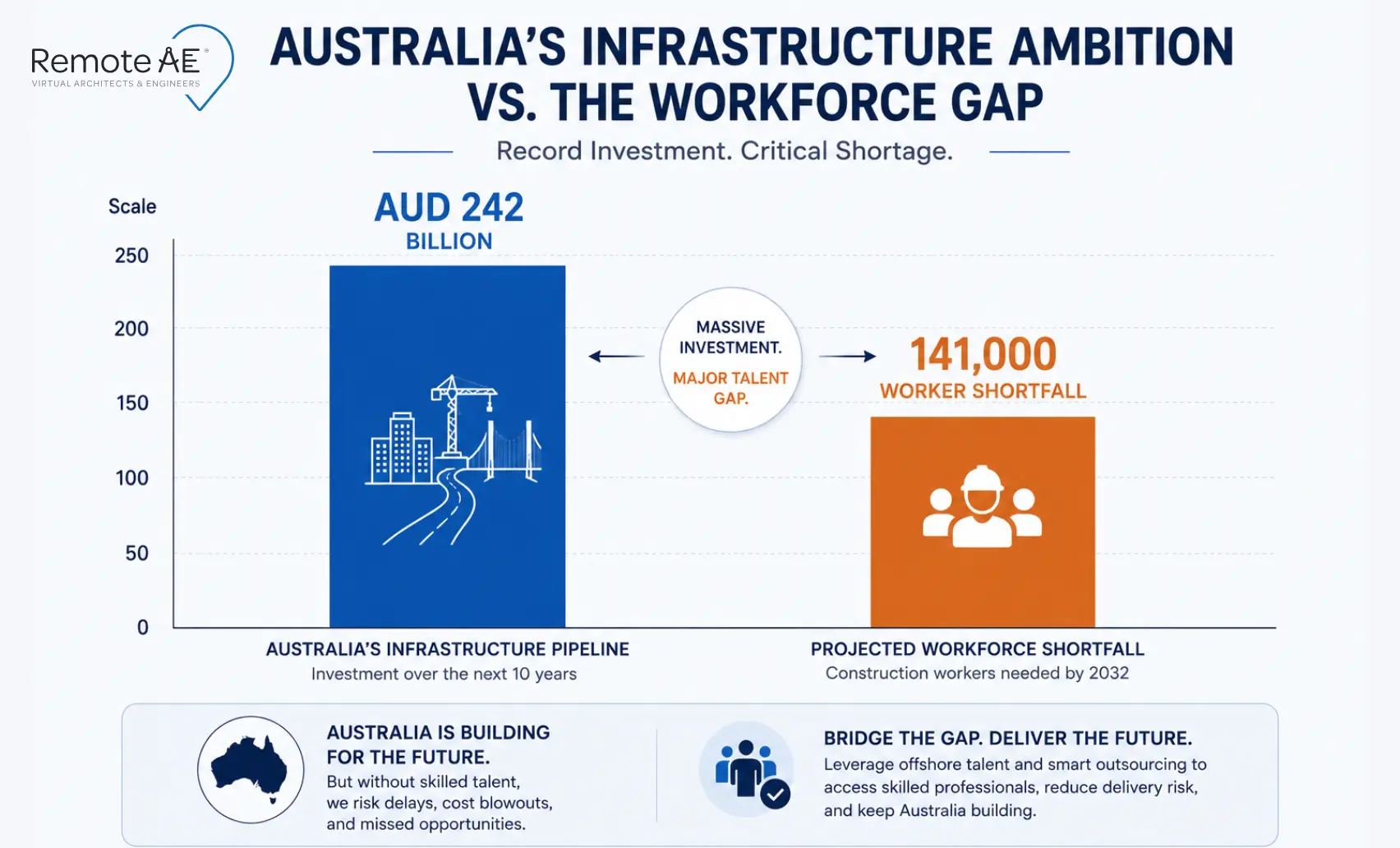
Australia’s construction pipeline has never been larger, AUD $1.14 trillion across five years, but the workforce to deliver it is running short by 141,000 workers and counting (Infrastructure Australia, 2025). Architecture, engineering, and construction firms across Sydney, Melbourne, Brisbane, and Perth are sitting on more work than their local teams can produce. AEC outsourcing in Australia is how firms close that gap.
This guide covers why Australian AEC firms are outsourcing now, which functions move offshore well, what it actually costs in AUD, the legal side explained plainly, and how to start without the risk of a poor hire.
Key Takeaways
- Australia’s construction industry is short 141,000 workers, projected to exceed 300,000 by mid-2027 (Infrastructure Australia, 2025).
- Managed offshore drafting costs at AUD $9 to $18 per hour versus AUD $38 to $62 per hour for loaded local staff.
- Offshore AEC staff do not require an Australian work visa, superannuation, or payroll tax because they work outside Australia.
- Offshore AEC services agreements require a full IP assignment clause, not a licence, so drawings become your property on creation.
- Australia’s five-year Major Public Infrastructure Pipeline hit AUD $242 billion in 2025, up 14% in one year.
- Remote AE charges AUD $719 per dedicated drafter per week, plus a one-time AUD $7,199 onboarding fee.
Why Australian AEC Firms Are Outsourcing (And Why Now)
Australian firms aren’t outsourcing AEC work to cut corners. They’re doing it because the local labour market genuinely cannot keep up.
The Skills Shortage Behind the Shift
Australia’s five-year Major Public Infrastructure Pipeline reached AUD $242 billion in 2025, a record high, up 14% in a single year (Infrastructure Australia, 2025). The construction industry is currently short 141,000 workers, a figure projected to surge past 300,000 by mid-2027.
The Housing Industry Association’s All Hands on Deck report found Australia needs 83,000 additional tradespeople just to meet the National Housing Agreement’s 1.2 million home target. That report specifically names drafters, engineers, and technicians alongside on-site trades as occupations under pressure. Two-thirds of small builders surveyed in 2026 reported difficulty recruiting or retaining skilled workers (HIA, 2026 Small Business Conditions Report).
The Jobs and Skills Australia 2025 Occupation Shortage List confirms the broader picture: 29% of assessed occupations remain in national shortage, with construction and engineering among the hardest-hit sectors (Jobs and Skills Australia, 2025 OSL).
Capacity vs. Cost: The Two Real Drivers
Most firms approach AEC outsourcing Australia for one of two reasons: they cannot find local staff, or they cannot afford to carry the overhead of a full-time hire between project peaks. Often, both apply at once.
As of 2025–26, base salaries for an Australian drafter range from roughly AUD $68,071 (PayScale, architectural draftsman average) to AUD $85,000 (Indeed, drafter average). This is before superannuation at 11.5%, payroll tax, workers’ compensation, and equipment overhead.
Offshore AEC staffing removes those on-costs entirely. The capacity benefit compounds this: a remote drafting services Australia model lets firms scale headcount to match the tender pipeline, not the permanent headcount budget.
Which Functions Move Offshore Well
Not everything suits an offshore delivery model. Here is a plain split:
Works well offshore:
- Architectural and structural drafting
- BIM modelling and Revit production
- CAD documentation and drawing updates
- Estimating and quantity take-offs
- Tender document production
- RFI preparation and coordination logs
- Construction documentation and as-built updates
Stays local:
- Site leadership and supervision
- Licensed trades work
- Client-facing design leadership
- Authority submissions requiring a local registered professional’s stamp
The rule is straightforward: if it happens on a screen and can be briefed through a drawing, a mark-up, or a Teams call, it can move offshore. If it requires a physical presence, a local licence, or face-to-face client trust, it stays in-house.
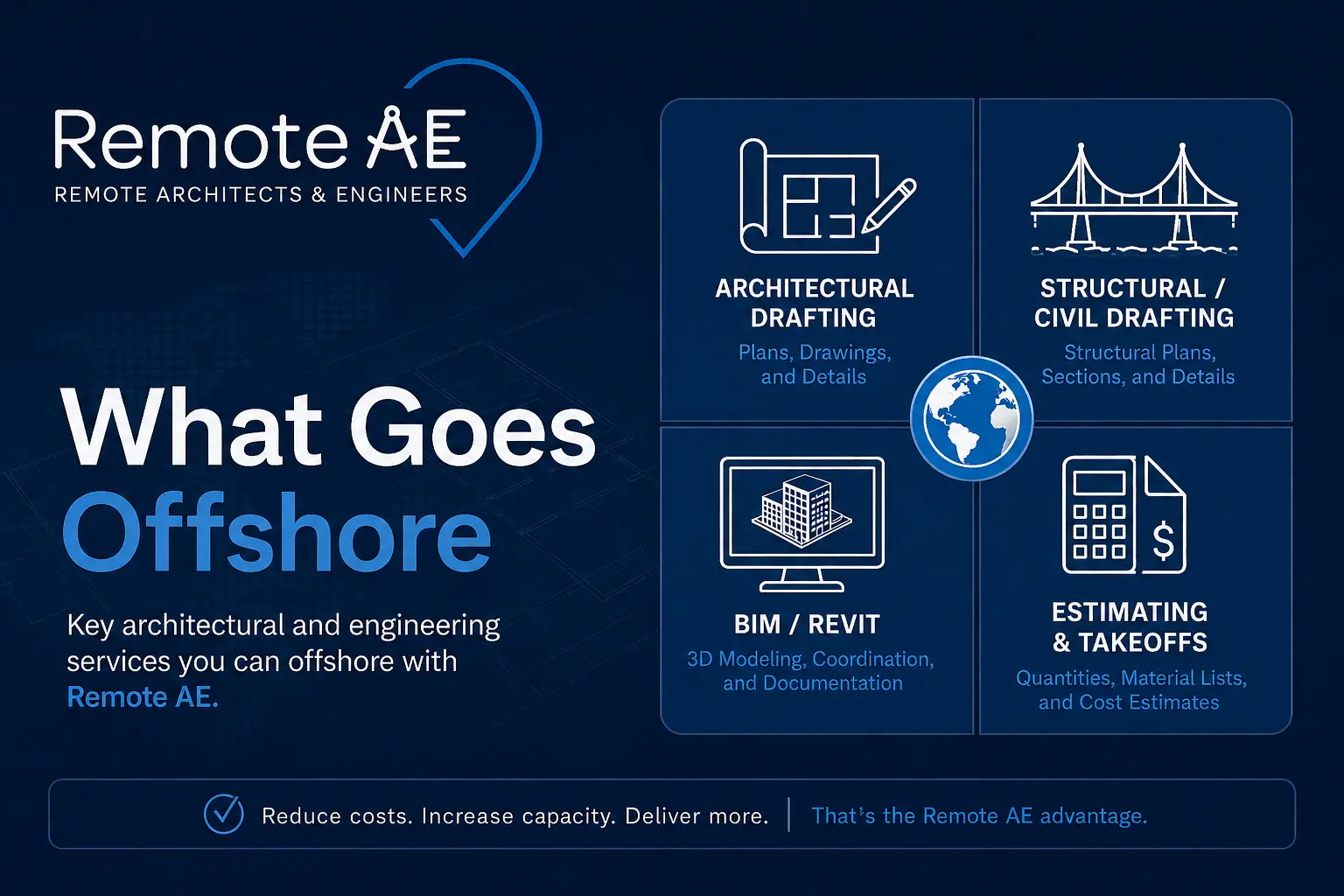
Outsource Drafting Australia: What Firms Actually Send Offshore
When Australian firms outsource drafting, they’re not handing over design intent. They’re delegating production. The hours-heavy, screen-based work that consumes their senior team’s time without requiring their senior team’s judgement.
Architectural Drafting and 2D Documentation
This is the most common starting point for firms new to offshore AEC staffing in Australia. Tasks include:
- Floor plans, elevations, and sections from sketch or marked-up PDF input
- Reflected ceiling plans and demolition plans
- Door and window schedules
- Finish and materials schedules
- Life safety plans prepared under the architect’s direction
- As-built drawing updates from site mark-ups
A draftsperson working remotely in this model follows your firm’s templates, title blocks, and layer standards, not a generic output format.
Structural and Civil Drafting
Structural and civil documentation suits offshore delivery well, provided the engineering calculations and design decisions stay with a registered engineer locally. Remote drafting services Australia for structural work typically cover:
- Reinforcement detailing from engineer-marked sketches
- Framing plans and connection details
- Civil earthworks and services coordination plans
- Long-section and cross-section production
BIM Modelling and Revit Production
Revit production is one of the highest-value tasks to move offshore. A skilled BIM technician working in your Revit environment, using your shared model, your family library, and your BIM execution plan, delivers the same output as an in-house hire. But this happens at a fraction of the loaded local rate. Typical scope includes:
- Existing conditions modelling from point cloud or CAD input
- Design development and construction documentation modelling
- Model cleanup, coordination views, and sheet setup
- Clash detection support using Navisworks or BIM 360
- Revit family creation for custom elements
Estimating and Quantity Take-Offs
More firms are now sending estimating and quantity take-off work offshore as a way to respond to more tenders without expanding their in-house estimating team. A remote estimator can handle:
- Elemental cost plans from schematic drawings
- Measured quantities from Revit models or 2D PDFs
- Subcontractor scope packages
- Tender document compilation and formatting
This frees your senior estimator to focus on rate judgement, subcontractor relationships, and the final tender submission, the parts that actually require local market knowledge.
The Legal and Practical Side
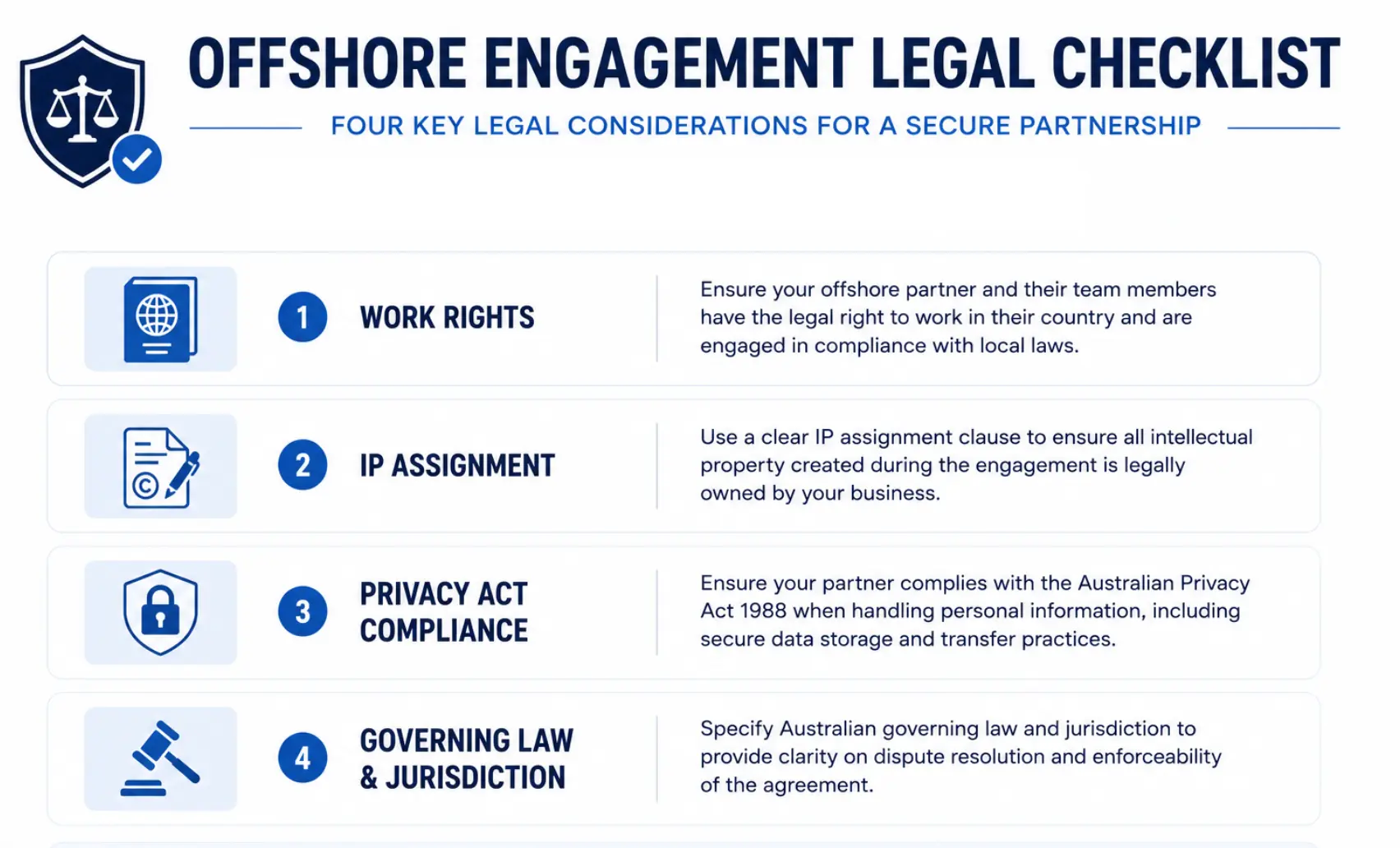
This is where firms hesitate. It shouldn’t be complicated. Here is what actually applies.
Why Right-to-Work and Visa Sponsorship Don’t Apply
Offshore staff works from their own country, under their own country’s employment laws. They are not working in Australia. That means Australian work rights, Skills in Demand visa sponsorship, and migration compliance are irrelevant to the engagement.
This is a direct contrast with hiring a local draftsperson or BIM technician, where you carry the full burden of Fair Work compliance, superannuation at 11.5%, payroll tax obligations, and workers’ compensation coverage. None of those obligations attach to a properly structured offshore contractor engagement.
IP Ownership: Assignment Clauses, Not Just Licences
This matters. A licence allows someone to use IP; an assignment transfers ownership to you. Your offshore services agreement should include a full IP assignment clause. All drawings, models, and documentation produced become your property on creation, not on payment or delivery. Do not accept a licence-only arrangement for AEC production work.
Data Handling Under the Privacy Act 1988
If your project files contain personal information, client names, addresses, or tenant data in residential projects, the Privacy Act 1988 (Cth) applies to how that data is handled offshore.
Your agreement should require the offshore party to handle personal information consistently with Australian Privacy Principles, restrict data to project purposes only, and prohibit secondary use or storage beyond the engagement term.
Contracts, NDAs, and Governing Law
A fit-for-purpose offshore AEC engagement uses:
- A master services agreement specifying scope, deliverables, and IP ownership
- A mutual NDA covering project files, client identity, and firm methodology
- Governing law clause nominating an Australian jurisdiction (typically the state where your firm operates)
- Project-level work orders for scope, timelines, and file handover standards
If your current or prospective offshore partner cannot produce these documents on request, that is a signal to look elsewhere.
What It Costs: Offshore AEC Staffing in AUD
Australian firms often underestimate how much a local hire actually costs once every on-cost is added. The base salary is only the starting point.
Loaded Local Cost vs. Offshore Rate
A mid-career architectural drafter earns between AUD $65,837 (PayScale AU, 2025) and AUD $80,985 (Indeed AU, 2025) in base salary. Add superannuation at 11.5%, payroll tax of approximately 4.85% (varies by state), workers’ compensation, equipment, and software licences, and the loaded hourly cost climbs well above the base rate.
The table below uses conservative market benchmarks.
| Role | Loaded AU Hourly (incl. super/payroll tax) | Offshore Managed Hourly (AUD) | Typical Monthly (Offshore) |
| Architectural Drafter | AUD $38–$52/hr | AUD $9–$15/hr | AUD $1,500–$2,600 |
| BIM Technician (Revit) | AUD $42–$62/hr | AUD $10–$18/hr | AUD $1,700–$3,000 |
| Structural Drafter | AUD $40–$58/hr | AUD $10–$16/hr | AUD $1,600–$2,800 |
| Estimator / Take-Off Specialist | AUD $45–$65/hr | AUD $11–$18/hr | AUD $1,800–$3,000 |
Loaded local rates are indicative benchmarks. Offshore managed rates reflect dedicated staff models through managed AEC providers.
Offshore AEC staffing typically saves 40–60% on labour costs compared to equivalent local hires, before factoring out superannuation and payroll tax obligations entirely (Remote AE, offshore architectural services data).
Engagement Models
Three models suit different firm sizes and workload types:
- Dedicated staff, a named remote team member works exclusively for your firm, full-time, on your tools and your projects. Best for ongoing production volume.
- Project-based, scoped to a specific deliverable: a CD package, a Revit model, a tender set. Cleaner handover but higher per-hour cost and more management overhead per engagement.
- Staff augmentation, a remote drafter or BIM technician, joins your existing team temporarily to cover a peak period or deadline crunch. Sits between the two models in cost and integration depth.
Most Australian AEC firms start project-based, then shift to dedicated staff once they’ve validated the output quality and workflow fit.
The Hidden Costs Nobody Quotes
Offshore AEC staffing is not free of overhead. Factor these in before comparing raw hourly rates:
- Management time: someone in your firm needs to brief, review, and redirect the remote team. Budget two to four hours per week per remote staff member during onboarding, settling to one to two hours ongoing.
- Communication friction: unclear briefs produce unclear drawings. Firms that invest time in documented standards, marked-up PDF templates, and consistent check-in cadences recover this cost quickly. Firms that don’t pay for it in revision rounds.
- Churn risk: generic offshore platforms carry higher turnover. Managed providers with dedicated placement and replacement guarantees reduce this risk materially.
How to Start Outsourcing AEC Work
Step 1: Define Scope and Document Your Processes
Before approaching any offshore AEC staffing provider, write down exactly what you want produced. This means:
- A list of drawing types and deliverables
- Your CAD or Revit standards and templates
- File naming conventions and folder structure
- A sample brief or marked-up drawing showing expected output quality
Firms that skip this step spend the first month re-explaining the same things repeatedly.
Step 2: Choose an Engagement Model
Match the model to your workload pattern. If you have steady drafting volume across multiple projects, dedicated staff costs less per hour and integrates more deeply. If you have a single urgent CD package to produce, a project-based engagement is faster to initiate.
Step 3: Vet the Partner
Before signing anything, ask for:
- Case studies from Australian or comparable AEC projects
- A paid test drawing on a real (non-sensitive) project file
- References from current clients in a similar firm type
- Their IP assignment and NDA documents for review
A provider that resists a test drawing or cannot provide current client references is not worth the risk.
Step 4: Onboard With a 30/60/90-Day Plan
- Days 1–30, file access, tool setup, template review, first supervised drawings with detailed feedback
- Days 31–60, increasing output independence, regular check-ins, quality review loop established
- Days 61–90, full production integration, communication cadence locked in, output quality benchmarked against your internal standard
Graphic: “30/60/90-Day Onboarding Plan” — horizontal timeline showing four steps: define scope, choose model, vet partner, onboard
Outsource Your AEC Work to Remote AE
Remote AE is not a generic virtual assistant platform. It has spent more than 15 years placing drafters, BIM technicians, estimators, and project coordination staff inside architecture, engineering, and construction firms.
Every placement is AEC-specific. The vetting process focuses on Revit proficiency, CAD standards, drawing set experience, and real project exposure, not general office skills.
That specialisation matters when you’re handing over a live CD package or a Revit model mid-design development.
The Roles You Can Staff
Remote AE supports Australian AEC firms across these functions:
- Architectural and structural drafting, floor plans, elevations, sections, details, schedules, as-built updates
- Revit and BIM modelling, design development modelling, sheet production, family creation, clash coordination support
- Estimating and quantity take-offs, elemental cost plans, measured quantities, and tender document compilation
- Project coordination and documentation support, RFI logs, submittal tracking, construction documentation, drawing registers
How Remote AE Fits Your Workflow
Remote AE places dedicated staff, not rotating freelancers. Your remote team member works inside your own tools: your Revit model, your AutoCAD templates, your BIM 360 or Autodesk Construction Cloud environment, your reporting lines.
AEST time-zone overlap is factored into every AU engagement, so your remote drafter or BIM technician is available during your working day, not delivering files while your office is closed. Managed onboarding handles the first 30 days of integration, reducing the setup burden on your internal team.
The commercial terms are structured for Australian firms:
- Guaranteed quality and reliability, output reviewed against your standards before delivery
- No long-term commitment, scale up or down as your tender pipeline moves
- No upfront costs, no placement fees to engage
- Risk-free replacement, up to two staff replacements if the fit isn’t right
Built Around Australian Requirements
Remote AE’s engagement agreements include full IP assignment clauses, mutual NDAs, and data handling provisions consistent with the Privacy Act 1988 (Cth). Governing law is nominated to your Australian jurisdiction. These are not add-ons; they are standard in every Remote AE engagement.
What Remote AE Costs
Remote AE’s dedicated remote staffing model runs on two simple cost lines: no payroll tax, no superannuation, no equipment overhead.
- AUD $719/week: the weekly fee for a dedicated remote drafter, BIM technician, or estimator working exclusively for your firm
- AUD $7,199 one-time fee: covers recruitment, AEC-specific candidate vetting, and managed onboarding
The weekly fee scales with your project load. Add a drafter for a CD deadline. Ease back when the pipeline settles. No redundancy exposure, no notice period, no dead salary between projects.
Common Risks and How to Manage Them
Quality Control and Review Loops
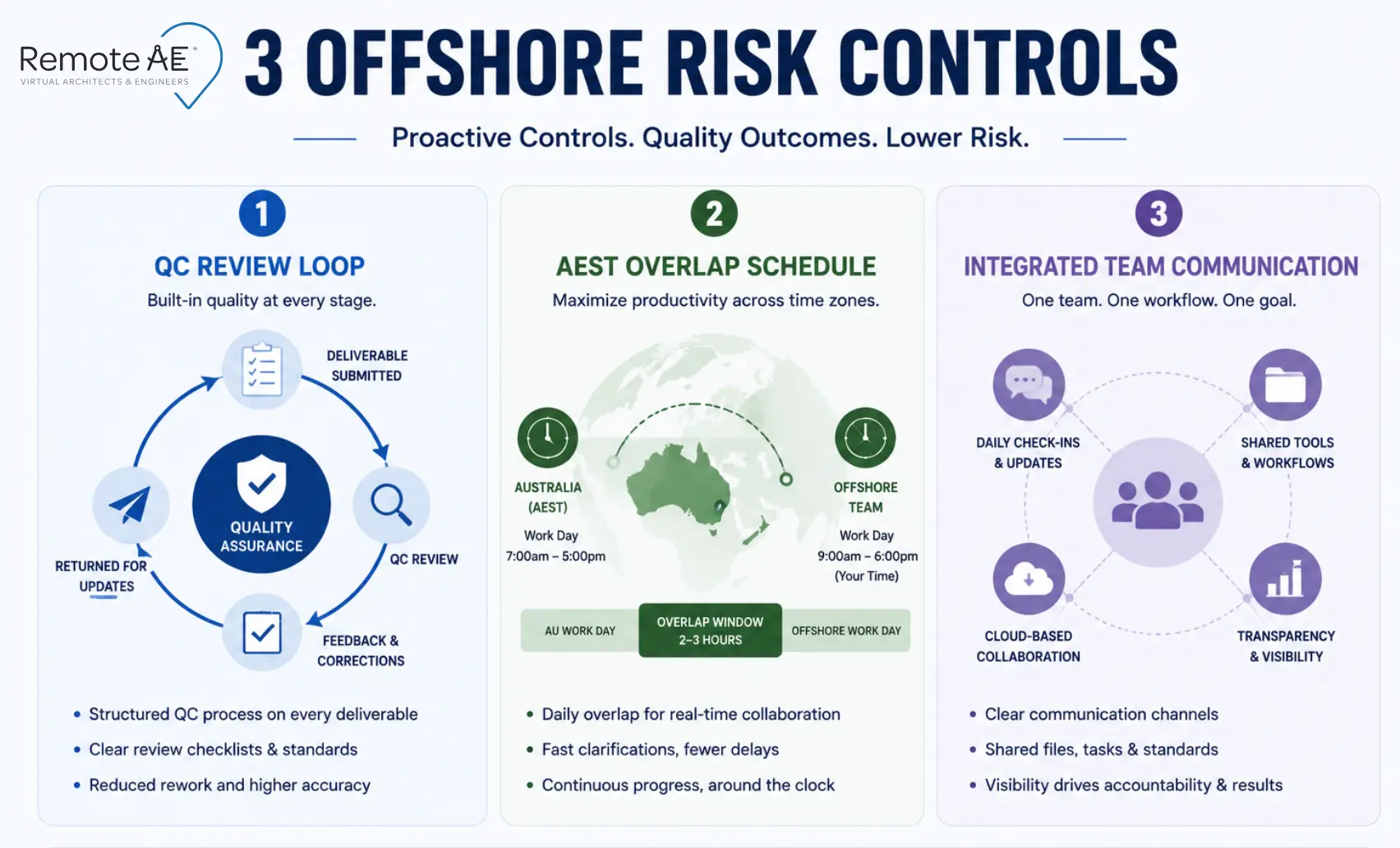
Set a review gate before any drawing leaves the offshore team for internal use. A simple QC checklist, layer compliance, dimension strings closed, title block complete, sheet index matched, catches 90% of output issues before they reach your senior staff.
Time-Zone Overlap and Communication Cadence
AEST overlap with common offshore staffing locations gives Australian firms a four-to-eight-hour working window for real-time collaboration. Use it. A daily 15-minute check-in at the start of the overlap window resolves ambiguities that would otherwise cost a full revision cycle.
Treating Offshore Staff as Integrated Team Members
Firms that treat their offshore drafter or BIM technician as a black-box vendor get black-box results. The firms that get strong, consistent output give their remote team member access to the same project files, the same briefing meetings, and the same feedback loops as their in-house staff. That integration is what makes offshore AEC staffing in Australia work at scale.
Ready to Add Offshore Capacity to Your AEC Firm?
Australia’s construction pipeline is not slowing down. The worker shortfall is not resolving quickly. Waiting for the local labour market to catch up is not a production strategy.
Remote AE places dedicated remote drafters, BIM technicians, and estimators inside Australian AEC firms, with AEST overlap, IP-safe agreements, and a replacement guarantee. Share your scope and Remote AE will match you with AEC-trained offshore staff within two weeks, no upfront cost, no long-term lock-in.
Book a free consultation with Remote AE today and scope your offshore AEC staffing solution!
Outsourcing AEC Work in Australia: FAQs
What AEC work can Australian firms outsource offshore?
Firms most commonly outsource architectural, structural, and civil drafting, Revit and BIM modelling, estimating and quantity take-offs, and construction documentation. Any function that runs on software, drawings, and data rather than physical site presence can move offshore. Licensed trades, site supervision, and senior client-facing roles stay local.
Do offshore drafters need an Australian work visa or right-to-work?
No. Offshore drafters work from their own country as employees or contractors of your outsourcing provider, so Australian work rights, visas, and sponsorship don’t apply. Right-to-work rules only matter when someone physically works inside Australia, which offshore staff never do.
How much does it cost to outsource drafting in Australia?
Managed offshore drafting typically runs around AUD $9–$18 per hour, compared with a loaded local cost of roughly AUD $38–$62 per hour once superannuation, payroll tax, and overhead are included. That works out to savings of about 50–70% versus an equivalent onshore hire. Exact figures depend on role, seniority, and engagement model.
Is offshore AEC work compliant with Australian Standards?
Yes, provided your partner has drafters trained in Australian Standards and local documentation conventions. Experienced AEC outsourcing providers produce AutoCAD and Revit deliverables that meet local codes and submission requirements. Confirm this upfront by reviewing sample drawings and asking about the team’s Australian project experience.