

Australia’s construction pipeline is at a record AUD $242 billion over five years, but the industry is already short 141,000 workers to deliver it, with that gap projected to exceed 300,000 by mid-2027 (Infrastructure Australia, 2025). The official occupation list says architectural draftspersons aren’t in national shortage. Firms trying to hire one tell a different story. Architectural draftspersons sit inside a wider AEC skills squeeze that firms feel every time they open a position and wait months to fill it. The official data tells part of the story. The hiring experience tells the rest.
This guide breaks down the architectural draftsperson shortage Australia firms are navigating right now: what the occupation data actually shows, why the pipeline of new talent isn’t keeping pace, and what the firms that can’t find drafters locally are doing instead.
Key Takeaways
- Jobs and Skills Australia rates Architectural Draftsperson (ANZSCO 312111) as “No Shortage” nationally in the 2025 Occupation Shortage List.
- Regional Australia fills just 67.1% of vacancies versus 71.5% in metro areas (Jobs and Skills Australia, 2025 OSL).
- Training a job-ready architectural draftsperson takes two to three years, including an AQF Diploma and on-the-job experience.
- Skilled migration for a draftsperson runs six to twelve months minimum, covering VETASSESS assessment and Skills in Demand visa processing.
- Mid-career Melbourne architectural draftspersons command AUD $73,817 to $94,496 annually (Glassdoor AU, July 2026).
- Offshore draftspersons are onboarded and produce within two to four weeks, matching project deadlines rather than visa timelines.
What the Shortage Data Actually Says (and What It Misses)
Architectural Draftsperson (ANZSCO 312111) sits in unit group 3121, Architectural, Building and Surveying Technicians, assessed at Skill Level 2, requiring an AQF Diploma or higher, with VETASSESS as the assessing authority.
The 2025 Jobs and Skills Australia Occupation Shortage List formally rates Architectural Draftsperson as “No Shortage” nationally, with future demand assessed as moderate (Jobs and Skills Australia, 2025 OSL; VETASSESS). That classification matters, and it’s worth being honest about what it means and what it doesn’t.
A “No Shortage” national rating is an aggregate. It doesn’t mean every firm can easily hire a drafter. It means JSA’s modelling across the full national pool of vacancies and applicants doesn’t yet find a systemic imbalance at the macro level. What it doesn’t capture is the experience of a two-person architecture studio in Geelong or a residential builder in Mackay who’s had a drafter role open for four months with three applicants, none of whom were job-ready.
The occupation remains on the Core Skills Occupation List (CSOL) at entry 298, alongside Building Inspector (312113) and Construction Estimator (312114). That CSOL inclusion means employer-sponsored skilled migration under the Skills in Demand visa is still available for this role, a signal that the government acknowledges ongoing demand even where the shortage rating hasn’t yet tipped.
It’s Not Just Drafters, The Wider AEC Squeeze
The pressure on architectural draftspersons sits inside a larger AEC skills shortage Australia is navigating across the whole unit group 3121. Building inspectors, construction estimators, civil engineering draftspersons, and surveying technicians face similar hiring difficulties.
Infrastructure Australia estimates the industry is short 141,000 workers needed to deliver Australia’s public infrastructure pipeline as of October 2025, a gap projected to exceed 300,000 by mid-2027. That shortfall creates competition for every available AEC technician, including draftspersons.
The Housing Industry Association’s All Hands on Deck report is explicit: it names drafters, engineers, and technicians alongside on-site trades as occupations under pressure in the residential building pipeline (HIA, 2025).
Metro vs. Regional, Where the Gap Bites Hardest
The 2025 OSL shows the regional vacancy fill rate sits at just 67.1%, compared to 71.5% in metropolitan areas (Jobs and Skills Australia, 2025 OSL).
Twenty-one occupations are in shortage in regional Australia, up from 12 in 2024. For firms in regional NSW, Queensland, and Western Australia, the difficulty in finding a qualified draftsperson locally is acute. This is not because the national aggregate shows a shortage, but because the available talent pool in their location is thin and highly contested.
Why Australian Firms Can’t Find Draftspersons
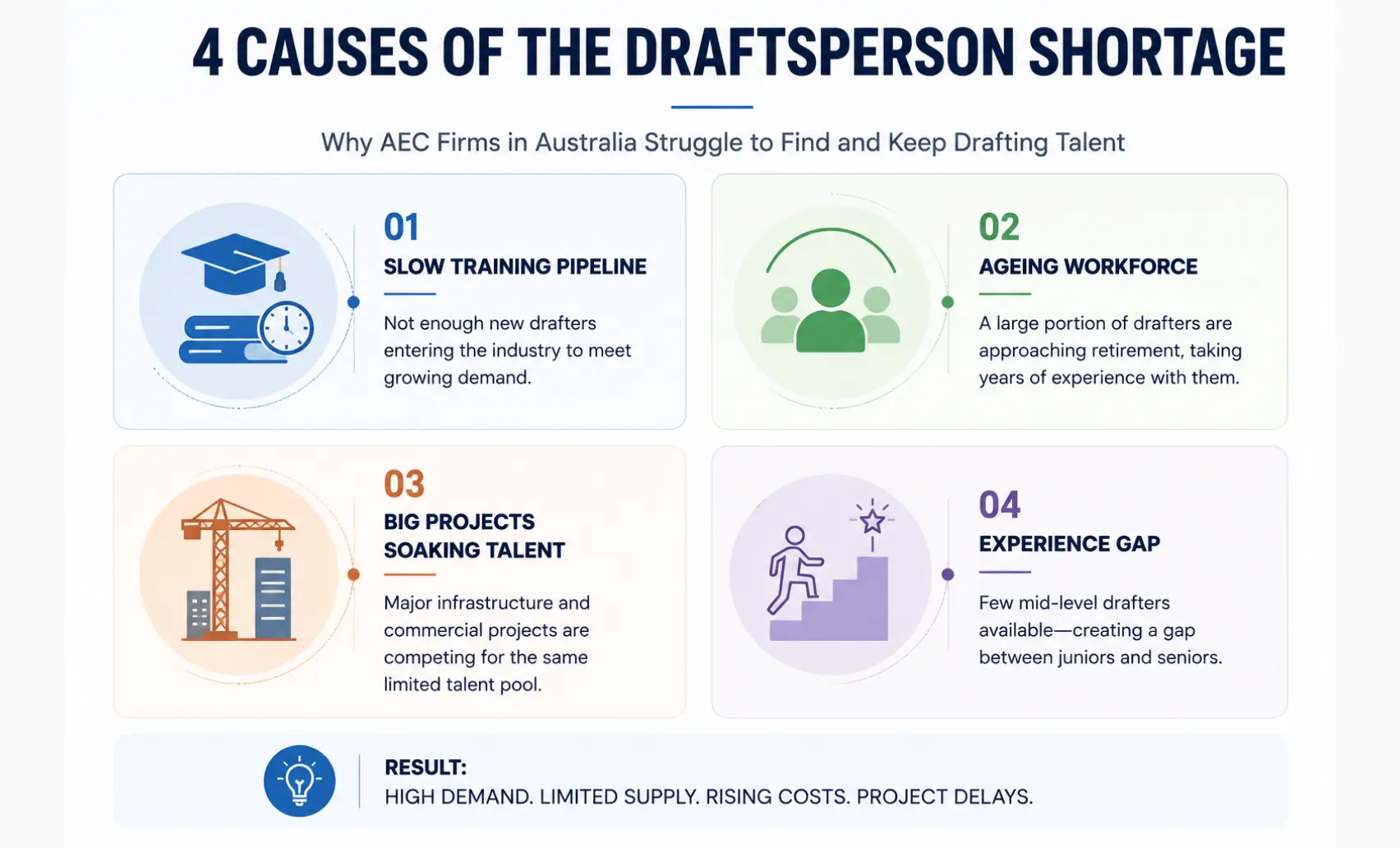
The AEC skills shortage Australian firms face today didn’t appear overnight. Four structural causes have been building for years, and none of them has been resolved quickly.
The Training Pipeline Is Too Slow
Becoming a qualified architectural draftsperson in Australia requires an AQF Diploma in Building Design or a Certificate IV in Residential Drafting. A TAFE pathway that takes one to two years of full-time study before a graduate is ready for unsupervised production work.
The pipeline from enrolment to job-ready drafter runs at least two to three years when you factor in the experience firms expect on top of qualifications.
NCVER reported government-funded VET student numbers fell 2.6% in 2024 versus 2023, though training package completions rose 6.2%, with notable growth in the Construction, Plumbing, and Services training package. When the industry needs more drafters now, a TAFE enrolment today doesn’t solve today’s deadline.
An Ageing Workforce and Shrinking Apprenticeship Commencements
A significant share of Australia’s current draftsperson workforce entered the profession in the 1980s and 1990s, when manual drafting transitioned to CAD. That group is now approaching retirement age.
Replacement is not keeping pace. The HIA’s 2026 Small Business Conditions Report found that two-thirds of small building businesses reported difficulty recruiting or retaining skilled workers. A finding that reflects the broader generational gap across AEC technical roles, not just on-site trades.
Younger entrants to the industry often move toward architecture degrees or BIM-focused roles rather than a drafting diploma, narrowing the traditional draftsperson pathway further.
Big Projects Soak Up the Talent
Australia’s five-year Major Public Infrastructure Pipeline stands at AUD $242 billion, the highest level recorded since Infrastructure Australia began tracking in 2020 (Infrastructure Australia, 2025).
Large contractors and tier-one engineering firms working on metro rail, renewable energy, and transport projects compete for the same draftspersons and BIM technicians that smaller architecture studios and residential builders need.
When a major infrastructure project offers above-market rates and long-term contracts, small practices cannot compete on compensation. The firms that can’t find drafters Australia-wide are disproportionately the studios, small builders, and mid-tier engineering consultancies that lack the volume to offer certainty. They advertise, wait, and often hire below their requirements out of necessity.
Even Qualified Applicants Aren’t Always Job-Ready
The JSA Occupation Shortage Drivers report identifies a lack of qualified applicants as the leading cause of construction shortages, but adds that even among qualified candidates, employers report deficits in practical experience and employability skills (Jobs and Skills Australia, 2025 Occupation Shortage Drivers).
For draftspersons, this surfaces as graduates with Revit or AutoCAD training who haven’t produced a complete drawing set, don’t understand NCC documentation requirements, and need months of supervision before they’re genuinely productive.
Firms end up hiring and training, which costs time and money, or not hiring at all and absorbing the production shortfall into their senior team’s hours.
The Fixes Firms Usually Try (and Why They Fall Short)
Most firms work through the same set of responses before arriving at offshore AEC staffing. Each has real value and real limits.
Skilled Migration: Real, But Slow and Uncertain
Architectural Draftsperson (ANZSCO 312111) sits on the Core Skills Occupation List, making it eligible for employer-sponsored Skills in Demand visa pathways. That means migration is a legitimate option. It is not a fast one.
Skills assessment through VETASSESS, visa processing, and the time between identifying an overseas candidate and having them at a desk typically runs six to twelve months minimum. For a firm with a CD package due in ten weeks, that timeline offers no relief. Migration is a long-term workforce strategy, not a production fix.
Poaching and Pay Wars: Expensive and Unsustainable
In a tight talent market, firms compete by offering higher base salaries, flexible arrangements, and sign-on bonuses. A mid-career architectural draftsperson in Melbourne commands AUD $73,817 to $94,496 annually (Glassdoor AU, July 2026). Pushing above that range to attract someone from a competitor firm is an option only larger studios can sustain.
For small practices, which make up the bulk of Australia’s architectural sector, a salary war is a losing strategy. And even if a firm wins the hire, the candidate has already demonstrated they’ll move for a better offer.
Training Juniors In-House: Worth Doing, But Not Today’s Answer
Investing in graduate and junior draftspersons is a sensible long-term practice. A well-structured in-house pathway builds firm-specific knowledge, loyalty, and production standards that an external hire can rarely replicate quickly.
The problem is the timeline. A junior draftsperson hired today with a Certificate IV and minimal experience will typically need six to twelve months before they’re producing independently to a standard that reduces senior staff workload. That investment is worth making, but it runs in parallel with the current deadline, not instead of it.
The process of elimination points to one answer that operates entirely outside the local talent pool.
What Firms Can Actually Do Right Now
Rethink Where the Work Sits
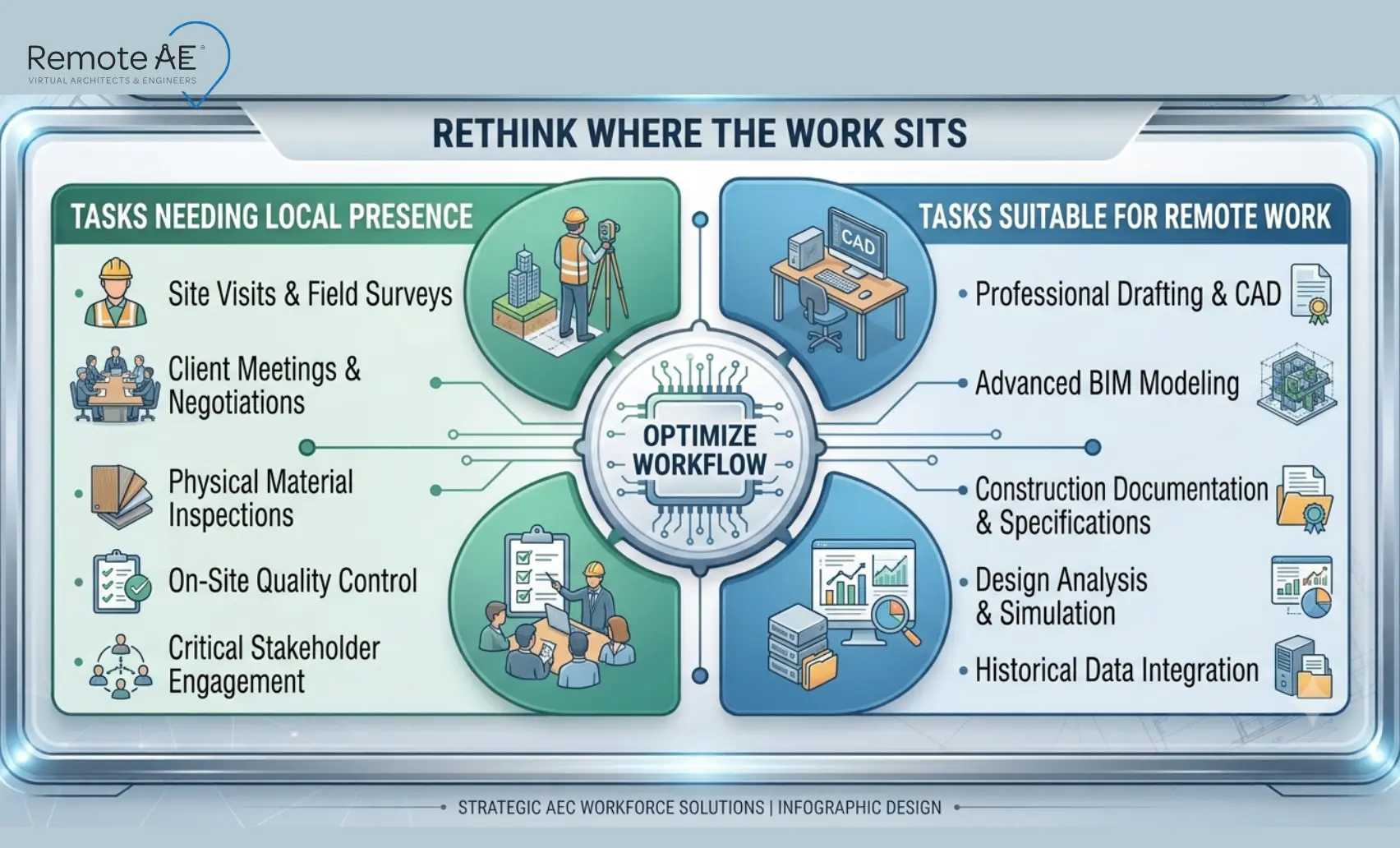
The firms making the most progress with the AEC skills shortage in Australia have shifted how they think about the problem. The question isn’t “where do we find a local drafter?” It’s “which of these tasks actually need someone in the office?”
Floor plans, elevations, reflected ceiling plans, schedules, Revit models, and as-built updates- none of these require physical presence. They require a screen, the right software, a clear brief, and a reliable review loop. The local talent shortage doesn’t constrain work that can be done from anywhere.
Site visits, client meetings, authority submissions, and licensed sign-offs stay local. Everything else is a candidate for a different model.
Remote AEC Staff as a Pressure-Release Valve
A dedicated offshore draftsperson working inside your Revit or AutoCAD environment, using your templates, your layer standards, and your file naming conventions, functions as a production extension of your existing team.
They’re not a vendor delivering a finished product; they’re a team member doing your firm’s work to your firm’s standards.
For firms that can’t find drafters Australia-wide through local channels, this model resolves the immediate production bottleneck without waiting for the training pipeline, the migration process, or a salary war to produce results.
An offshore drafter can be onboarded and producing within two to four weeks, a timeline that aligns with real project deadlines, not visa processing schedules.
What This Frees Up
The direct benefit isn’t just the drawings produced offshore. It’s what your senior staff stop doing when production support is in place.
- Registered architects return to design, client relationships, and authority submissions
- Project managers stop staying late to finish documentation
- Senior draftspersons move into QC and coordination rather than base-level drawing production
- The firm takes on more work without adding permanent headcount
That reallocation is where the real value compounds. The drawings produced offshore are worth something. The senior hours recovered are worth more.
How Remote Staffing Eases the Draftsperson Shortage
The architectural draftsperson shortage Australia experiences is a local supply problem, not a global one. Skilled draftspersons and BIM technicians trained in Revit, AutoCAD, and ArchiCAD, with real drawing-set experience across residential, commercial, and mixed-use projects, are in high supply in markets where the training pipeline is strong and local construction demand is lower.
The constraints are geography and the hiring model. Remote AEC staffing removes both.
Scale Up or Down With Your Project Load
One of the practical limits of local hiring is that a permanent drafter is a fixed cost. You carry that salary through quiet periods, tender phases, and project gaps. A dedicated offshore drafter on a flexible engagement scales with your pipeline, provides additional capacity for a CD crunch, and reduces commitment when the workload settles.
For the small-to-mid practices that dominate Australian architecture and building design, that flexibility changes the economics of taking on larger or more complex projects. You don’t need to have the team in place before you win the work.
Purpose-Built AEC Teams vs. General Staffing
Not all offshore staffing providers are equivalent. A general virtual assistant platform with a construction category is not the same as a provider like Remote AE that has spent more than 15 years vetting drafters, BIM technicians, and estimators specifically for AEC firms. The difference shows in output quality, software proficiency, documentation standards, and the speed of the onboarding cycle.
Every placement- architectural drafting, structural drafting, Revit modelling, and estimating goes through a vetting process built around real AEC production standards, not general office skills.
How Remote AE Fills Your Draftsperson Gap
AEC Drafters Ready When the Local Market Has None
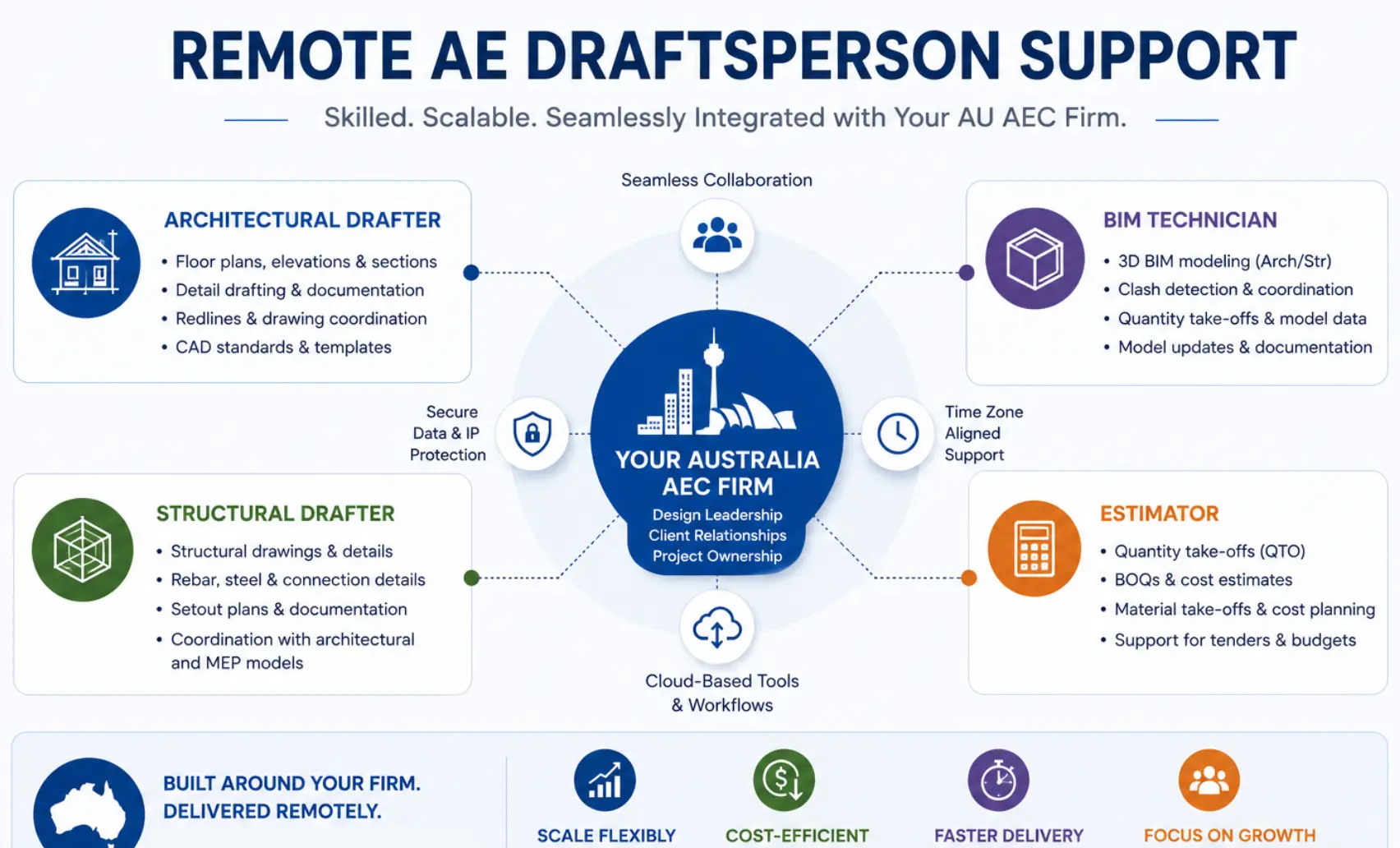
When local hiring returns nothing usable, Remote AE’s talent pool operates outside that constraint. Roles available include:
- Architectural draftspersons for floor plans, elevations, sections, schedules, and documentation
- Structural and civil draftspersons for reinforcement detailing, framing plans, and coordination drawings
- Revit and BIM technicians for design development, modelling, sheet production, and clash coordination
- Estimating and quantity take-off support for tender packages and cost plans
Dedicated Staff, Not a Temp Desk
Every Remote AE placement is a named, dedicated staff member, not a rotating roster of anonymous contractors. They work:
- Exclusively for your firm, on your projects
- Inside your own tools, Revit, AutoCAD, BIM 360, Autodesk Construction Cloud
- To your drawing standards, NCC documentation conventions, and file naming rules
- On your reporting lines, with daily check-ins during AEST overlap hours
- Under full IP assignment and NDA protection, consistent with Australian Privacy Act 1988 requirements
Scale With Your Pipeline
Remote AE’s engagement model flexes with your workload. That means:
- Add drafting capacity for a CD deadline or project surge
- Scale back when the pipeline is quiet, no redundancy process, no dead salary
- No permanent headcount commitment on your books
- Onboarding within two weeks, aligned to real project deadlines, not visa timelines
Commercial Terms Built for Australian Practices
- Guaranteed quality and reliability, output reviewed against your standards
- No upfront costs, no placement fees to get started
- Risk-free replacement, up to two staff replacements if the fit isn’t right
Ready to Fill Your Draftsperson Gap?
The local hiring market for architectural draftspersons in Australia is competitive, slow, and increasingly regional in its shortages. The training pipeline won’t catch up with your next deadline. Skilled migration won’t either.
Remote AE places dedicated offshore draftspersons, BIM technicians, and estimating staff inside Australian AEC firms, with AEST overlap, IP-safe agreements, and a replacement guarantee built in. Share your scope, and Remote AE will match you with AEC-trained drafting support within two weeks, no upfront cost, no long-term lock-in.
Book a free consultation today and put a drafter on your next project without waiting for the local market to catch up.
FAQs – Australia’s AEC Skills Shortage
Is there really a shortage of draftspersons in Australia?
Not according to the national data. The 2025 Jobs and Skills Australia Occupation Shortage List rates Architectural Draftsperson (ANZSCO 312111) as “No Shortage” nationally, with future demand assessed as moderate. That rating is an aggregate, and it doesn’t describe what individual firms experience. The occupation still sits on the Core Skills Occupation List at entry 298, which keeps employer-sponsored skilled migration available, and regional Australia fills just 67.1% of vacancies against 71.5% in metro areas. For a small studio in a regional market, the shortage is real even where the national rating says otherwise.
Why is it so hard to hire architectural drafters in Australia right now?
The training pipeline is too slow to keep up with demand, AQF Diploma-level qualifications take years, and apprenticeship commencements have been falling. At the same time, major infrastructure projects are pulling experienced drafters toward tier-one contractors, leaving smaller practices with little left in the market.
Which AEC roles are hardest to fill in Australia?
Architectural draftspersons, building inspectors (ANZSCO 312113), and construction estimators (312114) sit in the same ANZSCO unit group 3121 and face similar hiring difficulty, though none is rated in national shortage on the 2025 Occupation Shortage List. The pressure shows up in the numbers around them: 21 occupations are in shortage in regional Australia, up from 12 in 2024, and Infrastructure Australia puts the industry 141,000 workers short as of October 2025. Drafters and estimators are hardest to source because residential and infrastructure pipelines compete for them at the same time.
Can outsourcing solve the drafting skills shortage?
Outsourcing won’t fix the structural shortage in the local market, but it removes your firm from the competition entirely by giving you access to a separate, larger talent pool. For most practices, that’s a more immediate and reliable fix than waiting on migration pipelines or training programmes to catch up.
“`html id=”faq-australia-draftsperson-shortage-2025″
“`