

The most common reason Australian AEC firms hesitate on offshore staffing is the time zones. The assumption is that “offshore” means overnight file drops, missed briefings, and drawings that come back wrong because nobody could ask a question in time. That assumption is borrowed from US firms dealing with 12–16-hour time differences; it doesn’t apply to Australia.
Australia sits closer to Southeast Asia’s offshore AEC talent pool than any other English-speaking market. Philippines-based drafters and BIM technicians work within two to three hours of AEST and zero hours from Perth.
This guide explains exactly how the working day runs, what the overlap window looks like by city, and how Remote AE structures AEST-aligned engagements so that same-day turnaround is standard, not exceptional.
Key Takeaways
- Perth operates on AWST (UTC+8), identical to Philippine Standard Time year-round, giving Perth AEC firms zero time zone gap.
- Sydney, Melbourne, and Brisbane get seven hours of live overlap, 11 am to 6 pm AEST, with Philippines-based drafters.
- Daylight saving in NSW, VIC, ACT, and TAS shifts the overlap window to 12 pm to 6 pm AEDT from October through April.
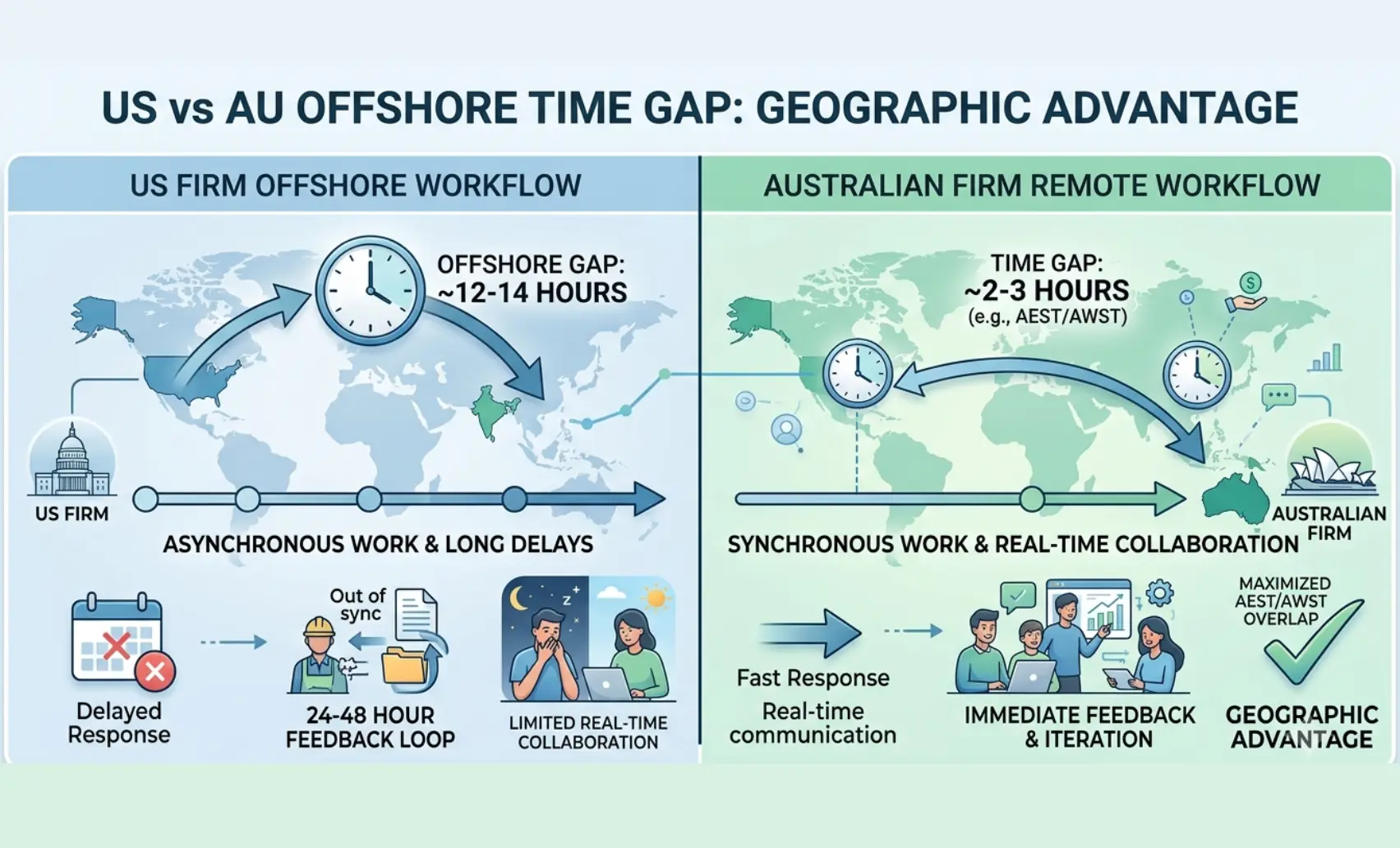
- Australian firms face a two-to-three-hour offshore gap, against the 12 to 16 hours that US firms manage.
- Work handed off at 5 pm AEST returns by 7 am AEST the next morning, with no overtime cost.
- Remote drafters answer RFIs the same day, within the 11 am to 3 pm AEST core overlap window.
The Graveyard Shift Myth: Why It Doesn’t Apply to Australian AEC Firms
Where the Myth Comes From: US and European Offshore Models
US firms outsourcing to India or the Philippines face a 12–16-hour time difference. A New York firm working with a Manila-based team is genuinely dealing with an overnight gap; the US business day ends as the Philippines day begins.
That reality shaped most English-language writing about offshore staffing, including the assumption that offshore always means asynchronous.
Australian AEC principals read the same content and absorb the same assumptions. It’s the wrong one to apply.
Australian firms working with Philippine-based AEC teams face a two- to three-hour difference, not twelve. The briefing you send at 9 am AEST reaches a drafter who is starting their day at 7 am Manila time, not waking up in the middle of the night. That’s a completely different working relationship.
Australia’s Geographic Advantage: Closer to Offshore AEC Talent Than Anywhere Else
Southeast Asia sits zero to five and a half hours behind Australian time zones, depending on which state and which offshore location. That proximity is one reason Australia is the second-largest market for Philippine outsourcing globally. Behind only North America, accounting for approximately 12% of all Philippine BPO client revenue (VA Masters, April 2026; Matchboard, 2026).
The time zone alignment is a structural advantage that Australian firms have over their US or European counterparts. A Sydney architecture studio working with a Philippines-based Revit drafter has more real-time overlap in a single business day than a London firm working with the same team.
That advantage compounds across every project phase: briefings land at the start of the offshore day, mark-ups come back the same afternoon, and revision cycles are complete within a single AEST business day.
AEST vs AWST: Two Very Different Overlap Stories
Perth Firms (AWST, UTC+8): Zero Time Zone Barrier
Perth operates on AWST (UTC+8) year-round, no daylight saving, no seasonal adjustment. Philippine Standard Time is also UTC+8, year-round. They are in the same timezone.
A Philippines-based Revit drafter working 9 am–6 pm PHT is working 9 am–6 pm Perth time, the same desk hours as an in-house hire sitting two desks away. For Perth AEC firms, the AWST time zone remote work question doesn’t arise at all.
There is no overlap calculation to make, no scheduling adjustment, and no concern about briefings landing outside business hours. The remote drafter is available at the same moment the Perth principal arrives at the office.
This makes Perth firms uniquely positioned to benefit from offshore AEC staffing. The cost advantage is substantial, AUD $719/week versus a fully loaded local hire at AUD $111,280 in Year 1, and the time zone concern that gives some east coast firms pause simply doesn’t exist.
East Coast Firms (AEST/AEDT): 2–3 Hours Difference, 6–7 Hours of Live Overlap
Sydney, Melbourne, and Brisbane operate on AEST (UTC+10) during standard time. The Philippines is two hours behind; a drafter starting at 9 am PHT is working at 7 am AEST. That two-hour gap at the start of the day is the only meaningful difference.
Queensland stays on AEST year-round, with no daylight saving adjustment and no seasonal overlap shift. Brisbane firms have a clean, consistent two-hour gap and seven hours of live overlap every day of the year.
From 11 am AEST onward, both parties are in their working day simultaneously. A Philippines-based drafter working 9 am–6 pm PHT overlaps with the Sydney, Melbourne, or Brisbane business day from 11 am to 6 pm AEST. Seven hours of real-time collaboration during a standard East Coast business day.
During daylight saving (AEDT, UTC+11), which applies in NSW, VIC, ACT, and TAS from October through April, the Philippines falls three hours behind. The live overlap window shifts to 12 pm–6 pm AEDT, still six hours of real-time coverage during core business hours.
The Daylight Saving Variable: How to Manage the 1-Hour Seasonal Shift
The Philippines observes no daylight saving time. When NSW, VIC, ACT, and TAS move to AEDT in October, the gap between Sydney and Manila widens from two hours to three. When those states return to AEST in April, it narrows back.
Two practical fixes:
- Schedule all standing syncs in AEST time, not AEDT. Reference the non-daylight-saving baseline so the calendar doesn’t drift twice a year.
- Flag the October and April transitions in advance. A five-minute team note when clocks change prevents a week of missed briefings
Queensland and Western Australia firms have no adjustment to make; their overlap window is consistent year-round.
| Location | Time Zone | Offset from PHT | Live Overlap Window | Seasonal Adjustment? |
| Perth | AWST (UTC+8) | 0 hours | Full business day (9 am–6 pm) | None |
| Brisbane | AEST (UTC+10) | +2 hours | 11 am–6 pm AEST (7 hrs) | None |
| Sydney / Melbourne | AEST (UTC+10) | +2 hours | 11 am–6 pm AEST (7 hrs) | Yes, shifts Oct–Apr |
| Sydney / Melbourne (DST) | AEDT (UTC+11) | +3 hours | 12 pm–6 pm AEDT (6 hrs) | Adjust in Oct, revert in Apr |
What a Working Day Actually Looks Like for an Australian AEC Firm With a Remote Drafter
The Morning Brief: Mark-Ups, Model Notes, and Priorities Set at the Start of AEST
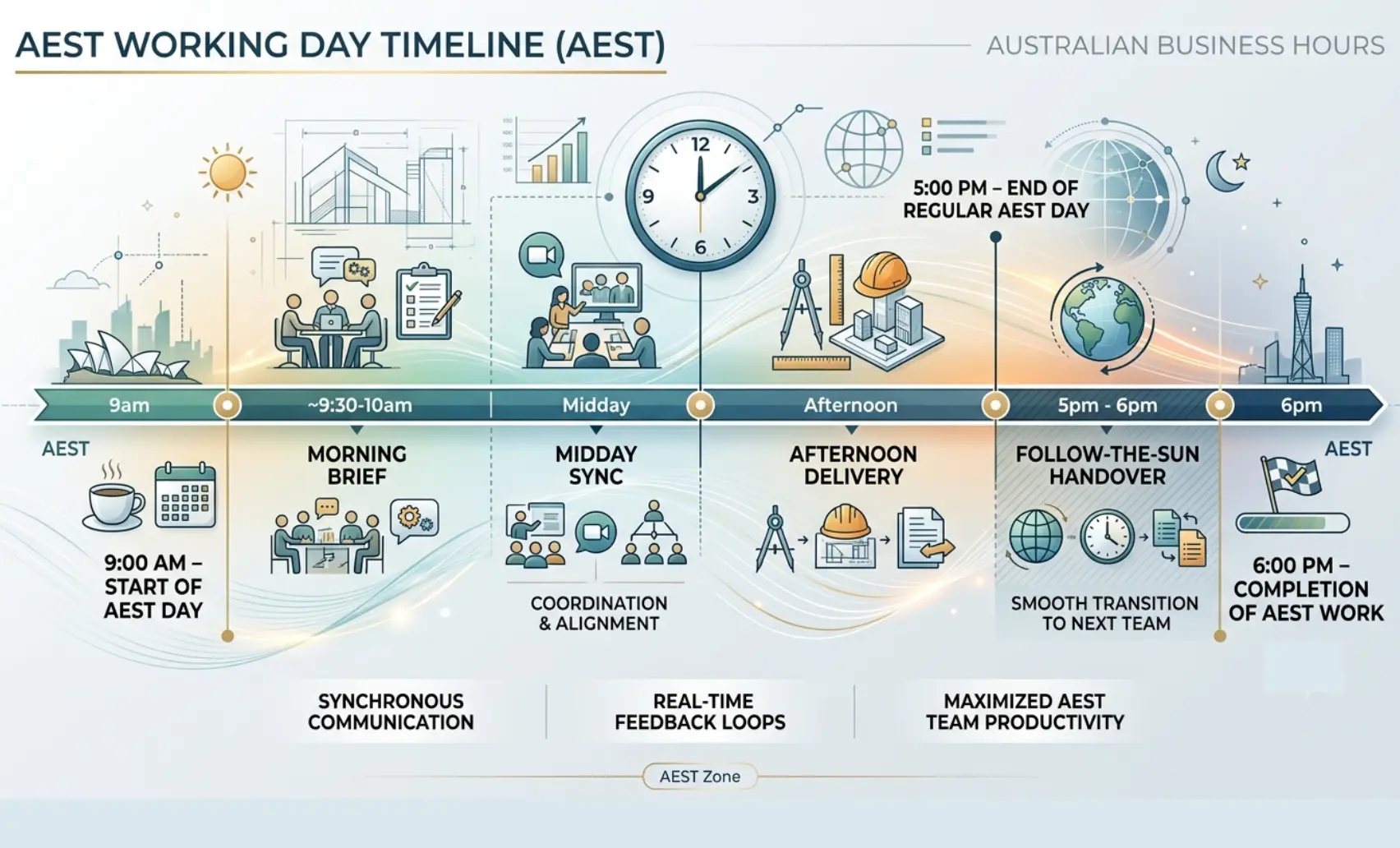
The PM or senior architect sends mark-ups, Revit comments, or RFI notes at 9 am–10 am AEST. The Philippines-based drafter receives them at 7 am–8 am PHT, the start of their working day. There is no overnight lag. The brief is live, the drafter reads it with fresh eyes, and production starts immediately.
This is the moment that separates AEST-aligned offshore staffing from a generic overnight model. The brief doesn’t sit in an inbox for twelve hours. It lands at the start of the offshore team’s day and drives their morning production.
The Midday Sync: Model Review, Clash Check, Coordination Window
The core overlap window runs from 11 am–3 pm AEST, which is 9 am–1 pm PHT. This is the ideal window for a 15–30 minute video sync, model review, RFI walk-through, coordination questions, or a quick mark-up review before the drafter continues production.
Revit Cloud Worksharing, Autodesk Docs, or BIM 360 allow live model access during this window. Both parties can be in the same Revit model, in the same Teams or Slack channel, resolving questions in real time rather than via a chain of emails that spans two calendar days.
The Afternoon Delivery: Completed Drawings and Handover Notes by the end of the AEST Business Day
The drafter completes revised documentation during their afternoon, 1 pm–4 pm PHT, which equals 3 pm–6 pm AEST. Deliverables and handover notes are posted before 4 pm PHT, landing at 6 pm AEST, inside the Australian business day. The PM reviews them the same afternoon, not the first thing the following morning after an overnight wait.
For CD package deadlines and permit submissions with fixed lodgement dates, that same-day turnaround is the difference between hitting a deadline and missing it.
The Follow-the-Sun Bonus: Extended Coverage Without Overtime
Work handed off at 5 pm AEST is picked up at 9 am PHT, which is 7 am AEST the following morning. Drawings return before most East Coast offices open. For Brisbane firms on AEST year-round, the two-hour gap creates a clean follow-the-sun cycle with zero seasonal adjustment and no overtime cost on either side.
That extended production window is one of the least-discussed practical benefits of offshore AEC staffing in Australia. The firm isn’t paying for overtime. The drafter isn’t working late. Work queued at the end of one AEST business day returns complete at the start of the next.
Outside the Overlap Window: How to Structure Async AEC Work So Nothing Stalls
The End-of-Day Handover Note: What It Should Include
A strong handover note removes every reason for production to stall overnight. It should cover:
- Completed items, what was finished, and where the files are located
- Blockers, anything that stops progress, and what’s needed to resolve it
- Queue for tomorrow, what’s next in priority order
- Open questions, anything needing an answer before the next sync
Four items, clearly written, posted to your shared channel before 6 pm PHT. That’s the discipline that makes async AEC work function as smoothly as in-office production.
Writing a Brief That Works Without You There
The brief has to carry the full context; the drafter needs to work independently for several hours. That means:
- Mark-ups on annotated PDFs with clear, numbered revision notes
- Loom video walk-throughs for complex redline sessions or multi-sheet coordination changes
- Revit comments are attached directly to the elements being revised
- A written priority list, what gets done first if time is limited
Phone calls and verbal walk-throughs don’t survive the async gap. Annotated PDFs and short Loom videos do.
The Overnight Bonus: Treat It as Extended Production Time
Work queued at 5 pm AEST returns by 7 am AEST the next morning. That’s not dead time, it’s production capacity that costs nothing extra. A firm that briefs well at 5 pm and reviews at 7 am the following morning is effectively running an extended production day without carrying overtime or keeping anyone late.
How Remote AE Structures the Time Zone Setup for Australian Firms
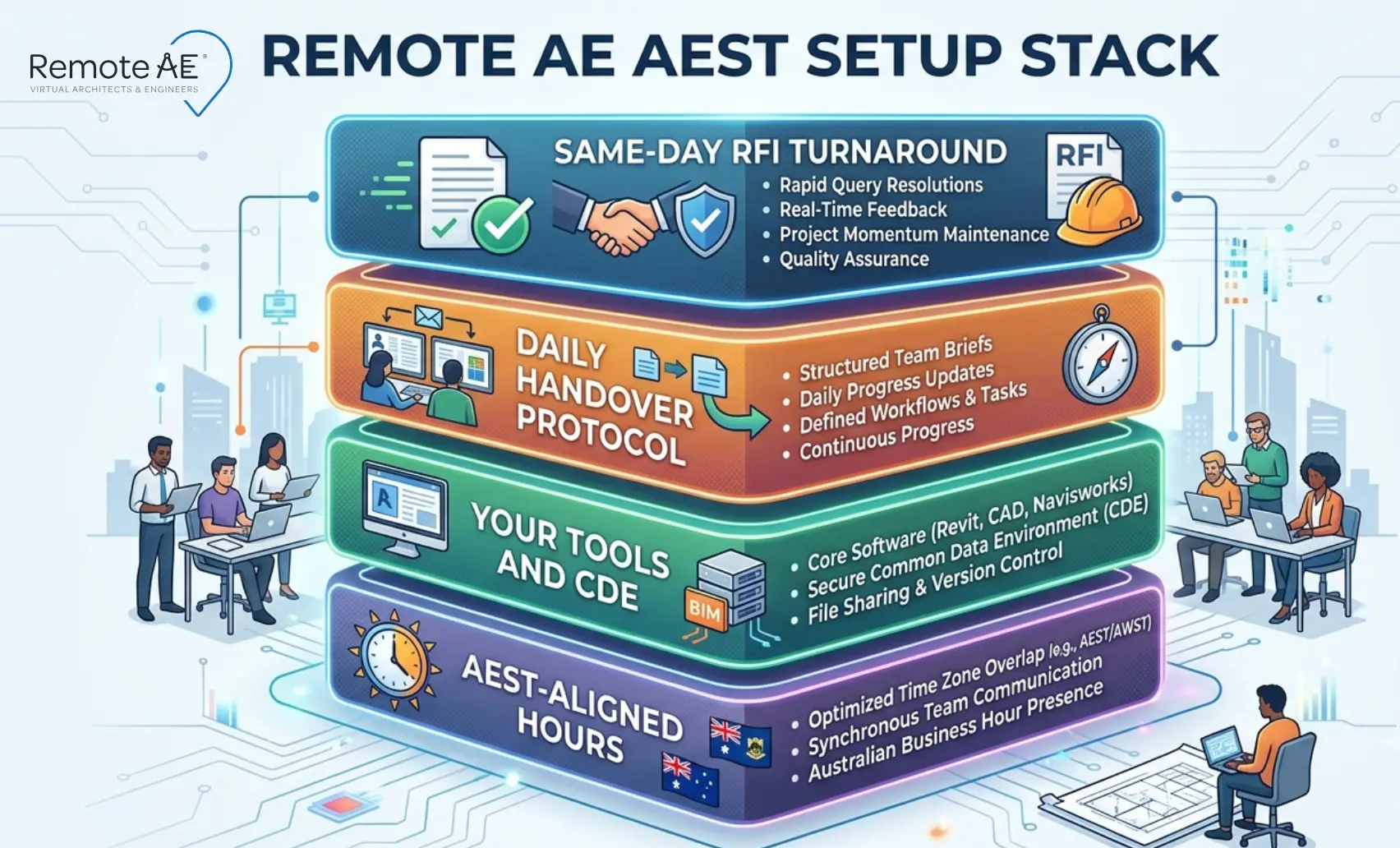
Remote AE’s dedicated AEC professionals work hours aligned to your Australian business day, not generic offshore shifts that happen to have some incidental overlap. The overlap window, sync schedule, and handover protocol are agreed upon at onboarding, before production starts.
That means no first week of figuring out when to reach each other, no miscommunication about when deliverables are expected, and no drawn-out adjustment period where the time zone setup is still being worked out while your deadline approaches.
Your Tools, Your BIM Environment, Your Communication Channels
- Revit Cloud Worksharing, Autodesk Construction Cloud, BIM 360, or your preferred CDE, your remote AEC professional works inside your live environment, not a parallel one
- Communication via your existing Slack, Teams, or email, no new platform to learn or manage
- Daily handover notes as standard, the PM always knows what was completed, what’s queued, and what questions are waiting before the next sync window opens
What This Means for RFI Turnaround and Drawing Revision Cycles
The AEST overlap window closes the gap that makes offshore drafting frustrating under a generic model. With Remote AE’s AEST-aligned setup:
- Same-day RFI responses during the 11 am–3 pm AEST core overlap window
- Mark-up incorporation and drawing reissue within one business day, not 48 hours
- No more waiting overnight for a revised set that arrives too late to review before the next coordination meeting
For remote drafting, Australian hours to actually work, the drafter needs to be experienced enough to act on a brief independently during the non-overlap hours. That’s why Remote AE’s minimum experience requirement matters here.
Remote AE’s AEC-Specific Vetting
A minimum of five years of AEC experience means the drafter needs minimal hand-holding during the overlap sync. Less sync time spent explaining what a reflected ceiling plan is. More sync time spent reviewing the one that’s already been produced.
The vetting process covers Revit proficiency, drawing set experience across project types, and documentation standards, so the brief that lands at 7 am PHT gets acted on correctly, not sitting while the drafter figures out your layer naming convention.
Common Time Zone Concerns
“What If I Need Something Urgently Outside the Overlap Window?”
Post it to your shared channel with a priority flag. Your drafter picks it up at the start of their day, 7 am AEST for east coast firms, or in real time for Perth. Most urgent requests return before your next business day opens.
“How Do We Handle the Daylight Saving Change Twice a Year?”
Schedule all standing syncs in AEST and keep that as your year-round reference. When clocks change in October or April, send a one-line note confirming the new local time. That’s the entire adjustment.
“Can I Run a Daily Standup With My Remote Drafter?”
Yes. A 15-minute sync between 11 am–1 pm AEST sits inside the core overlap window for east coast firms and inside full business hours for Perth. Keep it to three points: what’s done, what’s next, and any blockers.
“What Happens When My Remote Drafter Finishes Their Day Before I Do?”
They post a handover note, completed items, queued work, and open questions before logging off. You review it in the afternoon. Answers are waiting when they start the next morning. Nothing stalls.
Ready to Set Up AEST-Aligned AEC Staffing for Your Firm?
The time zone concern is the most common reason Australian AEC firms delay acting on offshore staffing. This guide shows why it’s the least valid one. Perth firms have zero time difference. East coast firms have seven hours of live overlap and a follow-the-sun production cycle that extends the working day without overtime.
Remote AE builds the AEST overlap window, sync schedule, and handover protocol into every engagement from day one, so your remote drafter is producing inside your business day, not around it.
Talk to Remote AE about setting up AEST-aligned AEC staffing for your firm. Book a free consultation and get matched with a dedicated remote AEC professional within two weeks.
FAQs – Remote AEC Teams Time Zone Overlap for Australia
What time zone do offshore AEC teams work in for Australian firms?
Remote AEC professionals placed through Remote AE work hours aligned to Australian business time, typically Philippine Standard Time (PHT, UTC+8), which sits 2 hours behind Brisbane and Sydney on AEST and is identical to Perth on AWST. This means East Coast firms get 6–7 hours of live daily overlap, and Perth firms get full business day alignment (9 am–6 pm) with zero scheduling adjustment needed.
How many hours of overlap does an Australian firm get with a Philippines-based drafter?
A Philippines-based drafter working standard PHT hours (9 am–6 pm PHT) overlaps with Sydney and Melbourne from 11 am–6 pm AEST in standard time, 7 hours of live, real-time business-day coverage. During daylight saving (AEDT, October–April), the window shifts to 12 pm–6 pm AEDT, giving east coast firms 6 hours of overlap, still more than enough for a morning brief, midday sync, and afternoon delivery cycle.
Is the time zone difference a problem for Perth firms using remote AEC staff?
No, Perth operates on AWST (UTC+8), which is identical to Philippine Standard Time (UTC+8) year-round, meaning a Philippines-based drafter working 9 am–6 pm PHT is working 9 am–6 pm Perth time simultaneously. There is no time zone gap, no scheduling adjustment, and no daylight saving complication; the overlap situation for Perth firms is the same as hiring someone in the same office.