

The most technically grounded objection to offshore AEC drafting in Australia is also the most reasonable one: can a remote drafter produce documentation that meets the National Construction Code and referenced AS/NZS Standards? The short answer is yes, but the conditions matter. NCC 2025 is now published and being adopted state by state from 1 May 2026, with significant changes to commercial energy efficiency, water management, and structural Performance Solutions (ABCB, May 2026). Compliance doesn’t attach to where the drafter sits; it attaches to the review and sign-off process.
This guide explains where compliance responsibility lies under Australian law, which AS/NZS Standards apply to MEP documentation, and how a vetted remote drafter fits into a compliant production workflow.
Key Takeaways
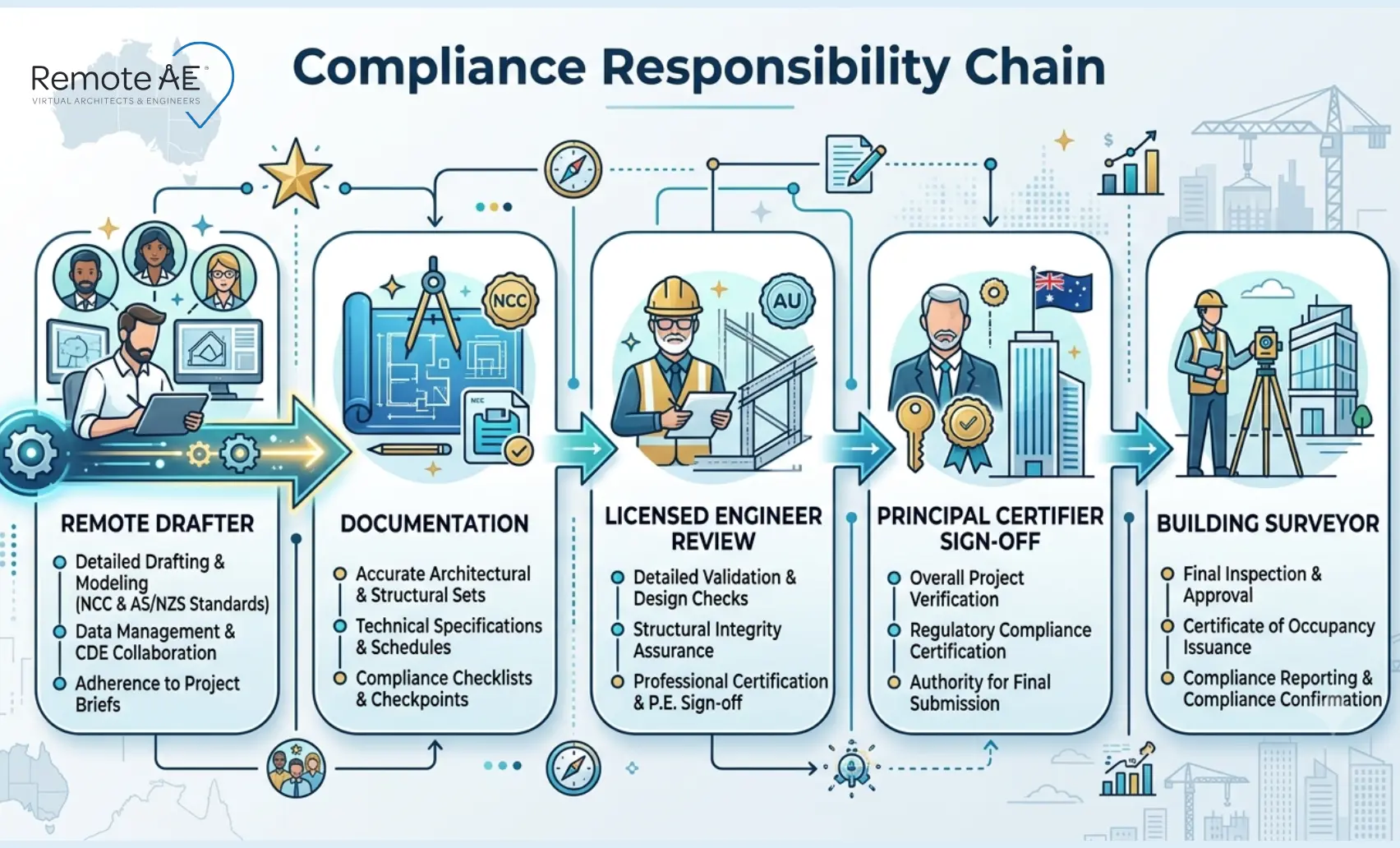
- NCC compliance rests with the engineer of record (RPEQ or CPEng), not the drafter who produced the drawings.
- NCC 2025 applies in Victoria, ACT, and WA from 1 May 2026, while NSW and Queensland stay on NCC 2022 until 30 April 2027.
- Australian MEP documentation runs on four standards: AS 1100, AS/NZS 3500, AS/NZS 3000, and AS 1668.
- Compliance-aware remote drafters need to have confirmed Australian project history and at least 5 years of AEC documentation experience.
- Compliance-ready remote drafting costs AUD $44,587 in Year 1, roughly 60% less than an in-house MEP drafter, who costs AUD $111,280.
- A vetted remote drafter produced AS/NZS 3500 hydraulic drawings for a Melbourne Class 5 office that passed on first submission.
First, Understand Where Compliance Actually Sits in Australian Law
The Drafter’s Role vs the Engineer of Record’s Role
In Australia, the Registered Professional Engineer, RPEQ in Queensland under the Professional Engineers Act 2002, or CPEng nationally through Engineers Australia, bears statutory responsibility for design compliance under state building acts and the NCC.
That responsibility doesn’t transfer to the drafter who produced the drawings. It sits with the engineer who reviewed, marked up, and certified them.
The drafter’s job is to accurately represent the engineer’s design intent in documentation, dimensions, annotations, symbols, layouts, schedules, and compliance notes, to a standard the engineer can review efficiently.
A competent drafter reduces the engineer’s review burden. A poor drafter increases it. But neither makes compliance decisions.
The offshore drafting compliance AU question, properly framed, is not “does a remote drafter know Australian law?” It’s “Can this drafter produce documentation I don’t have to redo before I can review it completely?” That’s a vetting and QA question, not a location question.
What NCC Compliance Actually Means for Documentation
The NCC is published by the Australian Building Codes Board (ABCB) and given legal effect through each state and territory’s building legislation. NCC 2025 was published on 1 May 2026, with adoption fragmented across jurisdictions:
- Victoria, ACT, and WA adopted NCC 2025 from 1 May 2026
- In NSW and Queensland, NCC 2022 remains in force until 30 April 2027
- South Australia, Building Code deferred to 1 May 2027; Plumbing Code (Volume Three) adopted from 1 May 2026
- Northern Territory and Tasmania, NCC 2022 continues to apply (ABCB; CPD On Demand, May 2026)
A remote drafter working across multi-state projects needs to be briefed on which edition applies in each jurisdiction. Because a project in Sydney and a project in Melbourne are currently under different editions of the Code.
This is not a remote-drafter-specific problem; it’s a documentation management problem that applies to any drafter. The solution is the same: your firm’s project brief specifies the applicable edition, and the drafter works to it.
A drawing doesn’t “comply with the NCC” in isolation. It complies when it accurately represents a design that meets NCC performance or deemed-to-satisfy requirements, as certified by the engineer of record and assessed by the building surveyor or principal certifier. NCC-compliant drafting outsourcing is a production support function, not a compliance guarantee function.
The Australian Standards MEP Firms Use: What Remote Drafters Need to Know
NCC 2025 changes are underpinned by new and updated Australian Standards, which provide the detailed technical requirements, test methods, and performance criteria needed for consistent application across building types and project stages (Standards Australia, February 2026).
For offshore drafting compliance AU purposes, four standards sit at the centre of MEP documentation work. Standards Australia
AS/NZS 3500: Plumbing and Drainage
AS/NZS 3500 is the primary standard for hydraulic services documentation in Australia. It runs across four parts:
- Part 1, Water services: pipe sizing, flow rates, backflow prevention
- Part 2, Sanitary plumbing and drainage: fixture units, drain gradients, venting
- Part 3, Stormwater drainage: roof drainage, surface water management
- Part 4, Heated water services: storage and instantaneous systems, temperature requirements
What a competent remote drafter needs to produce AS/NZS 3500-compliant hydraulic documentation:
- Pipe sizing notation consistent with Part 1 and Part 2 conventions
- Isometric drawing conventions for hydraulic riser diagrams
- Riser diagram formatting that clearly shows invert levels and connection points
- NCC-referenced hydraulic compliance notes citing AS/NZS 3500 clauses
NCC 2025 update directly relevant to hydraulic documentation: NCC 2025 strengthens water management provisions, particularly for apartments and larger, more complex buildings, with updates in Volume One Section F to reduce ambiguity and support more durable outcomes (ABCB, May 2026).
Drafters producing hydraulic documentation for commercial and apartment projects in Victoria, ACT, and WA from 1 May 2026 onward need to be briefed on these changes. NSW and QLD follow NCC 2022 until 30 April 2027. National Construction Code
AS/NZS 3000: Wiring Rules
AS/NZS 3000 governs all electrical installation drawings in Australia, single-line diagrams, switchboard layouts, distribution board schedules, and electrical schematics. What a competent remote drafter needs:
- Correct symbol libraries per AS 1100.401 (the electrical drawing standard within the AS 1100 suite)
- Circuit notation and load schedule formatting consistent with AS/NZS 3000 requirements
- Switchboard and distribution board layout conventions
- Consistent title block, sheet numbering, and revision conventions per the project standard
NCC reference relevant to electrical documentation: the NCC calls up AS/NZS 3000 as the governing standard for electrical installations across all building classes, so electrical drawings must carry AS/NZS 3000 compliance notes that the certifying engineer can check against the wiring design.
AS 1668: Mechanical Ventilation and Air Conditioning
AS 1668 governs mechanical services documentation across two parts:
- Part 1: Fire and smoke control requirements for mechanical systems in buildings
- Part 2: Ventilation design for indoor air quality in commercial buildings
What a competent remote drafter needs:
- HVAC duct layout conventions and air volume notation
- Plant and equipment schedule formatting
- Smoke exhaust system notation per Part 1
- Coordination drawings showing mechanical, structural, and fire services in the same ceiling zone
NCC reference relevant to mechanical documentation: the NCC references AS 1668.1 for fire and smoke control and AS 1668.2 for ventilation, so mechanical drawings for commercial buildings must call out the applicable AS 1668 clauses for the certifier to confirm the ventilation and smoke-control design.
AS 1100: Technical Drawing Standards (The Foundation Under Everything)
AS 1100 is the non-negotiable baseline for all Australian technical documentation, across four parts relevant to AEC drafting:
- AS 1100.101, General principles: sheet sizes, title blocks, line types, projection
- AS 1100.201, Mechanical drawing conventions
- AS 1100.301, Architectural drawing conventions
- AS 1100.401, Electrical drawing conventions
A drafter who doesn’t know AS 1100 will produce drawings that look wrong to any Australian reviewer, regardless of technical content. The title block doesn’t match. The line weights are off. The projection is inconsistent.
These aren’t minor formatting preferences; they’re the visual language Australian engineers and building surveyors use to read and assess documentation. AS/NZS drafting standards compliance starts here, before any discipline-specific standard applies.
What Separates a Vetted AEC Drafter From a Generic Offshore Hire
The Problem With Generic Offshore Freelancers?
A freelancer sourced from a general job board with no Australian project experience is a genuine compliance risk, not because of where they’re located, but because of what they haven’t worked on.
No familiarity with AS 1100 drawing conventions means the formatting is wrong from sheet one. A lack of understanding of NCC-referenced deemed-to-satisfy clauses means compliance notes are missing or incorrect. No knowledge of local council or state authority title block requirements means the drawings don’t pass a basic submission check.
This is what the outsourcing of drafting Australian codes horror stories are actually describing: generic freelancers, not specialist AEC staff. The distinction is the entire point.
What Vetting for Australian Standards Actually Looks Like
Three checks separate a standards-aware remote drafter from a risk:
- Australian project portfolio review: Not just “CAD experience” but documented experience producing hydraulic, electrical, or mechanical drawings to AS/NZS 3500, AS/NZS 3000, or AS 1668 on real Australian projects
- Sample drawing review: Request an AS 1100-formatted drawing before engagement. Check the title block, line types, sheet layout, and discipline-specific notation against the relevant standard before committing to live project work
- Reference check from an Australian firm: Did their previous drawings require significant rework before review, or did they arrive submission-ready?
How Remote AE Vets for Australian Standards Compliance
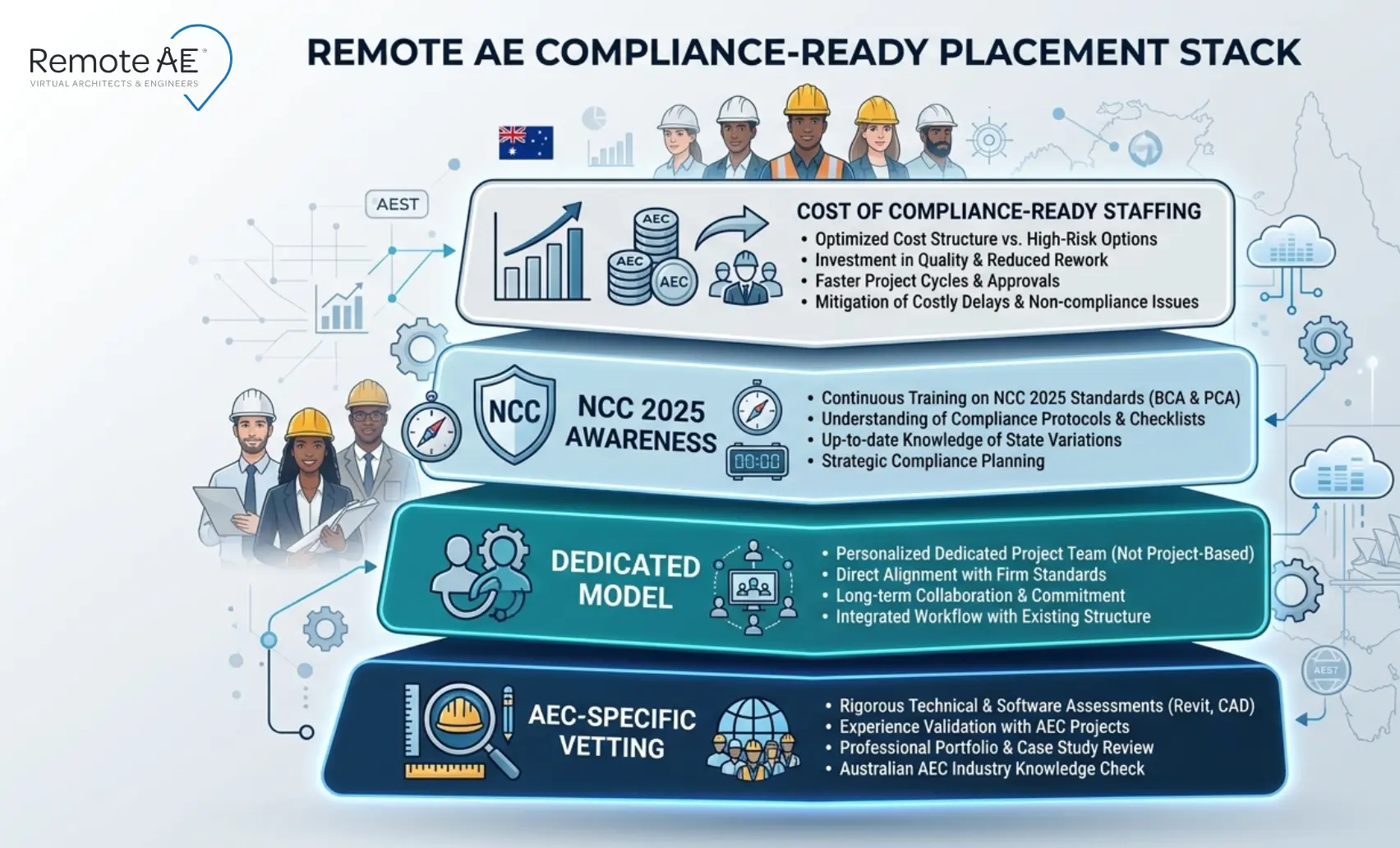
- Minimum five years of AEC experience: the baseline that filters out graduates without documentation exposure across multiple project types
- Australian project history confirmed during placement: not assumed from general AEC experience
- AEC-only staffing: the talent pool is drafters who work in hydraulic, electrical, and mechanical documentation daily, not generalists who list AutoCAD on a resume
The QA Loop: How Australian MEP Firms Maintain Compliance With a Remote Drafter
Your Review Process Is the Compliance Mechanism
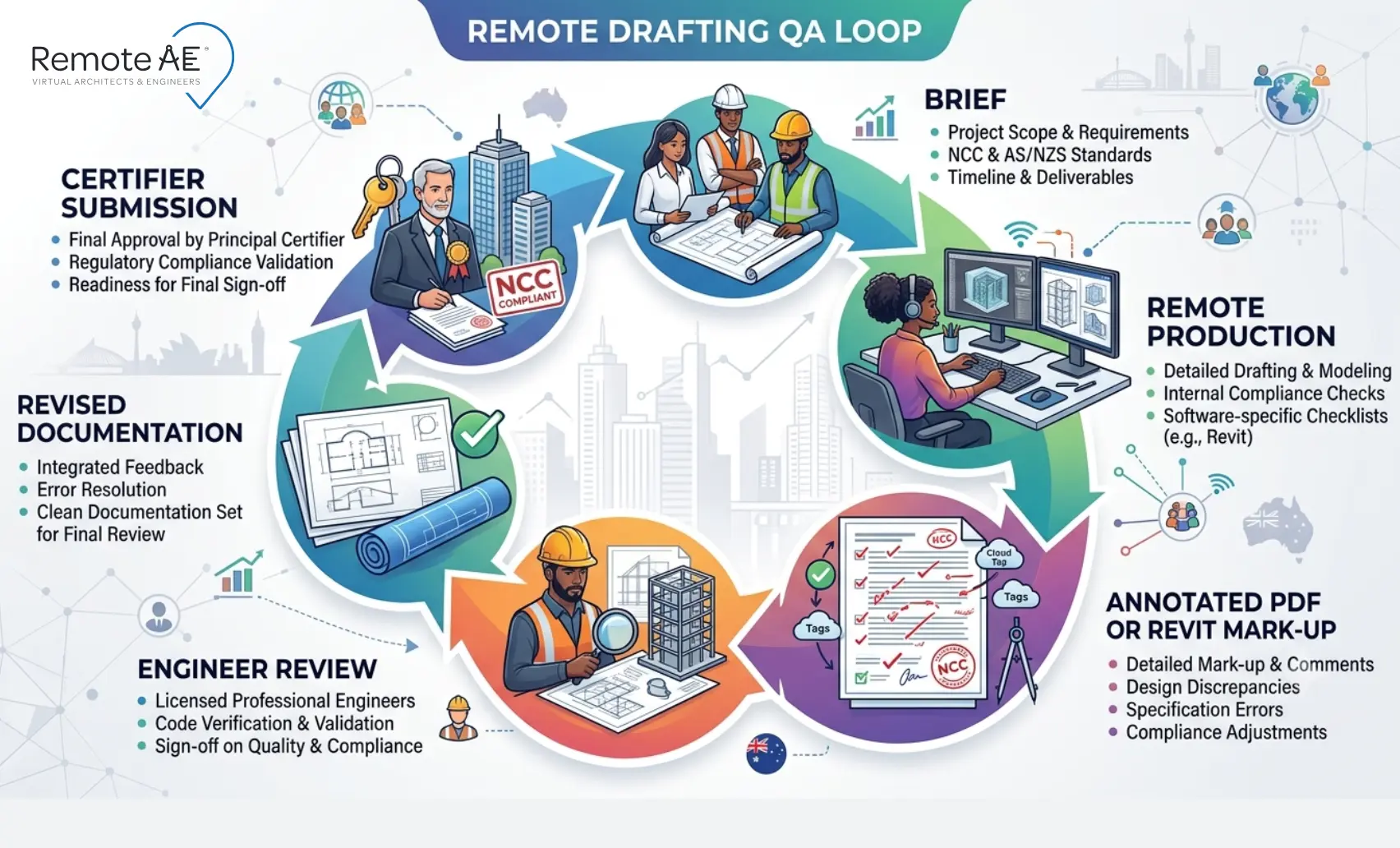
MEP principals review and mark up drawings before certification, whether the drafter sits in the next room or works remotely. The review cycle is the same. What changes is how mark-ups and comments travel, via Revit Cloud Worksharing, BIM 360, Autodesk Construction Cloud, or an annotated PDF rather than a printed redline handed across a desk.
A competent remote drafter reduces rework in that review cycle. They understand AS 1100 conventions, know the discipline-specific notation, and arrive at the review session with drawings the engineer is correcting for design intent, not fixing for basic formatting. That’s the output standard a vetted placement should meet from the first submission.
Building a Standards-Compliance Checklist for Your Remote Drafter
Give your remote drafter a written checklist before the first drawing is produced. It removes ambiguity and makes the review cycle faster from week one. Cover these items as a minimum:
- Title block and revision history formatted per AS 1100.101, sheet size, project details, revision table, approval signatures
- Symbol conventions per the relevant discipline standard, AS 1100.401 for electrical, AS 1668 notation for mechanical, AS/NZS 3500 pipe sizing conventions for hydraulic
- NCC-referenced compliance notes on drawings, e.g., AS/NZS 3500 reference clauses called out on hydraulic drawings, AS/NZS 3000 references on electrical schematics
- Applicable NCC edition for the project jurisdiction: NCC 2025 for VIC/ACT/WA projects; NCC 2022 for NSW/QLD projects until 30 April 2027 (ABCB/CPD On Demand, May 2026)
- State-specific requirements, QBCC notation in Queensland, Victorian Building Authority references in Victoria, and council-specific title block requirements where applicable
The First Drawing Test: Why It Matters More Than the Interview
Brief your remote drafter on a real but low-stakes document before committing to live project work. A single hydraulic riser diagram or electrical load schedule works well for this purpose.
Review the output against AS 1100 and the relevant discipline standard, not for design, but for formatting, notation, and convention. Check the title block against AS 1100.101. Check the pipe sizing notation against AS/NZS 3500.
Check symbol usage against AS 1100.401. A drafter who passes this test on first submission requires minimal review overhead on live projects. One who doesn’t flag the gap before it affects a permit submission.
What NCC-Compliant Remote Drafting Looks Like on a Real MEP Project
The Brief
A Class 5 commercial office building in Melbourne, adopted under NCC 2025 from 1 May 2026. Scope: hydraulic services drawings for the base building, covering AS/NZS 3500 Part 1 (water services) and Part 2 (sanitary plumbing and drainage).
NCC Volume One performance requirements apply, with the deemed-to-satisfy pathway adopted throughout. The MEP engineer holds RPEQ/CPEng registration and is the engineer of record for hydraulic certification.
What the Remote Drafter Received
- Engineer’s schematic showing fixture locations, pipe routes, and connection points
- Riser diagram sketch with pipe sizing calculations attached
- Floor plan with fixture schedule and hydraulic zone boundaries marked
- AS 1100-formatted title block template with project details pre-populated
- Written brief specifying NCC 2025 (VIC adoption) and AS/NZS 3500 Parts 1 and 2 as the operative standards
What Came Back
- Isometric drawings for each hydraulic zone with pipe sizing notation per AS/NZS 3500 Part 1
- Sanitary drainage plan with fixture unit counts and gradient callouts per Part 2
- NCC compliance notes referencing applicable AS/NZS 3500 clauses on each sheet
- AS 1100.101-compliant layout, title block, and revision history
- All sheets reviewed and marked up by the MEP principal in a single session, no formatting corrections required, design intent corrections only
What the MEP Principal Certified
A complete hydraulic documentation set that went to the building surveyor without rework. The certifier’s review identified no drawing standard deficiencies. The NCC 2025 water management provisions were correctly referenced throughout. Permit issued on first submission.
How Remote AE Ties Compliance to Its Placement Process
Remote AE places drafters with a minimum of five years of AEC experience and confirmed Australian project history. That means AS 1100-formatted drawing sets, discipline-specific notation to AS/NZS 3500, AS/NZS 3000, or AS 1668, and real exposure to the documentation conventions Australian engineers and building surveyors expect to see.
Generic AEC experience from non-Australian projects is not assumed to transfer. Every placement for an Australian MEP firm goes through a portfolio review that confirms the drafter has worked on Australian project types, not just that they can use Revit or AutoCAD.
Dedicated Model: One Drafter, Your Projects, Your Standards
Every Remote AE placement is a dedicated individual working exclusively for your firm. They learn your drawing templates, your title block standards, your AS 1100 conventions, and your NCC edition baseline from day one.
That institutional knowledge builds across every project they work on; it doesn’t reset with each job the way a freelancer or shared offshore team would.
- Your Revit model, your AutoCAD templates, your BIM 360 or Autodesk Construction Cloud environment
- Your firm’s discipline-specific notation standards and NCC compliance note conventions
- Your state jurisdiction’s operative NCC edition, briefed at onboarding and updated when adoption changes
NCC 2025 Awareness: Current on Code Changes That Affect Documentation
NCC 2025 introduces changes that directly affect MEP documentation production across multiple building classes. The key updates relevant to remote drafters placed by Remote AE:
- Commercial energy efficiency (Section J), mandatory on-site solar PV for Class 3 and Class 5–9 buildings; tighter fabric and services requirements affecting MEP coordination drawings (ABCB, May 2026)
- Water management (Section F), strengthened provisions for commercial and apartment buildings affecting hydraulic documentation and AS/NZS 3500 compliance notes
- Fragmented adoption by jurisdiction, VIC, ACT, WA on NCC 2025 from 1 May 2026; NSW and QLD on NCC 2022 until 30 April 2027; SA Building Code deferred to 1 May 2027 (CPD On Demand, May 2026)
Remote AE briefs placed drafters on the operative NCC edition at onboarding for each jurisdiction. When adoption changes, as NSW and QLD will transition in 2027, that briefing will be updated accordingly.
The Cost of Compliance-Ready Remote Staffing
A compliance-aware remote drafter through Remote AE costs:
| Cost Item | Amount (AUD) |
| Weekly fee (AUD $719 × 52 weeks) | $37,388 |
| One-time recruitment + ops fee | $7,199 |
| Year 1 all-in | $44,587 |
| Year 2+ ongoing | $37,388/year |
| Hourly equivalent | ~AUD $19/hr |
Compare that to a mid-level MEP drafter hired locally, AUD $111,280 in Year 1 fully loaded (base salary, superannuation at 12%, payroll tax, workers’ compensation, leave entitlements, recruitment, and equipment). Dive into a complete cost breakdown here.
The compliance-ready offshore drafting compliance AU model costs 60% less in Year 1, with no reduction in documentation standard.
Ready to Add a Compliance-Aware Remote Drafter to Your MEP Team?
NCC and AS/NZS compliance in remote drafting is a vetting, briefing, and QA question, not a location question. Australian MEP firms that outsource drafting Australian codes work successfully are the ones that brief clearly, test before committing, and work with a provider that vets specifically for Australian documentation standards.
Remote AE places dedicated remote drafters with confirmed Australian project experience, AS 1100 formatting competence, and discipline-specific knowledge across AS/NZS 3500, AS/NZS 3000, and AS 1668, at AUD $719/week, with managed onboarding and a risk-free replacement guarantee.
Book a free consultation to scope your remote MEP drafting placement and get matched with a compliance-aware drafter within two weeks.
FAQs – NCC & AS/NZS Compliance
1. Can offshore drafters produce NCC-compliant drawings for Australian projects?
Yes, provided they have documented Australian project experience, understand AS 1100 drawing conventions, and are briefed on the operative NCC edition for each project jurisdiction. NCC compliance attaches to the engineer of record’s review and sign-off process, not to where the drafter is located.
2. What Australian standards apply to MEP drafting documentation?
The four core standards are AS 1100 (technical drawing conventions), AS/NZS 3500 (plumbing and drainage), AS/NZS 3000 (wiring rules and electrical installations), and AS 1668 (mechanical ventilation and air conditioning). All four are referenced by the NCC and must be applied correctly in documentation before an engineer can efficiently review and certify a drawing set.
3. What is the difference between NCC 2022 and NCC 2025 for MEP documentation?
NCC 2025 was published on 1 May 2026 and introduces strengthened water management provisions under Volume One Section F for commercial and apartment buildings, plus mandatory on-site solar PV for Class 3 and Class 5–9 buildings under Section J, both of which directly affect MEP documentation scope and compliance notes. Adoption is fragmented: Victoria, ACT, and WA adopted NCC 2025 from 1 May 2026, while NSW and Queensland remain under NCC 2022 until 30 April 2027 (ABCB; CPD On Demand, May 2026).
4. How do I know if an offshore drafter understands AS/NZS 3500 and AS 1668?
Request a sample drawing before committing to live project work, a hydraulic riser diagram for AS/NZS 3500 or an HVAC duct layout for AS 1668, and check it against the relevant standard for pipe sizing notation, compliance note references, and drawing conventions.
5. What is AS 1100, and why does it matter for offshore drafting?
AS 1100 is Australia’s technical drawing standard, covering general principles (AS 1100.101), architectural drawing (AS 1100.301), mechanical drawing (AS 1100.201), and electrical drawing (AS 1100.401). It defines the sheet sizes, title block requirements, line types, projection conventions, and symbol libraries that Australian engineers and building surveyors use to read and assess documentation.