

Architect outsourcing lets design-build firms, studios, and developers add bandwidth without expanding payroll. By shifting CAD drafting, BIM modeling, and construction docs to remote specialists, leaders cut overhead, shrink schedules, and free senior staff for concept work.
This guide defines architect outsourcing, shows why global talent beats local shortages, and details workflows, risk controls, and skill checklists. You’ll see real industry numbers, like the 25% of surveyed executives who say outsourcing reduced vendor service costs, per Deloitte’s 2024 global survey, and learn why Remote AE onboards in half the time of traditional hiring. Read on to see if this model fits your growth plan.
Book a Free 20-Min Consultation, No Commitment Required!
Key Takeaways
- Outsourcing a full Construction Document set costs $3,500 to $9,000, depending on project size, scope, and detail level.
- Outsourced architectural drafting is legal in the U.S. only when a licensed U.S. architect reviews and seals the final drawings.
- Offshore architecture teams onboard in 4 to 5 weeks through Remote AE, versus 12-plus weeks for local hiring.
- One Mid-Atlantic studio cut drafting cost per sheet from $68 to $28 while keeping error rates below 2 percent.
- The Philippines, India, Vietnam, and Argentina supply skilled Revit architects with strong English and U.S. timezone overlap.
- Protect BIM models with NDAs, VPNs, multi-factor authentication, and role-based access in BIM 360 under ISO 27001 standards.
What is Architect Outsourcing?
Architect outsourcing means hiring an external team, often offshore, to handle architectural drafting, modeling, and production work. Unlike in-house hires, outsourced architectural services are typically engaged on a monthly retainer or project basis. You don’t handle payroll, HR, or onboarding. Instead, you get skilled professionals ready to plug into your projects.
In-house hire: salary, benefits, hardware, training, and admin support.
Outsourced architect: flat monthly rate, pre-vetted skills, minimal ramp-up time.
Core Services You Can Outsource
Most AEC firms outsource technical execution rather than design direction. Here’s what AEC firms commonly delegate:
| Service | Typical Deliverables | Sample Tools |
| Architectural Drafting Services | DWG updates, detail callouts, layer cleanup | AutoCAD |
| BIM Modeling | LOD 300–400 Revit models, parametric families | Revit, Dynamo |
| 3D Rendering & Visualization | Stills, walkthroughs, VR scenes | Enscape, Twinmotion |
| Code Checks | IBC compliance markups, ADA clearances | Bluebeam Revu |
3D Architect Outsourcing: Rendering, BIM Modeling, and Visualization
3D architectural outsourcing goes well beyond a static render. Firms outsource this work for three distinct purposes: client presentations, planning and permitting approvals, and marketing deliverables. Here is what each category involves in practice.
Revit LOD 300–400 Modeling
Outsourced BIM modelers build out full Level of Development 300 and LOD 400 Revit models, coordinated geometry, accurate dimensions, and manufacturer-specific parametric families. This is the backbone of coordinated documentation sets and clash detection workflows.
A Remote AE BIM specialist can pick up your existing model, follow your BIM execution plan, and deliver coordinated sheets without coaching on your internal standards.
Architectural Rendering & Visualization
Outsourced rendering teams produce design development stills, animated walkthroughs, and VR-ready scene files using Enscape, Lumion, or Twinmotion. All are linked directly to your Revit model, so updates propagate automatically.
Typical turnaround for a high-quality exterior still is 24–48 hours; a full walkthrough animation runs 3–5 business days, depending on complexity.
Parametric Family Creation
Custom Revit families, site furniture, specialty structural elements, and MEP equipment are time-consuming to build in-house. Outsourced specialists build them to your firm’s content standards, with correct shared parameters, type catalogues, and nested geometry.
This is one of the most commonly outsourced 3D tasks because it is highly repetitive but requires genuine Revit expertise.
Who Typically Outsources?
Architect outsourcing is used across the industry:
- Design-build firms looking to balance design and construction timelines
- Architectural studios needing overflow capacity for CDs and BIM work
- Real estate developers managing multiple projects across markets
- Construction companies with internal design coordination teams
Why Are More AEC Firms Outsourcing Architectural Services?
Rising Costs and Shrinking Margins
BLS reports wages and salaries rose 5.1% for the year ending June 2024; AIA reported soft billings across much of late 2024. Hiring and retaining architects is expensive. Between salaries, software licenses, desk space, and training, overhead costs add up quickly. Outsourcing architectural services turns those fixed costs into flexible, project-based expenses.
Talent Gaps in Local Markets
In AGC’s 2025 survey, 78% of firms had difficulty filling craft positions, and 77% had trouble filling salaried roles. In many U.S. and UK cities, qualified Revit or BIM talent is hard to find. Even when available, the hiring process can stretch to 12+ weeks. By contrast, an offshore architecture team can be onboarded in as little as 4 to 5 weeks through RemoteAE. How?
Project-Based Flexibility
No two projects are the same. Architect outsourcing allows you to scale teams up or down depending on deadlines and deliverables, without committing to long-term contracts. Ideal for firms with fluctuating workloads.
Faster Turnaround with Global Teams
Time-zone spread creates a follow-the-sun cycle. A Chicago studio sending mark-ups at 6 p.m. CST, receives sheets back by 6 a.m., netting an extra iteration per day
What Does Architecture Outsourcing Cost?
Cost is the first question every firm asks, and it should be. Here is exactly what you pay with Remote AE, and what you save compared to an equivalent in-house hire.
Remote AE pricing:
- One-time recruitment & operations fee: $4,999, covers sourcing, vetting, and onboarding your dedicated hire
- Ongoing weekly rate: $499/week, full-time equivalent, dedicated exclusively to your firm
- Annualised equivalent: ~$26,000/year in ongoing costs
- Payment by credit card. No long-term contract required.
Compare that to the fully-loaded cost of a junior architect in the U.S. According to the BLS Occupational Employment Statistics, the median annual wage for architects is $93,310.
Add employer payroll taxes (~7.65%), health insurance (~$6,500–$9,000/year), equipment, software licences, and desk overhead, and a single junior hire routinely costs $100,000–$120,000 fully loaded.
Remote AE clients typically save 50–70% versus an equivalent in-house hire.
Cost comparison at a glance:
| Cost Item | In-House Junior Architect vs Remote AE |
| Base salary | $65,000–$93,000/yr vs Included in $499/wk |
| Payroll taxes (~7.65%) | $5,000–$7,100/yr vs $0 |
| Health insurance | $6,500–$9,000/yr vs $0 |
| Equipment & software | $3,000–$6,000/yr vs $0 |
| Office space (avg/desk) | $6,000–$12,000/yr vs $0 |
| Recruitment/agency fee | $8,000–$15,000 (one-time) vs $4,999 (one-time) |
| Total estimated Year 1 | $93,500–$142,100 vs ~$30,947 |
| Potential Year 1 savings | _ vs $62,553–$111,153 (50–78%) |
Ready to see what outsourcing would save your firm specifically? Get a Custom Cost Estimate!
Benefits of Architect Outsourcing with a Trusted Partner
Cost Savings Without Compromising Quality
Countries like the Philippines or India offer affordable hourly rates, but that doesn’t mean cutting corners. A Mid-Atlantic studio cut drafting cost per sheet from $68 to $28 after moving redlines to a Remote AE pod, yet kept error rates below 2 % thanks to dual QC passes. A trusted outsourcing partner includes:
- Built-in QA/QC workflows
- Peer-reviewed deliverables
- Defined SLAs and KPIs to track output
Access to Specialized Skills
Need LEED-ready sets? ADA compliance? Custom Revit families?
Outsourced teams often:
- Hold certifications in BIM, AutoCAD, and LEED
- Understand U.S. codes (IBC) or UK RIBA stages
- Adapt quickly to your firm’s standards and templates
More Time for High-Value Design Work
Your architects should spend time designing, not drawing door schedules. A virtual architect assistant frees your in-house team to:
- Focus on design and client strategy
- Avoid burnout from repetitive tasks
- Deliver better outcomes, faster
Operational Agility
Outsourcing removes red tape. Shift project priorities overnight. Try new tools or workflows. No payroll headaches or slow hiring loops.
How Architect Outsourcing Actually Works?
Most outsourced architectural workflows follow a clear, repeatable process:
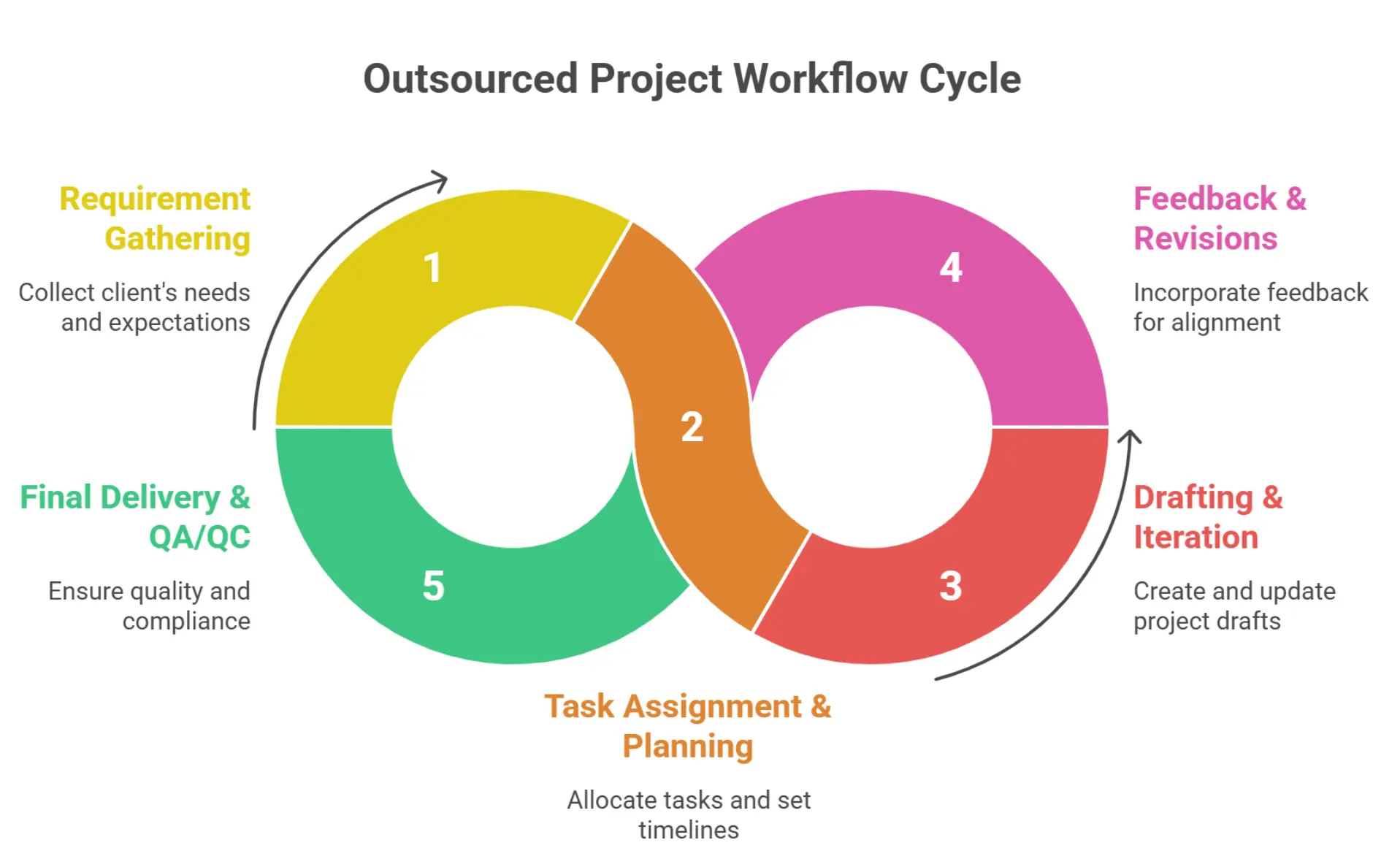
- Requirement Gathering: The client shares drawings, markups, BIM execution plans, and schedules. A kickoff call defines expectations.
- Task Assignment & Planning: Tasks are scoped, resources are assigned, and timelines are set using PM tools like Trello or Monday.com.
- Drafting & Iteration: Drafters and modelers begin work using your firm’s templates, title blocks, and CAD standards. Regular updates are shared.
- Feedback & Revisions: Feedback loops via markups, redlines, or BIM 360 comments ensure output aligns with client expectations.
- Final Delivery & QA/QC: All drawings or models go through internal checks for layering, dimensioning, and code compliance before final submission.
Tools and Platforms Commonly Used
Most architecture outsourcing teams are fluent with:
- Design Tools: Revit, AutoCAD, SketchUp, Rhino, Enscape
- Collaboration: BIM 360, Bluebeam, Google Drive
- Project Management: Asana, Trello, Monday.com
This allows seamless remote integration with your in-house teams.
Data Security and NDA Protections
When outsourcing architectural services, protecting your IP is critical. Good partners ensure:
- Signed NDAs and confidentiality agreements
- Secure access via VPN and multi-factor authentication
- Use of least privilege file access and ISO 27001-aligned data storage. DBIR 2024 finds ~15% of breaches involved a third party, and 68% involved the human element, highlighting the significance of data security.
- Ownership clauses to guarantee the client retains all IP rights
Skills to Consider in an Outsourced Architect
A strong outsource hire should slide into your workflow on day one.
| Skill | Why It Matters | Quick Test |
| Revit / AutoCAD mastery | Sets up LOD 300-400 models and clean DWGs without coaching. | 1-hour redline exercise in your template. |
| Code knowledge (IBC, ADA, Eurocodes) | Cuts rework during plan check. | 10-question code quiz + sample detail fix. |
| Phase fluency (SD→CD) | Understands deliverable depth at each milestone. | Ask for a sheet set from a past CD package. |
| Communication chops | Clear markup questions avoid ping-pong delays. | 5-minute Loom of how they handle unclear redlines. |
| Remote teamwork | Knows CDE permissions, async stand-ups, and version control. | Review past experience in BIM 360/ACC |
Research frequently cited by Brandon Hall Group finds that strong onboarding is linked to +82% retention and +70% productivity gains.
How to Choose the Right Architect Outsourcing Partner?
Now that we’ve discussed what skills to consider and how architectural outsourcing works, the next step is to consider the things to select the right one:
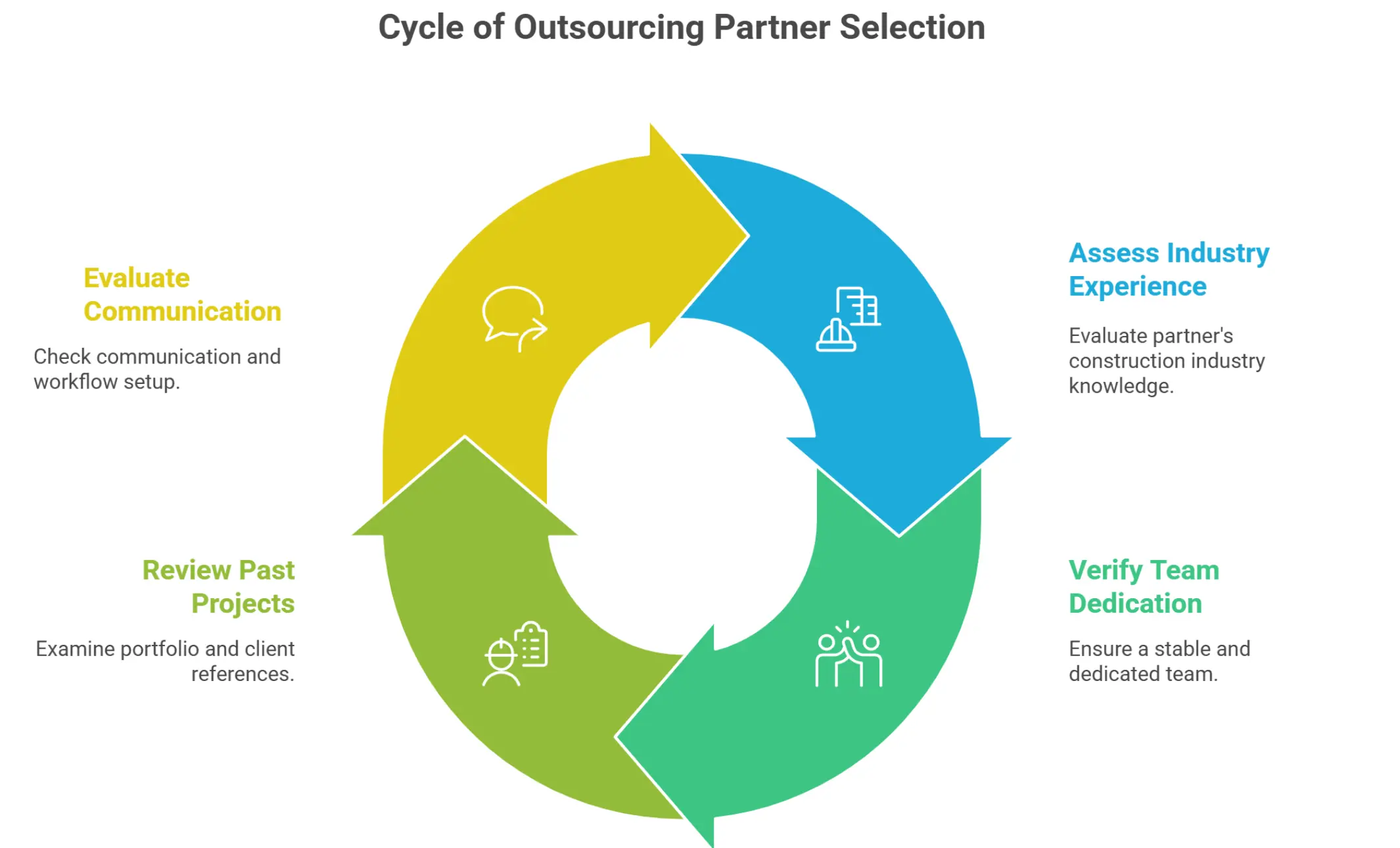
Look for Industry Experience
AEC work isn’t like other outsourced services. A partner with deep construction industry experience will already understand how projects evolve, and what’s at stake.
Check for a Skilled, Dedicated Team
Avoid marketplaces where freelancers come and go. Choose firms that assign dedicated resources who work with you long term, with clear escalation paths and delivery ownership.
Review Past Projects and References
Ask for sample deliverables. Look for repeat clients and portfolio diversity. A solid outsourcing firm will have success stories across commercial, residential, and institutional work.
Evaluate Communication and Workflow Setup
How do they manage updates? Do they have point-of-contact roles, internal QA teams, or scheduling trackers? You need a team that doesn’t just execute, but communicates clearly. See our 3-stage vetting process.
Why AEC Firms Choose Remote AE for Architecture Outsourcing
Remote AE was built specifically for the AEC industry, not adapted from a general staffing model. With 15 years of AEC-only experience, we recruit, vet, and manage outsourced architects who understand your workflow, your deadlines, and your clients’ expectations from day one.
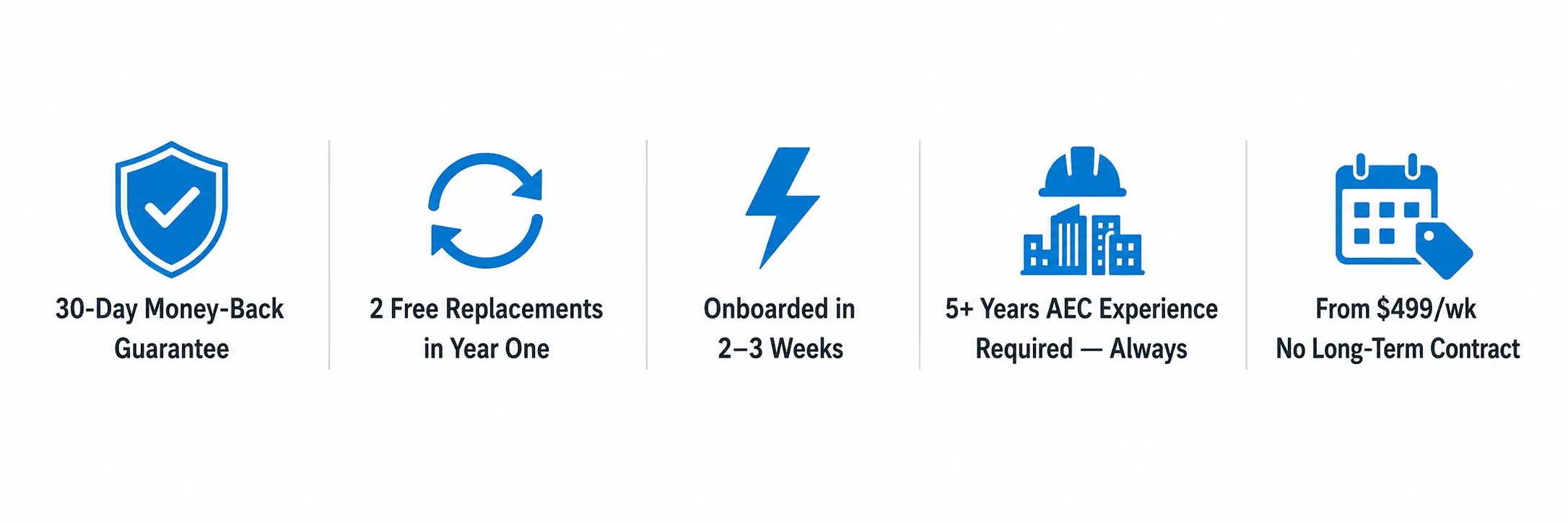
Every placement goes through our 3-stage vetting process. Every hire comes with a 30-day money-back guarantee and up to 2 free replacements in your first year.
And unlike freelance platforms or general staffing agencies, your architect works exclusively for your firm, not across 4 concurrent clients, and is supervised by a Remote AE talent manager throughout the engagement.
Remote AE is the right fit if you are:
- A solo practitioner or small firm (1–5 people) spending too many hours on CAD work instead of design and client development
- A 5–25 person architecture or engineering firm that is capacity-constrained and cannot hire fast enough for project surges
- An MEP or structural firm with senior engineers doing drafting work that should be delegated
- Any AEC firm looking to reduce per-project labour costs by 50–70% without compromising technical quality or data security
Our talent pool draws from across the globe, the USA, Canada, the UK, South Africa, and New Zealand. The architects who are fluent in Revit, AutoCAD, and U.S. code standards and who work your business hours. If you have been through the offshore staffing experience and found it lacking, Remote AE is a different model: managed, dedicated, and accountable.
Frequently Asked Questions
Will an outsourced architect actually understand our projects?
Every Remote AE candidate must have a minimum of 5 years of AEC industry experience before they are even considered. They then pass a 3-stage vetting process: a technical skills assessment, a portfolio review with one of our AEC specialists, and a live redline exercise using your software stack (Revit, AutoCAD, or whichever tools your firm uses).
This means your hire already understands IBC code compliance, Revit LOD standards (300–400), RIBA work stages, and sheet set conventions before their first day, not after a 3-month ramp-up. You interview the top 2 candidates and only proceed if you are satisfied. There is no obligation until you choose to move forward.
What happens if my outsourced architect quits or underperforms?
Remote AE includes up to 2 free replacements within your first year of engagement. If a placement does not work out, for any reason, we source, vet, and onboard a replacement at no additional cost to you.
The knowledge transfer process is managed by Remote AE, not left to you. We facilitate handover documentation and a transition meeting, so your project continuity is not disrupted. Compare this to the typical in-house scenario: if an employee leaves, you restart a 6–12 month hiring process from zero, often with an ongoing project at risk.
Is architecture outsourcing actually cheaper than hiring in-house?
Yes, and the gap is larger than most firms expect. A dedicated Remote AE architect costs $499/week (~$26,000/year in ongoing costs), compared to a U.S. junior architect at $65,000–$93,000 in base salary alone, before payroll taxes, health insurance, equipment, software, and office space. When you account for the full cost of employment, most firms save 50–78% in Year 1 with Remote AE. See the detailed cost breakdown in the ‘What Does Architecture Outsourcing Cost?’ section above.
How do you protect my BIM models and client IP?
Every Remote AE engagement starts with a signed NDA and confidentiality agreement before any project access is granted. File access is managed through VPN and multi-factor authentication, with role-based permissions in BIM 360/ACC. Your architect sees only what they need to work on.
Remote AE operates under ISO 27001-aligned data storage protocols. All IP rights remain with you, the client; this is written into the engagement agreement. According to Verizon’s 2024 DBIR, 68% of breaches involve the human element; our access controls and least-privilege file policies are designed specifically to mitigate this risk in a remote working context.
Will my outsourced architect work during my business hours?
Yes. Remote AE matches you with talent that works your preferred business hours, including full overlap with U.S., UK, Canadian, and Australian time zones. You define the working hours in the brief. Your architect adapts to your schedule, not the other way around. Remote AE also conducts quarterly check-ins with you to make sure the arrangement continues to work operationally.
Is outsourcing architectural work legal in the U.S.?
Yes. Outsourcing drafting, BIM modeling, and construction document production is fully legal and is standard practice across the AEC industry. The legal requirement is that a licensed U.S. architect of record must review, stamp, and seal all final construction documents. The outsourced team functions as production support, the same role that in-house CAD technicians and junior drafters play in any firm.
This model is used by some of the largest AEC firms in the country. If you have questions about how this works within your specific state licensing board requirements, Remote AE can provide guidance based on your jurisdiction.
Ready to Build Your Remote Architecture Team?
Remote AE helps AEC firms outsource confidently with pre-vetted professionals, secure workflows, and flexible models. From Revit detailing to 3D rendering, we’ve got your back.
Book your free consultation and let’s talk about your workload and goals.