

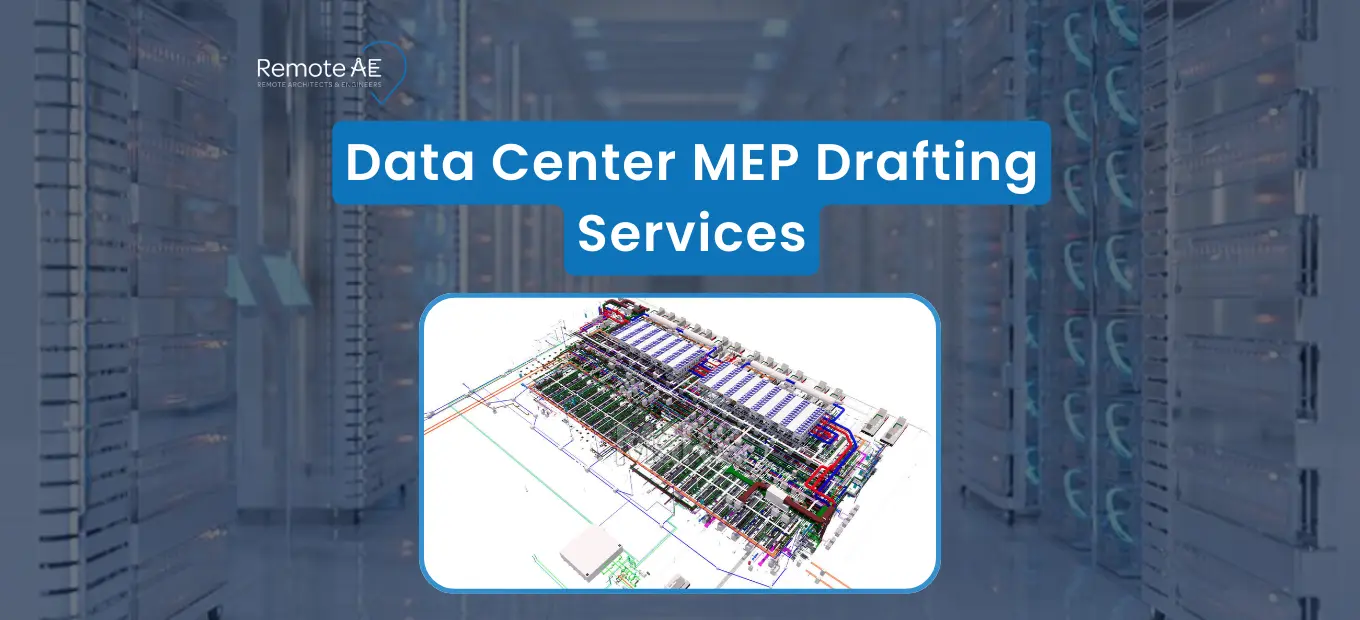
Data center schedules break drafting teams fast. Revisions hit late. Coordination stays dense. Permit and IFC dates don’t move. Data center MEP drafting services give you remote drafting capacity without pushing senior engineers into sheet production. You keep design decisions, code calls, and sign-offs in-house. A remote team handles redlines, sheet setup, schedules, coordination backgrounds, and revision packaging inside your standards.
Remote AE provides remote specialists who integrate into your Revit and CAD standards to keep sheets moving while senior engineers stay focused on decisions. You gain drafting horsepower in two weeks, not months, while preserving control over scope, quality, and schedule. This guide explains why data centers hit limits sooner than other builds, why traditional construction industries’ outsourcing often fails, what deliverables you should demand, and a two-week plan to add steady output with Remote AE.
Why Data Centers Hit Drafting Capacity Limits Faster Than Other Projects
Data centers push more changes through MEP sheets than most projects. That’s the core issue. Not talent. Volume.
The “Revision Velocity” Problem (DD → CD → Permit → IFC)
Data centers move fast across phases. That creates repeat revisions that hit the same sheets again and again.
Example you’ve lived:
“Issued-for-permit set due Friday. Three vendor submittals changed on Tuesday. Your team needs an extra drafter tonight.”
This is also a hiring reality. 92% of firms report difficulty filling open positions in the AGC 2025 Workforce Survey. That includes salaried roles.
Density and Coordination: Power, Cooling, Controls, and Pathways
Data centers pack power, cooling, controls, and redundant pathways into limited footprints. Tier expectations and reliability pressures force tight layouts and heavy data center MEP coordination services across electrical, mechanical, and plumbing trades.
The Hidden Cost: Senior Engineers Doing Sheet Work
When drafting stalls, senior engineers jump into production. Decisions slow. Errors rise.
Median annual pay benchmarks show the cost of pulling senior engineers into sheet work:
- Electrical engineers: $111,910 median annual wage (BLS, May 2024).
- Mechanical engineers: $102,320 median annual wage (BLS, May 2024).
- Drafters: $65,380 median annual wage (BLS, May 2024).
Remote AE shifts that load by placing trained remote drafters on sheet updates, so leads stay on system logic and risk review.
Why Traditional Outsourcing Fails for Mission-Critical Facilities
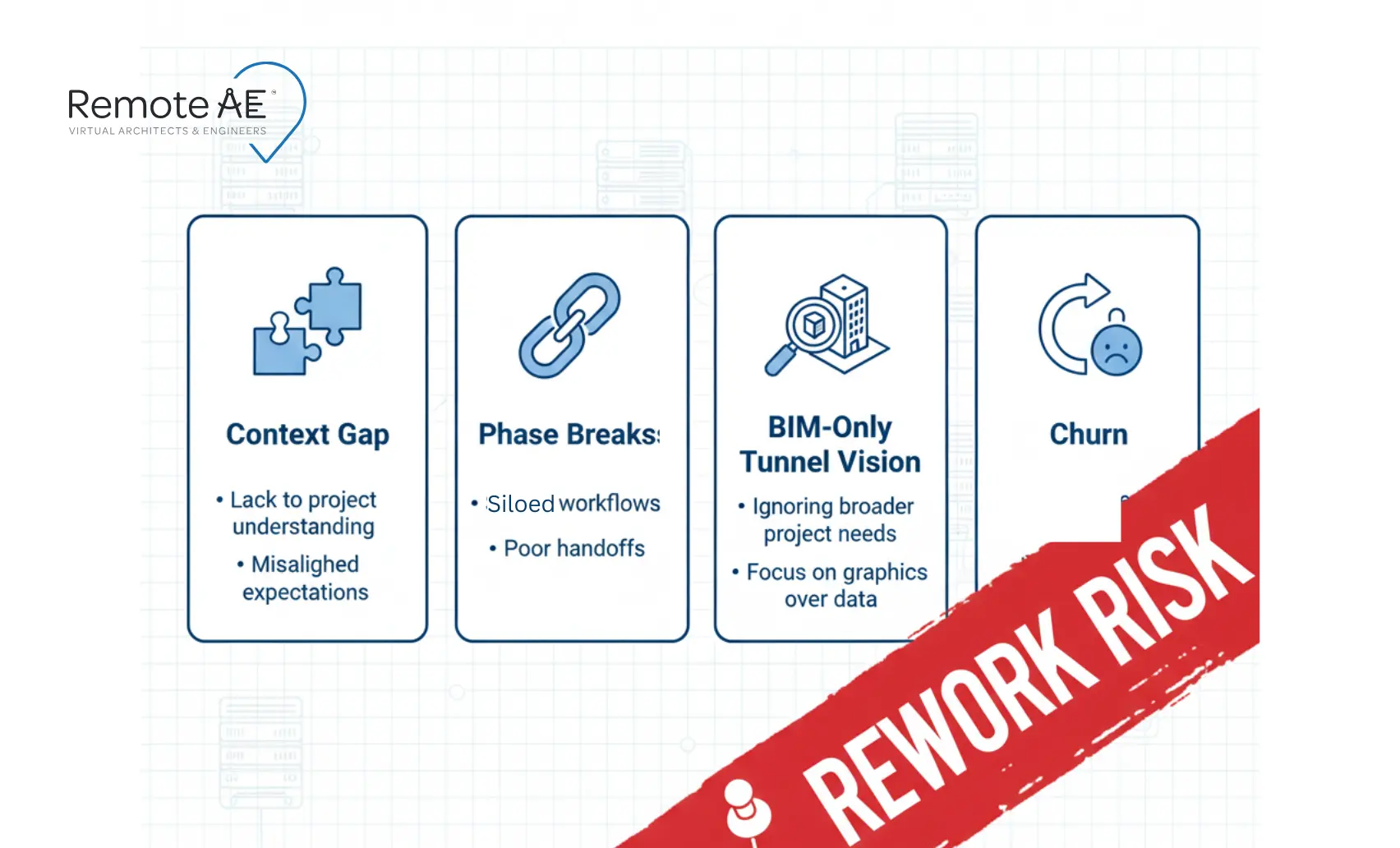
Data centers punish “generic outsourcing.” Not because remote work can’t deliver. Because mission-critical work needs context, continuity, and control.
Offshore vendors lack a data center context
A vendor can draft lines and still miss intent. Data centers rely on disciplined documentation across power, cooling, controls, and pathways.
If a drafting resource lacks that “whole system” awareness, coordination misses rise.
No continuity across phases
DD, CD, permit, and IFC packages carry forward decisions and constraints. When you rotate drafters every phase, you pay the retraining cost repeatedly.
BIM-only focus ignores DD/CD reality
A lot of outsourcing shops sell “BIM.” But data center delivery still lives in:
- sheet sets
- schedules
- details
- cross-references
- revision packaging
High churn and retraining cost
Poor workmanship and frequent rework show up when outsourced labor isn’t governed and checked. A 2023 research study on cost overruns due to outsourced labour found themes like poor workmanship and frequent rework among causes.
That risk is avoidable. You just need:
- defined standards
- controlled access
- a “definition of done” checklist
- continuity week to week
Remote AE pushes continuity and fit protection as part of its model, including risk-free replacement for up to two virtual assistants in the first year.
What “Data Center MEP Drafting Services” Should Include (Deliverables Checklist)
Remote drafting must cover more than models.
Electrical (Mission-Critical) Drafting Outputs
Single-line diagrams, risers, panel schedules, equipment layouts, grounding details, and coordination views define data center electrical drafting services. Remote AE provides remote production support, so leads stay on decisions, and it highlights a fully managed service with no upfront costs until the contractual phase.
Mechanical and Cooling Drafting Outputs
Piping layouts, schematics, equipment schedules, details, and sections shape cooling plant performance. Data center mechanical drafting services reduce coordination misses and preserve airflow design intent.
Data Center Plumbing Drafting Services
Process piping, RO and makeup water, and drainage systems often change late. Data center plumbing drafting services from Remote AE keep permit sets clean during final CD pushes.
Low-Voltage and Telecom Coordination Drafting
Data center delivery demands tight control over low-voltage systems. Pathways, sleeve locations, penetration schedules, and coordination backgrounds drive how trades work in the field. Remote AE supports these packages as part of full data center MEP coordination services, helping teams meet the expectations defined in standards such as TIA-942 for mission-critical facilities.
Not Just BIM: Documentation and Coordination Breadth
Remote AE does more than model. Teams support RFIs, sheet indexing, permit sets, as-builts, and revision processing. This breadth ensures drafting work reflects the full DD and CD reality of data center programs.
How Remote AE Adds Data Center MEP Drafting Capacity in 2 Weeks
Two weeks is realistic when you control inputs, standards, and a daily handoff rhythm. The goal is steady output, not heroics.
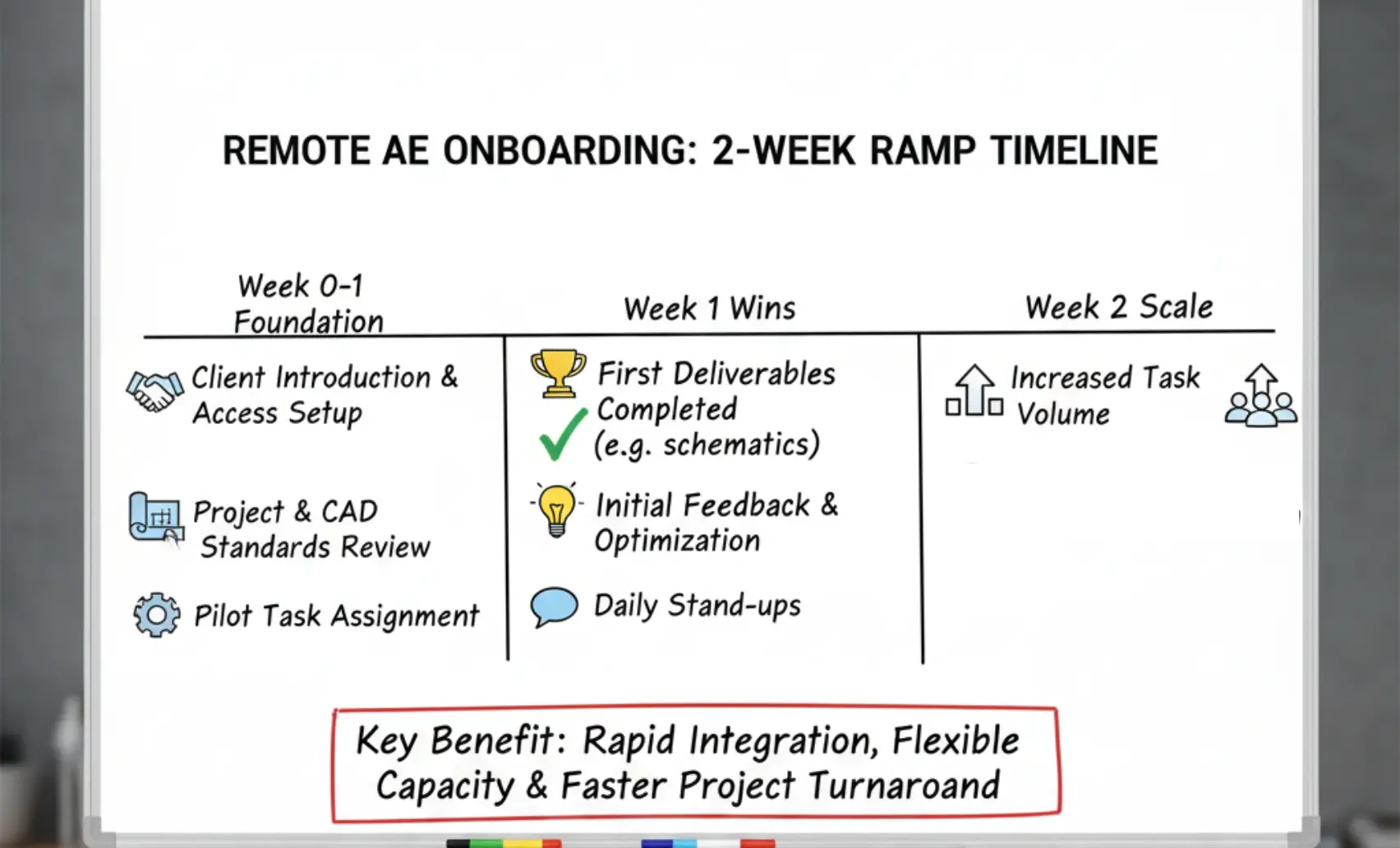
Week 0–1: Set the Foundation (Inputs and Standards)
Your team shares Revit and CAD standards, title blocks, sheet lists, view templates, naming rules, shared parameters, and family library rules. ACC or BIM 360 folder structures and permissions are established. Remote AE works inside your stack and standards from the first day.
Week 1: First Production Wins (Start Small, Then Expand)
The first tasks focus on redlines, sheet setup, schedule updates, and backgrounds. A daily handoff routine follows a simple loop: end-of-day markups, overnight updates, morning review, repeat. Momentum builds without disruption.
Week 2: Scale Output (Steady Weekly Capacity)
Once rhythm forms, Remote AE expands into discipline packages, coordination sheets, and permit deliverables. Weekly staffing preserves continuity. You no longer reset context every cycle.
How Remote AE Supports Data Center Teams
Remote AE fits teams that need repeatable output and a fast ramp without losing control. You keep standards and approvals. Remote AE supplies trained production capacity.
- Production Capacity on Demand for Mission-Critical Schedules: Rapid ramp-up and week-to-week continuity let data center programs flex without long hiring cycles.
- Senior Assistants, Vetted for AEC Production: Every assistant brings at least five years of experience. Remote AE offers risk-free replacement for up to two assistants and no-cost consultations to align the scope early.
- Coverage Beyond Drafting: Support spans BIM and VDC, DD and CD sets, takeoffs, permitting documents, and coordination tasks. Drafting lives inside a broader production ecosystem.
Pricing Model That Matches Data Center Reality
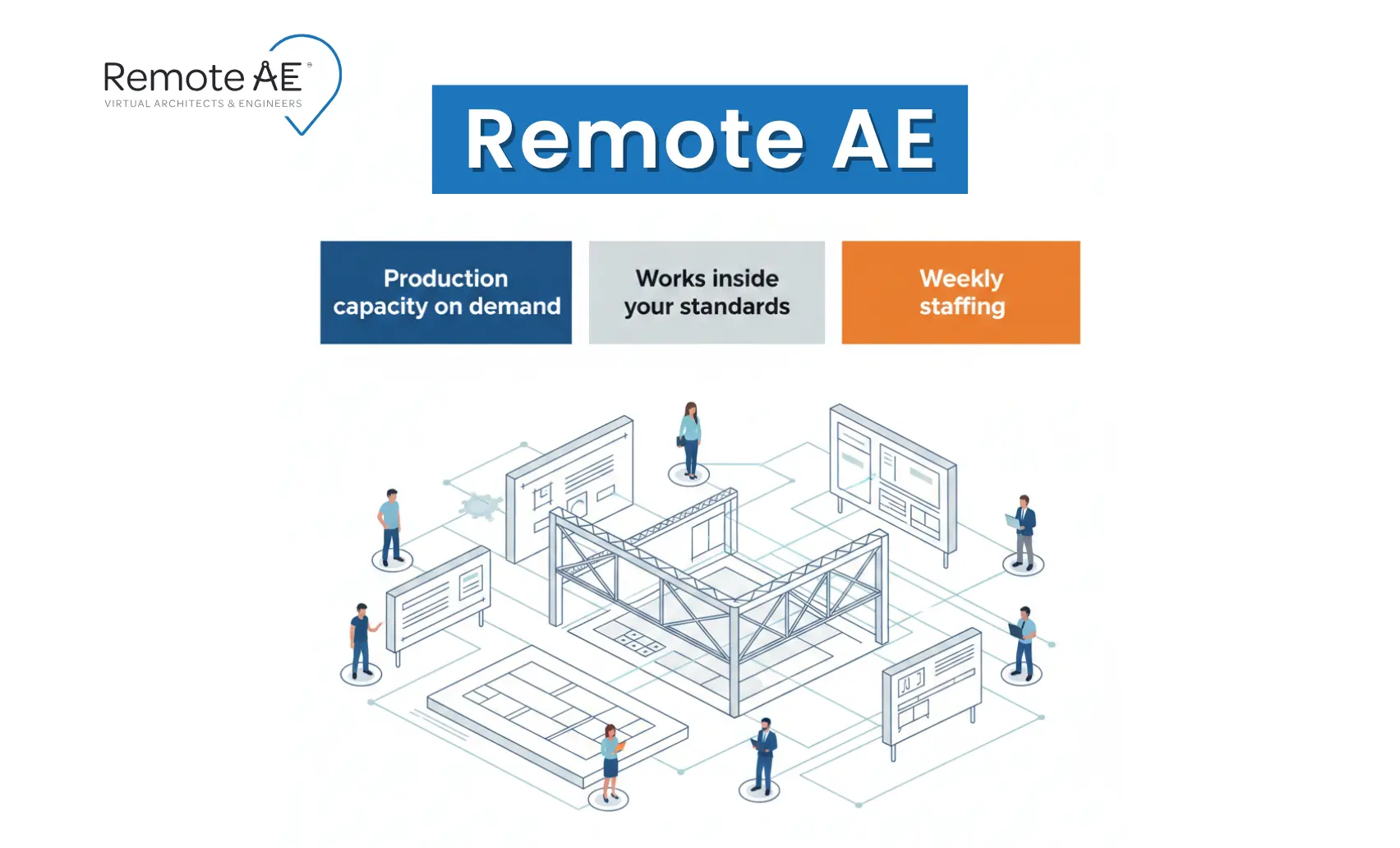
Data center delivery does not fit a fixed headcount. Work surges around vendor updates, permit deadlines, and construction issue dates. Remote AE uses weekly staffing, so capacity rises when scope expands and contracts when packages close. There are no long contracts and no hidden fees. You scale anytime.
QA/QC That Prevents “Outsourcing Rework”
Quality concerns are valid. Outsourcing fails when standards aren’t enforced, and outputs aren’t auditable. Remote AE addresses that risk with clear controls.
Why Outsourcing Fails (and How to Avoid It)
Most failures come from vague scopes, missing standards, and unclear ownership. When drafts do not follow internal rules, senior staff spend nights cleaning up files. That is not a staffing problem. It is a process gap.
Remote AE QA Approach (Practical)
Each task starts with a “definition of done” checklist. Sheets move only after meeting your standards. Your internal checker stays light because drafts already align with expectations.
Model Safety: Versioning and Access Control
Remote AE enforces least-privilege access, issues logs, and clears revision ownership. Files never drift without accountability.
Add Data Center MEP Drafting Capacity in 2 Weeks!
Drafting bottlenecks should not slow mission-critical programs. Remote AE provides dedicated data center MEP drafting services that scale with your workload. From full data center electrical drafting services to reliable data center mechanical drafting services and accurate data center plumbing drafting services, our remote teams absorb production pressure while you keep control of scope and quality. Combined with structured data center MEP coordination services, your sheets stay current across every revision cycle.
Schedule a call for a fast scope and weekly quote.
FAQs – Data Center MEP Drafting Services
Can I add remote MEP drafting capacity in 2 weeks for a data center project?
Yes. A practical plan is: days 1–3 finalize scope, NDAs, and access; days 4–7 share templates, naming rules, and sample sheets; week 2 run pilot redlines and QA checks. By the end of week two, most teams can deliver real Revit or AutoCAD production.
What should I outsource vs keep in-house on mission-critical MEP?
Outsource production tasks like Revit modeling, sheet setup, equipment families, clash prep, and as-built updates. Keep system design, redundancy strategy, load calculations, and client-facing decisions in-house.
How do you manage redlines and overnight updates with remote drafters?
Use an end-of-day markup cycle. Your team uploads redlines before the close of business, the remote drafter updates models overnight, and you review first thing in the morning. A short change log with screenshots prevents missed items and avoids long email threads.
What software should a data center MEP drafter know (Revit, AutoCAD, Navisworks, ACC)?
They should be fluent in Revit MEP for modeling, AutoCAD for legacy details, Navisworks for clash checks, and Autodesk Construction Cloud (ACC/BIM 360) for file control. Experience with large linked models and heavy equipment families is critical in data center work.
How do you protect sensitive data center drawings and equipment schedules?
Protect them with NDAs, role-based ACC permissions, MFA, VPN access, and no local downloads. Keep all work inside your CDE with audit logs enabled. Share only project-specific folders, and remove access as soon as a scope or phase is complete.