

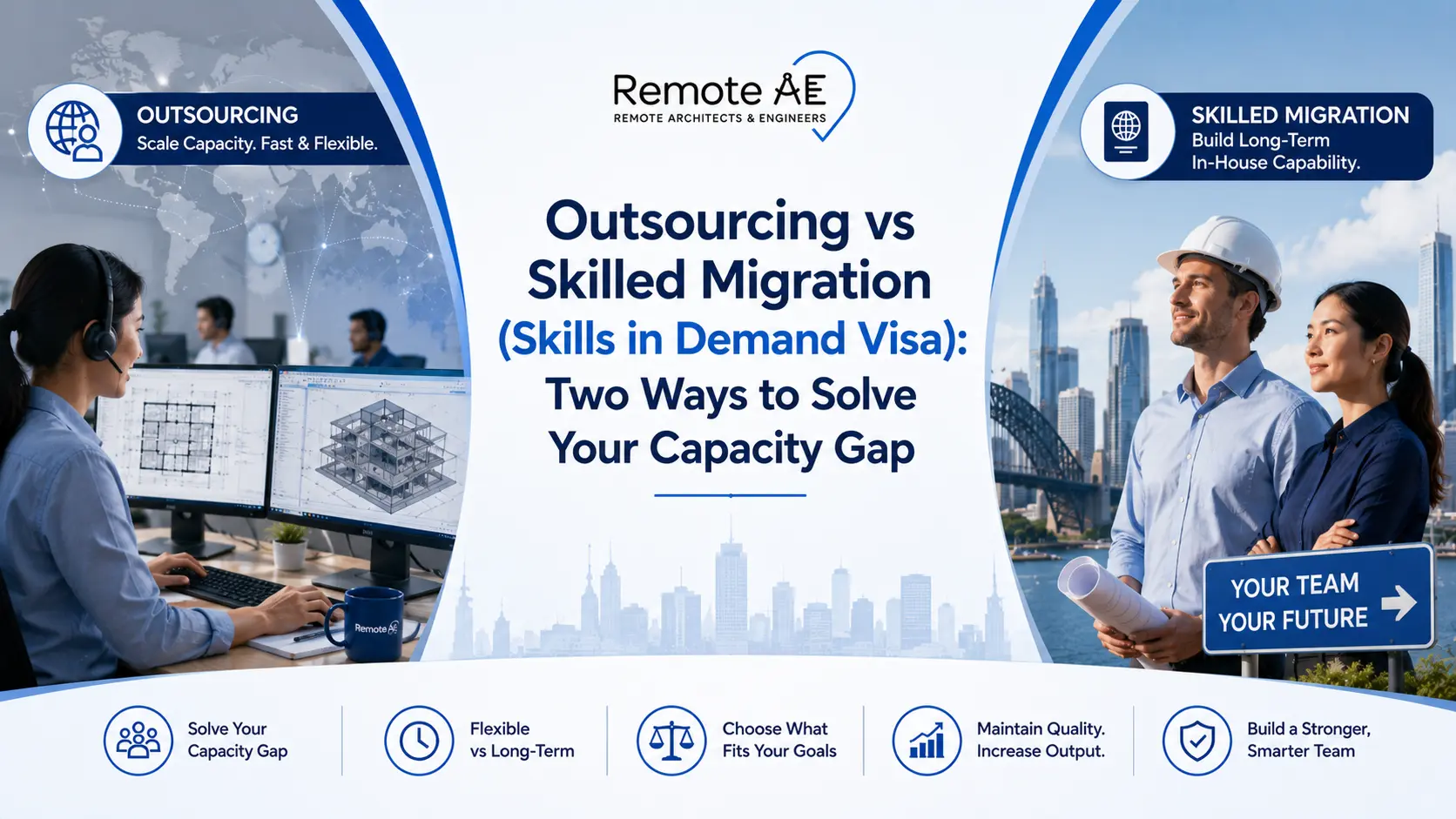
Australian AEC firms facing a drafter shortage have two offshore pathways: sponsor an overseas worker through the Skills in Demand (SID) visa, or engage a dedicated remote drafter through offshore AEC staffing. The numbers and timelines are very different.
A sponsored drafter costs AUD $118,365–$125,365 in Year 1 and takes up to 14 months to reach productive employment. A dedicated remote drafter through Remote AE costs AUD $44,587 in Year 1 and is typically productive within 2–3 weeks. Both paths are legitimate. This guide presents both honestly, including when sponsorship makes more sense, so you can make the right call for your firm’s actual situation.
Key Takeaways
- Sponsoring a draftsperson in Australia costs AUD $118,365 to $125,365 in Year 1, against AUD $44,587 for a remote drafter.
- A sponsored drafter takes roughly 14 months to become productive, while a remote drafter produces within two to three weeks.
- The Skills in Demand visa forces a salary floor of AUD $76,515, above the AUD $71,000 draftsperson market average.
- The Skills in Demand visa replaced the TSS subclass 482 on 7 December 2024 and locks sponsors into a four-year commitment.
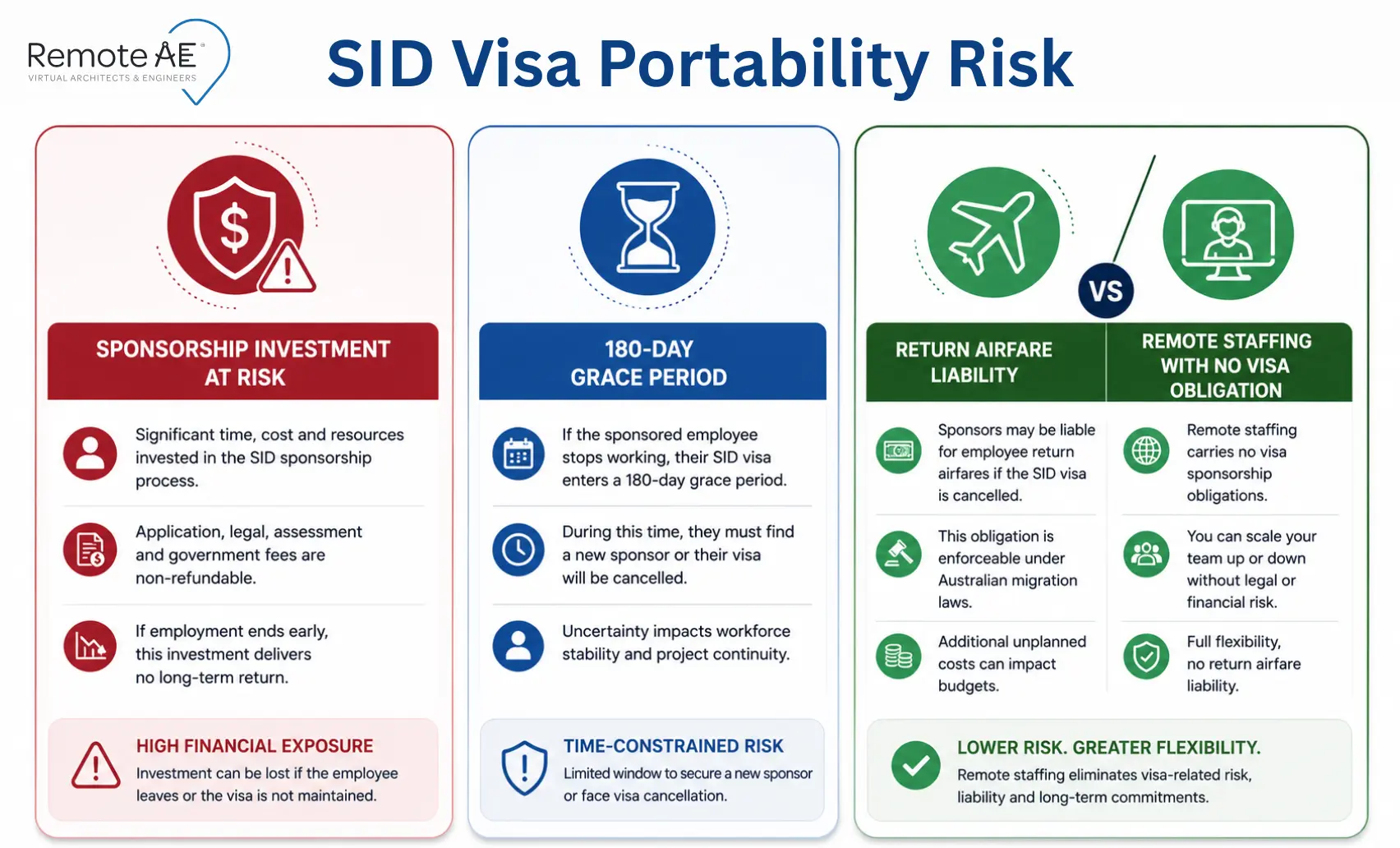
- Sponsored workers get an 180-day grace period to change employers, putting the sponsoring firm’s investment at risk.
- Visa sponsorship suits roles needing physical presence in Australia or long-term PR headcount via subclass 186 after two years.
What the Skills in Demand Visa Actually Involves for an AEC Employer
What the SID Visa Is, and What Changed in December 2024
The Skills in Demand (SID) visa formally replaced the Temporary Skill Shortage (TSS) subclass 482 visa from 7 December 2024. All applications lodged after that date are assessed under the new SID framework (Department of Home Affairs; Fragomen, December 2024).
The SID visa operates across three streams:
- Core Skills, for occupations on the Core Skills Occupation List (CSOL), earning between the CSIT minimum and AUD $141,210. This is the applicable stream for AEC drafters.
- Specialist Skills, for high earners above AUD $141,210, no occupation list required
- Essential Skills, aged care, and disability sectors; not relevant to AEC
Architectural Draftsperson (ANZSCO 312111) sits on the CSOL at entry 298, confirmed eligible for the Core Skills stream (Jobs and Skills Australia, 2025 OSL). The visa grants up to four years, with a clear PR pathway available after two years with any approved employer.
The CSIT Problem: You Must Pay a Sponsored Drafter Above Market Rate
The Core Skills Income Threshold (CSIT), previously referred to as the TSMIT (Temporary Skilled Migration Income Threshold), sets the minimum salary floor for all Core Skills nominations. Under the SID framework:
- AUD $76,515 for nominations lodged before 30 June 2026
- AUD $79,499 for nominations lodged from 1 July 2026 onward
The current average draftsperson salary in Australia sits at AUD $71,000 (Glassdoor AU, June 2026). That means sponsoring an overseas drafter under the Core Skills stream requires paying AUD $5,515–$8,499 above the current market average, before superannuation, on-costs, or any sponsorship fees are added. Most firms don’t see this number until they’re already in the process.
The Timeline: From Decision to Productive Employee
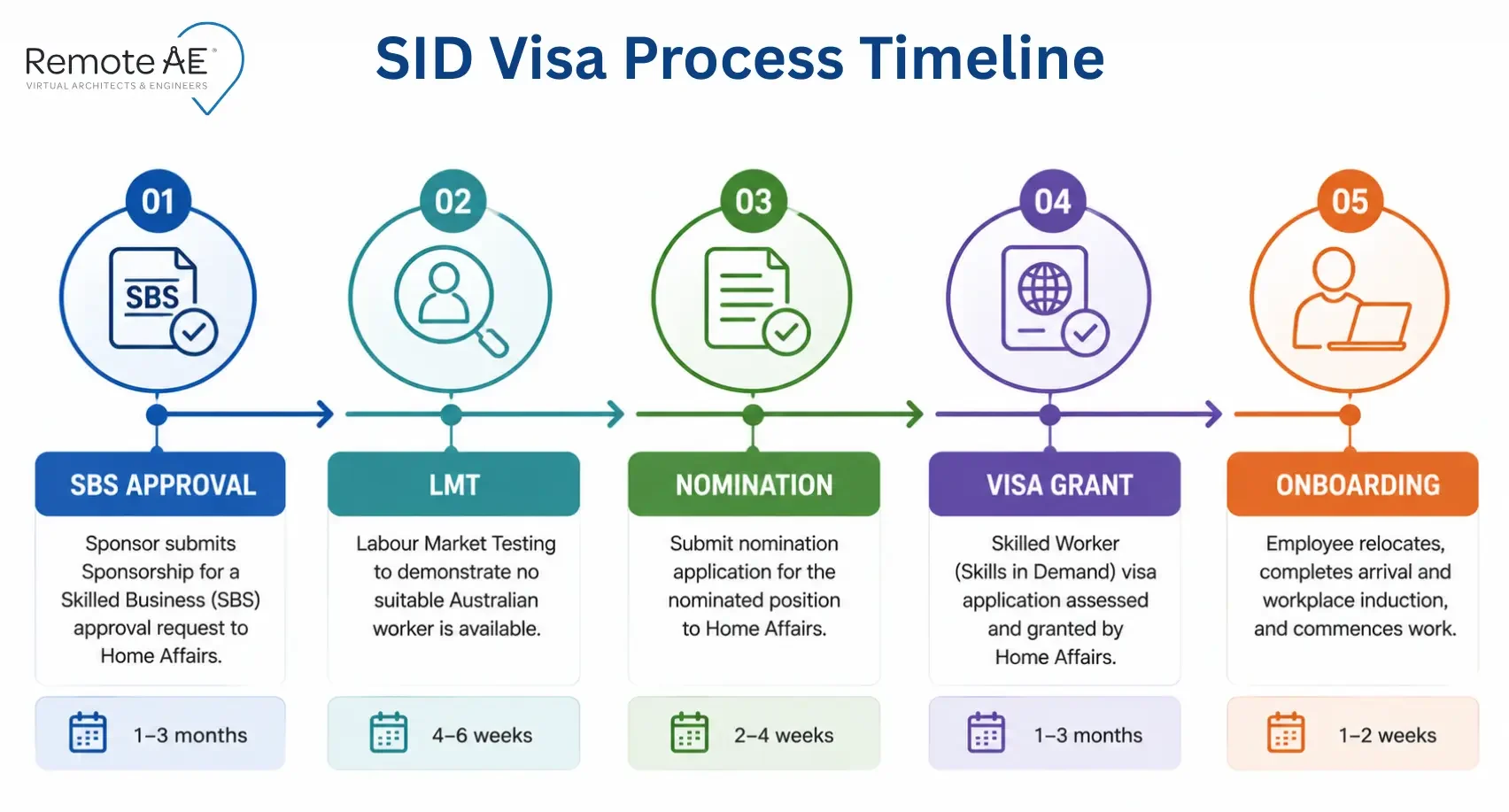
The timeline from deciding to sponsor to having a drafter at their desk involves four sequential steps, each with its own processing window:
- Become an approved Standard Business Sponsor (SBS), required before any nomination; first-time sponsors start from zero
- Labour market testing (LMT) must advertise the position for at least four weeks and demonstrate that no suitable Australian candidate was available (RosterElf, 2025)
- Lodge nomination: the employer nominates the specific position
- Visa grant: 50% of Core Skills stream applications are processed in four months; 90% in seven months (Work Visa Lawyers, January 2026)
The realistic timeline from first decision to productive employee, for a firm starting as a first-time Standard Business Sponsor: approximately 14 months (Fenro Migration, 2026). Firms already holding SBS approval compress that window, but first-time sponsors carry the full timeline.
The Total Employer Cost, Fees, Levy, and Loaded Salary
Before a sponsored drafter produces a single drawing, the AEC firm carries these mandatory costs:
| Cost Item | Amount (AUD) |
| Standard Business Sponsorship (SBS) fee | $420 |
| Nomination fee | $330 |
| Skilling Australians Fund (SAF) levy (4 years, small business) | $4,800 |
| Visa application charge (if employer-funded) | $3,210 |
| Migration agent fees | $3,000–$6,000 |
| VETASSESS skills assessment | ~$600 |
| Ancillary costs (health checks, police clearances, translations) | ~$1,000–$3,000 |
| Total direct sponsorship fees | $17,365–$24,365 |
Adding the loaded annual employment cost at the CSIT salary floor, base $76,515, plus superannuation at 12%, workers’ compensation, payroll tax, and leave entitlements, brings the Year 1 all-in total to AUD $118,365–$125,365.
Ongoing obligations don’t end at visa grant. The sponsoring firm must maintain records for five years, notify Home Affairs of material changes, and, if the visa is cancelled or the worker leaves, may be liable for the sponsored worker’s return airfare costs (Department of Home Affairs, sponsorship obligations).
What Outsourcing Your AEC Drafting Involves
The Model: A Dedicated Remote Drafter, Not a Freelancer or a Team
When you engage a remote drafter through Remote AE, you get one named person working exclusively for your firm full-time. They work on your tools, to your drawing standards, inside your Revit or AutoCAD environment, not a rotating pool of operators or a shared offshore team.
No sponsorship, no visa, no right-to-work concerns. Offshore staff work from their own country under their own jurisdiction’s employment arrangements. Australian work rights, Fair Work obligations, and visa compliance don’t apply to the engagement. No labour market testing, no SAF levy, no migration agent, no return airfare liability.
The Timeline: From Decision to Productive Drafter
Remote AE manages the full recruitment, vetting, and onboarding process on your behalf. The vetting standard is a minimum of five years of AEC experience with confirmed project history in architectural, structural, civil, or MEP documentation.
Most firms have a dedicated drafter placed and producing work within two to three weeks, before the current project crunch has passed. The one-time recruitment and operations fee of AUD $7,199 covers the entire process, including candidate sourcing, AEC-specific assessment, and managed onboarding.
The Total Cost: What You Actually Pay
- AUD $719/week, weekly fee for a dedicated remote drafter working exclusively for your firm
- AUD $7,199 one-time recruitment and operations fee
| Period | Cost (AUD) |
| Weekly fee (AUD $719 × 52 weeks) | $37,388 |
| One-time recruitment + ops fee | $7,199 |
| Year 1 all-in | $44,587 |
| Year 2+ ongoing | $37,388/year |
No superannuation obligation. No payroll tax. No workers’ compensation premium. No leave entitlements. No equipment or software licence costs. No redundancy exposure. No return airfare liability.
Side by Side: The Numbers That Drive the Decision
| Skills in Demand Visa (Core Skills) | Remote AE Outsourcing | |
| Time to productive | ~14 months (Fenro Migration, 2026) | 2–3 weeks |
| Year 1 all-in cost | AUD $118,365–$125,365 | AUD $44,587 |
| Year 2+ cost | AUD $93,780+ (loaded salary only) | AUD $37,388 |
| Minimum salary floor | AUD $76,515 (CSIT, FY2025–26) | No floor, AUD $719/week |
| Flexibility | 4-year commitment, CSIT rises annually | Scale up or down, no lock-in |
| Portability risk | A worker can change employers (180-day grace period) | No visa obligation at risk |
| Return airfare liability | Yes, if the visa is cancelled or the worker leaves | No |
| Superannuation obligation | Yes, 12% of OTE | No |
| Payroll tax | Yes, where the threshold is exceeded | No |
Time to Productive: 14 Months vs 2–3 Weeks
What does a 14-month vacancy actually cost a firm? Projects delayed. Principals absorbing production work. Senior staff pulled off billable hours to cover documentation. At AUD $130–$150/hr in standard Australian architectural billing rates, a principal doing drafting work for even 10 hours a week represents AUD $67,600–$78,000 in lost billable capacity over 14 months.
A remote drafter placed and productive within two to three weeks means your next CD package, DA set, or BIM coordination task gets done before the deadline, not after the visa clears.
Year 1 Cost: AUD $118,365–$125,365 vs AUD $44,587
The Year 1 gap between the two models is AUD $73,778–$80,778. That difference funds:
- A second remote drafter for most of the year, at AUD $719/week; $73,778 covers approximately 102 weeks of a second dedicated placement
- Recovered principal billing time, 450–520 hours at standard architectural billing rates
- Software upgrades, BIM 360 licence seats, and project management tools for the year
Flexibility vs Commitment
The SID visa locks the sponsoring firm into a four-year arrangement. The CSIT rises annually; nominations lodged from 1 July 2026 carry a minimum of AUD $79,499, and that floor will increase again in subsequent years.
Return airfare obligations apply if the visa is cancelled. Home Affairs notification requirements run for the full sponsorship period.
Remote AE’s model carries no lock-in. Scale up drafting capacity for a project surge. Ease back when the pipeline settles. No redundancy process, no notice period obligations, no salary floor that rises regardless of what the market bears.
The CSIT Trap: Paying Above Market to Sponsor Below-Market Candidates
A firm paying AUD $76,515–$79,499 to meet the CSIT is paying above what the current Australian market average for a draftsperson actually is (AUD $71,000, Glassdoor AU, June 2026). That above-market floor applies regardless of the candidate’s experience level or the firm’s financial position; it’s a structural cost of the sponsorship model that doesn’t flex.
Remote AE carries no salary floor, no minimum threshold, and no above-market obligation. The AUD $719/week fee is the fee, regardless of which jurisdiction’s CSIT rises next July.
The Portability Risk: What Happens If Your Sponsored Drafter Leaves?
Under the SID visa rules introduced in December 2024, sponsored workers gained significantly increased portability compared to the old TSS 482 framework. A sponsored worker whose employment is terminated, for any reason, has a 180-day grace period to find a new employer sponsor before their visa is affected (Department of Home Affairs, SID visa conditions).
That flexibility serves the worker. For the firm that funded the sponsorship, it creates a material financial and operational risk.
Consider the position of a small AEC firm that has spent AUD $17,000–$24,000 in sponsorship fees, waited 14 months, onboarded a drafter, invested time in training and integration, and then watched that drafter move to a tier-one contractor offering better career progression 18 months into the arrangement. The visa obligation transfers cleanly to the new employer. The sponsorship investment does not.
Under the New SID Visa, Sponsored Workers Can Change Employers With Reduced Friction
The 180-day grace period and streamlined employer-change process under the SID visa are a deliberate policy improvement for workers; they reduce the dependency that characterised the old TSS system.
For small AEC firms, the practical implication is that a sponsored drafter is a flight risk in a way that didn’t exist before December 2024. Larger firms with clearer career pathways, higher salaries, and established brand recognition can absorb that risk. A five-person studio cannot.
The Return Airfare Obligation
If a sponsored worker’s visa is cancelled, or if the employer terminates the sponsorship arrangement, the sponsoring firm may be liable for the worker’s return airfare to their home country (Department of Home Affairs, sponsorship obligations).
This is a legacy obligation that catches first-time sponsors by surprise. It doesn’t apply in every scenario, but it’s a real cost exposure that should be factored into the total risk calculation before committing to the sponsorship path.
How This Risk Compares to Remote Staffing
Remote AE’s model carries none of these exposure points. There is no sponsorship investment at risk if the engagement ends. No visa obligation to manage or transfer. No return airfare liability.
No 180-day grace period to navigate. If the placement isn’t working, for any reason, Remote AE’s risk-free replacement guarantee covers up to two replacements at no additional cost. The firm’s capital stays in the firm.
When Visa Sponsorship Is the Right Answer
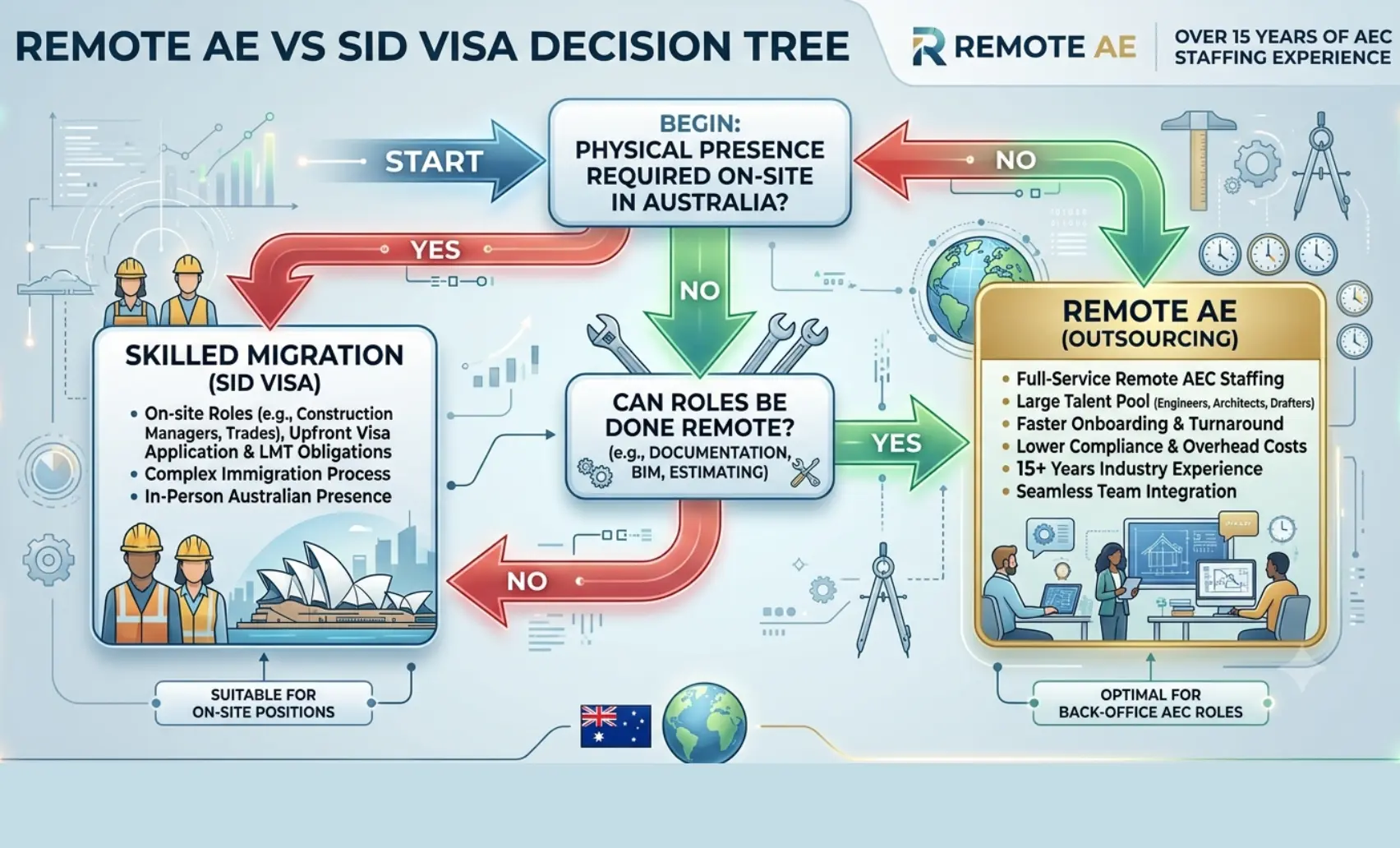
Sponsorship is the right call in three specific scenarios:
- When the Role Requires Physical Presence in Australia: Site visits, in-person client liaison, licensed trade work, and authority meetings can’t be delivered remotely. If the function genuinely requires someone physically in Australia, the SID visa Core Skills stream is the only path. Outsourcing is not a substitute for a role with a physical presence requirement
- When You Want to Build Long-Term Permanent Headcount: Core Skills holders can apply for permanent residency via the subclass 186 visa after two years with any approved employer. If the goal is to convert an overseas hire into a permanent Australian team member over four years, sponsorship serves that purpose. This is a long-term workforce investment, not a capacity gap solution
- When the Firm Already Has Standard Business Sponsor Approval: Pre-approved sponsors skip the SBS stage entirely, and the 14-month clock shortens materially. LMT, nomination, and visa processing move faster without the SBS approval queue. For firms already in the sponsorship system, the timeline objection weakens significantly.
When Remote AEC Staffing Is the Right Answer
Remote AEC staffing wins in four clear scenarios:
- When You Need Capacity in Weeks, Not Months: CD package due in six weeks, DA set in three, or a Revit model needing coordination support by Monday. The 14-month sponsorship timeline cannot solve the current project problem. Remote AE places a vetted drafter in your workflow within two to three weeks.
- When the Role Is Documentation, BIM, Estimating, or Coordination: Floor plans, Revit models, hydraulic documentation, structural details, quantity take-offs, RFI logs, all run on software, not physical presence. These are exactly the functions remote AEC staffing is built to support. Compliance becomes a vetting and briefing question, not a location question.
- When the Project Pipeline Fluctuates and You Need Flexibility to Scale: DA submission crunches, CD deadlines, and tender windows create temporary production peaks. A sponsored visa worker is a fixed cost across every peak and valley. A remote drafter through Remote AE scales with the pipeline, no redundancy liability, no lock-in.
How Remote AE Solves the Capacity Gap Without the Visa Process
Remote AE places dedicated AEC professionals across the roles Australian firms most need remote support for:
- Architectural draftspersons, DA packages, CD sets, as-built updates, drawing issue management
- Structural and civil drafters, from engineer mark-ups to coordinated Revit packages
- Revit and BIM technicians, design development, modelling, sheet production, clash coordination, family creation
- Estimators and quantity take-off specialists, elemental cost plans, measured quantities, and tender packages
- Project coordinators, RFI logs, submittal tracking, drawing registers, and construction documentation
Every placement is AEC-specific. Not a general virtual assistant platform with an AEC category, AEC only, every role, every time.
Dedicated Model: One Drafter, Your Tools, Your Standards
Your remote drafter works exclusively for your firm on your tools:
- Your Revit model, your AutoCAD templates, your BIM 360 or Autodesk Construction Cloud environment
- Your drawing standards, NCC documentation conventions, and file naming rules
- Your AEST-aligned working hours, real-time collaboration during your core business day
- Daily handover notes as standard; your PM always knows what was completed and what’s queued
No rotating roster. No generic offshore team. One named person is building institutional knowledge of your firm across every project they work on.
15+ Years Placing AEC Professionals for Australian Firms
Remote AE has spent more than 15 years building a vetting process and talent pool focused exclusively on architecture, engineering, and construction. That specialisation means faster onboarding, less hand-holding, and output that matches your production standard from week one, not week twelve.
- Guaranteed quality and reliability, output reviewed against your standards
- No long-term commitment, scale up or down with your project pipeline
- No upfront costs, no placement fees to engage
- Risk-free replacement, up to two staff replacements if the fit isn’t right
- AEST-aligned hours, real-time collaboration during your business day, not overnight file drops
Fill Your Drafting Gap in Weeks, Not Months!
The Skills in Demand visa is the right tool for roles that require physical presence in Australia, or for firms building long-term permanent headcount over a four-year horizon. For everything else, documentation, BIM, estimating, coordination, and any role where the work runs on software rather than physical presence- remote AEC outsourcing through Remote AE delivers a vetted, productive drafter in two to three weeks at AUD $44,587 in Year 1, without the visa process, the salary floor, the portability risk, or the return airfare liability.
The capacity gap is costing your firm billable hours, project delivery speed, and principal time every week it stays open. The SID visa cannot be closed in time. Remote AE can.
Talk to Remote AE about filling your drafting gap in weeks, not months. Book a free consultation and get matched with a dedicated AEC professional within two weeks.
FAQs: Outsourcing vs Skilled Migration
What is the Skills in Demand visa, and how does it apply to AEC firms?
The Skills in Demand (SID) visa replaced the Temporary Skill Shortage (TSS) subclass 482 visa from 7 December 2024, operating across three streams, Core Skills, Specialist Skills, and Essential Skills (Department of Home Affairs; Fragomen, December 2024). For AEC firms hiring draftspersons, the Core Skills stream is the applicable pathway, as Architectural Draftsperson (ANZSCO 312111) sits on the Core Skills Occupation List at entry 298 (Jobs and Skills Australia, 2025 OSL).
Can I sponsor a draftsperson on a Skills in Demand visa in Australia?
Yes, Architectural Draftsperson (ANZSCO 312111) is listed on the Core Skills Occupation List (CSOL), making it eligible for employer sponsorship under the SID visa Core Skills stream (Jobs and Skills Australia, 2025 OSL). The sponsoring firm must be an approved Standard Business Sponsor, complete four weeks of labour market testing, and pay the sponsored drafter at least AUD $76,515, the Core Skills Income Threshold for nominations lodged before 30 June 2026.
How long does it take to sponsor an overseas drafter in Australia?
The realistic timeline from deciding to sponsor to having a drafter at their desk, including SBS approval, four weeks of labour market testing, nomination, and visa grant, is approximately 14 months for a first-time sponsor (Fenro Migration, 2026). Once placed, 50% of Core Skills stream visa applications are processed in four months and 90% in seven months, but first-time sponsors must complete the SBS approval stage before the visa processing clock even starts (Work Visa Lawyers, January 2026).
Is it cheaper to outsource drafting or sponsor a skilled migrant in Australia?
Outsourcing is significantly cheaper. Remote AE’s dedicated remote drafter model costs AUD $44,587 in Year 1, compared to AUD $118,365–$125,365 for a sponsored drafter in Year 1, once the CSIT salary floor, superannuation at 12%, payroll tax, leave entitlements, and direct sponsorship fees of AUD $17,365–$24,365 are included. The Year 1 saving of AUD $73,778–$80,778 is structural; it exists because Australian statutory employment obligations and sponsorship costs don’t attach to an offshore engagement.
How quickly can a remote AEC drafter be placed compared to a sponsored migrant?
Remote AE places a dedicated, AEC-vetted remote drafter and has them productive within two to three weeks, covering recruitment, vetting to a minimum of five years of AEC experience, and managed onboarding within the one-time AUD $7,199 recruitment and operations fee. A sponsored migrant through the Skills in Demand visa Core Skills stream takes approximately 14 months from first decision to productive employee for a first-time sponsor, meaning the current project deadline will have passed long before the sponsored drafter arrives (Fenro Migration, 2026).