

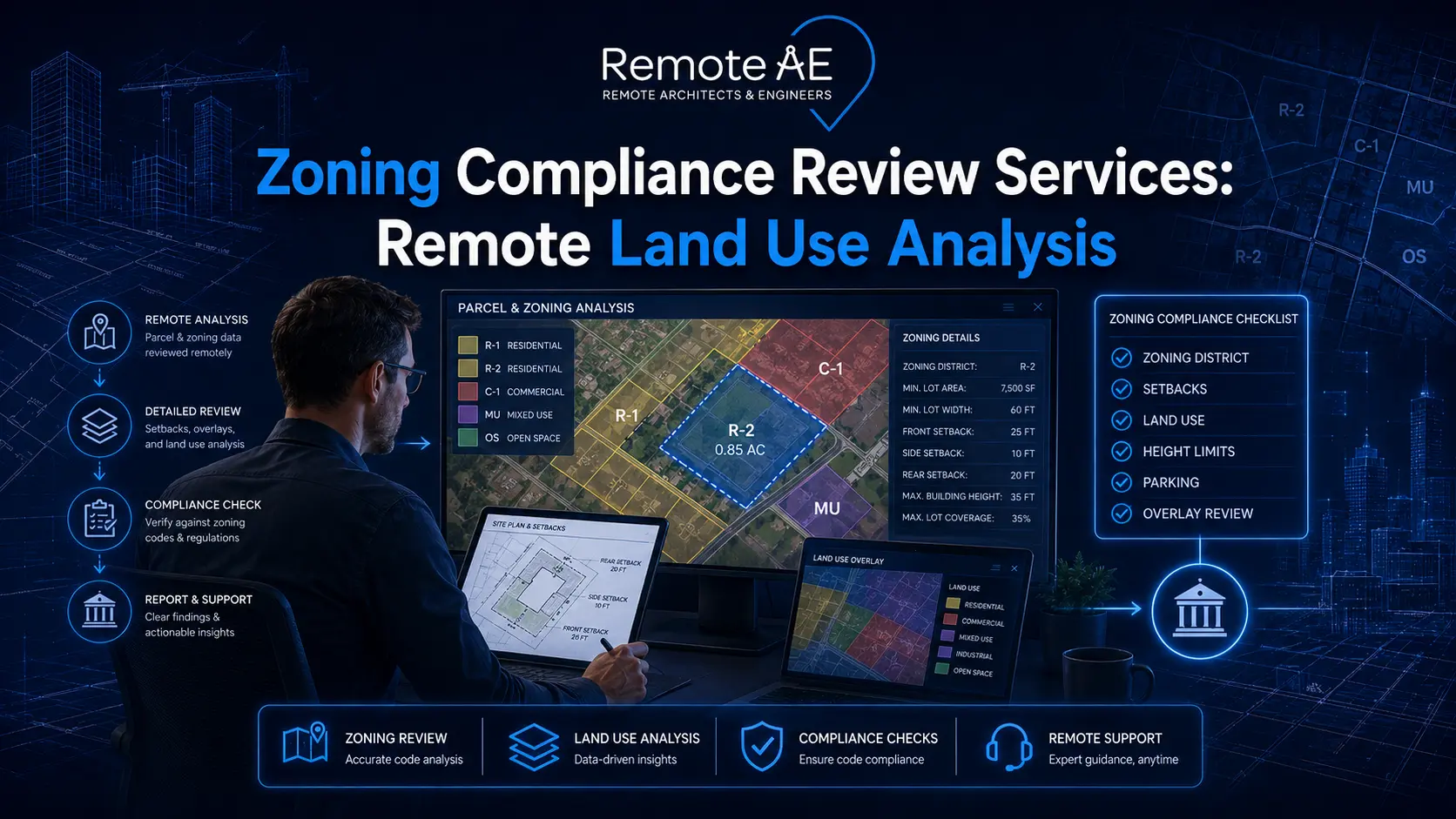
Zoning errors caught after design begins cost far more than zoning research conducted before the first sketch is drawn. For AEC firms managing multiple active projects, conducting thorough land use analysis on every site is not realistic without dedicated support. Remote zoning compliance review services change that, giving architects, engineers, and developers structured, verified zoning research before design decisions are made or purchase commitments are signed.
What Is a Zoning Compliance Review?
A zoning compliance review is a structured analysis of how a specific property relates to the local zoning ordinance, confirming what uses are permitted, what development standards apply, and what regulatory triggers exist before design or entitlement work begins.
A zoning compliance review answers one core question: Can this site accommodate the proposed project under current land use regulations? It pulls from the zoning ordinance, zoning district maps, GIS parcel data, and municipal code to produce a verified picture of what the site allows, and what it does not.
Zoning Review vs Building Code Review
These two reviews are frequently conflated, and confusing them causes project teams to advance designs that pass building code but fail zoning, or vice versa.
- Zoning compliance review: Governs land use, what can be built on the site, how large, how close to property lines, how many parking spaces, and under what conditions
- Building code review: Governs construction, how the building is built, what materials and systems it uses, and how it meets fire, structural, and accessibility requirements
Both reviews are required. They draw from different regulatory sources and answer different questions. A building permit application that passes building code review will still be rejected if the proposed use violates the zoning ordinance.
Core Purpose of Zoning Reviews
Zoning compliance review serves three operational purposes for AEC teams:
- Ensuring projects follow local land-use laws: Confirming the proposed use, density, and building dimensions comply with the zoning district before design investment is made
- Avoiding legal issues, fines, or redesigns: Identifying prohibited uses, nonconforming conditions, or overlay district requirements that would trigger a variance, conditional use permit, or full rezoning process
- Aligning project scope with zoning codes: Giving the design team verified setback, building height, floor area ratio, lot coverage, and parking requirement data before massing and site planning begins
Key elements checked in a zoning review:
- Land use classification: residential, commercial, industrial, or mixed-use
- Setbacks, height limits, and floor area ratio
- Parking requirements and driveway access rules
- Environmental overlays and special district requirements
Why Remote Land Use Analysis Matters Before Design or Purchase
It Catches Site Problems Early
The cheapest time to discover a zoning problem is before the architect starts drawing. The most expensive time is after a building permit application is rejected, or after a purchase closes on a site that cannot accommodate the intended use.
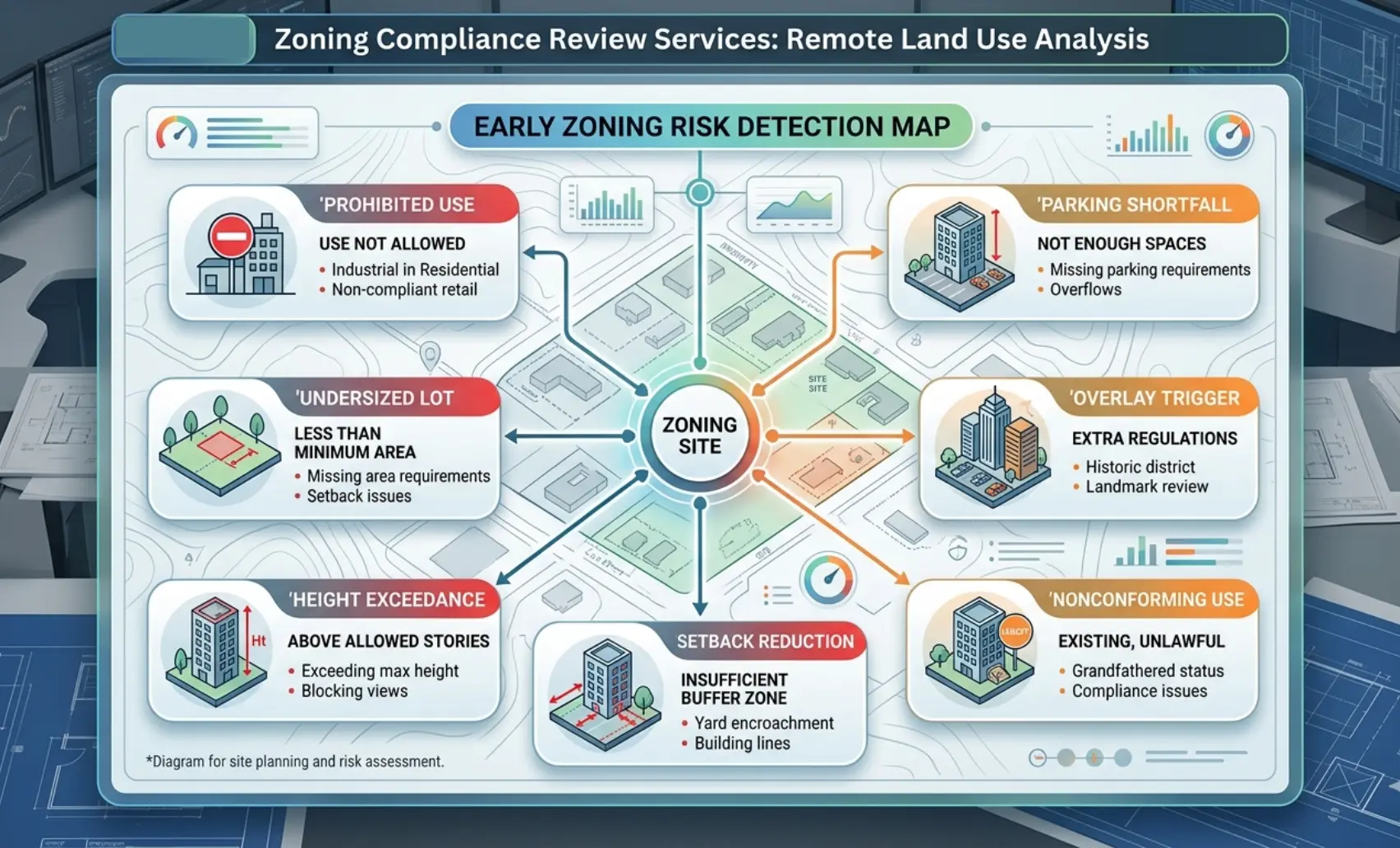
Common site problems that remote land use analysis catches early:
- Use not permitted: The proposed use, medical office, drive-through restaurant, and data center are not listed as permitted uses in the zoning district and require a conditional use permit or variance
- Lot too small: Minimum lot area requirements disqualify the parcel for the proposed building program
- Building exceeds height limits: The intended number of stories violates the zoning district’s maximum building height
- Setbacks reduce buildable area: Front, side, and rear setback requirements shrink the buildable envelope below the program requirements
- Parking minimums are not met: Required parking ratio for the proposed use exceeds what the site can physically accommodate
- Overlay district adds extra review: A historic district, coastal zone, or airport approach overlay triggers additional agency review not anticipated in the project schedule
- Existing use is legal nonconforming: The current use was established before the zoning ordinance changed; expanding or rebuilding may eliminate grandfathered status
It Reduces Senior Staff Bottlenecks
Zoning research is time-consuming, pulling ordinances, navigating GIS viewers, cross-referencing use tables, and documenting findings can consume three to six hours per site. That work does not require a licensed architect or engineer. It requires trained research discipline and AEC workflow knowledge.
Remote assistants handle the full data collection layer:
- Pulling zoning ordinances and municipal code sections from official city and county portals
- Finding and screenshotting zoning maps and GIS parcel viewer data
- Gathering parcel records, APN, lot dimensions, recorded conditions, and prior approvals
- Checking the use tables against the proposed program
- Saving planning department contacts and fee schedules
Senior architects and engineers review structured findings, not raw data, which is where their expertise actually belongs.
It Helps Teams Decide Earlier
Example: A developer wants to convert a vacant retail shell into a medical office. Before the architect begins concept design, a remote assistant checks the zoning district’s use table, confirming whether a medical office is a permitted use, a conditional use, or prohibited.
The assistant also pulls the parking ratio for medical office versus retail, checks signage limits, and identifies whether a change-of-use triggers a full site plan review.
The lead architect receives a structured summary before the first design meeting. The developer makes a go/no-go decision on the entitlement path before committing to design fees. Three days of remote research prevent three months of redesign.
What a Remote Zoning Compliance Review Should Include
A zoning compliance review is only as useful as its completeness. Missing one overlay district or misreading a nonconforming condition can invalidate the entire analysis. Here is what every thorough remote zoning review must cover.
Property and Jurisdiction Confirmation
Every review starts with confirmed property identity, not an assumed address.
- Parcel address and legal description
- APN (Assessor’s Parcel Number) or tax parcel ID
- City, county, or unincorporated jurisdiction, and which zoning authority has jurisdiction
- Current zoning district designation
- Future land-use designation from the general plan or comprehensive plan
- Relevant planning department contacts, zoning counter, plan review staff, and public works
Jurisdiction confirmation matters because city and county zoning rules frequently differ for parcels near municipal boundaries, and unincorporated areas fall under county authority, not city authority, even when they carry a city mailing address.
Zoning District and Permitted Use Check
This is the most consequential finding in any zoning compliance review. Cornell Legal Information Institute notes that if a use is not outlined in a zoning ordinance, it is generally not permitted without a variance, making use table analysis the first and most critical step.
Document the use findings in this structure:
- Existing use on the parcel
- Proposed use under the project program
- Permitted by right, allowed without additional approval
- Conditional use, allowed with a conditional use permit from the planning commission
- Special exception, allowed with administrative approval under defined criteria
- Prohibited use, not allowed in the zoning district under any approval path
- Variance or rezoning trigger, when the proposed use or development standard requires a formal exception process
Dimensional Standards Review
Dimensional standards define the physical envelope of what can be built. Every standard must be verified against the proposed program before massing begins.
- Minimum lot area and lot width
- Front setback, side setbacks, and rear setback, measured from property line to building wall
- Maximum building height, in feet, stories, or both, depending on the ordinance
- Maximum lot coverage is the percentage of the lot area that structures can occupy
- Floor area ratio (FAR), the ratio of total floor area to lot area, which caps total building density
- Minimum open space or landscaping requirements
- Density limits for residential uses, dwelling units per acre
Parking, Loading, and Access Review
Parking requirements are among the most common feasibility killers on urban and suburban infill sites.
- Required parking ratio, spaces per unit, per square foot, or per seat, depending on use type
- ADA accessible parking count and location requirements
- Loading zone requirements, number of berths, dimensions, and access path
- Bicycle parking requirements are increasingly required in urban jurisdictions
- Driveway and curb-cut limits, number of access points, and minimum spacing from intersections
- Shared parking options, whether the jurisdiction allows parking agreements with adjacent properties, to reduce on-site requirements
Overlay, Environmental, and Special District Checks
Overlay districts layer additional requirements on top of base zoning, and missing one is a common source of late-stage project surprises.
Overlay districts to check for every site:
- Historic preservation district, design review, material approval, and demolition restrictions
- Coastal zone, California Coastal Commission, or equivalent state authority triggers
- Floodplain overlay, FEMA flood zone designation, base flood elevation, freeboard requirements
- Wetland buffer, setback from mapped wetlands or waterways
- Airport approach overlay, height restrictions, noise disclosure, and land-use limitations near airports
- Downtown design district, facade standards, ground-floor use requirements, pedestrian amenity obligations
- Transit-oriented development zone, reduced parking minimums, increased density allowances, and active frontage requirements
Existing Conditions and Nonconforming Status
Nonconforming status is one of the most misunderstood and highest-risk findings in any due diligence review.
- Legal conforming: Current use and structure fully comply with the current zoning ordinance
- Legal nonconforming use: Use was established legally before the current ordinance, protected but restricted from expansion
- Legal nonconforming structure: Building was built legally, but no longer meets current dimensional standards; reconstruction triggers compliance
- Illegal nonconforming: Use or structure was never permitted, carries enforcement and permit risk
- Grandfathered use: Common term for legal nonconforming, confirms the specific protection standard in the applicable ordinance
- Prior variance or site plan approval: Recorded conditions from prior approvals may modify or expand what is permitted on the site
- Recorded conditions: Deed restrictions, development agreements, or prior entitlement conditions that run with the land
Deliverable Format
A remote zoning compliance review should produce a structured, usable deliverable — not a raw data dump.
Recommended deliverable components:
- One-page zoning summary: Plain-language overview of key findings, use status, dimensional compliance, and major risks
- Zoning matrix: Table mapping each code requirement against the site condition and proposed condition with a pass/fail/flag status
- Risk register: Ranked list of identified issues, prohibited use, nonconforming status, overlay triggers, with recommended next steps
- Source link log: Direct URLs to every ordinance section, GIS viewer, and planning department page cited
- Screenshot folder: Captured images of zoning maps, GIS parcel data, use tables, and code sections for reference
- Open questions for the planning department: Specific questions requiring official clarification, use classification ambiguity, overlay applicability, and prior approval status
- Handoff notes for licensed review: Summary of items requiring architect, engineer, attorney, or land use planner judgment before project advancement
What Remote AEC Assistants Can Handle
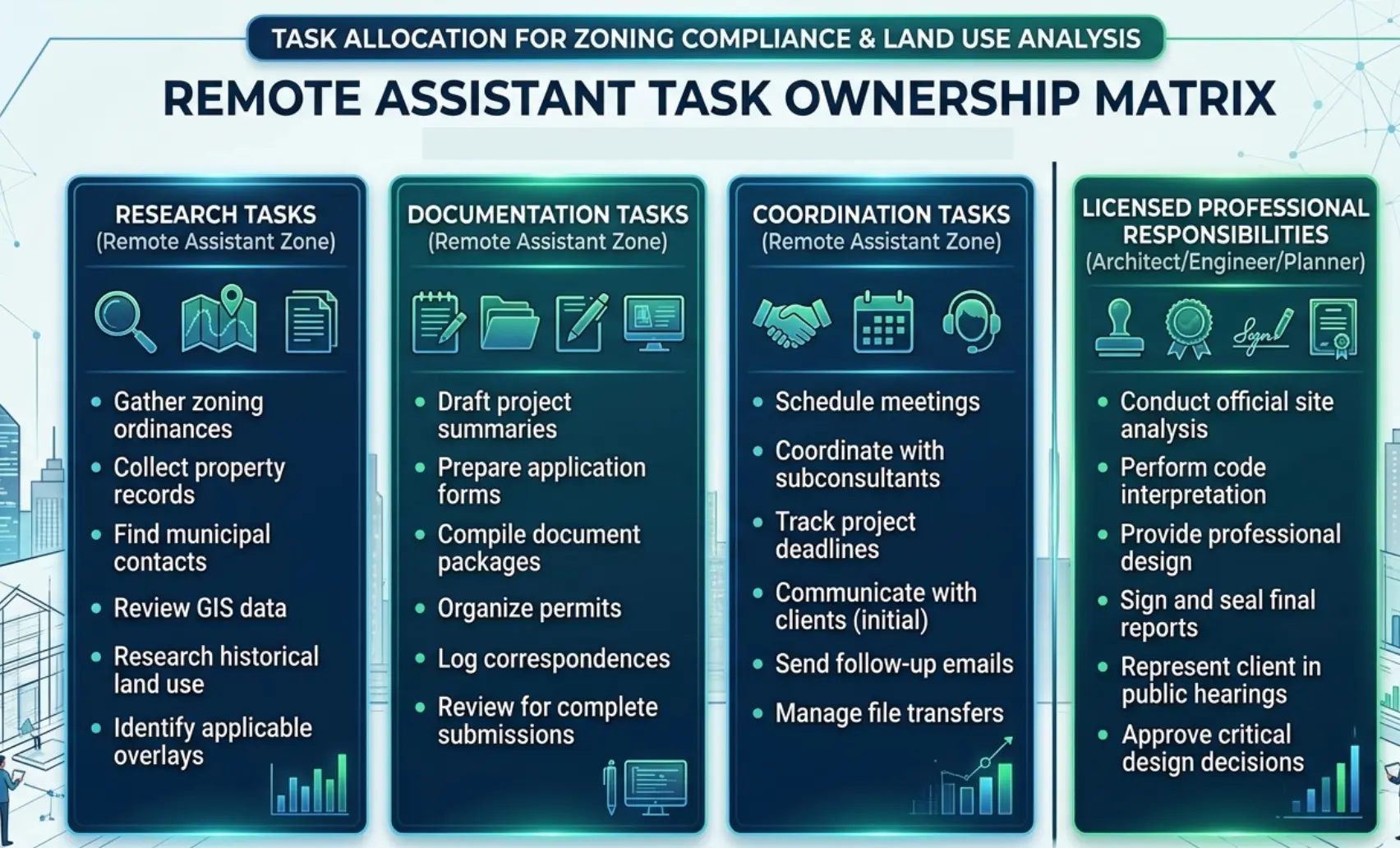
Research Tasks
- Pull zoning ordinances and municipal code sections from official city and county portals
- Find and screenshot zoning maps and GIS parcel viewer data
- Gather parcel records, APN, lot dimensions, ownership, and recorded conditions
- Review the use tables against the proposed program
- Save planning department contacts, fee schedules, and application forms
Documentation Tasks
- Build zoning matrices mapping code requirements against site conditions
- Prepare site-risk summaries with ranked findings and recommended next steps
- Mark up PDFs, annotating zoning maps, using tables, and code sections for architect review
- Compare site data against dimensional standard tables, setbacks, FAR, height, and lot coverage
- Organize exhibits and source documentation for an architect or land use attorney review
Coordination Tasks
- Draft written questions for zoning staff, specific, sourced, and ready to submit
- Track municipal responses, logging dates, staff names, and response content
- Log all source documents with direct URLs for audit and permit review reference
- Prepare handoff notes for permit expediters, land use consultants, or licensed reviewers
What Should Stay With Licensed Professionals
Remote assistants handle research and documentation. These tasks stay with licensed professionals:
- Legal interpretation of ambiguous zoning language
- Final code compliance opinion on the proposed project
- Sealed drawings and stamped documents
- Land use attorney advice on variance or rezoning strategy
- Entitlement strategy and negotiation with planning staff
- Public hearing representation before planning commissions or zoning boards
Remote Land Use Analysis Workflow
Step 1: Intake the Site and Proposed Use
Collect: address, survey, existing building data, proposed use, target program, and project deadline. Confirm all inputs before research begins.
Step 2: Confirm the Jurisdiction
Verify whether the parcel falls under city or county authority. Incorporated vs. unincorporated status determines which zoning ordinance, planning department, and review process applies, a critical distinction near municipal boundaries.
Step 3: Pull the Zoning Rules
Sources to access:
- Zoning ordinance and municipal code
- Official zoning map and GIS parcel viewer
- Planning department website, use tables, overlay maps, and application forms
- Prior approvals and recorded conditions on the parcel
Step 4: Build the Zoning Matrix
Structure every finding in a consistent table:
| Requirement | Code Citation | Site Condition | Proposed Condition | Status | Risk Level | Notes |
| Front setback | §4.2.1 | 15 ft existing | 10 ft proposed | Flag | High | Variance may be required |
| Permitted use | §3.1.4 | Retail | Medical office | Conditional | Medium | CUP required |
| Max height | §4.3.2 | 35 ft limit | 28 ft proposed | Pass | Low | Compliant |
Step 5: Flag Open Questions
Common open questions to surface before handoff:
- Is the proposed use classified as office, clinic, retail, or personal service under the ordinance?
- Does a prior variance on the parcel still apply under current ownership?
- Does the overlay district override base zoning dimensional standards?
- Is required parking calculated on gross floor area or net floor area?
Step 6: Handoff for Review
Deliver the completed zoning matrix, risk register, source log, and open questions to:
- Architect for design advancement decisions
- Engineer for site planning and utility coordination
- Owner for go/no-go on entitlement path
- Attorney or land use planner if a variance, conditional use permit, or rezoning is indicated
Common Challenges in Zoning Compliance
Complex or Changing Zoning Codes
Zoning ordinances are amended frequently, use tables change, overlay districts expand, and parking standards get revised. A code section that was accurate six months ago may not reflect current requirements.
- Fix: Pull directly from the official municipal code portal on every project; never rely on cached or previously downloaded ordinance versions
Multi-Jurisdiction Projects
Retail rollouts, multi-site infrastructure programs, and regional development portfolios require parallel zoning research across multiple jurisdictions, each with different ordinance structures, GIS systems, and planning department contacts.
- Fix: A centralized remote team managing a standardized zoning matrix template across all locations ensures consistent findings and comparable risk assessments regardless of jurisdiction
Misinterpretation of Regulations
Zoning ordinances use defined terms that differ from plain-language meanings; “story,” “dwelling unit,” “floor area,” and “height” are all legally defined differently across jurisdictions.
- Fix: Cross-reference the definitions section of the ordinance for every term used in a dimensional standard or use classification, and flag ambiguous terms as open questions for the planning department rather than interpreting them independently
When to Use Remote Zoning Support
Best-Fit Scenarios
Remote zoning compliance review delivers the most value when early information directly affects a project decision:
- Early feasibility study: Confirm site viability before design fees are committed
- Site selection: Compare multiple parcels against the same development program simultaneously
- Lease review support: Verify permitted use and parking compliance before signing a commercial lease
- Change-of-use research: Identify triggers, conditional use requirements, and parking delta before tenant improvement design begins
- Concept design: Give the design team verified dimensional standards before massing begins
- Permit prep: Confirm zoning compliance before assembling a building permit application package
- Multi-site rollout research: Parallel zoning analysis across retail, hospitality, or office locations in multiple jurisdictions
- Mixed-use and industrial projects: Complex use tables and overlay requirements that benefit from dedicated research support
Why Remote AE Is a Fit for Zoning Review Support
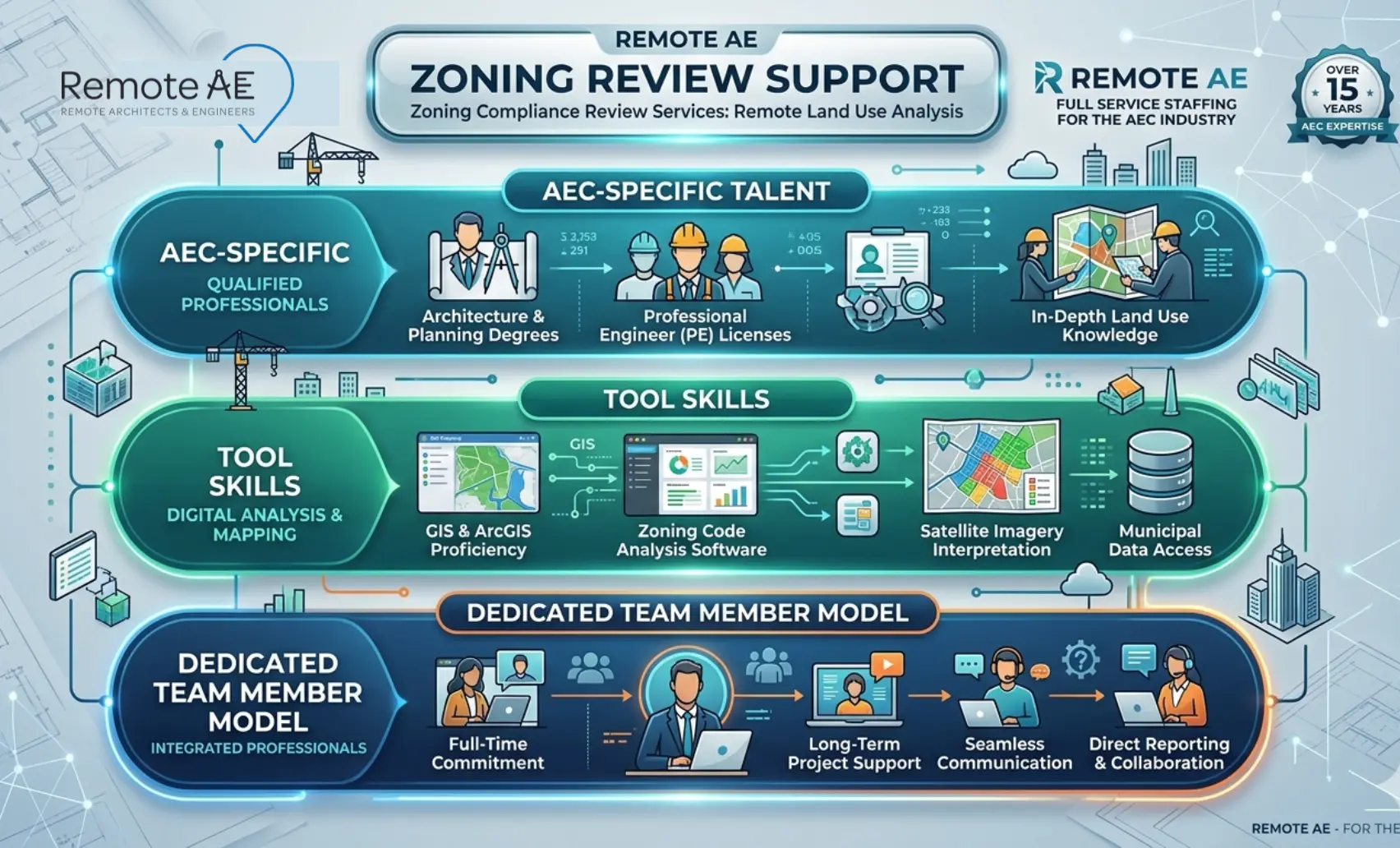
Remote AE focuses exclusively on AEC staffing; its remote architect assistants and remote engineering assistants support architecture, engineering, and construction workflows, not general business administration.
- Over 15 years providing virtual assistants tailored for the AEC industry
- Industry-specific expertise, assistants understand site plans, zoning tables, permit drawings, and planning department workflows
- Guaranteed quality and reliability, research deliverables meet defined standards, or issues are resolved immediately
- No long-term commitment, engage for a single feasibility study or as ongoing due diligence support
- No upfront costs, consult with Remote AE without any initial financial burden. No cost or obligation until the contractual phase begins
- Risk-free replacement, in the first year, Remote AE offers risk-free replacements for up to two virtual assistants
Useful Skills for Land Use Research
Remote AE assistants bring the tool proficiency that zoning research and documentation actually requires:
- AutoCAD and Revit: Reading site plans, floor plans, and massing drawings to confirm dimensional compliance
- Bluebeam: Marking up zoning maps, annotating code sections, and preparing PDF exhibits for attorney or planner review
- MS Office: Building zoning matrices, risk registers, and source logs in structured spreadsheet and document formats
- Zoning table creation: Organizing code requirements, site conditions, and compliance status in clear, auditable matrices
- PDF review and site documentation: Navigating municipal code PDFs, GIS viewer exports, and planning department applications efficiently
Dedicated Support for Busy AEC Teams
Remote AE positions its assistants as dedicated team members rather than one-off task workers. A remote architect assistant or remote engineering assistant assigned to your firm learns your project types, your documentation standards, and your preferred deliverable formats over time.
That continuity matters in zoning research. An assistant familiar with your firm’s projects asks sharper questions, builds more useful matrices, and flags the risks that a first-time researcher misses.
Add Zoning Research Capacity Without Adding Overhead!
Every project starts with a site, and every site has zoning implications that affect design, schedule, and cost. The firms that catch those implications early make better decisions, avoid redesigns, and move to permit faster.
Remote AE places pre-vetted remote architect assistants and remote engineering assistants trained in land-use research, zoning-compliance documentation, and AEC due diligence workflows, ready to support your feasibility studies, site selections, and permit preparation from day one.
Stop letting zoning research bottlenecks delay your early design decisions.
Book a Free Consultation with Remote AE Today, no obligation, no pressure. Just a direct conversation about what your due diligence and land use research workflow needs right now.
FAQs – Zoning Compliance Review Services
What is a zoning compliance review?
A zoning compliance review checks whether a proposed project meets local zoning rules, use, setbacks, height, FAR, parking, lot coverage, and overlays. It flags conflicts early so teams can adjust before permit submission, reducing redesign and delays during plan review.
Can a zoning compliance review be done remotely?
Yes. Most reviews rely on municipal codes, GIS maps, zoning maps, and submitted drawings, all accessible online. Remote teams can analyze parcels, overlays, and standards, then deliver a written summary and checklist for the design team.
What does a remote land use analysis include?
Typical outputs include:
- Allowed/conditional uses
- Dimensional standards (setbacks, height, FAR)
- Overlay districts (historic, floodplain, coastal)
- Parking/loading requirements
- Open space/landscaping rules
- Variance or special permit triggers
- A compliance matrix tied to the project drawing
Who needs zoning compliance review services?
Architects, developers, contractors, and property owners benefit, especially on new construction, additions, change-of-use projects, and sites with overlays or tight constraints. Early review is most valuable on fast-track or high-cost sites.
Does zoning review replace a land-use attorney?
No. Zoning review identifies issues and options. A land-use attorney handles interpretations, appeals, variances, and hearings. Use both when projects face nonconforming conditions or entitlement risk.