
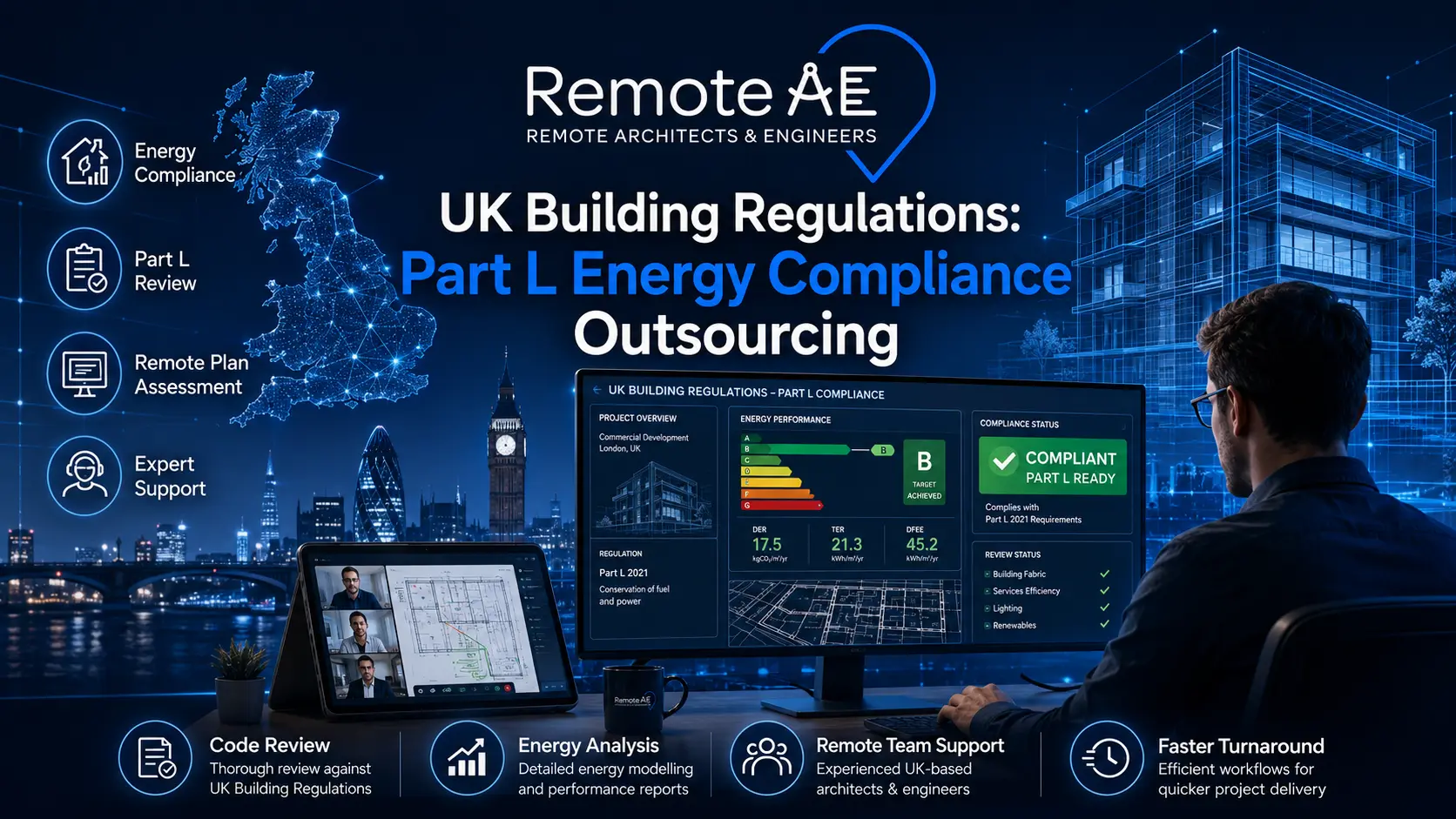
UK building energy compliance is getting harder and slower. The 2021 Part L uplift tightened carbon reduction targets significantly, and the 2026 Approved Document L update pushes requirements further still. According to the UK Environmental Audit Committee, buildings account for approximately 25% of the UK’s total greenhouse gas emissions, making Part L compliance a central mechanism in the country’s net-zero strategy.
For AEC firms managing residential and non-domestic projects simultaneously, keeping SAP calculations, SBEM assessments, BRUKL reports, and as-built submissions on track alongside active design and construction programmes is a significant operational challenge. Part L energy compliance outsourcing gives AEC teams the production capacity to meet those demands without bottlenecking qualified professionals on administrative coordination tasks.
What Part L Energy Compliance Outsourcing Means for AEC Firms
Outsourcing Part L compliance support does not mean handing off legal or professional responsibility. It means using trained AEC support staff to prepare, organise, review, and coordinate the information that an accredited energy assessor or OCDEA needs to run SAP calculations, produce SBEM outputs, and submit BRUKL reports to Building Control, accurately and on time.
The qualified professional remains accountable for compliance sign-off. The remote AEC assistant owns the data preparation, drawing review, version control, and coordination workflow that currently consumes that professional’s time.
Why This Matters Now
The 2026 Approved Document L update,, covering both dwellings and buildings other than dwellings, introduces further changes to energy efficiency standards that AEC firms must apply to new project submissions.
The UK GOV lists Approved Document L 2026 as the current compliance document for both building categories. Firms still operating from 2021 or 2022 workflows risk submitting non-compliant calculations to Building Control, generating corrections that delay approvals and increase project costs.
Purpose of Part L
Part L of the Building Regulations 2010, formally titled Conservation of Fuel and Power, governs energy efficiency in new and existing buildings across England. Its three core purposes:
- Reducing greenhouse gas emissions from the built environment, Part L sets carbon dioxide emission rate targets that buildings must meet or exceed
- Improving energy efficiency standards, through fabric performance requirements for U-values, thermal bridging, and air permeability
- Supporting UK net-zero targets, Part L is the primary regulatory mechanism connecting individual building projects to the UK’s 2050 carbon neutrality commitment
Part L Categories Explained
| Category | Applies To | Scope |
| Part L1A | New dwellings | Full SAP calculation, design-stage, and as-built submission |
| Part L1B | Existing dwellings | Extensions, alterations, or material change of use |
| Part L2A | New non-domestic buildings | Full SBEM/BRUKL, design-stage, and as-built submission |
| Part L1B | Existing non-domestic buildings | Extensions, renovations, change of use |
Why Part L Compliance Has Become More Complex
Changes Introduced in Recent UK Updates
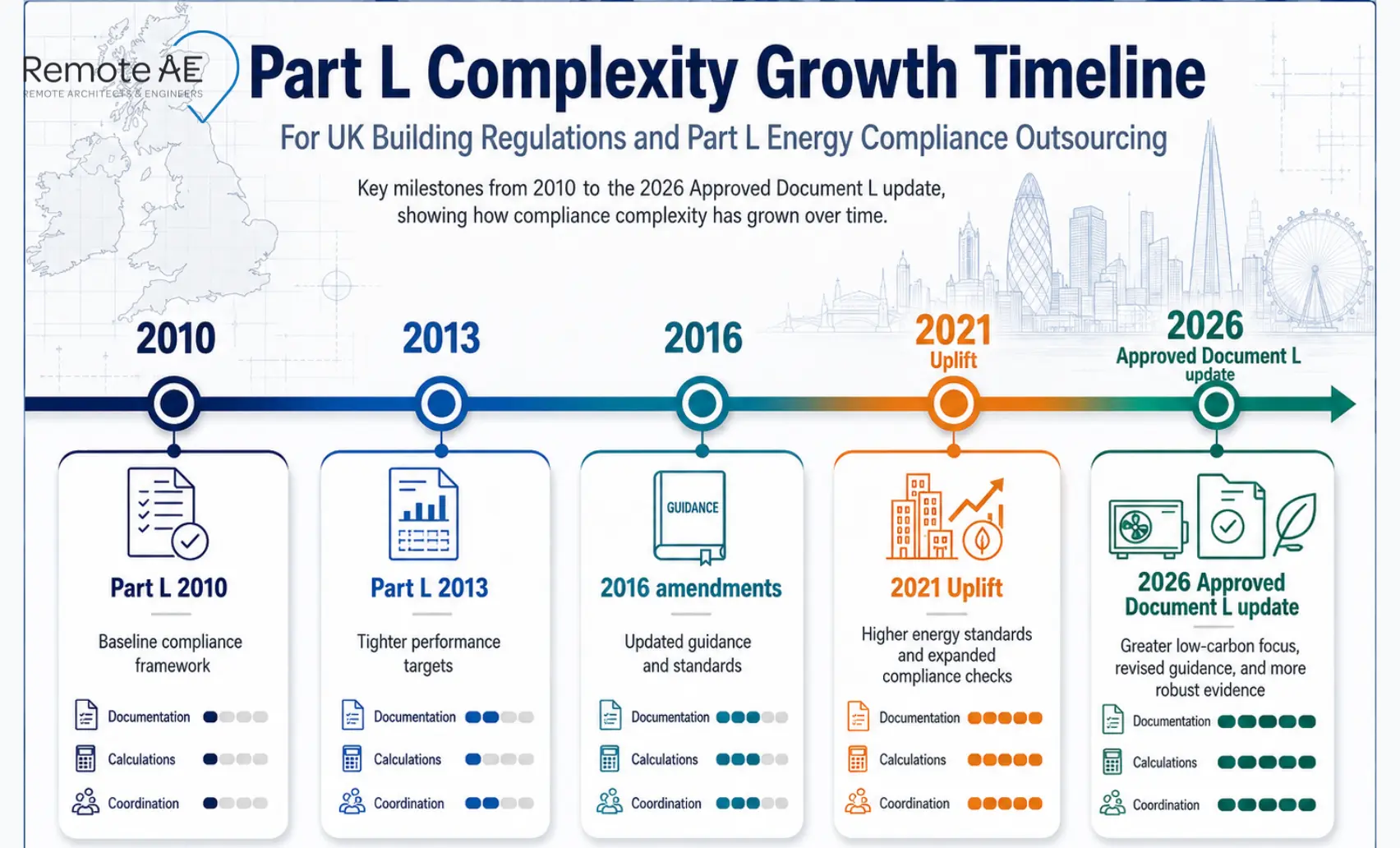
The 2021 Part L uplift, the most significant revision since 2013, introduced stricter carbon reduction targets for both dwellings and non-domestic buildings. New dwellings must now achieve a 31% reduction in carbon emissions compared to 2013 standards, with fabric efficiency and fixed building services performance both tightened.
The 2026 update continues this trajectory, with Future Homes Standard preparation driving further changes to heating system requirements, heat pump integration, and on-site renewable electricity obligations.
Growing Documentation Requirements
Each Part L submission now requires a more extensive evidence package than previous code cycles:
- Design-stage calculations: SAP or SBEM models submitted with the Building Regulations application, before construction begins
- As-built calculations: Updated SAP or SBEM reflecting actual construction, required before Building Control sign-off and EPC lodgement
- Compliance reports: BRUKL output for non-domestic projects, SAP output for dwellings, both formatted for Building Control submission
- EPC coordination: Energy Performance Certificates generated from the as-built SAP or SBEM, required for dwellings at completion and for non-domestic buildings on first occupation
Common Challenges Faced by AEC Firms
- Tight project timelines: Building Control submission deadlines and practical completion dates create compressed windows for compliance documentation
- Shortage of qualified assessors: OCDEAs and accredited energy assessors are in short supply, particularly for large residential developments requiring multiple as-built SAP submissions simultaneously
- Revisions during planning and construction: Design changes after the first SAP or SBEM calculation, glazing ratios, insulation specifications, and HVAC system changes require calculation reruns that create sequential delays
- Coordination gaps: U-value schedules from the architect, HVAC efficiency data from the MEP engineer, and air permeability test results from the contractor all feed the same compliance model, and gaps in any one input delay the whole submission
Risk of Non-Compliance
- Project delays, Building Control will not issue completion certificates without a compliant as-built submission
- Failed approvals, design-stage calculations that don’t meet the applicable Approved Document L targets, require redesign before Building Control approval proceeds
- Increased redesign costs, late-stage compliance failures identified during the as-built stage, require specification changes that carry contractor cost implications
- Client disputes, delayed practical completion caused by compliance documentation failures, create contractual liability that traces directly back to the project team’s compliance management process
SAP, SBEM, BRUKL, and EPC: What AEC Teams Need to Know
SAP Calculations for Dwellings
SAP, the Standard Assessment Procedure, is the UK government’s approved method for calculating the energy performance of new and existing dwellings. GOV.UK describes SAP as the way a home’s energy performance is calculated for Building Regulations compliance purposes.
SAP calculations assess:
- Fabric efficiency, U-values for walls, roofs, floors, and glazing
- Thermal bridging at junctions
- Air permeability from pressure test results or design assumptions
- Fixed building services, heating system efficiency, hot water, and lighting
- Where heat pumps and mechanical ventilation are specified
- On-site renewable electricity generation from solar PV
The calculation runs twice, at the design stage for Building Regulations application, and at the as-built stage, incorporating actual construction data before Building Control sign-off.
SBEM for Non-Domestic Buildings
SBEM, the Simplified Building Energy Model, is the compliance calculation tool for non-domestic buildings under Part L2A and Part L2B. The UK National Calculation Method (NCM) website lists SBEM and iSBEM as the approved energy calculation tools for non-domestic compliance.
SBEM models the building’s energy performance against a notional building baseline, assessing HVAC system efficiency, fixed building services, lighting controls, on-site renewable electricity, and building fabric performance across all zones.
BRUKL Reports and Building Control
The BRUKL report, Building Regulations UK Part L, is the standard compliance output document generated by SBEM for non-domestic projects. It is the document submitted to Building Control to demonstrate that a non-domestic building meets Part L2A or Part L2B requirements.
A BRUKL report covers:
- Building description and zone breakdown
- Notional versus proposed building energy performance
- Carbon dioxide emission rates, target versus actual
- Fabric U-values and thermal bridging summary
- HVAC system and fixed building services data
- Renewable energy contribution
Building Control will not accept a non-domestic Part L submission without a valid, current-edition BRUKL report.
EPC Connection
SAP and SBEM calculation results feed directly into Energy Performance Certificate production. For dwellings, the as-built SAP generates the EPC lodged on the national register at practical completion. For non-domestic buildings, the SBEM output informs the EPC required on first sale or letting.
Scope varies significantly; a single new-build house requires one SAP and one EPC. A residential development of 50 units requires 50 individual as-built SAP calculations and 50 EPCs, each referencing the specific plot’s actual construction data.
Remote AEC staffing that manages data collection, plot tracking, and evidence organisation across large residential schemes delivers measurable time savings on exactly these high-volume compliance workflows.
What Part L Tasks Can Be Outsourced?
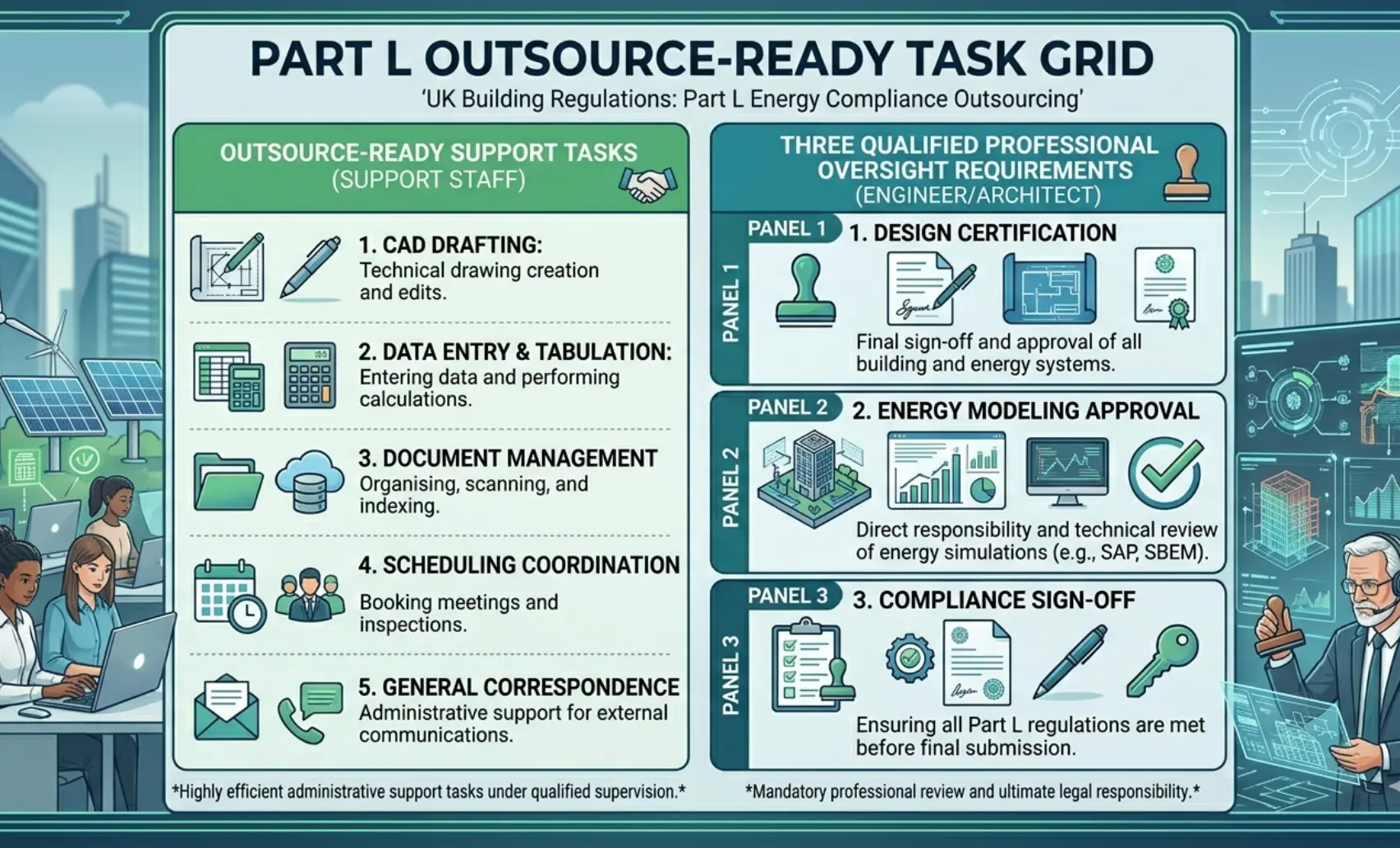
These tasks do not require accredited status; they require AEC workflow knowledge, documentation discipline, and attention to detail:
- Drawing review against assessor input lists: Checking architectural and MEP drawings for the data and energy assessor needs, U-values, glazing schedules, floor areas, orientation, and HVAC specifications
- SAP/SBEM data collection: Gathering U-value schedules, window schedules, heating system data, and air permeability targets from the design team
- U-value schedule support: Compiling and formatting wall, roof, floor, and glazing U-values from architect and structural specifications
- Window and door schedule checks: Confirming glazing areas, orientations, and frame specifications match the drawings submitted to the assessor
- Insulation specification tracking: Monitoring specification changes during design and construction that affect thermal performance inputs
- HVAC and lighting data coordination: Collecting efficiency ratings, control strategies, and system descriptions from the MEP engineer for SBEM inputs
- Renewable system documentation: Gathering solar PV output data, heat pump specifications, and battery storage details for SAP and SBEM modeling
- As-built evidence folders: Organising product certificates, air permeability test results, thermal bridging calculations, and site photographs for the as-built submission
- Report formatting and version control: Managing compliance report versions, tracking changes, and maintaining a single source of truth for all compliance documents
- Building Control submission prep: Assembling the complete submission package, calculations, reports, drawings, and supporting evidence, for the accredited assessor or project manager to review and submit
- RFI and consultant coordination: Drafting queries to architects, MEP engineers, and contractors when compliance data is missing or inconsistent
Tasks That Need Qualified Oversight
Remote AEC assistants support the compliance workflow; they do not replace the qualified professional at the top of it.
- Final compliance advice and signed compliance reports require an accredited energy assessor
- EPC lodgement on the national register requires an OCDEA for dwellings or an accredited non-domestic energy assessor for commercial buildings
- Formal Building Control submissions must be made by the Applicant or their authorised agent
- Design decisions that affect compliance, glazing ratios, insulation specifications, and heating system selection require architect and engineer input, not remote assistant judgment
Example Workflow
A clean Part L outsourcing workflow runs in seven steps:
- Step 1: The architect uploads drawings and specifications to the shared project folder
- Step 2: Remote AEC assistant checks for missing data, U-values, window schedule, HVAC efficiency ratings, and raises a data gap log
- Step 3: Assessor receives clean, complete inputs without spending time chasing the design team for missing information
- Step 4: The SAP or SBEM model is run, and the compliance report is reviewed against the design-stage target
- Step 5: Any design fixes required, glazing reduction, insulation upgrade, and heating system change are logged and tracked through the design team
- Step 6: Updated compliance reports are prepared, incorporating the confirmed design changes
- Step 7: As-built evidence is collected and organised through construction, product certificates, air test results, and substitution records tracked against the original design assumptions
Signs Your Firm Should Outsource Part L Compliance
- Your Team Is Missing Deadlines: Building Control submission dates are slipping because no one owns the compliance data collection process. The assessor is waiting on inputs that should have been ready weeks earlier.
- Compliance Revisions Are Slowing Projects: Every design change, a glazing substitution, an insulation upgrade, an HVAC system change, triggers a SAP or SBEM rerun that the team is not resourced to manage quickly.
- Hiring Qualified Specialists Is Difficult: OCDEAs and accredited energy assessors are in short supply. Recruiting permanently for a function that fluctuates with project volume is neither practical nor cost-efficient.
- Your Pipeline Is Growing Faster Than Your Staff Capacity: More projects mean more compliance submissions, but internal headcount has not scaled proportionally. Remote AEC staffing absorbs the production load without a permanent overhead commitment.
- Internal Teams Spend Too Much Time on Repetitive Technical Tasks: Senior architects and engineers are chasing U-value schedules and formatting BRUKL reports instead of focusing on design and engineering decisions.
How Remote AEC Support Reduces Compliance Risk
Better Inputs Before SAP or SBEM Modeling
Clean, complete data inputs mean fewer calculation reruns. A remote AEC assistant who checks every drawing against the assessor’s input list before submission eliminates the most common cause of compliance delay, missing or inconsistent data that only surfaces when the model is already running.
Faster Response to Assessor Comments
When the assessor flags a U-value discrepancy, a glazing area mismatch, or a missing thermal bridging calculation, a remote assistant tracks every comment, assigns it to the correct discipline owner, and updates the compliance matrix, without pulling senior staff into administrative coordination.
Better Version Control
One incorrect specification version flowing into a SAP calculation can produce a compliant result that the as-built building does not actually achieve, resulting in a failed as-built submission at practical completion. Strict version control, one source of truth for all compliance inputs, prevents this entirely.
Lower Pressure on Senior Staff
Accredited energy assessors and senior engineers should make compliance decisions, not chase product certificates or reformat BRUKL reports. Remote AEC support returns that time to the professionals who generate the most project value when they focus on technical judgment.
Why Remote AE Fits Part L Compliance Support
Remote AE provides virtual architect assistants and virtual engineering assistants trained in AEC compliance workflows, not general administrative support.
- Compliance coordination teams managing SAP/SBEM data collection, as-built evidence folders, and Building Control submission packages
- Industry-specific expertise: Every assistant understands AEC documentation — drawing registers, specification schedules, consultant comment logs, and compliance trackers
- Guaranteed quality and reliability: Compliance documentation meets defined standards, or issues are resolved immediately
- No long-term commitment: Engage per project, per phase, or as an ongoing compliance resource
- No upfront costs: Consult without any initial financial burden — no cost or obligation until the contractual phase begins
- Risk-free replacement: In the first year, Remote AE offers risk-free replacements for up to two virtual assistants
Experience Supporting UK-Based Workflows
- Familiarity with UK construction standards, Approved Document L, Building Regulations 2010, and current energy compliance documentation requirements
- AEC documentation processes, drawing issue registers, revision logs, Building Control submission formats, and consultant coordination workflows
- Remote collaboration systems, cloud-based file sharing, structured handoff protocols, and daily async communication rhythms aligned with UK business hours
Flexible Team Structures
- Full-time remote staff: Dedicated capacity for firms with consistent Part L compliance workload across multiple active projects
- Project-based support: Targeted assistance for specific design-stage or as-built submission deadlines
- Long-term technical assistance: Ongoing compliance coordination across a residential development programme or a multi-building commercial portfolio
Software and Technical Capabilities
Remote AE assistants bring proficiency in the tools UK Part L compliance workflows depend on:
- Revit and AutoCAD: Drawing review, schedule extraction, and specification coordination
- IES VE and DesignBuilder: Energy modeling environment familiarity for complex non-domestic projects
- SAP software and SBEM tools: Data input preparation, output review, and compliance report formatting support
- Bluebeam and PDF markup tools: Drawing annotation, consultant comment tracking, and compliance evidence organisation
Communication and Project Coordination
- Time-zone overlap with UK business hours, remote assistants available during core working hours for real-time query resolution and drawing review
- Structured reporting, daily progress updates, compliance tracker status, and open data gap logs shared with the project lead
- QA processes, internal review of all compliance documentation before it reaches the assessor or Building Control
How to Choose a Part L Compliance Outsourcing Partner
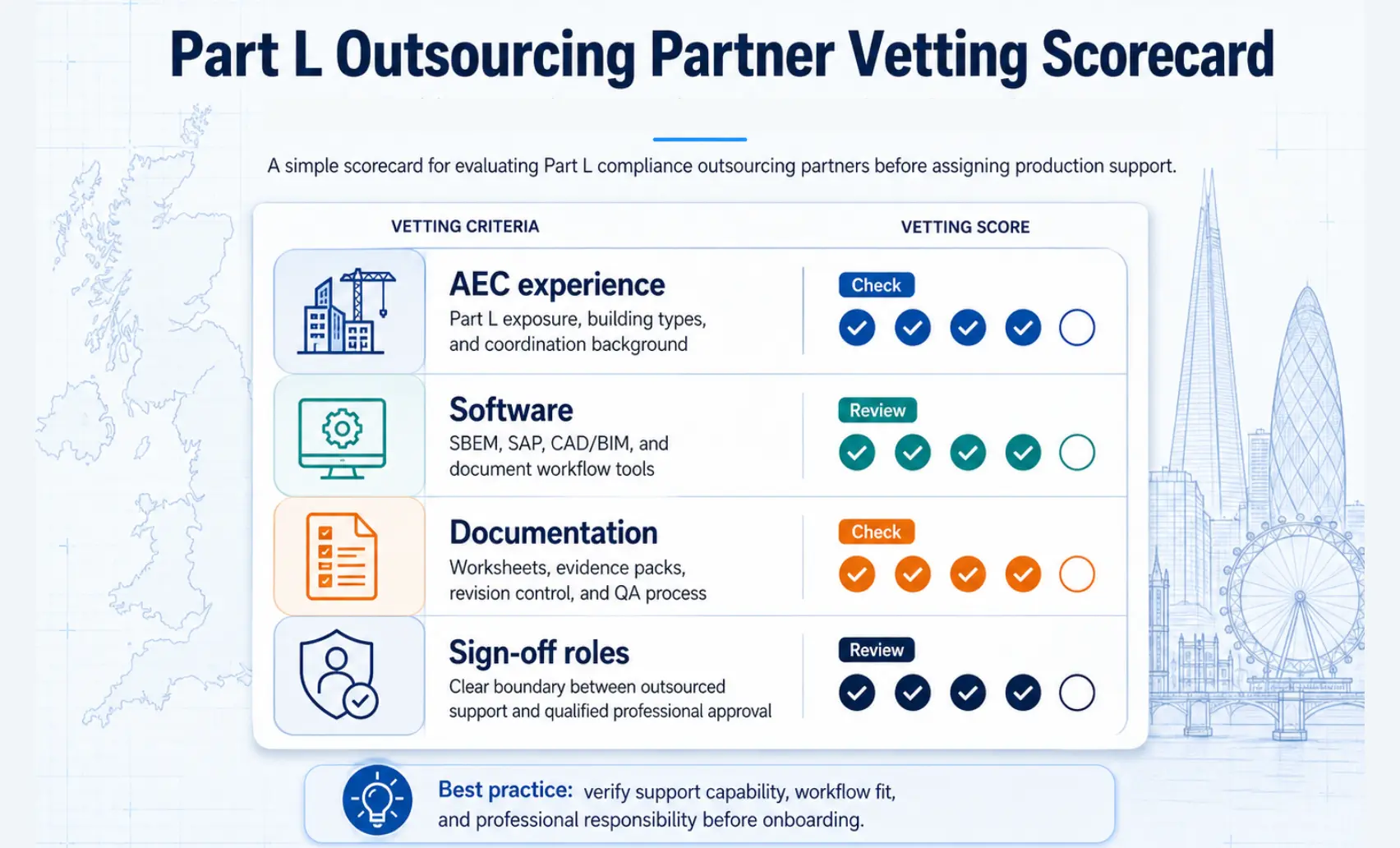
Look for AEC Experience: Not Generic VA Support
Part L compliance documentation requires AEC context, reading drawings, interpreting specifications, understanding consultant relationships, and recognising when a design change affects compliance. Generic virtual assistant services do not provide this. Remote AE’s niche in AEC-specific staffing is precisely what Part L compliance coordination requires.
Check Software Familiarity
Confirm proficiency in the tools your compliance workflow actually uses:
- AutoCAD and Revit for drawing review and schedule extraction
- Bluebeam for markup and evidence annotation
- Excel or Google Sheets for compliance trackers and data gap logs
- PDF markup tools for assessor comment response coordination
- Project management tools for deadline tracking and consultant coordination
Check Documentation Discipline
The right remote assistant is comfortable with drawing registers, revision logs, consultant comment matrices, and compliance evidence folders, and maintains them consistently without prompting. Ask for examples of compliance coordination documents from previous AEC engagements before making a placement decision.
Keep Sign-Off Roles Clear
The most effective Part L outsourcing structure is a three-layer:
- Remote AEC assistant: Data preparation, drawing review, version control, evidence collection, and coordination
- Project lead: Design decision-making and consultant management
- Accredited energy assessor or OCDEA: Compliance modeling, report sign-off, and formal Building Control submission
Blurring these boundaries, particularly the boundary between remote support and accredited professional responsibility, creates compliance accountability gaps that Building Control will identify at submission.
Add Part L Compliance Capacity: Without the Bottleneck!
Your accredited energy assessor should be running calculations, not chasing U-value schedules or reformatting BRUKL reports. Remote AE places pre-vetted virtual architect assistants and virtual engineering assistants trained in UK Part L compliance workflows, SAP data collection, SBEM input coordination, as-built evidence tracking, and Building Control submission preparation, ready from week one.
No Upfront Cost. No Commitment. Just Faster Part L Compliance. Book Now!
FAQs – UK Building Regulations
What is Part L of the UK Building Regulations?
Part L covers energy efficiency requirements for buildings in England and Wales. It regulates areas such as insulation, glazing, air tightness, lighting, HVAC efficiency, and carbon emissions to improve building energy performance and reduce operational energy use.
Can Part L compliance work be outsourced?
Yes. Many firms outsource SAP calculations, SBEM modeling, BRUKL reporting, drawing coordination, and compliance documentation. Final responsibility for the project and Building Control submission still remains with the design team and appointed professionals.
Can a remote assistant prepare Part L compliance documentation?
Yes. Remote assistants can organize drawings, gather specifications, prepare templates, coordinate revisions, and support submission workflows. Qualified assessors or consultants should still complete and review the official calculations and reports.
What happens if a project fails Part L compliance?
The design may need revisions such as improved insulation, glazing, HVAC systems, lighting efficiency, or renewable energy measures. Building Control approval can be delayed until compliance targets are met.
How can AEC firms reduce delays in SAP or SBEM submissions?
Start energy modeling early, keep architectural and MEP data coordinated, and avoid late specification changes. Most delays happen because drawings, glazing schedules, HVAC data, and compliance models do not match.