

Australia’s construction sector reached AUD $318 billion in activity in 2026, and the workforce to deliver it is running short across every major market (RLB, March 2026). Sydney, Melbourne, and Brisbane account for the largest share of Australia’s AEC professional employment, yet small and mid-size firms in each city are losing experienced drafters, BIM technicians, and engineering assistants to tier-one contractors on government-backed infrastructure pipelines.
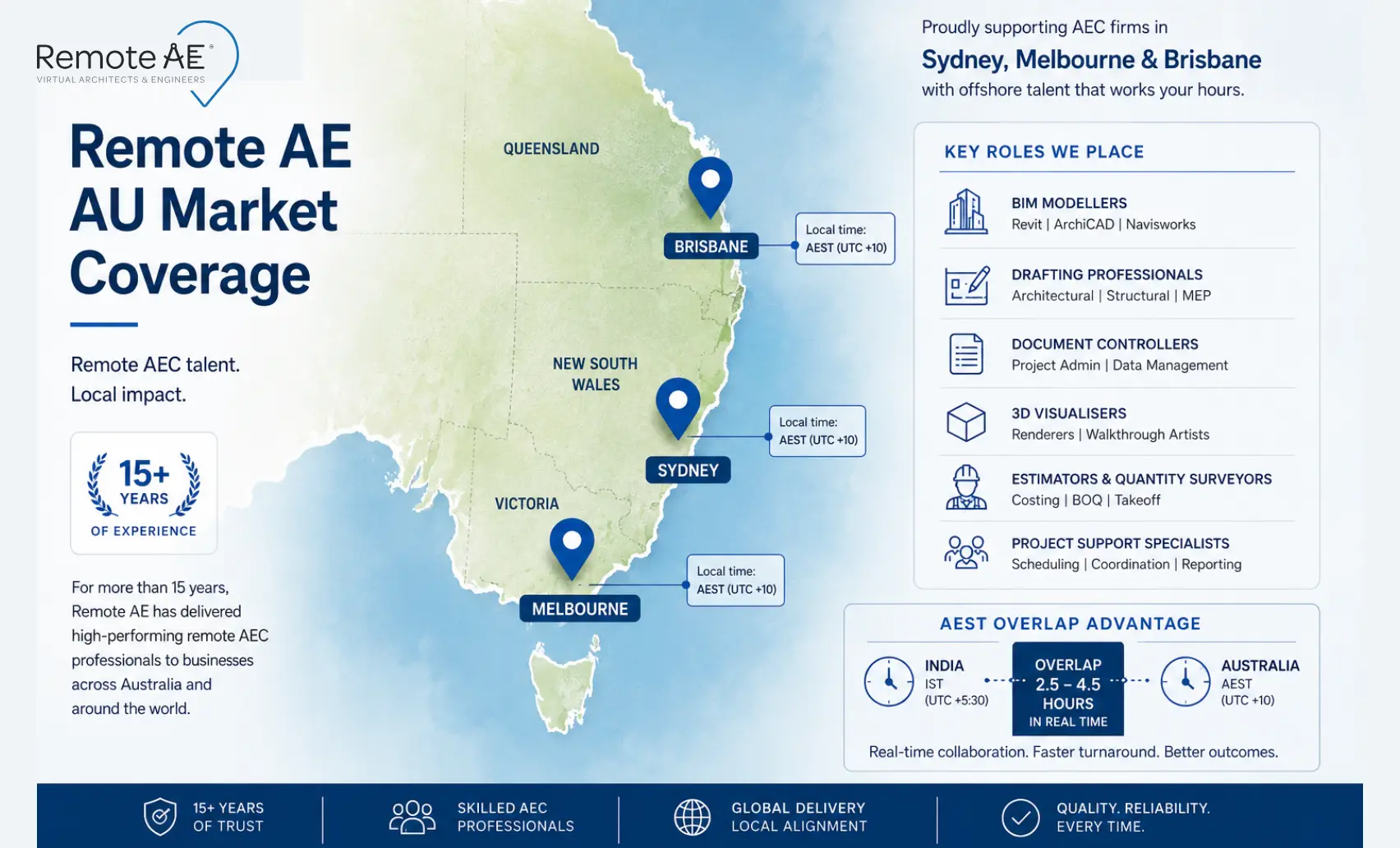
Remote AEC staffing gives these firms a direct answer: a dedicated, experienced AEC professional working inside their BIM environment at AUD $719/week. Moreover, AEST-aligned, on their tools, to their standards, without competing for the same shallow local talent pool.
Key Takeaways
- NSW holds 32.1% of Australia’s construction market, the largest state share, with Sydney Metro West alone worth AUD $27 billion.
- Remote AEC staffing costs AUD $719 per week, against a fully loaded in-house Sydney drafter at AUD $111,280 in Year 1.
- A dedicated remote AEC professional saves a Sydney firm AUD $66,693 in Year 1 versus an equivalent local hire.
- Remote AE places AEC professionals with a minimum of five years of experience, set up and producing within two weeks.
- Dedicated remote AEC staff suit 5 to 15-person practices, unlike freelancers or high-volume offshore teams built for enterprise output.
- Australia’s construction sector reached AUD $318 billion in activity in 2026, straining the talent pool across Sydney, Melbourne, and Brisbane.
Australia’s Three AEC Capitals: One Shared Problem
The National Picture: AUD $318 Billion, Rising Costs, Persistent Labour Shortfall
Australia’s construction sector reached AUD $318 billion in total activity at the start of 2026, driven by sustained public investment in energy infrastructure, data centres, and housing (RLB, March 2026). Construction costs are forecast to rise between 4 and 6 per cent nationally in 2026, as large public and private projects compete for labour and contractor capacity.
Labour shortages remain the sector’s most persistent constraint, affecting both trades and professional roles, including engineers and construction managers.
Building approvals rose 20.2% over the year to November 2025, driven by apartments and higher-density housing, with more projects entering the pipeline against the same shallow talent pool (ABS, November 2025).
Why Sydney, Melbourne, and Brisbane Lead Firm Demand for Remote Staff
Together, Sydney, Melbourne, and Brisbane account for the majority of Australia’s AEC professional employment and the bulk of its active construction pipeline. Infrastructure programs in all three cities extend well beyond 2030, with no signs of slowing.
The firms feeling this most acutely are not the tier-one contractors; they have scale, recruitment budgets, and long-term contracts to attract staff. The firms under pressure are small-to-mid-size architecture practices, engineering consultancies, and documentation-focused studios. The ones that compete for the same experienced drafters, Revit modellers, and remote engineering assistants as major infrastructure projects, and consistently lose.
Remote AEC staffing bypasses that competition entirely. Access to a dedicated, experienced AEC professional sits outside the local market constraint, outside the recruitment timeline, and outside the payroll overhead of a permanent hire.
Sydney: The Biggest Market, the Tightest Talent Pool
What’s Driving Demand in Sydney Right Now
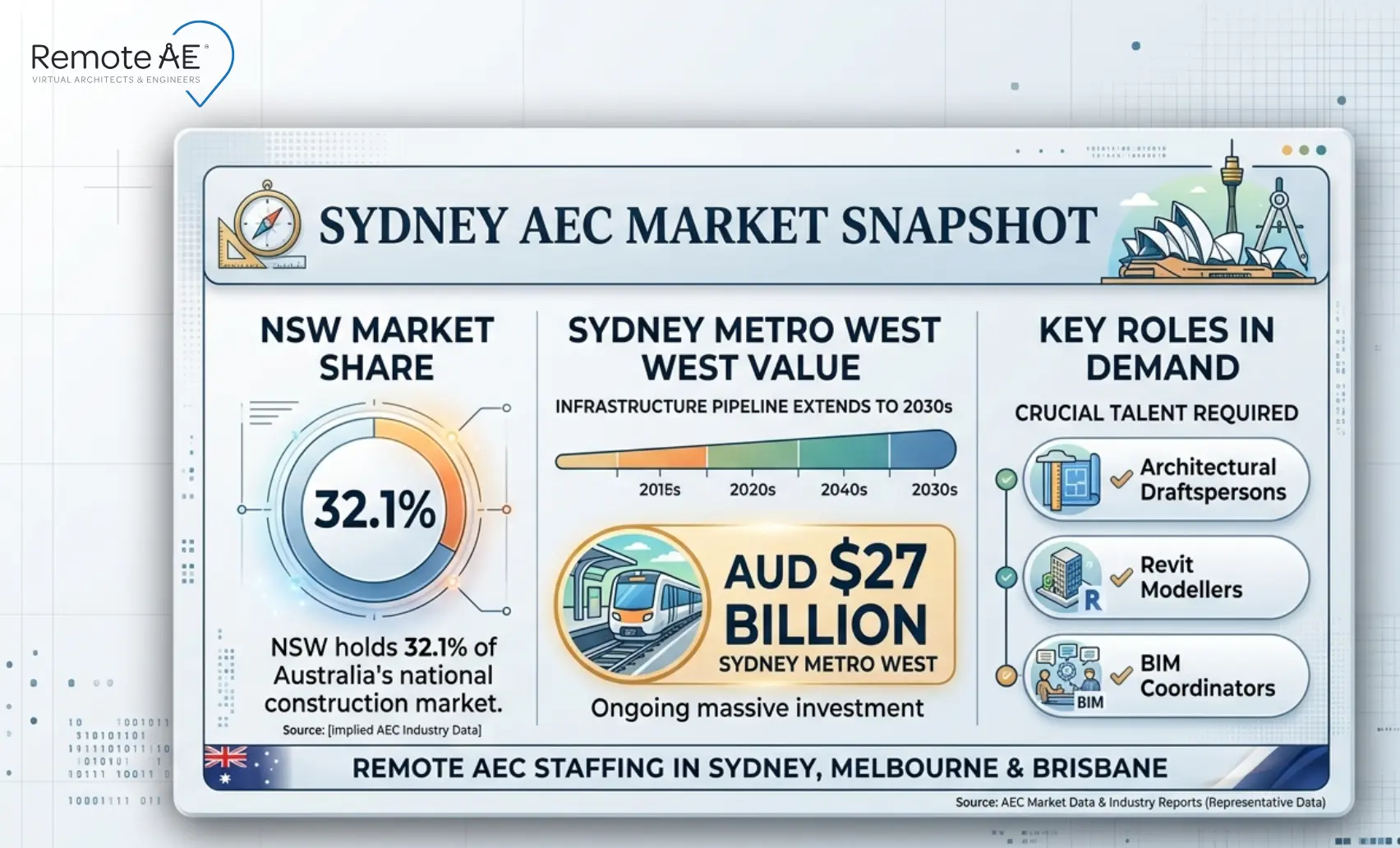
NSW holds 32.1% of Australia’s national construction market, the largest share of any state. Sydney’s infrastructure pipeline extends well into the 2030s, with Sydney Metro West (AUD $27 billion) and ongoing metro expansion programmes actively absorbing experienced civil, structural, and BIM staff from the wider market.
Architecture firms are actively hiring in Sydney but moving carefully. Strong documentation capability and Revit proficiency are the primary criteria for any new engagement (Vivid Recruitment, 2026). Construction costs in Sydney are forecast to rise 4% in 2026, putting margin pressure on smaller practices already stretched thin across active projects (RLB Q4 2025).
Private residential and mixed-use development is also rebounding after the 2024-25 rate cycle, adding to the documentation volume of practices that had scaled back. More work is coming in, but not more experienced staff to deliver it.
The Roles Sydney Firms Most Need Remote Support For
- Architectural draftspersons and Revit modellers for DA and CD documentation packages
- BIM coordinators for transport and infrastructure-adjacent project packages
- Estimating and quantity take-off support for commercial and residential pipelines
How Remote AEC Staffing Fits Sydney’s Firm Profile
Small and boutique Sydney practices compete directly with tier-one contractors for the same documentation staff and lose on compensation and job security every time. AEC outsourcing in Sydney solves that through a different model entirely.
Remote AE’s dedicated model gives a Sydney firm exclusive access to an experienced AEC drafter without the in-house headcount cost or the recruitment timeline. No job ad, no interview rounds, no three-month probation window while a deadline approaches.
AEST-aligned hours mean real-time collaboration during the Sydney business day, mark-up turnaround the same day, briefings during your core hours, and check-ins that fit your schedule.
 Melbourne: Mega Projects, Boutique Firm Pressure
What’s Driving Demand in Melbourne Right Now
Victoria’s budget is projected to be AUD $21.4 billion in annual infrastructure spend (Vic.Gov.au). Three projects alone, North East Link, Metro Tunnel, and Suburban Rail Loop, are collectively locking up Victoria’s experienced delivery workforce through the late 2020s.
The Melbourne market is described as “stabilising” in 2026, with boutique firms seeing strong demand in medium-density residential and design-led mixed-use projects (Planned Resources, 2026).
Construction costs in Melbourne are forecast to rise 4% in 2026; cost control has become a firm-level priority, not just a project-level concern (RLB Q4 2025).
The Roles Melbourne Firms Most Need Remote Support For
- Architectural documentation for medium-density residential and mixed-use schemes
- Structural drafting support produced directly from the engineer’s mark-ups
- Project coordination and construction documentation for design and documentation practices
How Remote AEC Staffing Fits Melbourne’s Firm Profile
Melbourne’s boutique architecture and engineering practices face a structural problem: the infrastructure sector pays more for the same staff. A drafter with strong Revit skills and five years’ documentation experience can earn significantly more on the SRL or Metro Tunnel supply chain than a boutique practice can offer.
Drafting services Melbourne firms need don’t have to come from the local market. A dedicated remote drafter at AUD $719/week gives a Melbourne practice consistent documentation capacity without competing against Victoria’s Big Build for talent. No payroll tax liability, no superannuation obligation, no leave exposure, immediate cost relief in a market where margins are tightening on every medium-density project.
Brisbane: The Fastest-Growing AEC Market in Australia
What’s Driving Demand in Brisbane Right Now
Brisbane’s construction pipeline is the most dynamic of any Australian capital in 2026 (Planned Resources, 2026). Two headline programs are driving demand beyond what the local workforce can absorb:
- Brisbane 2032’s Games Venue Infrastructure Program is an AUD $7.1 billion joint government commitment (roughly AUD $11 billion including transport, housing and precinct upgrades), with fixed delivery timelines that cannot slip.
- Logan & Gold Coast Faster Rail, AUD $5.75 billion, connecting the Olympic corridor, running in parallel with venue construction
Queensland’s construction market needs 30,000–40,000 additional workers annually through to 2032, a gap that no local training pipeline or migration pathway can close fast enough. Construction costs in Brisbane are forecast to rise 5% in 2026, the highest of any east-coast capital, with further escalation of 7% forecast from 2027 as Olympic delivery accelerates (RLB Q4 2025).
Queensland’s BIM mandate, requiring BIM on all government projects over AUD $50 million since July 2019, has also raised the floor for Revit capability across the market. Firms tendering on government-adjacent work need BIM deliverables. That requirement now filters through to private sector clients as well.
Tender pricing pressure sits at approximately 5% in Brisbane, making cost discipline central to staying competitive on any project type.
The Roles Brisbane Firms Most Need Remote Support For
- Revit and BIM drafters for Queensland government project tenders and BIM Execution Plan delivery
- Civil and structural drafting for infrastructure-adjacent commercial and residential projects
- Remote engineering assistants for consultancies scaling up capacity for the Olympic pipeline
How Remote AEC Staffing Fits Brisbane’s Profile
Brisbane firms in 2026 are caught between a booming project pipeline and a workforce that simply isn’t there- not locally, not via migration, not fast enough through training. A remote engineering assistant Brisbane firms can bring on through Remote AE bypasses that competition entirely. One dedicated, experienced AEC professional working in your BIM environment from day one, no recruitment cycle, no visa processing, no salary war with tier-one contractors.
Scale up with the Olympic pipeline. Ease back after delivery. No redundancy liability, no notice period, no dead salary between project phases.
What Remote AE Provides Across All Three Markets
Remote AE places dedicated AEC professionals across five production functions for Sydney, Melbourne, and Brisbane firms:
- Architectural draftspersons, DA packages, CD sets, as-built updates
- Structural BIM drafters, from engineer mark-ups to coordinated Revit packages
- Civil documentation specialists, road, drainage, and utilities in Revit and AutoCAD
- Estimators and quantity take-off specialists, tender packages, and elemental cost plans
- Project coordinators, RFI logs, submittal tracking, drawing registers, and construction documentation
The Model
Every placement is a dedicated individual, not a shared team, not a rotating roster. Minimum five years of AEC experience, vetted on real drawing set production, Revit proficiency, and documentation standards before placement.
Your remote AEC professional works on your tools, in your BIM environment, to your file naming and LOD standards.
The Cost
| In-House (AUD) | Remote AE (AUD) | Saving (AUD) | |
| Year 1 total | $111,280 | $44,587 | $66,693 |
| Year 2 total | $93,780 | $37,388 | $56,392 |
AUD $719/week + AUD $7,199 one-time recruitment and operations fee. In-house figures based on AUD $72,000 base salary plus super at 12% (ATO, FY2025–26), workers’ compensation, payroll tax, leave entitlements, recruitment, and equipment.
City-Specific Fit
- Sydney: AEST-aligned hours for same-day collaboration; no right-to-work complications; dedicated drafter working inside your NSW project and documentation standards
- Melbourne: Victorian time-zone overlap; no payroll tax liability, no super obligation; consistent capacity for medium-density and mixed-use documentation
- Brisbane: AEST hours for real-time BIM coordination; Revit-ready for Queensland government BIM deliverables; scale up and down with the Olympic pipeline without redundancy exposure
Remote AEC Staff vs Freelancers vs Large Offshore Teams: What Actually Fits a Small Firm
Not all remote options work the same way. For a five-to-fifteen-person practice in Sydney, Melbourne, or Brisbane, the model matters as much as the cost.
| Factor | Freelancer | Large Offshore Team | Dedicated Remote AEC Professional |
| Continuity | Different person for each project | Rotating staff | One named person, long-term |
| Firm knowledge | None, starts from scratch | Minimal, shared across clients | Deeply learns your standards and project types |
| Setup time | Fast but inconsistent | Slow, enterprise onboarding | Two weeks, managed by Remote AE |
| Cost | Per-task, variable | High fixed retainer | AUD $719/week, predictable |
| Best fit | One-off tasks | High-volume enterprise output | 5–15 person AEC practice |
Freelancers: Fast to Start, No Continuity
Freelancers are useful for isolated tasks, a single drawing, or a one-off task. The problem for a small AEC firm is continuity. A freelancer doesn’t learn your Revit template, your layer standards, or your documentation conventions. Every project starts from the beginning, and quality is inconsistent across engagements.
Large Offshore Teams: Suited for Volume, Not Boutique Practices
Enterprise offshore drafting teams are built for high-volume, repetitive output at scale. For a tier-one contractor running hundreds of drawings a week, that model works.
For a boutique Sydney or Melbourne practice producing design-led documentation across varied project types, a large offshore team is overkill, and the rotating-staff model means no one ever builds knowledge of how your firm works.
A Dedicated Remote AEC Professional: One Person, Your Tools, Long-Term
A dedicated remote AEC professional from Remote AE is the model that fits a small firm’s actual workflow. One named person, working exclusively for your practice, learning your standards, integrated into your BIM environment, available during your business day.
That’s what AEC staffing firms in Sydney, Melbourne, and Brisbane actually need, not a platform, not a team, not a rotating pool.
How to Get a Remote AEC Professional Started on Your Projects
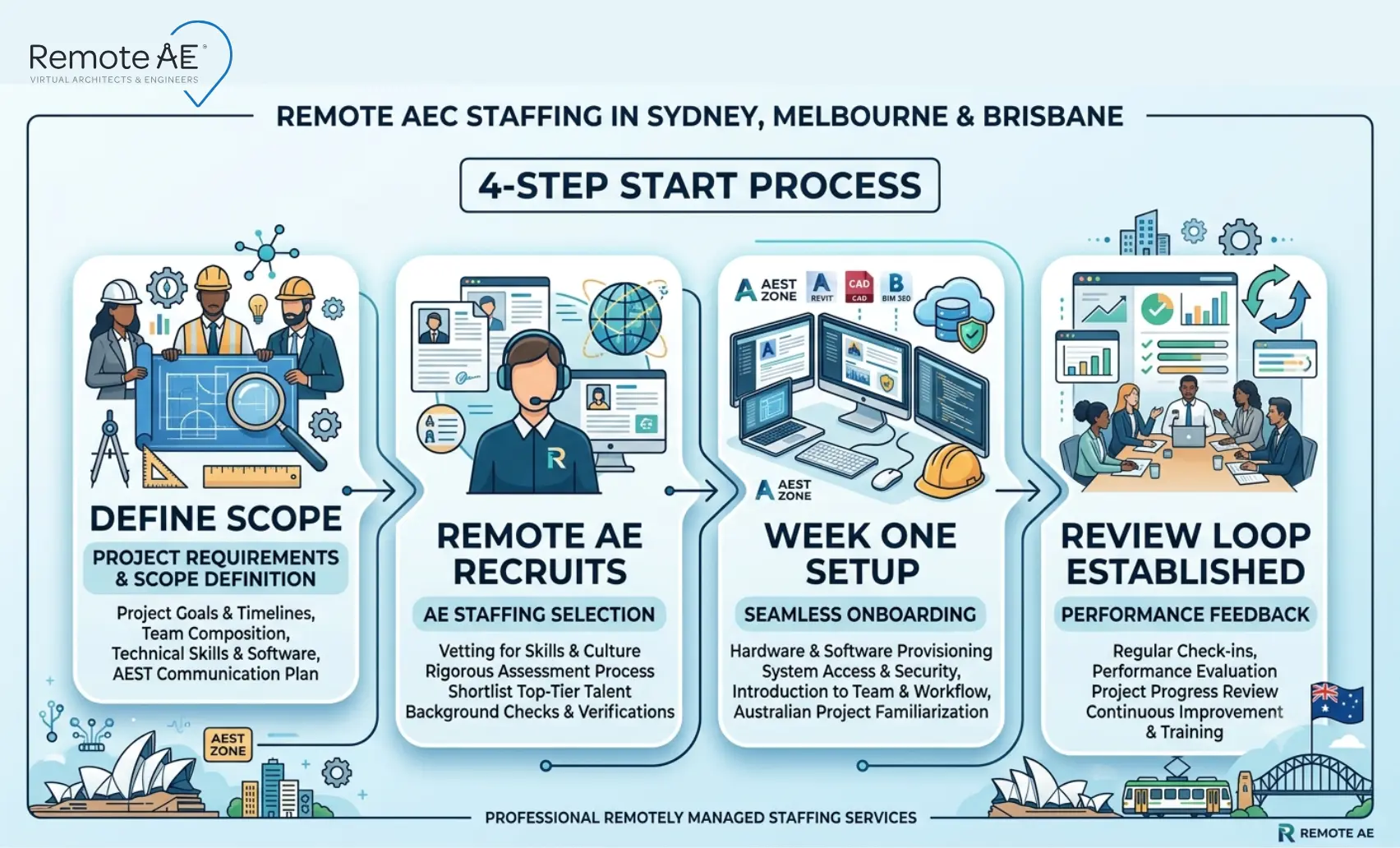
Define the Role and Scope Before You Start
Write down exactly what you need produced, drawing types, software, standards, file conventions, and what “done” looks like on a typical deliverable. Firms that invest 30 minutes in this step before onboarding starts save weeks of revision cycles later.
Remote AE Handles Recruitment, Vetting, and Onboarding
Remote AE sources candidates from an AEC-specific talent pool, assesses them on real production criteria, Revit proficiency, drawing set experience, NCC documentation standards, and manages the full onboarding process. You don’t advertise, interview, or carry probation liability. Your matched AEC professional is set up and producing within two weeks. Our process?
Week One: Getting Set Up in Your Tools and Standards
- Access to your Revit model, AutoCAD templates, and CDE (BIM 360, Autodesk Construction Cloud, or equivalent)
- Review of your file naming conventions, LOD standards, and drawing issue procedures
- First supervised drawings produced against your standards, with direct feedback from your team
The Review Loop: Quality Control From Day One
Most firms establish a simple daily or end-of-session review: your remote AEC professional submits drawings or model updates, your senior staff reviews and marks up, and feedback is returned the same business day. That loop tightens within two to three weeks as your remote drafter builds firm-specific knowledge, and the revision rounds drop.
 Ready to Add Remote AEC Capacity in Sydney, Melbourne, or Brisbane?
Australia’s three largest AEC markets are all running the same problem: more work than their local talent pool can deliver, with experienced drafters and BIM technicians absorbed by infrastructure pipelines that pay more and run longer than a boutique practice can match.
Remote AE gives Sydney, Melbourne, and Brisbane firms a direct answer: a dedicated, AEC-vetted remote professional at AUD $719/week, AEST-aligned, working on your tools, to your standards, with managed onboarding and no long-term lock-in.
Tell us about your firm’s workload. Book a free consultation and get matched with your remote AEC professional within two weeks.
FAQs – Remote AEC Staffing in Sydney, Melbourne & Brisbane
Which Australian city has the highest demand for AEC staff in 2026?
Brisbane is currently the fastest-growing AEC market nationally, driven by the AUD $10.2 billion Olympics infrastructure pipeline and a shortfall of 30,000–40,000 construction workers needed annually until 2032. Sydney and Melbourne are close behind, with NSW holding 32.1% of the national construction market share and Victoria sustaining AUD $19.3 billion in average annual infrastructure spend.
Can a remote AEC assistant work on Sydney or Melbourne council DA requirements?
Yes, experienced remote AEC professionals placed through Remote AE are trained in Australian documentation conventions, local council DA submission formats, and state-specific planning requirements across NSW and Victoria. Always confirm Australian project experience and review sample DA documentation before engagement to ensure the drafter is familiar with your council’s specific requirements.
How does remote AEC staffing work for a Brisbane firm dealing with the Olympics pipeline?
Remote AE places a dedicated AEC professional, drafter, Revit modeller, or engineering assistant, who works full-time and exclusively for your firm, in your BIM environment, during AEST-aligned hours. This gives Brisbane firms immediate access to experienced AEC capacity without competing against tier-one Olympic contractors for the same shrinking local talent pool.
What AEC roles can be filled remotely for Australian firms?
The most commonly placed roles include architectural and structural draftspersons, Revit and BIM modellers, civil drafters, construction estimators, quantity take-off assistants, and project coordination support. Any function that runs on software, drawings, and data, rather than physical site presence, can be delivered effectively by a dedicated remote AEC professional.