

BIM is now a delivery requirement in Architecture, Engineering, Construction (AEC). That reality forces firms to compare in-house hires against outsourced BIM support using real costs, not just salary. In-house BIM costs include fully burdened labor, recruiting and cost-per-hire, training, hardware, Revit licensing, and cloud collaboration. Outsourced BIM shifts cost from fixed to variable, but it adds management overhead and requires clear QA/QC gates.
This guide breaks down both sides, then provides a side-by-side cost view by phase and output unit. It also includes a Remote AE cost example ($3,999 setup + $499/week) and a simple decision checklist to choose in-house, outsourced, or hybrid.
Why Are AEC Firms Rechecking BIM Costs?
BIM is no longer “nice to have.” Owners and contractors expect coordinated models, clean exports, and dependable issue cycles. That makes BIM a delivery risk, not just a staffing line.
BIM is now a delivery requirement, not a nice-to-have
A decade ago, BIM was often treated as an advanced design capability. Today, it is a delivery requirement.
Owners, contractors, and public agencies increasingly require:
- BIM coordination models
- clash detection workflows
- digital handover models
This shift has forced architecture, engineering, and construction firms to expand their BIM capacity quickly. As BIM workloads grow, leadership teams begin evaluating the BIM staffing cost for AEC firms. The question becomes simple:
Should BIM production be handled internally or outsourced?
Why salary-only comparisons fail
Many cost discussions begin with salary numbers. That comparison is misleading. A BIM specialist earning $90,000 annually rarely costs only $90,000. The fully burdened annual BIM headcount cost typically ranges from:
$104,500 to $135,500 per employee
This includes:
- benefits
- payroll taxes
- office infrastructure
- management overhead
However, salary is only the beginning of the real cost equation. AEC firms must also account for utilization, technology infrastructure, and staffing risk.
What In-House BIM Really Costs?
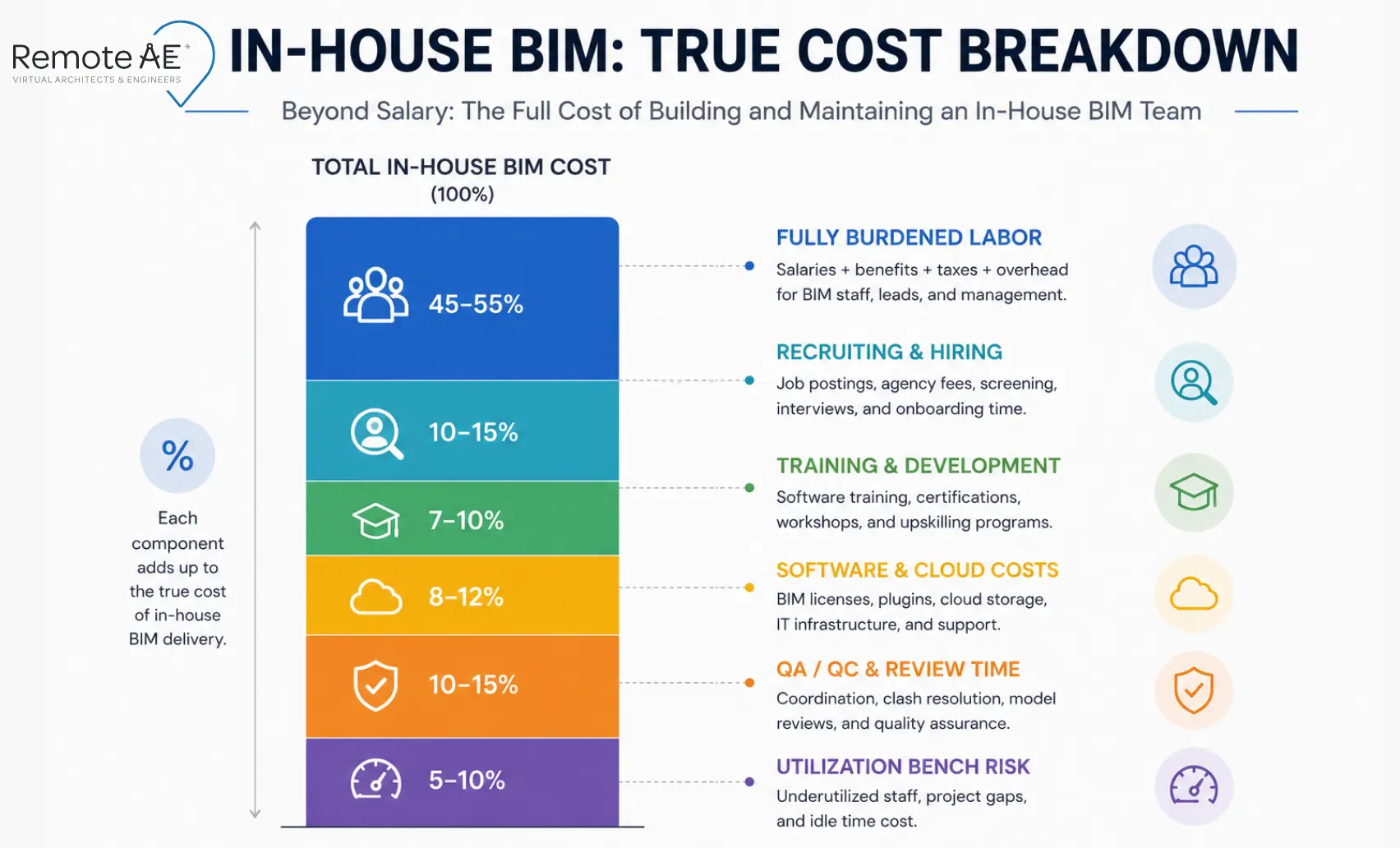
In-house BIM cost is the sum of labor, tools, ramp-up, and “bench risk.”
Base salary vs. fully burdened labor rate
The real in-house BIM team cost reflects a fully burdened labor rate.
Typical annual cost range:
| Cost Category | Estimated Range |
| Base BIM salary | $75,000–$95,000 |
| Fully burdened cost | $104,500–$135,500 |
This difference includes:
- benefits
- payroll taxes
- insurance
- management time
For firms running multi-person BIM teams, these costs scale quickly. For example, one cost benchmark shows a monthly internal BIM team expense of approximately:
$200,000 per month
This reflects the combined cost of multiple staff, infrastructure, and operational overhead.
Software, hardware, and cloud collaboration costs
BIM production requires significant technology investment.
Common costs include:
- BIM authoring software licenses
- cloud collaboration platforms
- high-performance workstations
- storage and backup systems
These costs often include platforms used in large BIM environments, such as:
- Autodesk collaboration platforms
- coordination tools
- digital model storage systems
Hardware must also support large models and high-performance rendering. Over time, technology upgrades become a recurring operational cost.
Recruiting, training, and turnover costs
Hiring BIM specialists is expensive.
Recruiting costs include:
- job advertising
- recruiter fees
- internal interview time
Once hired, new staff require onboarding.
Training includes:
- internal standards
- modeling workflows
- project coordination processes
Turnover adds another layer of risk. If an experienced BIM modeler leaves mid-project, teams must rehire and retrain. This creates hidden operational costs and project delays.
The utilization problem: paying for the bench
One of the biggest cost drivers in the in-house vs outsourced BIM cost comparison is utilization.
Internal BIM teams often operate at:
70–75% utilization
This means:
25% of payroll may produce no billable output.
This idle capacity occurs when:
- projects pause between phases
- workloads fluctuate
- Coordination cycles slow down
In contrast, outsourcing converts these fixed costs into flexible production capacity.
What Outsourced BIM Really Costs
Outsourced BIM is not “cheap labor.” It’s a cost structure change. You move from fixed cost (salary + bench time) to variable cost tied to deliverables and workload.
Hourly, weekly, and retainer-based outsourcing models
When firms evaluate BIM outsourcing vs in-house, they quickly notice that outsourced delivery models are structured differently. Instead of hiring full-time staff, companies pay for production capacity.
Common outsourcing pricing structures include:
- Hourly rates
- Weekly staffing retainers
- Project-based pricing
Typical offshore BIM hourly rates range between:
$18–$35 per hour
In comparison, internal BIM labor in high-cost markets often ranges between:
$60–$90 per hour when fully burdened.
This cost difference is why many firms begin exploring outsourced BIM services cost models for production tasks such as modeling, documentation, and clash coordination.
How outsourced BIM shifts cost from fixed to variable
The most important economic difference is how outsourcing changes the cost structure. The cost of an in-house BIM team is largely fixed. Salaries continue whether projects are active or not. Outsourcing converts these fixed costs into variable expenses tied to project work.
For example, real-world cost benchmarks show:
| Team Model | Example Monthly Cost |
| In-house BIM team | ~$200,000 |
| Fully offshore BIM team | ~$91,600 |
| Blended outsourcing model | ~$108,500 |
This illustrates why many AEC firms view outsourcing as a way to stabilize margins. Instead of paying for idle staff between project phases, firms only pay for active BIM production.
The hidden outsourcing cost: management overhead
Outsourcing is not completely hands-off.
Someone must still manage:
- coordination instructions
- modeling standards
- deliverable reviews
- QA/QC checks
This management time is the primary hidden cost in BIM outsourcing pricing. However, experienced outsourced teams like Remote AE often reduce management burden because they specialize in BIM production workflows.
Clear scopes, structured deliverables, and defined communication channels help keep management overhead low.
Quality threshold: when cheaper becomes expensive
Price alone should never drive outsourcing decisions. If outsourced BIM work lacks quality control, the cost advantage disappears quickly.
Common risks include:
- inconsistent modeling standards
- coordination errors
- poor documentation quality
These issues create rework, which erases cost savings. The most effective outsourcing partnerships combine:
- experienced BIM professionals
- clear QA/QC processes
- defined deliverable standards
When quality remains consistent, outsourcing provides both cost savings and production scalability.
In-House vs. Outsourced BIM Cost Comparison
The following table illustrates a simplified in-house vs outsourced BIM cost comparison based on industry benchmarks.
| Cost Factor | In-House BIM Team | Outsourced BIM Services |
| Annual staffing cost | $104,500–$135,500 | Project-based |
| Hourly equivalent rate | $60–$90 | $18–$35 |
| Monthly team example | ~$200,000 | ~$91,600 |
| Utilization | 70–75% | Near project demand |
| Infrastructure cost | High | Included in service |
Cost by project phase: preconstruction, coordination, construction, handover
Different BIM project phases require different staffing levels.
Preconstruction
- conceptual modeling
- early design coordination
Internal teams often handle this phase.
Coordination phase
- clash detection
- federated model updates
This phase often benefits from outsourcing because workloads spike quickly.
Construction phase
- shop drawing modeling
- construction coordination updates
Outsourced BIM teams often support contractors and consultants during this stage.
Handover phase
- as-built models
- digital twin preparation
A mix of internal leadership and outsourced production often works best.
Output-based comparisons: per head, per hour, per square foot
Another way to evaluate BIM outsourcing vs in-house is to compare production outputs.
Typical outsourced modeling benchmarks include:
| Deliverable Type | Outsourced Cost Benchmark |
| LOD 300 modeling | $0.35–$0.50 per sq ft |
| LOD 400 modeling | $0.70–$0.95 per sq ft |
These pricing benchmarks are common in BIM outsourcing proposals. They allow firms to estimate project modeling costs based on building size rather than staff count. For large projects, this output-based pricing often provides predictable budgeting.
Where a Hybrid BIM Model Makes More Sense
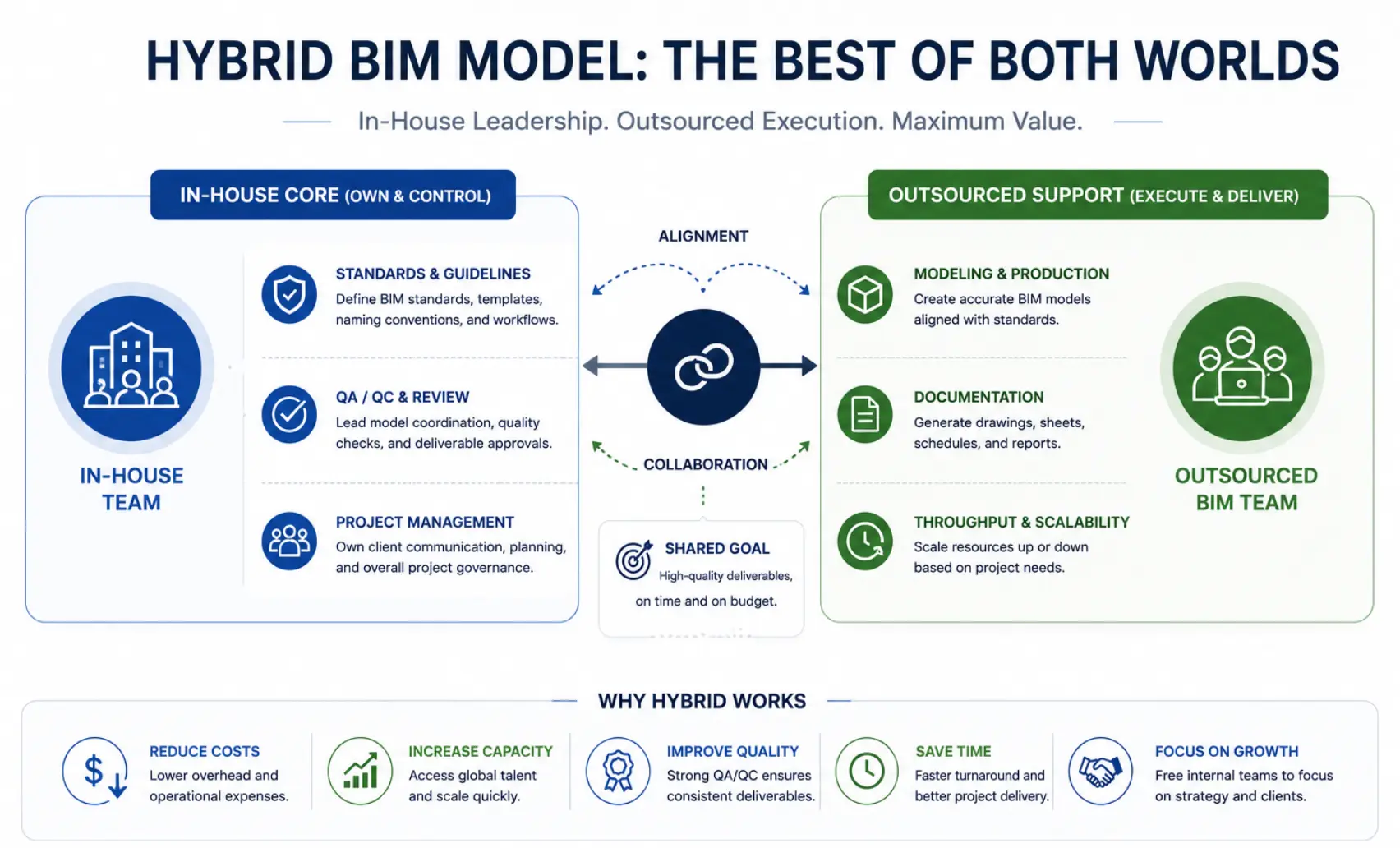
Hybrid is often the practical answer: keep strategy in-house, outsource production.
Keep strategy in-house, outsource production
Many AEC firms eventually move toward a hybrid BIM model rather than choosing a fully internal or fully outsourced approach. In this structure, strategic BIM leadership remains internal while production work is distributed externally.
Internal roles often include:
- BIM manager
- project BIM lead
- design coordination leadership
Outsourced teams support tasks such as:
- model production
- documentation updates
- clash detection preparation
- shop drawing modeling
This approach allows firms to maintain design control while scaling production capacity. It also improves the in-house vs outsourced BIM cost comparison because companies avoid hiring additional permanent staff for temporary workload spikes.
The 20/80 model for BIM delivery
A common strategy used by AEC firms is the 20/80 BIM delivery model.
In this model:
- 20% of BIM work remains internal
- 80% of production tasks are outsourced
Internal teams focus on high-value activities such as:
- BIM standards
- model strategy
- coordination leadership
External teams focus on production tasks that require scale but not strategic oversight. This model reduces the BIM staffing cost for AEC firms while preserving technical control of the project.
When a hybrid protects quality and margins
The hybrid model works best when firms face fluctuating workloads.
Common situations include:
- large coordination phases
- multi-project overlap
- contractor modeling support
Instead of expanding internal staff during busy periods, firms temporarily increase outsourced production capacity. When workloads decrease, outsourcing costs naturally decline. This flexibility helps firms maintain profit margins without carrying excess payroll.
Remote AE Cost Example
One emerging model for BIM outsourcing pricing focuses on dedicated remote assistants rather than traditional outsourcing contracts.
Remote AE provides a structured pricing approach:
- $4,999 one-time recruitment and operations fee
- $499 per week for a full-time remote assistant
This is a flexible BIM staffing model rather than large-scale outsourcing. It allows firms to add production capacity without long-term hiring commitments.
Simple 3-month and 6-month comparison versus one in-house BIM hire
To understand the difference, consider a simple comparison. A fully burdened in-house BIM employee typically costs:
$104,500–$135,500 annually
That equals approximately:
$10,900–$13,300 per month
Now compare that with the Remote AE staffing model.
| Staffing Model | 3-Month Cost | 6-Month Cost |
| In-house BIM employee | $26K–$34K | $52K–$68K |
| Remote AE assistant | ~$10,486 | ~$16,973 |
Best-fit tasks to outsource first
Firms testing BIM outsourcing vs in-house often start with production-heavy tasks.
Typical outsourcing candidates include:
- model cleanup and updates
- clash detection preparation
- documentation extraction
- shop drawing support
- as-built model updates
These tasks require technical skill but not constant strategic oversight. Outsourcing them allows internal teams to focus on higher-value design work.
When to Keep BIM In-House
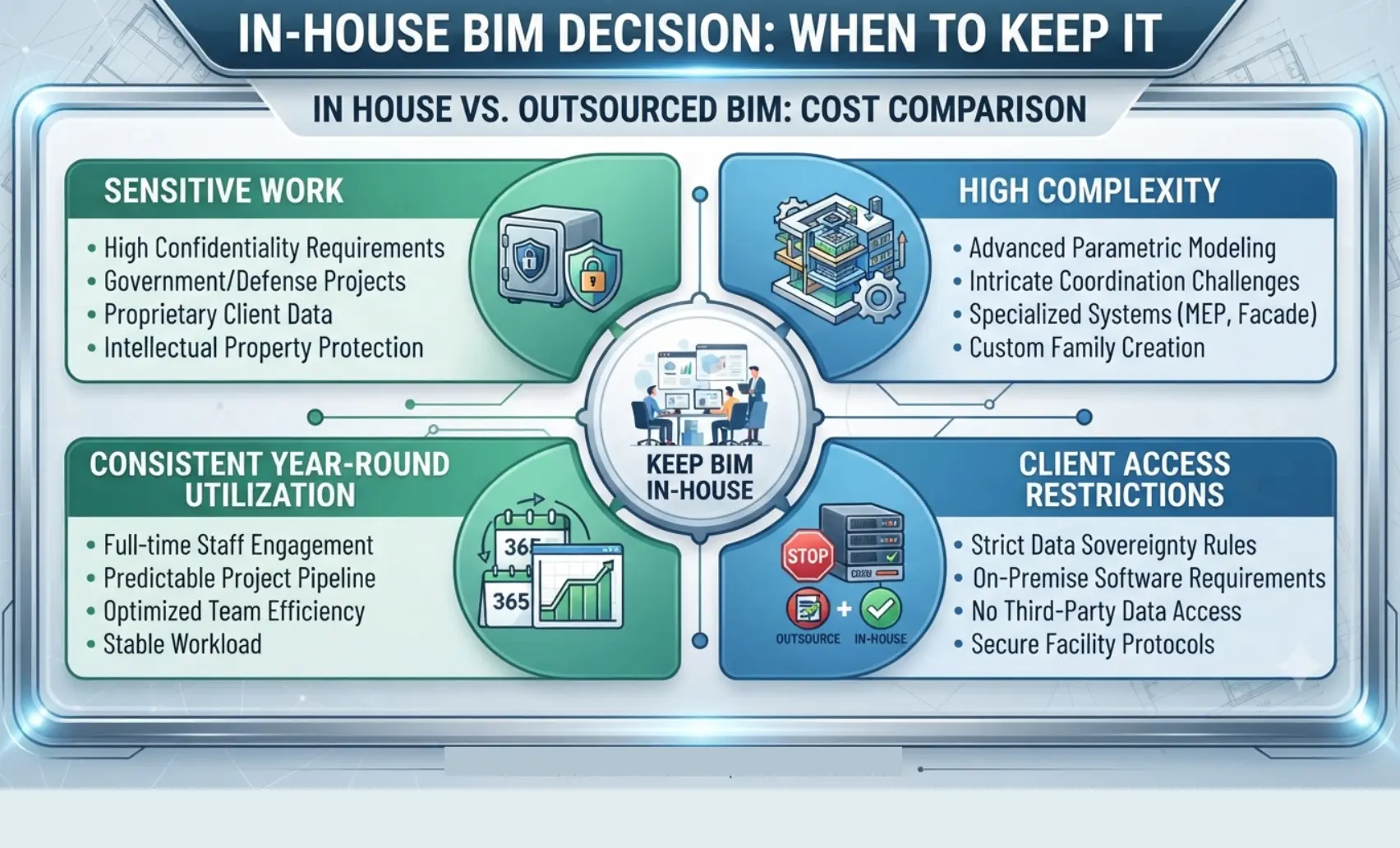
Outsourcing is not a fit for every BIM function. Some work is too sensitive, too complex, or too restricted.
Sensitive, highly complex, or client-restricted projects
Some projects require strict internal control.
Examples include:
- government or defense contracts
- confidential design projects
- projects with strict security requirements
In these situations, firms may keep BIM production internal to maintain tighter data control.
Cases with consistent year-round utilization
If a firm consistently runs large BIM projects with minimal downtime, internal teams may be more economical. High utilization improves cost efficiency.
For firms maintaining 90% or higher utilization, the cost difference between outsourcing and internal staffing narrows. However, many firms still combine internal staff with outsourced support to manage peak workloads.
How to Decide
Choosing between BIM outsourcing vs in-house is not only a financial decision. It also depends on project type, staffing stability, and long-term delivery strategy. AEC leaders should evaluate both cost structure and operational flexibility before expanding internal BIM teams or committing to long-term outsourcing contracts.
5-question decision checklist
Use this quick checklist when evaluating the in-house vs outsourced BIM cost comparison for your firm.
- What is your current BIM utilization rate?
If your internal team operates at 70–75% utilization, you may be paying for idle capacity. Outsourcing can absorb production spikes without expanding payroll. - How predictable is your project pipeline?
Firms with inconsistent workloads often benefit from outsourced BIM services cost models, because staffing can expand or shrink with project demand. - Which tasks require strategic oversight?
High-value BIM tasks, standards management, coordination leadership, and client communication are usually better handled internally. Production-heavy tasks can often be outsourced. - Do you need flexible scaling during coordination phases?
Many projects experience BIM workload spikes during clash detection and coordination. Outsourcing helps handle those peaks without hiring permanent staff. - What level of quality control do you require?
Successful outsourcing partnerships depend on strong QA/QC processes and clear modeling standards.
If those systems are in place, outsourcing can deliver consistent results.
Pilot project approach for firms moving to hybrid
Firms unsure about outsourcing often start with a pilot project.
A pilot allows teams to test a hybrid BIM model without restructuring their entire workflow.
Typical pilot steps include:
- Select a single project phase (for example, coordination modeling).
- Assign internal BIM leadership to manage standards.
- Use outsourced resources for production modeling.
- Track cost, quality, and turnaround time.
After one or two projects, firms can evaluate whether outsourcing improves productivity. Many AEC firms discover that hybrid delivery improves both efficiency and profitability.
Reduce BIM Production Costs Without Expanding Your Team!
If your firm wants to scale BIM production without adding permanent staff, a flexible staffing model may be the better option. Remote AE provides experienced AEC professionals who support BIM modeling, coordination, and documentation tasks under your firm’s standards. Instead of carrying the cost of full-time hires, you gain scalable production capacity that adjusts to project demand.
With pricing starting from $499 per week, firms can test outsourced BIM support without long-term commitments or hiring risk.
Schedule a call with Remote AE for a fast scope review and a clear weekly quote.
FAQs – In-House vs. Outsourced BIM
Is outsourcing BIM cheaper than hiring in-house?
Usually, yes, for firms that need flexible capacity. In-house BIM adds salary, benefits, software, hardware, and management overhead, while outsourcing converts much of that into a variable project cost. Freelance Revit specialists on Upwork are commonly listed at around $17–$25/hour, which is often below the fully loaded in-house cost.
What hidden costs make in-house BIM more expensive?
The missed items are usually benefits, payroll taxes, recruiting, onboarding, software seats, high-spec hardware, training time, and senior staff review time. Cloud collaboration and BIM workflows also require ongoing admin and coordination effort, which makes the true cost of an internal team higher than salary alone.
How much does outsourced BIM cost per hour or per square foot?
Hourly pricing is more common than per-square-foot pricing for outsourced BIM. Market-facing freelance Revit work is often shown around $17–$25/hour on Upwork, while more specialized BIM coordination and managed services usually price higher. Per-square-foot rates vary too much by LOD, trade, and scope to use one reliable benchmark.
When is an in-house BIM team worth the cost?
An in-house team makes more sense when BIM is core to your delivery model, you have a steady year-round workload, proprietary standards, or frequent live coordination with internal design leads. It also fits firms that need tighter control over QA, family libraries, and long-term digital standards.
What is the biggest risk of BIM outsourcing?
The biggest risk is usually scope and coordination drift, not the modeling itself. If standards, naming, revisions, and change management are vague, remote teams can deliver technically correct models that still do not match your internal expectations or downstream workflows.