
Data center construction document (CD) production breaks normal workflows. Fast-track delivery overlaps design and construction. Phased permits split packages. MEP density pushes coordination across power, cooling, controls, and pathways. And change never stops, OEM updates, tenant needs, and utility constraints keep hitting sheets. The risk is real money. Delays in data center construction can cost $14.2M per month (STL Partners, 2025). That is where mission-critical data center construction documentation services with dedicated remote capacity make the difference.
Remote AE provides senior-level drafting support that works inside your standards. You keep control. We carry the production load. The result is faster turnarounds, fewer redline backlogs, and cleaner data center as-built drawing services without hiring delays or rework cycles.
Why Data Center CDs Break Typical Production Workflows
Data centers compress schedules and multiply coordination points. That combination overwhelms typical CD staffing.
Fast-track delivery and phased permits (why packages matter)
Data centers rarely wait for a single permit cycle. Teams issue shell permits, then power, then cooling, then tenant fit-outs. Each package must stand alone yet remain aligned. One missed change creates weeks of redline cleanup. That pace overwhelms traditional production models.
Mission-critical MEP density (power + cooling + controls)
A data center CD set holds more MEP content than most hospitals. UPS layouts, generator yards, chilled water loops, and BMS interfaces stack into every room. Coordination errors hide in these overlaps. That is why mission-critical construction documentation services require senior production, not junior drafting.
High change volume (tenant needs, OEM updates, utility constraints)
Vendors revise specs. Utilities shift transformer locations. Tenants change rack density. Each update forces data center drawing revisions support across electrical, mechanical, and architectural sheets. Without extra capacity, in-house teams fall behind within days.
What’s Included In Data Center Construction Document Sets
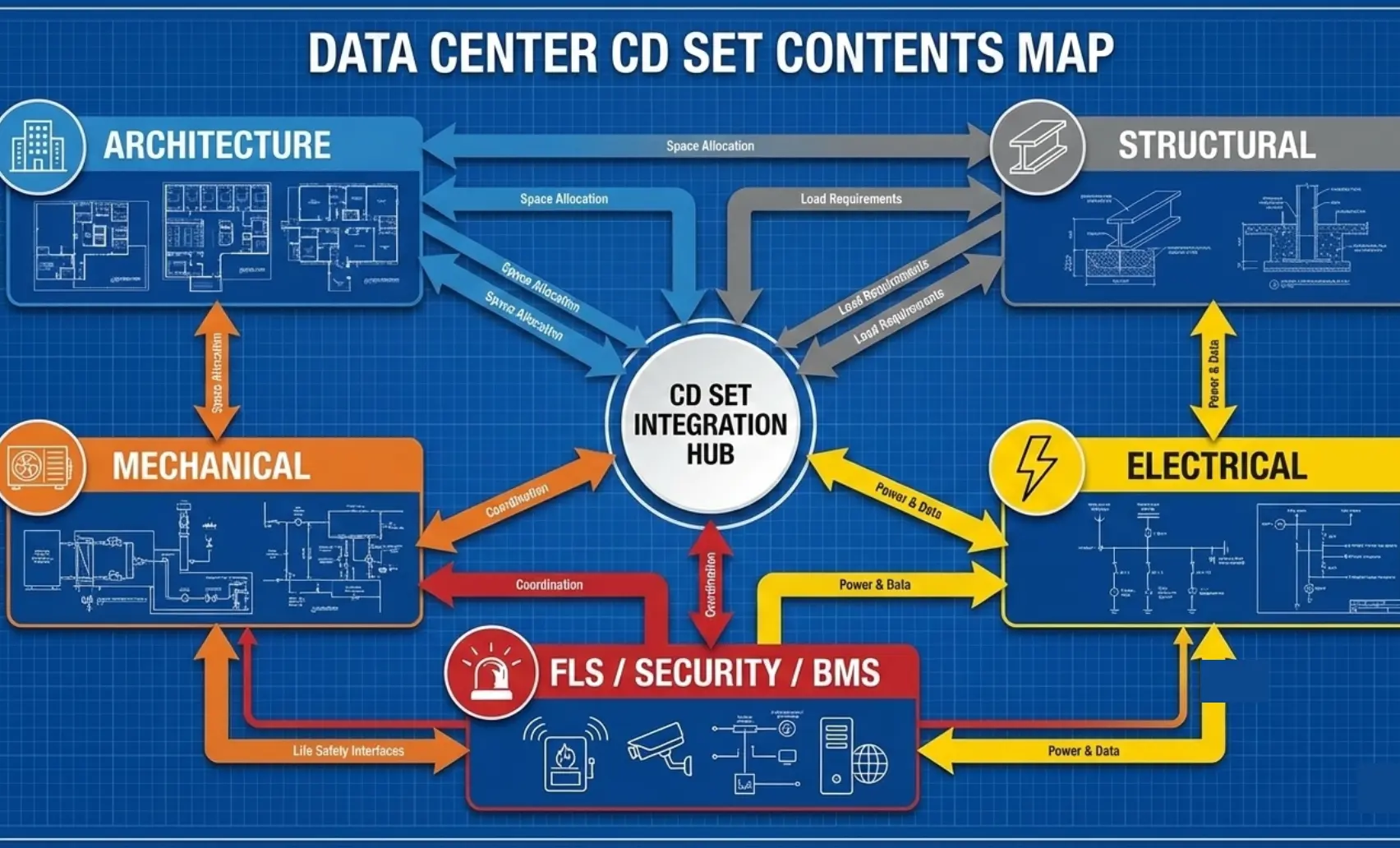
Data center CD sets aren’t “just drawings.” They are the coordination contract your field team builds from. ANSI/TIA-942 also frames the scope reality: data center physical infrastructure touches architectural, electrical, mechanical, fire safety, telecom, and security.
Architectural CDs
Architectural CDs must protect equipment access and maintenance. Missed clearances turn into field rework. These sets include floor plans, room data sheets, equipment clearances, access zones, and finish schedules. Remote AE handles late-stage updates and keeps architectural CDs aligned with evolving MEP requirements.
Structural CDs
Data centers depend on precision. Pads, housekeeping, embeds, equipment frames, and seismic supports must align with real equipment loads. Our assistants process updates quickly, so structural drawings never lag behind vendor changes.
Mechanical CDs
Mechanical CDs must keep the cooling intent intact under constant revision pressure. So, cooling plants, CRAH/CRAC layouts, piping schematics, control points, and airflow details dominate these packages. Remote AE supports data center mechanical drafting services that keep thermal strategies intact through fast revisions.
Electrical CDs
Power never stops. UPS rooms, generator yards, one-lines, grounding plans, and pathways form the backbone of every project. Our team provides data center electrical drafting services that protect redundancy paths and maintain coordination across trades.
Fire/life safety + security + BMS integrations
Interfaces matter. Sequences must line up with control drawings. Remote AE manages these cross-disciplinary connections so compliance issues do not surface late.
Permit sets vs. IFC sets
Permit sets aim for approval. IFC sets an aim to build. Confusing the two causes requires rework. Our data center construction documentation services separate these tracks so each package meets its real purpose.
Mission Critical Construction Documentation Services
Owner’s reps and developer PMs don’t need “more people.” They need a reliable production capacity that already understands mission-critical spaces and can keep CDs moving week to week.
What Owner’s Reps Actually Need
Mission-critical construction documentation services exist to protect schedules when internal teams hit capacity limits.
In data centers, reliability comes from people who already understand:
- UPS room zoning and clearances
- Generator exhaust routing
- CRAH / CRAC spacing logic
- Rack power paths and maintenance envelopes
These are not tasks for junior staff. They demand senior-level drafting that stays accurate across dozens of change cycles. Remote AE assigns assistants with a real mission-critical background, so CD packages do not reset every time a new phase starts.
How Remote AE Supports Data Center CD Production
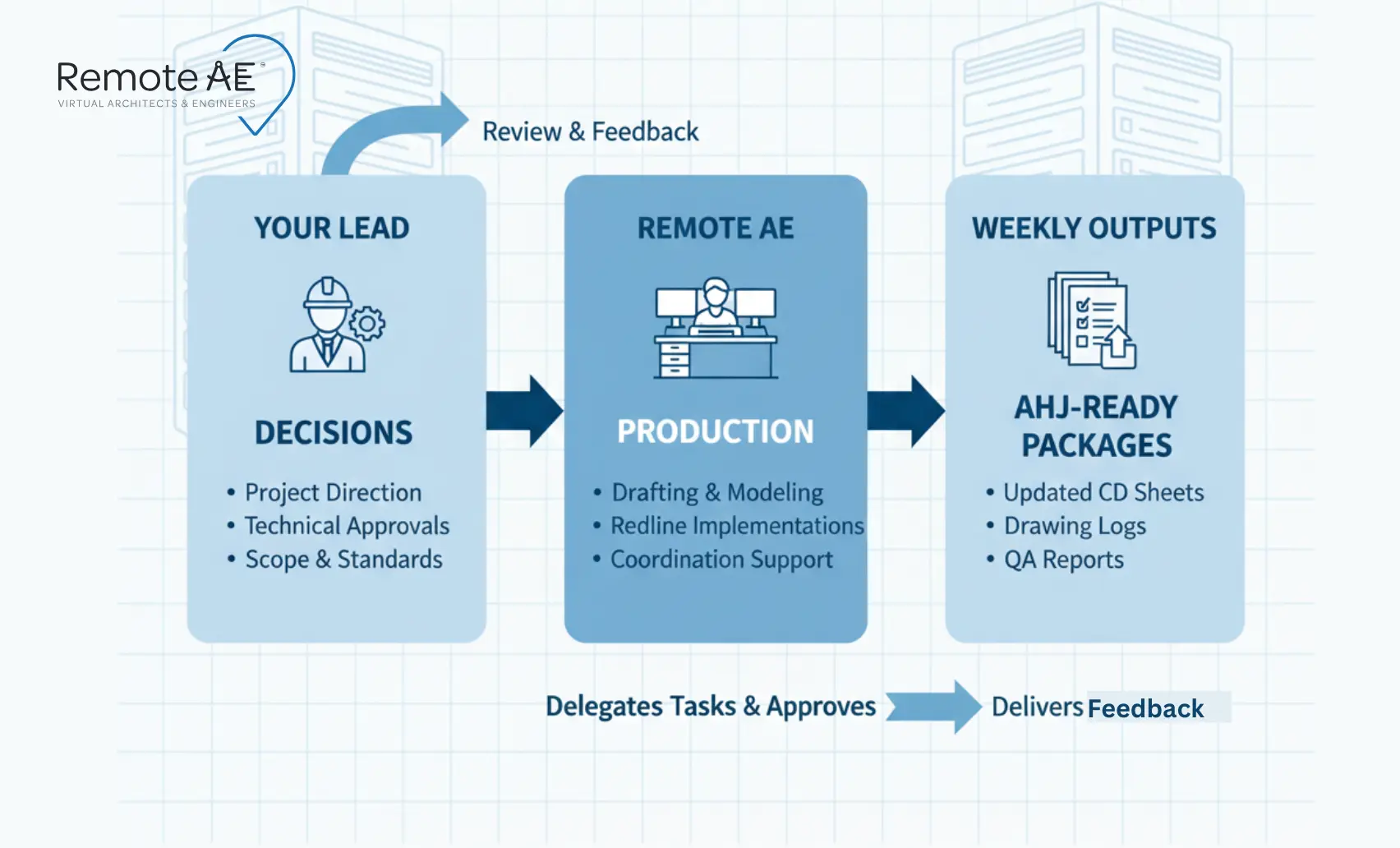
Remote AE’s value is straightforward: your engineers make decisions. Remote AE supplies production output within your standards.
Production capacity on demand
Remote AE ramps staff in days, not months. Weekly pricing replaces long hiring cycles. You gain immediate drafting capacity when a CD phase surges or when a permit package expands. Hiring delays are real. AGC reports widespread difficulty filling salaried roles.
What your Remote AE assistant handles
Our assistants cover the full scope of data center construction documentation services:
- BIM / VDC drafting
- MEP construction drawings
- DD to CD conversion
- Equipment schedules
- Permit drawing sets
- Project coordination logs
This includes data center redline to CAD services and data center as-built drawing services, so documentation never falls behind construction reality.
Weekly staffing that matches fast-track reality
Data centers move in bursts. One week is quiet. The next is a flood of redlines. Weekly staffing lets you scale up or down without renegotiating contracts or restarting training.
Continuity
Your assistant stays with the project. No handoff loss. No reset of context. This continuity prevents drawing drift across phases and keeps revision histories intact.
Remote CD production support workflow
A workflow matters more than a headcount. This is how Remote AE can plug into live data center CD production without changing your process.
Intake
You share standards, templates, sheet index, BIM execution plan, and naming rules. Remote AE configures access inside your environment.
Production lanes
Work splits cleanly into BIM/VDC drafting, MEP sheets, DD/CD production, and permit exhibits. Each lane runs in parallel, not in sequence.
Coordination cadence
Our team supports clash logs, RFI documentation, markups, and bulletin packages. That structure turns data center drawing revisions support into a predictable rhythm.
QA gates
Model-to-sheet checks, annotation reviews, and cross-reference audits occur before every handoff. Errors stop at the gate, not in the field.
Remote AE Engagement Model And What You Get
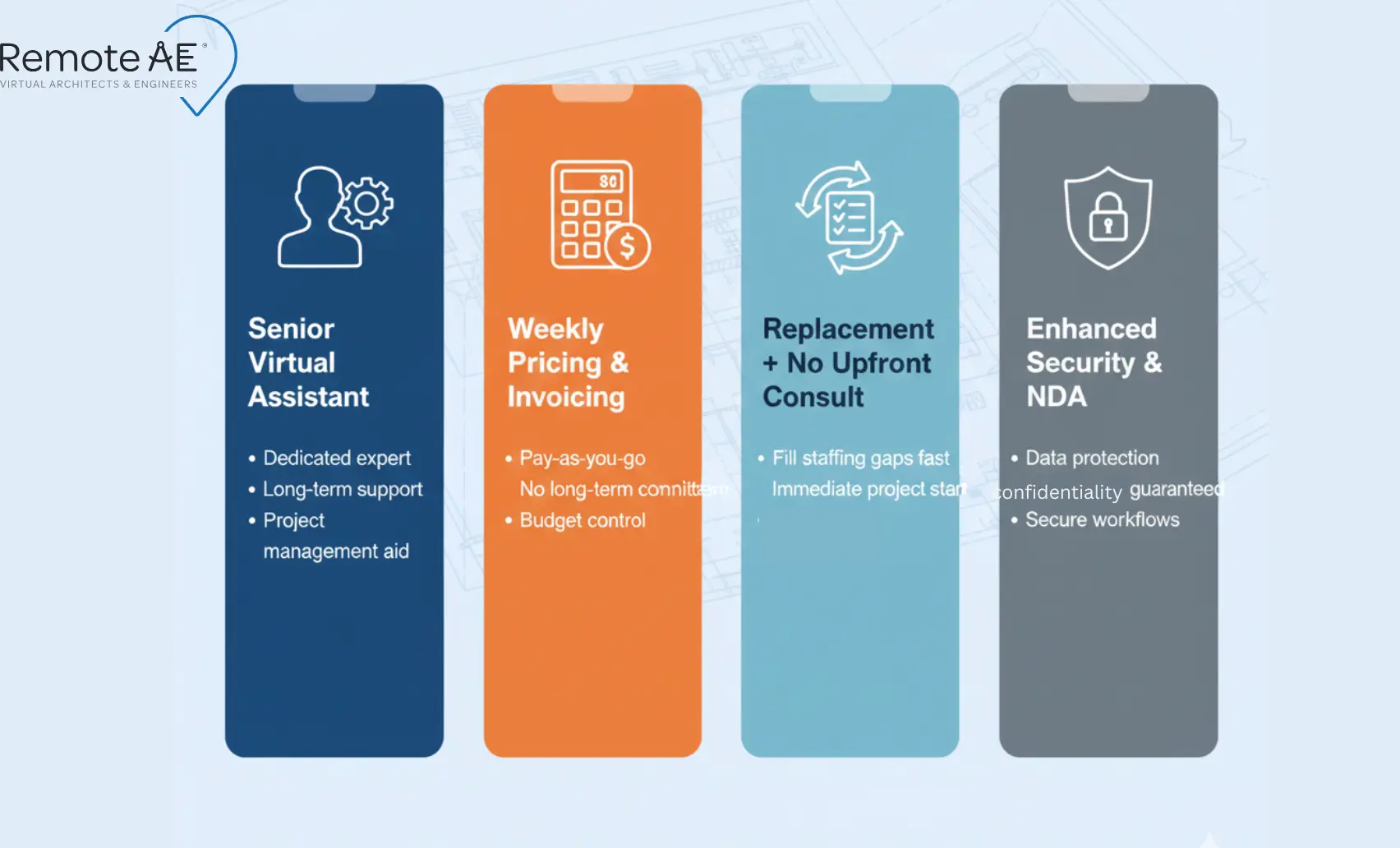
- Senior virtual assistants: Every assistant assigned to data center construction documentation services has over 15 years of AEC production experience. No training from scratch.
- Weekly pricing: Scale up during permit pushes. Scale down after IFC. No lock-ins.
- Risk-free replacement + no upfront consult cost: If the fit is wrong, we replace it fast. No downtime. No cost to start.
- Security & confidentiality: NDAs, access controls, and redaction practices protect sensitive mission-critical data.
How Remote AE Fits Into Your Existing Team?
Remote AE works alongside your engineers, designers, and VDC leads. No workflow changes are required.
We use:
- Your standards
- Your templates
- Your file structures
You retain control. We supply production depth. This model supports mission-critical construction document services without adding management burden to already stretched teams.
Keep Data Center CD Production Moving!
Mission-critical schedules don’t allow CD production to drift. If your team is drowning in redlines, phased packages, and change volume, add steady weekly output without a hiring cycle. Remote AE delivers data center construction documentation services built for fast-track, mission-critical programs. From permit sets to IFC packages, from data center redline to CAD services to full data center as-built drawing services, our teams keep documentation current through every phase.
Schedule a call to scope your CD workload and get a weekly production plan.
FAQs – Data Center Construction Documentation Services
How do fast-track data centers handle phased permitting without creating rework?
Fast-track teams split packages into site, shell, and core MEP phases with locked milestones. Each phase has frozen backgrounds, a change log, and a revision gate. This prevents later electrical or mechanical changes from breaking already-permitted scopes while still allowing parallel design and procurement to continue.
What drawings are most likely to trigger RFIs on data center projects?
RFIs most often come from electrical one-lines, power room layouts, chilled-water piping, busway routing, and fire/life-safety interfaces. These sheets combine many systems in tight spaces, so even small coordination gaps or ambiguous notes can ripple into field questions very quickly.
How do you keep BIM models and sheet sets from drifting during addenda?
Use a strict version-control rule. Every addendum includes a changed-sheet list, model revision tag, and a short delta summary. Lock prior versions in your CDE and require model updates to reference the addendum number, not just “latest,” so teams don’t overwrite approved work.
Can a remote team produce MEP and electrical sheets under a U.S. engineer’s standards?
Yes. Remote teams work inside your Revit templates, title blocks, and QA checklists. They draft and model, while your licensed U.S. engineer retains responsible control, reviews outputs, and stamps.