

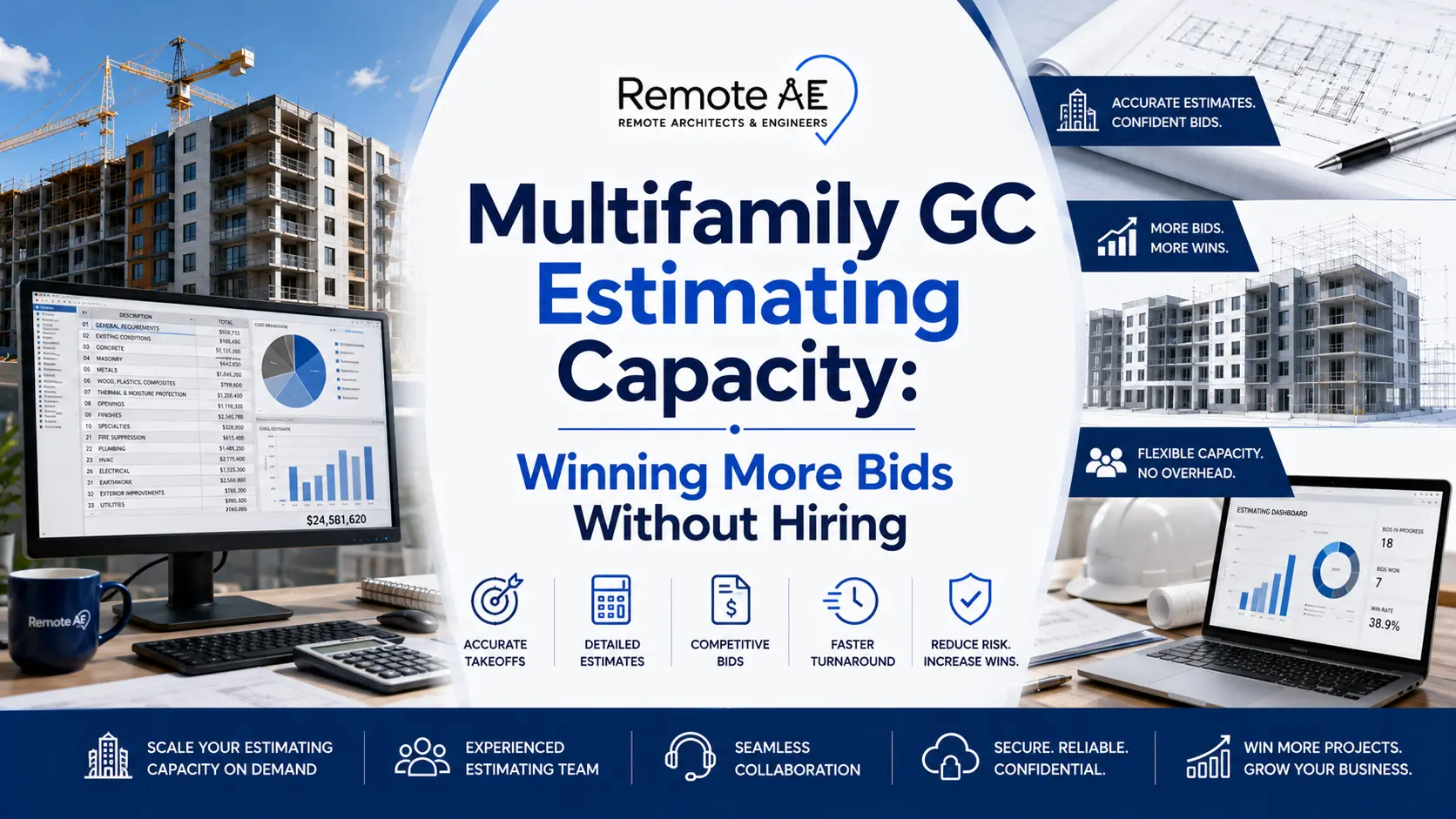
Bid awards come from two inputs: hit rate and bid volume. Nearly all preconstruction improvement effort goes into the first. The second is capped by multifamily estimating capacity- how many takeoff packages your team can actually carry in a given week- and that ceiling is rarely tracked, rarely budgeted, and rarely discussed as a revenue constraint. The demand is not the problem. NAHB reported that multifamily permits grew 7.1% year over year in Q1 2026 to 121,404 units, while single-family permits fell 7.6%. Rental work is where the bid opportunities are concentrated right now. The lever is this: multifamily takeoff is the most repetitive, most delegable production work in preconstruction. Add capacity there, and bid volume rises without a salaried estimator landing on overhead, and without pricing authority ever leaving the chief estimator’s desk.
Your bid board is the constraint, not your pipeline. Book a 30-minute consultation, and we’ll map your multifamily bid calendar against the takeoff capacity you’d need to cover it.
Key Takeaways
- Three or more multifamily bids declined in one quarter for scheduling reasons means estimating backlog, not strategy, is capping revenue.
- A 220-unit community with six unit types is six takeoff problems, each priced once and multiplied across the unit matrix.
- Subcontractor response rates run 9 to 15% per ConstructConnect, making three responsive bids per trade the practical floor for competitiveness.
- Estimating and preconstruction roles remain vacant for 60 to 90 days or more, so hiring rarely closes a bid-capacity gap quickly enough.
- Repetitive multifamily takeoff sits in CSI Divisions 06, 09, and 22, which delegate cleanly while pricing and contingency stay in-house.
- A GC bidding only two multifamily projects a year should buy individual takeoffs rather than fund dedicated estimating staff.
Bid volume drives wins, and multifamily estimating capacity is what caps volume
The arithmetic nobody puts on the whiteboard
Awards equal bid hit rate multiplied by bids submitted. That’s the whole equation, and it has exactly two variables.
Moving the first one is slow work. Hit rate improves through relationship depth, prequalification standing, sharper subcontractor coverage, and a number that lands closer to the owner’s expectation. Real gains there take quarters, sometimes years.
Moving the second is mechanical. ConstructConnect places competitive private work in a directional 15% to 25% win-rate range, with hard-bid public work running 10% to 20% and negotiated or repeat-client work higher.
Take the middle of that range as an illustrative example: a firm converting one in five qualified pursuits wins four out of twenty. Submit twenty-six of the same quality and the same conversion rate produces roughly five.
That additional award required no better relationships, no sharper pricing, no change to the firm at all. It required six more weeks of takeoff capacity spread across a year.
The lever most GCs quietly stopped pulling
Ask a preconstruction lead why they passed on a project, and you’ll usually get a reasoned answer: margin looked thin, the owner was unknown, the schedule was aggressive. Ask which week the package landed, and a different answer often surfaces.
ConstructConnect’s own framing of bid cost includes estimator hours, takeoff, plan review, and the opportunity cost of the bids you skipped. That last line item is the one no accounting system captures.
There is no ledger entry for the 240-unit garden-style package that arrived on a Tuesday when two other bids were already open.
Takeoff capacity is the binding constraint, and it behaves like a hard ceiling rather than a soft one. A team that can carry three concurrent multifamily packages does not carry four by trying harder.
The fourth gets declined, deprioritized, or bid thin, and a thin bid on a real opportunity is worse than no bid at all. This is the structural case for outsourcing multifamily production work rather than absorbing it internally.
One Gap worth stating plainly
More bids is not automatically better. Bidding more of the wrong work burns estimator hours, dilutes the attention on pursuits you should win, and drags average margin down. Volume only helps when it’s qualified volume.
Which is the actual argument for capacity. When the takeoff board is full, the calendar becomes the bid-no-bid filter and has no opinion about owner quality, scope fit, or competitive position.
Capacity doesn’t make you less selective. It’s what lets you stay selective while still putting a number on every multifamily opportunity that meets your criteria.
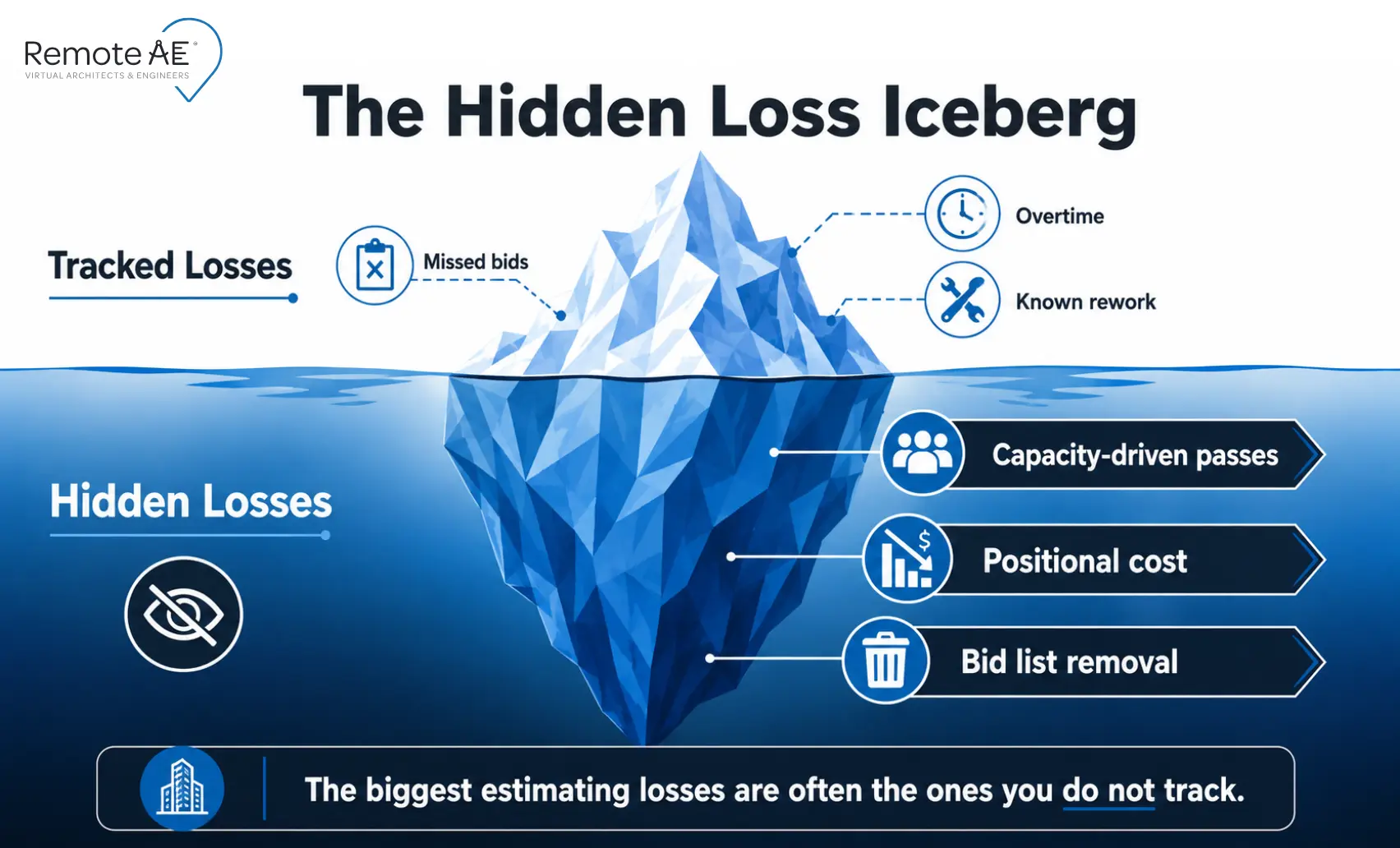
The no-bids you never recorded as decisions
Capacity triage is not bid-no-bid discipline
A real bid-no-bid decision weighs owner quality, scope fit, competitive position, risk, and the fee against the cost of chasing it. It produces a documented rationale you can review against win-loss data later.
Capacity triage produces none of that. It produces a pass, delivered fast, with a reason attached afterward. The package that arrives during a full bid week gets measured against the calendar first and the criteria second, if at all. Everyone on the call knows the difference, and nobody writes it down.
The distinction matters because the two failure modes need opposite fixes. A firm losing on fit needs a tighter scoring framework. A firm losing on calendar needs production hours. Applying the first remedy to the second problem produces a very disciplined firm that still can’t bid.
What a silent pass actually costs
The lost fee is the obvious half. The half that compounds is positional.
Multifamily developers and the architects serving them run repeat pipelines. A developer with four garden-style communities in a metro is going to bid all four, usually to a familiar list.
Decline the first because bid week was full, and you are not on the list for the second- not because anyone was unhappy, but because bid lists get built from who showed up. Subcontractor relationships work the same way: the trades that quoted you last time are the ones who answer next time.
One capacity-driven pass removes you from a sequence, not a project.
Estimating backlog as a leading indicator
The number worth watching is not win rate. It’s the count of packages your team declined in the last quarter where the stated reason was schedule, staffing, or timing.
If that count is zero, capacity is not your constraint, and this article isn’t for you. If it’s three or more, your estimating backlog is setting your revenue ceiling, and no amount of bid-strategy refinement moves it. The backlog is a production problem wearing a strategy costume.
Why Multifamily Is The Cleanest Place To Add Estimating Capacity
The unit-type multiplier cuts both ways
A 220-unit community with six unit types is not 220 takeoff problems. It’s six, priced once and multiplied across the unit matrix, plus the corridors, cores, amenity spaces, and site work that don’t repeat.
That structure is what makes multifamily uniquely suited to delegated production. Get one Type A one-bedroom quantified correctly- gypsum board, framing, finishes, plumbing fixture count- and the accuracy propagates across every instance of that type in the building. The leverage is multiplicative, not linear.
The same arithmetic runs in reverse, which is why multifamily quantity takeoff support lives or dies on its QC process. A miscounted fixture in one unit type is a miscounted fixture 40 times over by the time it reaches the bid form.
Countable divisions and judgment divisions
Not all of a multifamily bid delegates equally, and pretending otherwise is how outsourcing engagements fail.
The countable work sits in the repetitive CSI divisions: Division 06 rough carpentry and framing, Division 09 finishes, the fixture counts feeding Division 22. These scopes are governed by drawings, schedules, and quantities. They reward patience and consistency, and they consume the largest share of raw takeoff hours.
The judgment work sits everywhere else: sitework and earthwork variability, structural transitions in podium and wrap buildings, MEP coordination assumptions, phasing, general conditions. These need someone who has built the type. They are not delegable and should not be.
Capacity is a per-door number, not an hourly one
Developers underwrite per door. Your preconstruction cost behaves the same way, whether or not anyone expresses it that way.
A dedicated production resource carrying repetitive takeoff across a quarter of bids spreads across every unit in every package pursued, including the ones you didn’t win, which is the correct way to count it.
Framing the conversation that way puts preconstruction investment in the same unit as the pro forma it’s chasing, and it’s the same logic that governs cost per door rather than cost per hour on the design side of the business.
Count the multifamily packages you passed on last quarter for scheduling reasons. Bring that number to a free consultation, and we’ll show you what covering it would take.
Bid day and the feast-or-famine week
Demand arrives in clusters, not in a flow
Multifamily bid opportunities do not distribute themselves evenly. They cluster, because the things that release them cluster: entitlement approvals landing together, a developer pushing three communities to market in the same funding window, an architect issuing permit sets from the same production sprint.
The result is a preconstruction calendar that looks nothing like a staffing plan. Two weeks with three concurrent packages, then ten days where the estimating team has room to breathe and nothing urgent to fill it.
The average across the quarter looks perfectly manageable. The average is not what your team experiences. Hiring solves for the average. Bid days happen at the peak.
Addendum reconciliation is where the week actually goes
The hours that break a bid week are rarely the initial takeoff. That work is plannable; it lands with the package and can be scheduled.
What isn’t plannable is the addendum. A revised unit plan issued four days out means re-running quantities across every instance of that unit type, reconciling what changed against what your subs already quoted, and reissuing clarifications to the trades affected.
On a repetitive multifamily package, one addendum touching one unit type generates disproportionate rework precisely because of the multiplier that made the original takeoff efficient.
Layer in the administrative tail, logging addenda, confirming receipt, tracking which subcontractors quoted against which revision, and a significant share of bid-day hours is spent on work that requires diligence rather than judgment.
Subcontractor coverage and the scope gap problem
Coverage is a volume game of its own. ConstructConnect’s interview research with commercial GCs puts typical subcontractor response rates at 9–15%, and identifies three responsive bids per trade as the practical floor for building a competitive number.
Getting to that floor across every division on a multifamily package takes solicitation, follow-up, and tracking- hours that scale with trade count, not project value. And when coverage is thin, the scope gap risk rises: the space between what one sub included and what the next assumed, discovered either in your bid review or, expensively, after award.
Scope gap identification is estimator judgment. Building the coverage matrix that makes the gaps visible is production work, and it’s the first thing that gets rushed when three packages are open at once.
Fixed headcount against a variable curve
A salaried estimator is a flat line. Bid demand is a sawtooth. Overlay them, and you get two costs running simultaneously: unbilled capacity during the troughs, and declined opportunities at the peaks.
Most firms notice only the first, because idle payroll shows up on a P&L and a passed bid doesn’t. The second is almost always the larger number.
Graphic: “Demand vs. Headcount” (line chart — spiky bid demand curve overlaid on a flat fixed-headcount line, gaps labeled peak and trough)
Bid workload by multifamily project size
The table below maps typical multifamily bid packages to the scope drivers that determine workload and to the portion of that work that delegates cleanly.
It deliberately carries no hour figures; real preconstruction hours vary too widely by delivery method, drawing completeness, and trade coverage for a published range to mean anything useful for your firm.
| Project profile | Primary scope drivers | Workload concentration | Cleanly delegable |
| Garden-style, 100–250 units | 4–8 unit types across repeated building footprints; extensive sitework; surface parking | Unit-type takeoff × building count; sitework variability | High, repetitive divisions dominate; unit matrix drives most quantities |
| Wrap, 200–350 units | Structured parking wrapped by residential; single-podium interface; corridor and core repetition | Parking structure interface; corridor linear-foot quantities | Moderate to high, unit and corridor scopes delegate; structural transition does not |
| Podium mid-rise, 150–300 units | Type IIIA over Type IA transition; amenity deck; concrete-to-wood-frame interface | Structural transition detailing; amenity and podium-level scopes | Moderate, residential levels delegate cleanly; podium level needs judgment |
| High-rise, 250+ units | Type IA construction; vertical transportation; complex MEP risers | MEP coordination assumptions; logistics and general conditions | Lower repetition still helps, but coordination and phasing dominate |
| Build-to-rent, 100–200 units | Detached or attached units on platted lots; repetition at plan level rather than building level | Plan-type takeoff × lot count; site infrastructure | High, plan repetition is the cleanest multiplier in the sector |
Read across any row, and the pattern holds: the higher the repetition, the larger the share of the package that can be produced by a dedicated support resource before the chief estimator ever opens the file.
Garden-style and build-to-rent sit at the top of that list, which is also where the highest permit volume currently is, and where regional bid density is heaviest, particularly across Texas multifamily markets like Austin, Dallas, and Houston.
Translate that into a weekly capacity statement rather than a project statement. The relevant question is not “can we bid this project,” but “how many concurrent packages can we carry in a peak week without thinning any of them”, and then whether that number matches your pipeline.
What a remote estimating assistant handles, and what the chief estimator never gives up
The engagements that work draw a hard line before the first package, not during it. Everything on the left is production. Everything on the right is judgment, and it stays where it is.
Handled by remote estimating support:
- Quantity takeoff by unit type, run against the unit matrix and unit-type schedule
- Assembly takeoffs for repetitive divisions, framing, gypsum board, finishes, fixture counts
- Quantity worksheets structured to your template, ready for pricing
- Addendum logs and quantity reconciliation when drawings are revised
- Invitation-to-bid distribution tracking and subcontractor response follow-up
- Subcontractor coverage matrices by trade, flagging where coverage falls short
- Bid form assembly and document control through submission
Retained by the chief estimator:
- All pricing, unit rates, escalation, labor productivity assumptions
- Means and methods, phasing, and general conditions
- Risk assessment and contingency
- Scope gap judgment: what one sub included that another assumed
- Subcontractor qualification and selection
- The final number and the signature on the bid form
The scope statement
Remote AE provides production and documentation support. It does not provide cost consulting, pricing opinions, or any work requiring professional licensure or a stamp. The estimator of record retains full responsibility for pricing decisions, scope interpretation, and the bid submitted under your firm’s name.
That boundary is not a limitation to work around. It’s what makes the model safe to run. Quantities are verifiable against drawings; pricing is a commercial judgment about your market, your trades, and your risk tolerance. Only one of those travels.
The QC handoff
Delegated takeoff is only useful if it arrives at a standard the estimator can price without re-checking. That means quantities cross-referenced against the unit-type schedule before delivery, deviations from the previous revision flagged rather than silently overwritten, and any assumption made in the absence of clear drawing information raised as a question instead of a guess.
An assumption logged is a two-minute conversation. An assumption buried is a scope gap you find after award.
How Remote AE adds multifamily estimating capacity without a hire
Remote AE places dedicated offshore preconstruction staff with US general contractors, one person, working your hours, on your takeoff software, inside your templates and your bid calendar.
They learn how your firm structures a quantity worksheet and how your chief estimator likes assumptions flagged, and that knowledge compounds across every package rather than resetting with each engagement.
That is the difference between adding capacity and buying deliverables. A per-bid vendor produces a takeoff. A dedicated resource produces a takeoff the way your team does it.
The timeline argument
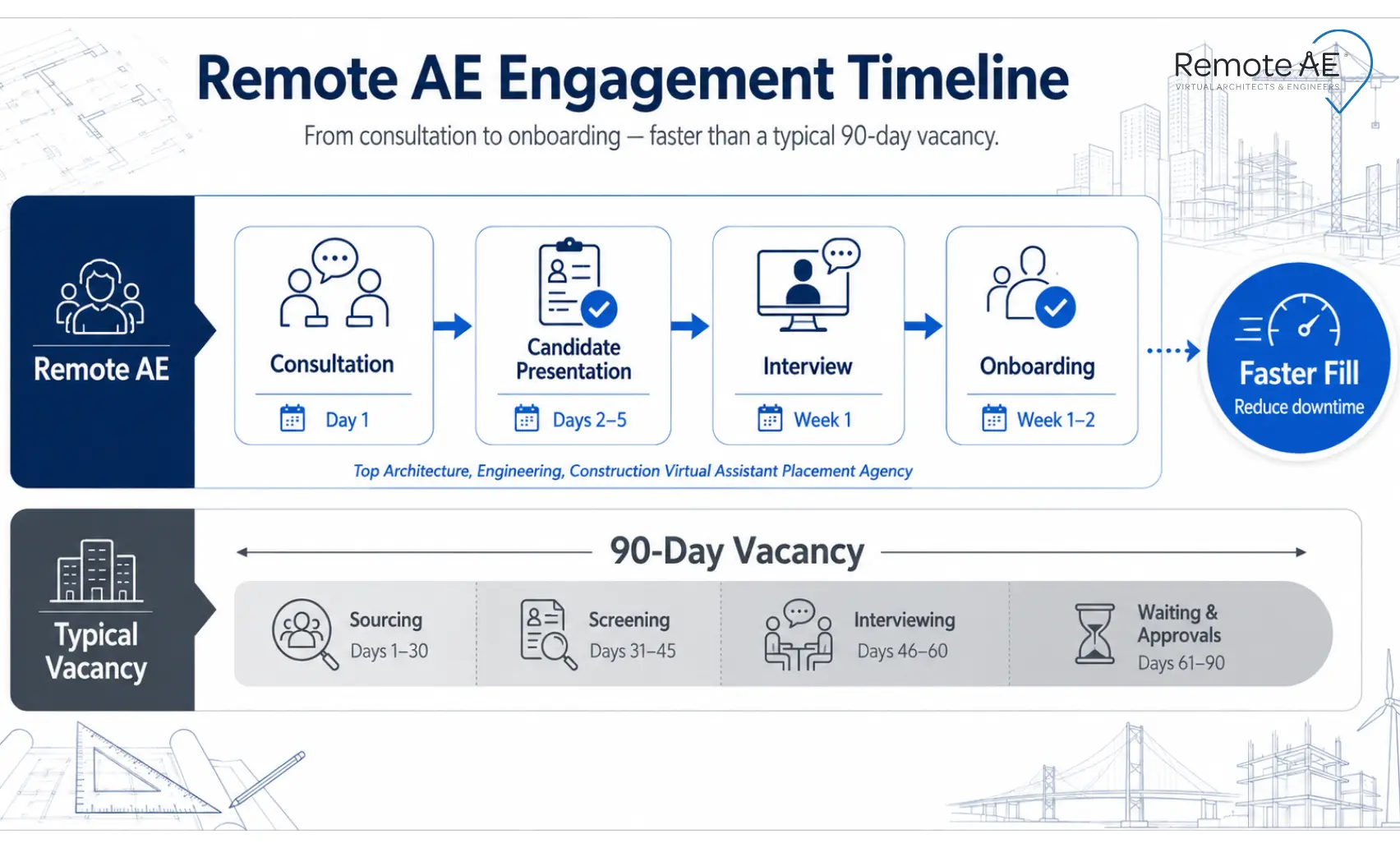
This is often the deciding factor, not cost. Estimating and preconstruction roles frequently sit vacant for 60 to 90 days or more, and contractors continue to report difficulty filling them.
Add ramp time, and the gap between deciding you need capacity and having it is most of two quarters; several bid cycles you’ll spend triaging.
The Remote AE sequence runs consultation, candidate presentation, your interview, then onboarding. You interview and approve the person who joins your team; nobody is assigned to you.
What you get weekly
Deliverable cadence is set against your bid board, not a generic schedule: quantity worksheets for active packages, an updated coverage matrix by trade, a current addendum log, and a standing check-in ahead of each bid day so priorities are set while there’s still time to act on them.
Risk reversal
Two concerns come up on every one of these calls. Both have concrete answers.
- What if the person isn’t right? Remote AE provides two free replacements. You are not stuck with a bad fit or paying to re-run a search.
- What if the model doesn’t work for us? There is a 30-day money-back guarantee. Thirty days is roughly two bid cycles, long enough to see whether your submitted volume moved.
Dedicated capacity vs. per-bid outsourcing
Three models compete for this budget, and they fail in different places.
- Freelance marketplaces price low per bid and work well for a single overflow package. They struggle on repeat work: every engagement restarts template fluency from zero, availability is never guaranteed on the week you need it most, and confidentiality on developer drawings depends on whoever accepted the job.
- Per-takeoff shops deliver a finished quantity set in their format, on their turnaround. That’s genuinely useful when you need one package covered. It is not capacity; you can’t hand them your bid board, and nothing about the arrangement makes the next package faster than the last.
- Dedicated managed staffing costs more than either on a single package and less than both across a year of them, because the resource is yours, ramp cost is paid once, and rework declines as familiarity builds. The trade-off is honest: it only makes sense if you have sustained multifamily bid volume. If you bid two apartment projects a year, buy the takeoffs.
The bid you can’t staff is the bid you already lost!
Every GC tracks win rate. Almost nobody tracks the packages that never reached the estimating board; a pass costs nothing today and appears nowhere on a P&L. It surfaces two developments later, when a developer’s next community goes to a bid list you’re no longer on. Multifamily takeoff is the most repetitive production work in preconstruction, which makes it the cheapest place in your business to buy back capacity. Remote AE supplies that capacity as dedicated staff on your software and your bid calendar. Your chief estimator keeps every decision that matters. What changes is how many packages reach their desk in a week.
Bring your next quarter’s bid calendar to a free 30-minute consultation. We’ll map it against the takeoff capacity required to cover it, and if the model doesn’t fit your volume, we’ll tell you that.
FAQs – Multifamily GC Estimating Capacity
How do I know if my estimating capacity is limiting bid volume?
Count the multifamily packages you declined last quarter where the stated reason was schedule, staffing, or timing rather than scope fit or owner quality. Three or more in a quarter means your estimating backlog is setting your revenue ceiling, and no bid-strategy refinement will move it.
What can an outsourced estimator do on a multifamily bid?
Production work: quantity takeoff by unit type, assembly takeoffs for framing, gypsum board and finishes, fixture counts, addendum logs and quantity reconciliation, ITB tracking, subcontractor coverage matrices, and bid form assembly. Pricing, means and methods, contingency, and the final number stay with your chief estimator.
Does outsourcing estimating mean losing control of the bid number?
No. Remote AE provides production and documentation support only. Quantities are verifiable against drawings and travel well; pricing reflects your market, your subcontractor relationships, and your risk tolerance, so it does not travel. The estimator of record retains full responsibility for the number submitted under your firm’s name.
How quickly can a remote estimating assistant become productive on our bids?
The engagement runs consultation, candidate presentation, your interview, then onboarding, in weeks rather than the 60 to 90 days an estimator vacancy typically stays open. Productivity builds fastest when the first package is repetitive: a garden-style or build-to-rent takeoff teaches your templates quickly.
Is outsourced estimating support worth it for a GC bidding fewer than twenty projects a year?
Probably not as dedicated staffing. Dedicated capacity earns its cost through sustained volume, because ramp time is paid once and rework declines as familiarity builds. At low multifamily bid volume, buying individual takeoffs from a per-package vendor is the more sensible arrangement.