
Fast-track data center programs live or die by coordination. RFIs pile up, submittals get buried in email, and document versions drift across teams. This breakdown costs time on the jobsite and creates avoidable rework. Data center project coordination support fills that gap by providing dedicated remote staff who own your RFIs, submittals, and logs. Instead of reacting to chaos, your project team gains clean registers, tracked approvals, and clear handoffs. Remote AE brings production capacity on demand with assistants trained for mission-critical environments. You stay in control of decisions. We handle the operational load that keeps your project moving from design through commissioning.
What “Project Coordination Support” Means in Real Tasks
Project coordination support is not “admin help.” It’s the daily system that keeps decisions moving and documents traceable. When you run fast-track data centers, that system protects the schedule and quality.
Procore notes that RFIs can create significant backlogs because owners and project managers must review and respond to each one. That backlog risk is exactly why coordination needs ownership.
RFI Intake, Formatting, Routing, and Closeout
Remote assistants manage the full RFI cycle. They intake questions from the field, format them to your standard, route them to the right consultant, and track responses to close. This structure prevents lost questions and stalled trades.
A CMAA/Navigant research perspective estimated an average of $1,080 per RFI review and response (CMAA/Navigant Construction Forum).
That cost makes sloppy RFI handling expensive.
Submittal Register Build, Packaging, and Expediting
Coordination support includes building the submittal register, packaging vendor data, and expediting reviews. Equipment does not wait. Your team should not either.
Log Ownership
Ownership is the difference between visibility and noise. Remote AE assistants maintain:
- RFI log
- Submittal log
- Drawing log
- Revision log
- Transmittal log
- Meeting minutes with action items
- Equipment long-lead tracker for data center procurement
This log ownership forms the backbone of data center document control support.
Data center equipment can carry long lead times. One industry guide notes switchgear, chillers, and UPS systems can take 36–48 weeks to deliver (Mastt). That makes an equipment tracker a practical necessity, not a “nice to have.”
Where Projects Fail Without Proper Coordination
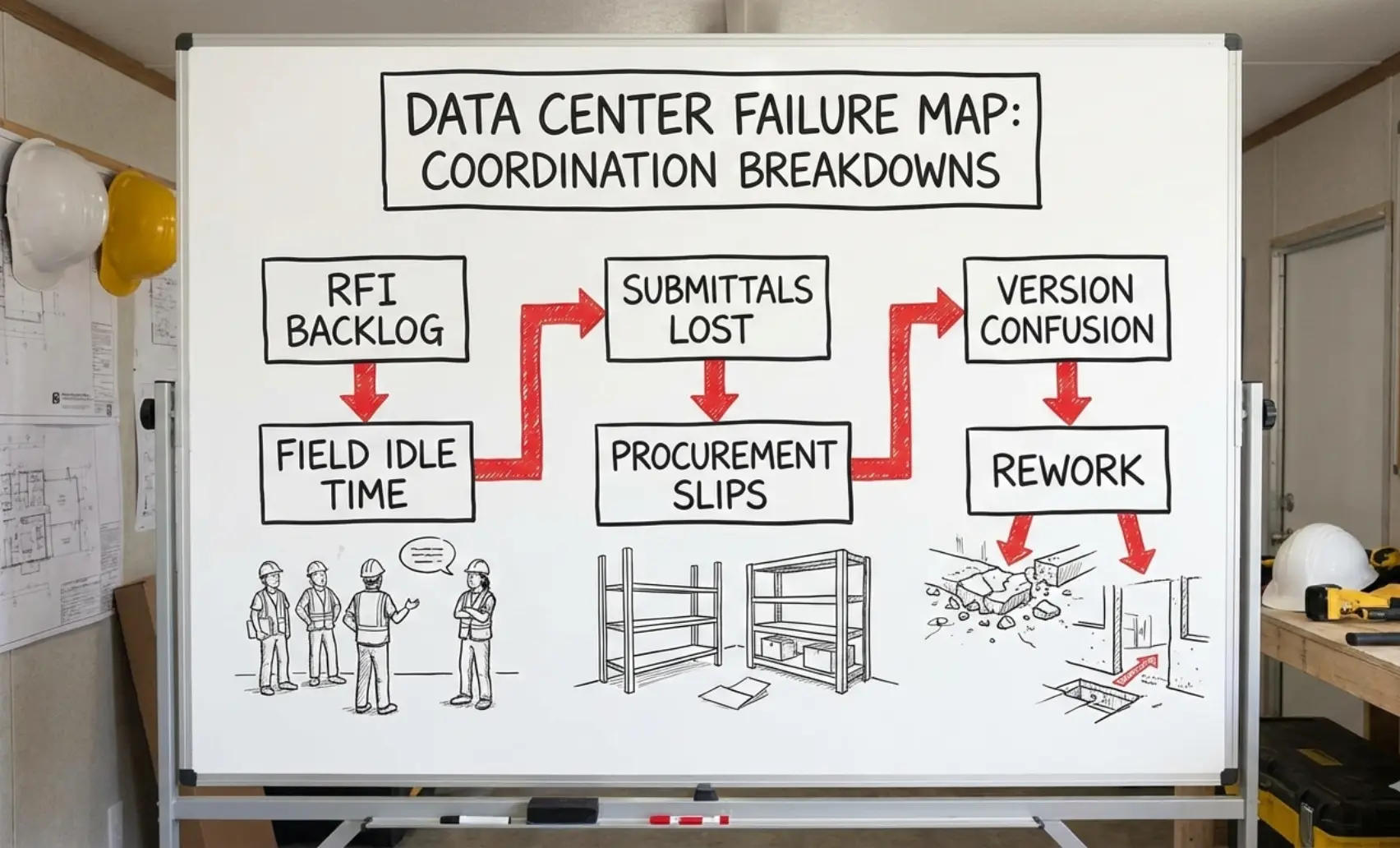
Data centers are fast-track, multi-trade, and paperwork-heavy. When coordination falls behind, the schedule pays for it.
RFI Backlogs Stall Construction
Missed RFI deadlines force field teams to guess. Crews wait on answers while schedules slip. The Navigant Construction Forum research (published via CMAA) estimated an average of 796 RFIs per project, with 8 hours per RFI and an average cost of $1,080 per RFI review/response. This is why programs rely on mission-critical RFI log services that treat every question as a tracked deliverable.
Submittals Lost in Email Threads
When submittals live in inboxes, equipment approvals arrive late, and vendors rework packages. This breakdown is why owners turn to data center submittal log services that enforce real-time tracking.
No Control Over Document Versions
Version confusion creates silent failure:
- drawing mismatches
- outdated specs circulating
- Teams are building to the wrong sheet set
Autodesk and FMI estimated $88.69B in rework in 2020, tied to avoidable rework and poor information practices.
Remote AE: Production Capacity on Demand for Data Centers
Data centers don’t wait for hiring cycles. When coordination volume spikes, you need trained production staff fast. That’s where Remote AE comes.
Built for Mission-Critical Delivery
Remote AE supports AEC production work with more than 15 years of field-tested processes. Every assistant assigned to data center programs brings at least five years of experience. You do not train from scratch. They step into live coordination workflows from day one.
This model protects momentum on hyperscale and colocation programs where delays cascade across trades.
Weekly Staffing for Fast-Track Schedules
Data center projects do not scale in clean phases. Work surges during design development, procurement, and commissioning. Remote AE adds staff in days, not months. You scale up for peak demand, then downshift when the load drops. Continuity remains intact from DD through commissioning because the same assistant stays with your team.
Our Data Center Project Coordination Support Services
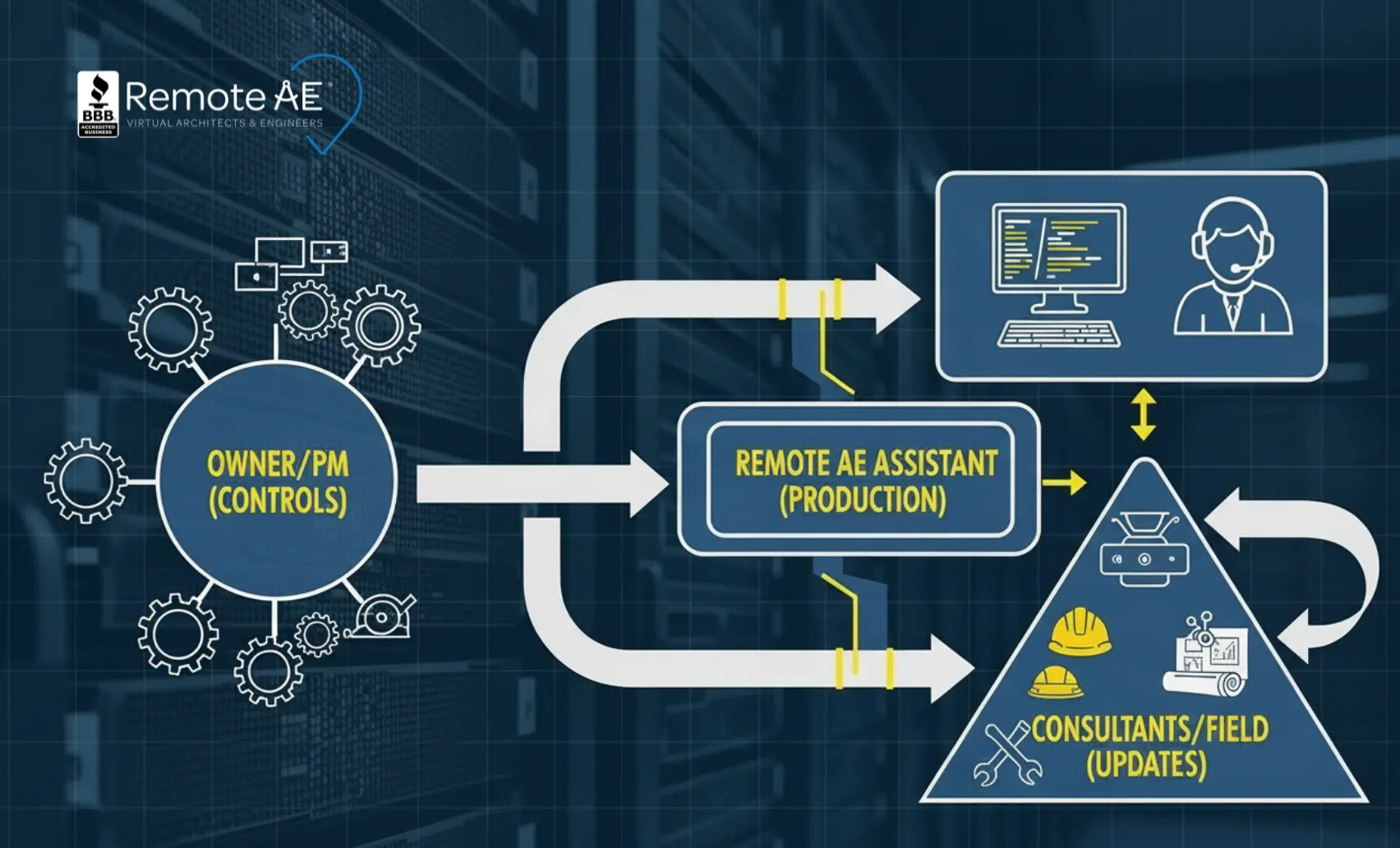
Remote AE delivers data center project coordination support as an extension of your internal team. You control priorities. We manage production.
Data Center RFI Log Services
Assistants create and maintain live RFI logs. They track responses across consultants and close loops with field teams. Every question has an owner and a due date.
Data Center Submittal Log Services
Coordination staff track equipment packages, monitor review cycles, and manage approval workflows. This control keeps long-lead items from drifting past procurement windows.
Document Control and Version Management
Remote AE provides full data center document control support. Assistants maintain drawing registers, manage submittal archives, and operate cloud-based tracking systems so teams always work from the current set.
Beyond Logs: Full AEC Production Support
Coordination does not stop at registers. Remote AE also supports:
- BIM and VDC workflows
- MEP drafting
- DD and CD production
- Estimating and takeoffs
- Permitting documentation
This breadth lets you centralize production support under one accountable service.
How Remote AE Fits Inside Your Existing Team
Remote support works only when the authority is clear.
- You Keep Control: You assign tasks. You set standards. You approve outputs. Remote AE supplies trained production staff who execute your workflows without friction.
- Risk-Free Replacement Model: Remote AE replaces fast if the fit is wrong. There is no downtime in your production flow. This keeps schedules intact even when staffing changes.
Why Owner’s Reps and Developer PMs Choose Remote AE
Owner’s reps live between design intent and construction reality. Coordination failure lands on their desk first.
Speed
Remote AE ramps support in under a week. There are no HR delays, no recruitment cycles, and no onboarding bottlenecks. When RFIs spike or submittals flood in, production capacity arrives before the backlog forms.
Continuity
The same assistant stays with your program across phases. There is no knowledge loss between design, procurement, and commissioning. This continuity prevents the reset costs that plague rotating temp staff.
Cost Clarity
Remote AE works on weekly pricing. There are no hidden fees and no upfront consultation costs. You know exactly what your coordination support costs each week.
How Engagement Works?
Coordination only succeeds when the startup process is clear.
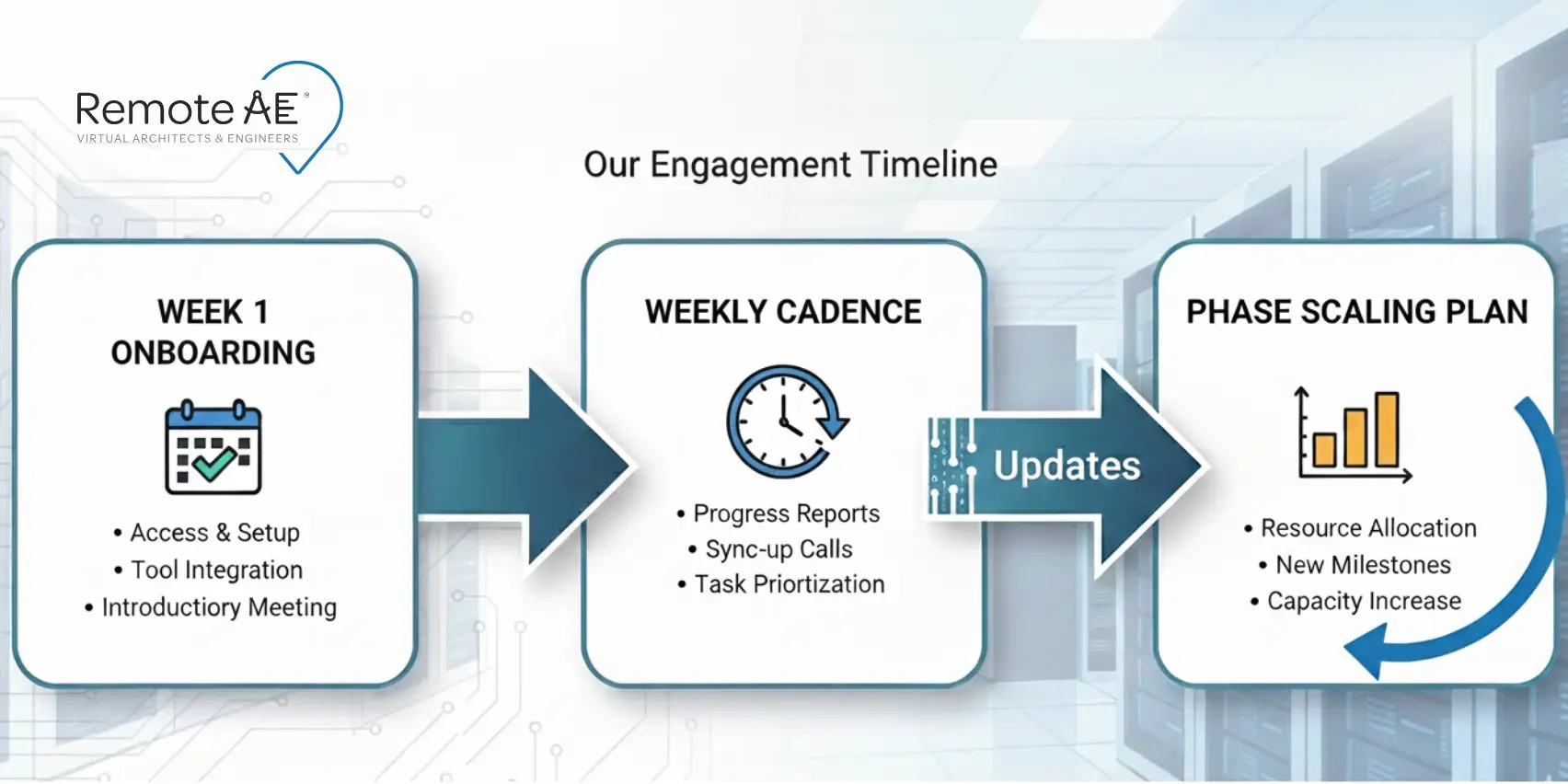
Week 1 Onboarding Checklist
The first week establishes control.
- Your team shares the project directory and naming rules.
- RFI and submittal templates are provided along with the routing matrix and contact list.
- Standing meetings and escalation rules define response expectations.
This setup removes guesswork and allows assistants to act with confidence.
Weekly Cadence
Once live, Remote AE follows a weekly staffing model with a continuity plan. Logs are updated daily. Backlogs are reviewed weekly. Gaps surface early instead of at the deadline.
Schedule a Call for a Fast Scope and Weekly Quote!
Data centers move too fast for broken coordination. Remote AE provides data center project coordination support that keeps RFIs, submittals, and logs under control, without adding full-time headcount. From data center RFI log services to data center submittal log services and complete data center document control support, our assistants operate as part of your team, not outside it.
Schedule a call so we can help you.
FAQs – Data Center Project Coordination Support
Who is responsible for the submittal log on a construction project?
The GC or construction manager usually owns the submittal log, since they control procurement and approvals. Architects and engineers review and respond, but the GC maintains the master register, tracks due dates, and follows up with trades so nothing stalls the schedule.
What should a submittal register include?
A proper register lists the spec section, submittal number, description, trade, required date, review status, revision history, and approvers. It should also flag critical-path items and long-lead equipment so procurement risks are visible weeks, not days, in advance.
What’s the difference between an RFI and a submittal?
An RFI asks for clarification when drawings or specs are unclear. A submittal sends proposed products or shop drawings for approval. RFIs resolve questions; submittals confirm that the contractor’s chosen solution matches the design intent before fabrication or installation.
Can a remote project coordinator manage RFIs and submittals inside Procore/ACC?
Yes. With project-level permissions, a remote coordinator can log RFIs, route submittals, track due dates, and chase reviews. As long as workflows and SLAs are defined, this role is well-suited for remote support and often frees on-site staff from admin overload.