

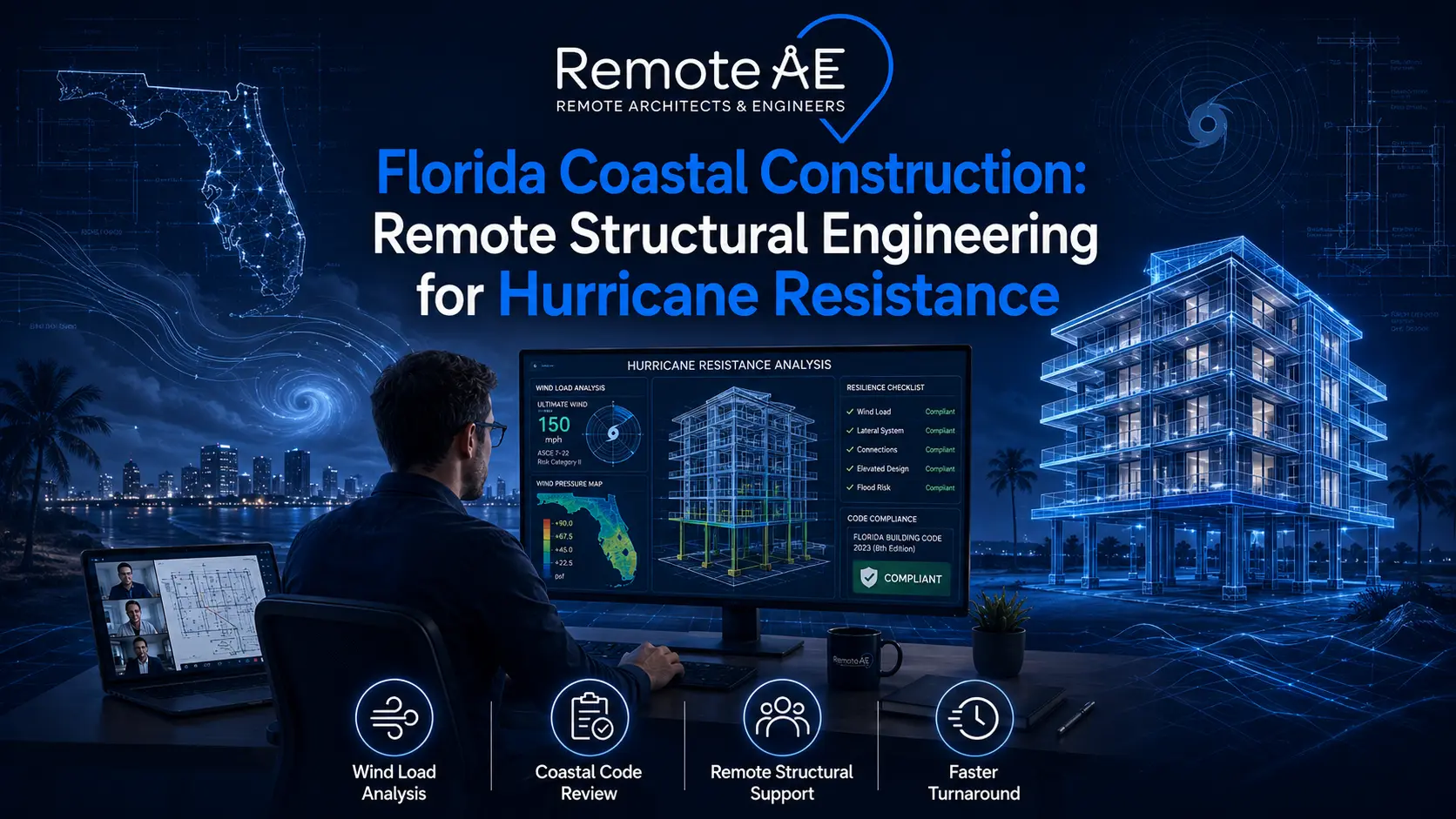
Florida’s coastal construction environment is among the most technically demanding in the United States. According to the National Oceanic and Atmospheric Administration, Florida has been impacted by more hurricanes than any other U.S. state since records began, and the economic cost of hurricane damage to coastal structures continues to climb with each major storm season. Designing structures that perform under Florida’s wind loads, storm surge, and flood conditions requires a complete engineering system, not just stronger materials.
For AEC firms managing Florida coastal projects, remote structural engineering support provides the technical production capacity to handle ASCE 7-22 wind load analysis, ASCE 24 flood-resistant design, continuous load path documentation, and BIM coordination without bottlenecking the licensed engineer of record.
Why Florida Coastal Construction Needs More Than Standard Design
Florida coastal construction is not standard construction with heavier hardware. It is a fully integrated design system where wind, flood, debris, corrosion, and code compliance interact at every level, from the pile foundation to the roof sheathing fastener pattern.
Florida’s Coastal Risk Profile
Six distinct hazard categories shape every Florida coastal construction decision:
- Hurricanes: Category 1 through 5 storms generating sustained winds from 74 to 157+ mph, with wind loads that increase dramatically near the coast and in high-velocity hurricane zones
- Storm surge: Ocean water pushed inland by hurricane winds, capable of inundating ground-level structures with several feet of moving water carrying debris and hydrostatic pressure
- Wind-borne debris: Missiles generated by damaged structures, vegetation, and loose materials, penetrating unprotected openings and triggering internal pressure increases that amplify roof uplift loads
- Flood zones: FEMA-designated V Zones, Coastal A Zones, and inland A Zones, each carrying specific foundation, elevation, and flood-resistant construction requirements
- Saltwater corrosion: Airborne salt deposits from coastal environments attack unprotected steel connectors, fasteners, and reinforcement, accelerating structural degradation in ways not seen in inland construction
- Fast-changing permit requirements: Local amendments, product approval updates, and evolving Florida Building Code editions create a regulatory environment that requires active code monitoring on every project
The Cost of Poor Structural Planning
Structural planning failures in Florida coastal construction don’t just cause construction problems; they create cascading project consequences:
- Delayed permits, missing wind load documentation, incorrect flood zone analysis, or incomplete product approval submittals all generate plan review corrections that reset the permit clock
- Failed inspections, connection details that don’t match approved drawings, missing anchor bolts, or non-compliant product installations discovered during framing inspections force costly rework
- Higher insurance costs, structures without documented continuous load path engineering, and verified impact protection carry higher windstorm insurance premiums in Florida’s coastal insurance market
- Long-term liability, structural failures during a hurricane event trace directly back to the engineering documentation and construction quality at the time of building, creating professional liability exposure that persists for decades
Why “Hurricane-Proof” Is the Wrong Promise
No building is hurricane-proof. The correct framing, and the technically accurate one, is hurricane-resistant.
Hurricane-resistant construction reduces the probability of structural failure, minimizes damage under design-level wind and flood events, and protects life safety during a storm. It does not guarantee zero damage from a direct major hurricane strike.
Every structural design decision in Florida coastal construction is a risk management decision, reducing consequence and probability, not eliminating them.
The Core Codes and Standards Behind Hurricane-Resistant Coastal Design
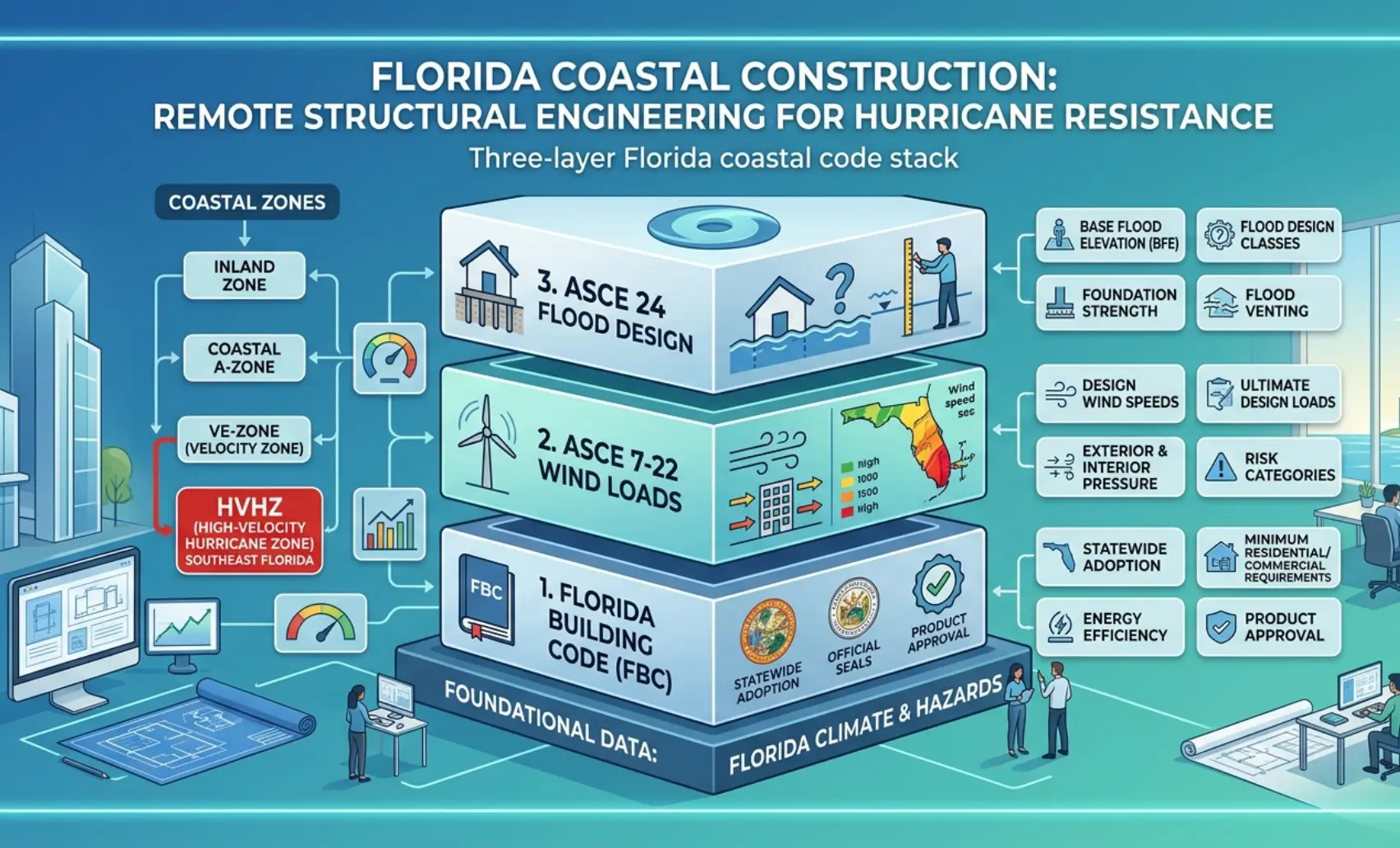
The 8th Edition 2023 Florida Building Code references ASCE 7-22 for wind load design, establishing the technical framework for ultimate design wind speeds, load combinations, and component pressure calculations across Florida’s coastal regions.
The FBC flood provisions require ASCE 24-based design for coastal high-hazard areas and Coastal A Zones, setting the flood-resistant construction standards that govern foundation design, building elevation, and flood opening requirements.
Florida Building Code and ASCE 7-22
ASCE 7-22 governs wind load design for Florida coastal structures through a structured analysis framework:
- Ultimate design wind speed: Florida’s coastal wind speed maps show design wind speeds of 130–180+ mph in high-risk coastal areas, confirmed by ASCE 7-22 Figure 26.5-1 for the project’s specific location
- Risk category: Occupancy-based classification (Risk Category I through IV) that scales design wind loads, essential care facilities, and emergency shelters carry higher wind speed factors than standard residential
- Exposure category: Site roughness classification (B, C, or D) based on surrounding terrain, coastal sites typically fall in Exposure D, the most severe category, reflecting open ocean fetch
- Components and cladding: Pressure coefficients for individual envelope elements, windows, doors, roof panels, wall cladding, that are higher than the main wind-force resisting system loads in the corner and edge zones
- Roof pressure zones: End zones, interior zones, and corner zones with dramatically different uplift pressure coefficients, critical for roof sheathing fastening pattern design
- Elevated building provisions: Special wind load considerations for structures elevated on pile or column foundations, accounting for wind exposure below the elevated floor level
ASCE 24 and Flood-Resistant Construction
ASCE 24 governs the design of structures in flood hazard areas, and in Florida’s coastal zones, its requirements drive foundation design, building elevation, and below-grade construction decisions:
- Design flood elevation: The elevation to which the lowest horizontal structural member of an elevated building must be placed, accounting for base flood elevation plus required freeboard
- Lowest horizontal structural member: In V Zones, the bottom of the lowest structural member (beam, joist, or pile cap) must be at or above the design flood elevation, and ground-level enclosures must use breakaway walls
- Pile and column foundations: Required in V Zones to elevate the structure above the wave crest and allow water to pass beneath, with scour and erosion depth factored into pile embedment design
- Breakaway walls: Below-design-elevation enclosures in V Zones must use breakaway walls, designed to fail under flood loads without transferring forces to the elevated structural system above
- Flood openings: In Coastal A Zones and enclosed areas in A Zones, flood openings must allow automatic equalization of hydrostatic pressure, reducing net hydrostatic load on foundation walls
- Hydrostatic and hydrodynamic loads: Flood load analysis under ASCE 24 accounts for still-water pressure, wave action, flood-borne debris impact, and current drag forces, all of which exceed standard hydrostatic pressure calculations
HVHZ and Wind-Borne Debris Regions
The High-Velocity Hurricane Zone applies exclusively to Miami-Dade and Broward counties, the highest wind design standard in the United States for buildings.
- Impact-rated openings: All windows, doors, skylights, and glazed openings in HVHZ buildings must be impact-rated to the Large Missile Test standard (9-lb 2×4 at 50 fps), or protected by impact-rated shutters or screens
- Product approvals: Florida requires state-level product approval for impact-rated windows, doors, garage doors, and roofing products, separate from standard building code product listings. Miami-Dade Notice of Acceptance (NOA) is the most recognized product approval documentation for HVHZ applications
- Testing documentation: Product approval submittals must include test reports confirming performance to the applicable Florida product approval protocol, including large missile impact, cyclic wind pressure, and water infiltration testing
- Internal pressure effect: A single-opening failure during a hurricane, or a non-impact-rated window breached by wind-borne debris, triggers a dramatic increase in internal pressure that amplifies roof uplift loads across the entire structure. This is why opening protection is a structural issue, not just an architectural preference.
How Remote Structural Engineering Supports Hurricane-Resistant Design
Faster Structural Drafting and Revisions
Florida coastal permit review generates frequent drawing corrections, wind-load documentation gaps, missing connection details, and product-approval cross-references, all of which result in plan-examiner comments that require rapid drawing updates.
- Remote engineering assistants handle rapid sheet updates in Revit and AutoCAD, incorporating redlines and review comments within 24 to 48 hours of receipt
- Markup coordination between the engineer of record and the remote production team is managed through Bluebeam Revu, maintaining a clean audit trail of every revision
- Real-time collaboration tools keep the remote team aligned with design changes as they occur, not after they have propagated through multiple drawing sheets
Remote BIM Coordination Reduces Construction Errors
BIM coordination in Florida coastal projects is particularly high-stakes; structural framing, MEP systems, and foundation elements must be precisely coordinated in a building where structural continuity is a life safety requirement.
- Clash detection between structural framing and MEP systems, catching conflicts between shear wall locations, duct penetrations, and pipe routing before construction begins
- Structural coordination with MEP systems, confirming that mechanical equipment penetrations through fire-rated assemblies and structural elements are properly detailed
- Improved field communication, BIM coordination models shared with the contractor, provide spatial clarity that 2D drawings alone cannot deliver in complex elevated coastal structures
Engineering Support During Permit Approval
Florida coastal permit review is not a one-submission process for most projects. Plan examiner comments, wind load verification requests, and product approval documentation gaps are routine.
- Remote engineering assistants prepare structured response matrices, listing each comment, the drawing sheet it references, the revision made, and the code section or product approval that supports the resolution
- Revised calculations and drawing updates are turned around faster when a dedicated remote team owns the response production workflow
- Supporting the local engineer of record, who reviews, approves, and seals the revised submission, without adding to their drafting burden
Remote QA/QC for Structural Documentation
- Drawing consistency checks, confirming that wind speed, exposure category, risk category, and design flood elevation are stated consistently across all structural sheets
- Wind load verification, confirming that component and cladding pressures on the drawings match the ASCE 7-22 analysis for the building’s location and configuration
- Detail review before submission, checking that connection details show the required hardware, fastener spacing, and product approval references before the permit package is assembled
Scalable Staffing for Large Coastal Projects
- Remote engineering assistants scale with project demand; additional Revit drafters or BIM coordinators can be onboarded within days for large coastal developments without the delay of a local recruitment cycle
- Multiple concurrent coastal projects can be supported simultaneously, with permit documentation, BIM coordination, and revision tracking running in parallel across different project teams
What Must Stay With the Licensed Engineer of Record?
Remote support is production support, not a substitute for licensed professional responsibility.
- Final structural design and sealed engineering calculations
- Code interpretations and site-specific engineering judgment
- ASCE 7-22 wind load analysis and ASCE 24 flood load design decisions
- Permit sign-off and professional seal on all submitted documents
- Construction observation is required by the Florida Building Code or the project’s contract documents
Best Remote Workflow for Florida Coastal Structural Projects
- Intake: Survey data, FEMA flood zone determination, geotechnical report, and architectural drawings collected before engineering production begins
- Code mapping: Florida Building Code edition, ASCE 7-22 wind speed and exposure category, ASCE 24 flood zone classification, and local amendments confirmed for the project address
- BIM/CAD setup: Firm-standard Revit template or AutoCAD seed file with correct title block, structural layer standards, and sheet naming confirmed
- Engineering production: Connection details, hardware schedules, shear wall layouts, and foundation plans produced under the engineer of record’s direction
- QA review: Senior engineer check of all structural sheets against the code matrix and wind/flood load analysis before permit package assembly
- Permit package: Complete drawing set with code notes, product approval references, and supporting calculations organized for AHJ submission
- Revisions: Structured response matrix prepared for each plan examiner comment, updated sheets issued with revision clouds and delta tags
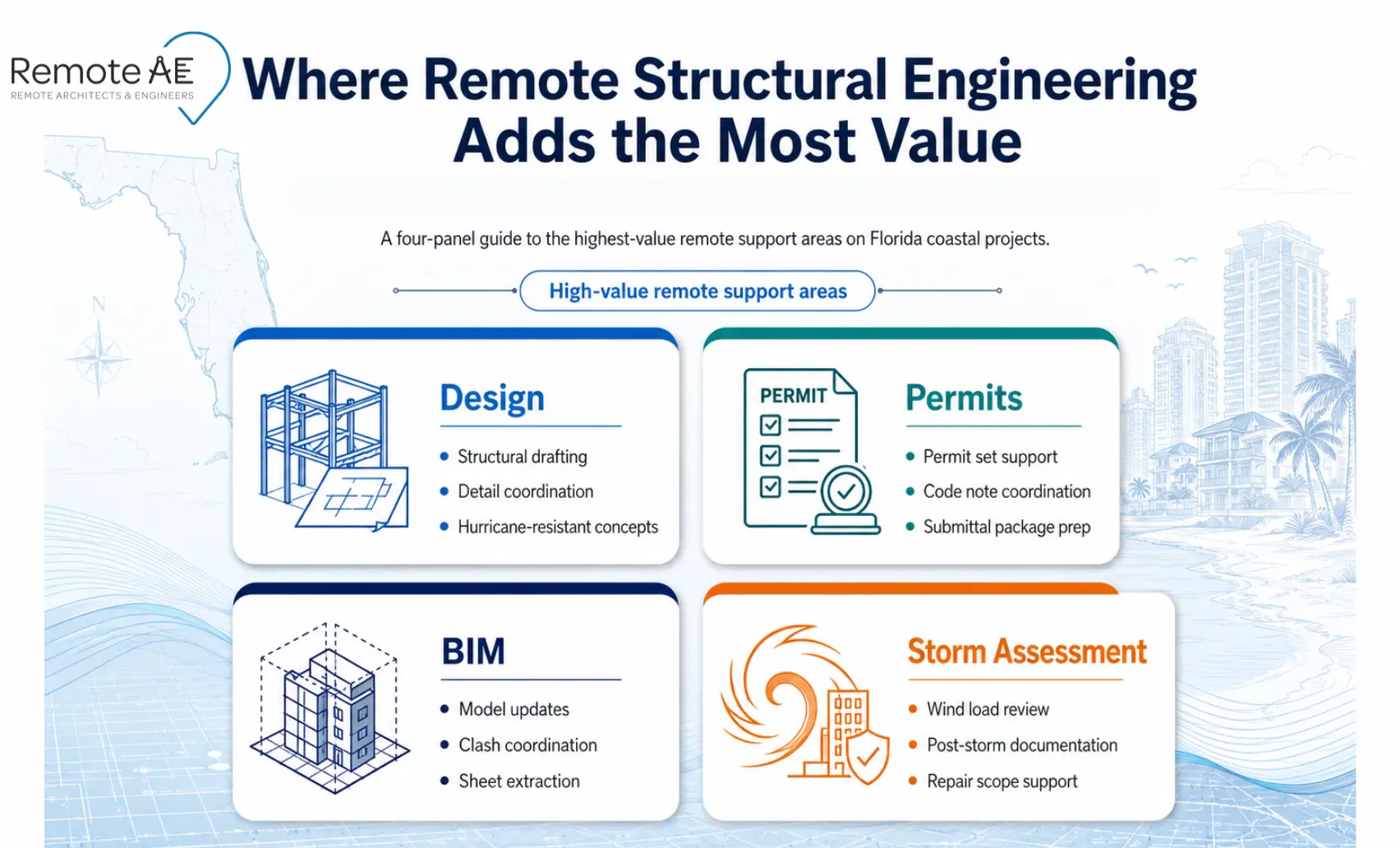
Where Remote Engineering Adds the Most Value
Early Design Coordination
- Foundation depth and pile spacing aligned with geotechnical data
- Building elevation confirmed against the design flood elevation before architectural plans advance
- Roof form selection, hip vs gable, documented for wind performance implications
- Opening layout coordinated with wind-borne debris region requirements
- Shear wall and structural grid established before MEP routing begins
Permit Documentation
- Faster sheet updates when design changes affect structural drawings mid-permit cycle
- Cleaner detail libraries, standardized connection details for Florida coastal hardware
- Better revision tracking, every sheet change logged with revision cloud and delta tag
- Clear code notes, wind speed, exposure category, risk category, and flood zone are stated consistently on every structural sheet
BIM and Clash Coordination
- Structural framing vs MEP system conflicts caught before construction
- Foundation element coordination with civil and site drawings
- Opening and penetration locations coordinated with the shear wall layout
- Mechanical shaft penetrations through fire-rated assemblies are detailed correctly
Post-Storm Assessment Support
- Photo logs organized by building element and damage type
- Damage mapping overlaid on original structural drawings
- Report drafts prepared for the engineer of record review and signature
- Repair drawing updates incorporating field-verified damage scope
- Scope documentation for insurance claims and permit applications
When AEC Firms Should Add Remote Structural Support
Signs the Team Needs Help
- Senior engineers are spending time drafting rather than engineering
- Plan review comments are stacking up without a dedicated response owner
- BIM coordination updates lag behind design changes, creating coordination conflicts in the field
- Florida coastal projects are delayed because documentation tasks are blocking permit submission
- Local structural engineering talent is scarce or cost-prohibitive for the project’s staffing budget
What to Look for in a Remote Engineering Assistant
- AEC-only experience, familiarity with structural drawings, connection details, and permit documentation
- Revit, AutoCAD, Bluebeam, and Navisworks proficiency, verified before placement
- Structural drawing familiarity, ability to read foundation plans, framing plans, and connection details without extensive training
- Clear QA process, defined review steps before any drawing leaves the remote team
- Secure file-sharing habits, cloud-based collaboration within the firm’s existing project environment
- Ability to work within the firm’s established drawing standards from day one
Why Remote AE Fits the Future of Coastal Construction
Remote AE provides virtual engineering assistants and structural drafting support specifically for AEC firms, not generalist staffing. Every placement carries AEC-specific training in structural drawing production, BIM coordination, and construction documentation workflows.
Remote AE has been providing virtual assistants tailored for the AEC industry for more than 15 years, giving Florida coastal firms immediate access to production-ready remote engineering assistants without the delay of a local recruitment cycle.
Helping Firms Handle Growing Coastal Construction Demand
- Flexible staffing support, scale remote engineering capacity up during permit phases and down during quieter production periods
- Long-term project assistance, dedicated remote professionals who build familiarity with the firm’s Florida coastal project standards over time
- Industry-specific expertise, every assistant understands AEC workflows, wind load schedules, connection detail libraries, BIM coordination models, and permit documentation packages
- Guaranteed quality and reliability, structural documentation meets defined QA standards, or the issue is resolved immediately
- No long-term commitment, engage per project, per phase, or as an ongoing engineering production resource
Combining Technical Precision With Staffing Flexibility
Remote AE assistants operate as an extension of the in-house engineering team, producing faster without sacrificing the documentation quality that Florida coastal permit review demands.
- No upfront costs: Consult with Remote AE without any initial financial burden. No cost or obligation until the contractual phase begins
- Risk-free replacement: In the first year, Remote AE offers risk-free replacements for up to two virtual assistants, protecting your project continuity if a placement does not meet your production standards
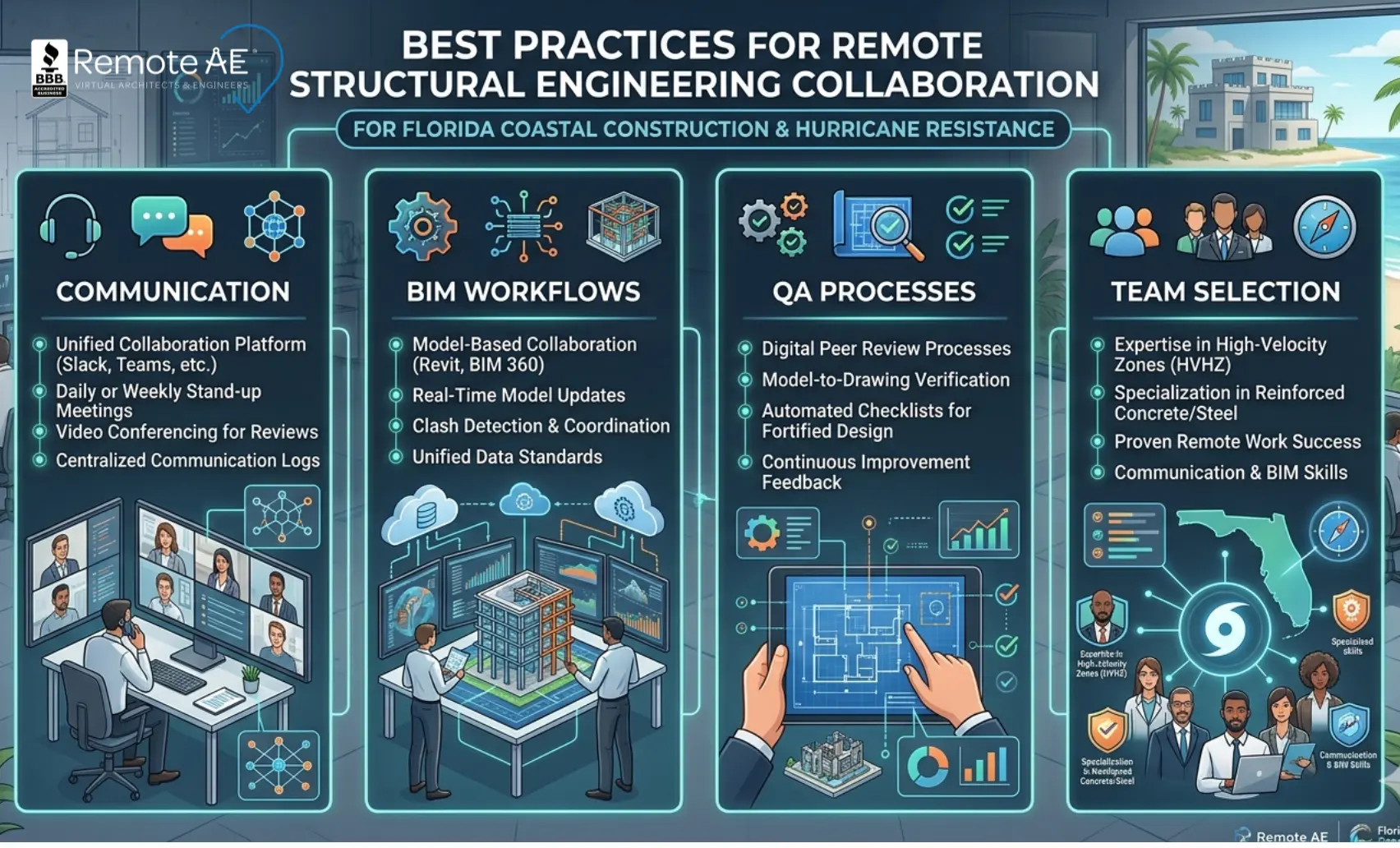
Best Practices for Successful Remote Structural Engineering Collaboration
Establish Clear Communication Protocols
- Weekly coordination meetings are brief, structured, and focused on open drawing items and permit status
- Markup standards, Bluebeam Revu comment layers, revision cloud protocols, and response log format are defined at project kickoff
- Defined responsibilities, which tasks belong to the remote assistant, which to the engineer of record, and which to the permit coordinator
Use Standardized BIM and CAD Workflows
- Shared Revit templates and AutoCAD seed files, distributed to the remote team before production begins
- File naming conventions are aligned with the AHJ’s permit submission requirements and the firm’s internal document control protocol
- Revision tracking, every issued drawing set logged with date, version number, and distribution record
Maintain Strong QA/QC Processes
- Peer reviews, remote assistant drawings, and drawings reviewed by a senior engineer before permit submission
- Structural calculation checks, wind load inputs, ASCE 7-22 pressure coefficients, and ASCE 24 flood elevation values were verified against the engineering analysis
- Coordination audits, BIM clash detection run before every major drawing issue to catch structural, MEP, and architectural conflicts
Add Florida Coastal Structural Engineering Capacity!
Your engineer of record should be making engineering decisions, not drafting connection details or preparing permit response matrices. Remote AE places pre-vetted remote engineering assistants trained in Florida coastal structural workflows, BIM coordination, permit drawing production, wind load schedules, and AHJ comment response, ready from week one.
Stop letting structural documentation tasks slow down your Florida coastal permit timeline.
Book a Free Consultation with Remote AE Today, no obligation, no pressure. Just a direct conversation about what your Florida coastal structural engineering workflow needs right now.
FAQs – Florida Coastal Construction: Remote Structural Engineering
What makes a Florida coastal building hurricane-resistant?
Florida coastal buildings use features such as reinforced connections, impact-resistant openings, elevated foundations, roof uplift protection, and continuous load paths. Designs focus on resisting high wind pressures, storm surge, flying debris, and water intrusion common in hurricane-prone regions.
Can remote structural engineers work on Florida hurricane-resistant projects?
Yes. Remote engineers can support modeling, calculations, drafting, detailing, coordination, and permit documentation. However, final engineering responsibility and signed/sealed documents must remain with a Florida-licensed professional engineer.
Does a remote engineer replace a Florida-licensed PE?
No. Florida projects requiring engineering responsibility must be reviewed and approved by a Florida-licensed PE. Remote engineers can assist with production and coordination, but they cannot replace the engineer legally responsible for the project.
What is the difference between HVHZ and a wind-borne debris region?
The HVHZ (High-Velocity Hurricane Zone) applies mainly to Miami-Dade and Broward Counties and has stricter structural and product approval requirements. A wind-borne debris region is a broader classification where buildings must protect openings from flying debris during hurricanes.
How can AEC firms use remote engineers for permit documentation?
Remote engineers can prepare calculations, drafting updates, details, schedules, coordination models, and redline revisions. This helps local licensed teams handle deadlines and production volume while retaining control over final engineering review and permitting responsibility.