

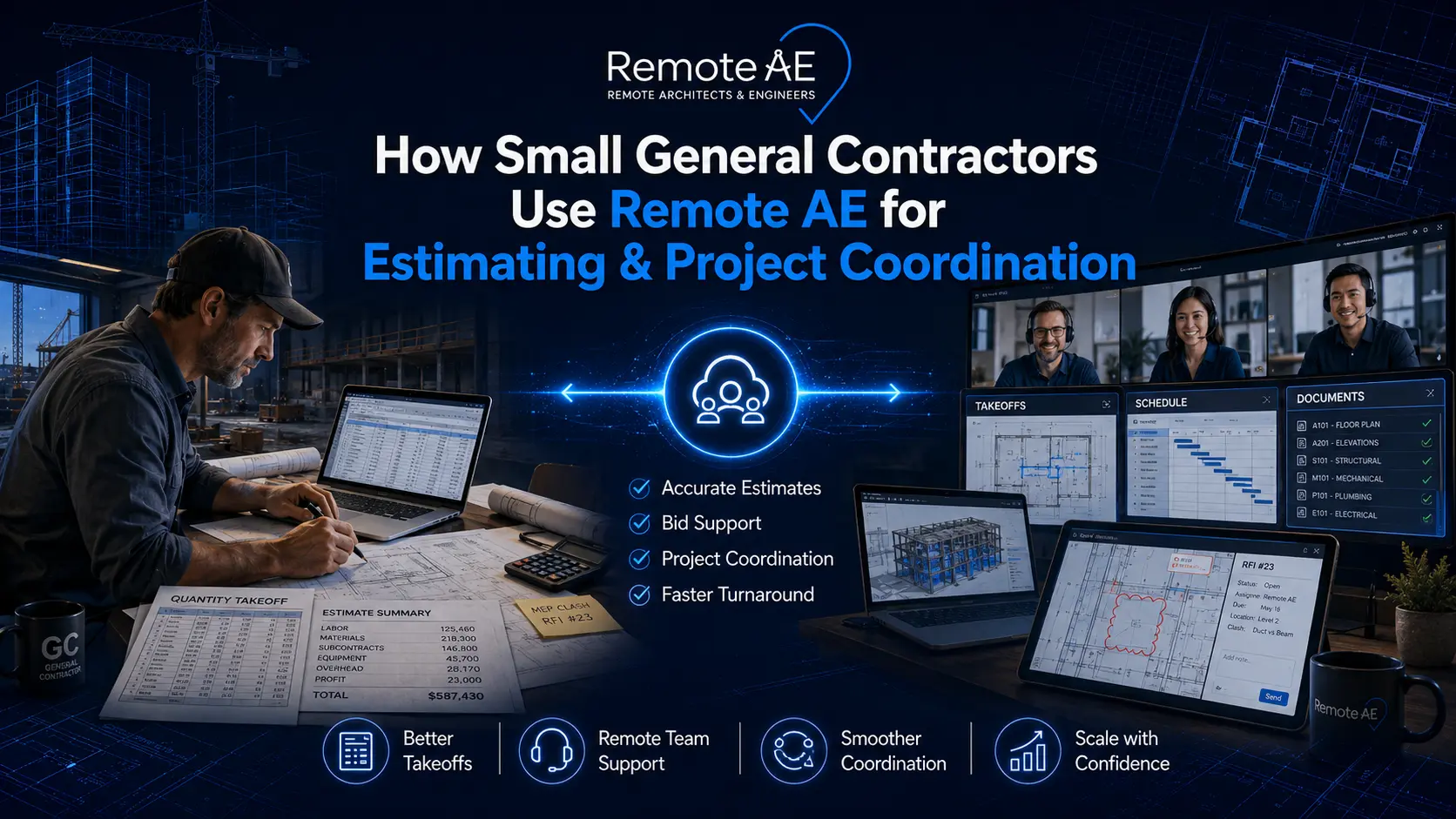
Small general contractors are among the most capacity-constrained businesses in the Architecture, Engineering & Construction industry. According to the U.S. Census Bureau, over 80% of construction establishments have fewer than ten employees, yet these firms compete for the same projects, bid the same drawing sets, and manage the same RFI and submittal workflows as much larger operations. The difference is not capability; it is support capacity. A remote construction assistant from Remote AE gives small GCs the estimating, project coordination, and document control support that larger firms build into their overhead, without adding a local hire, office space, or payroll complexity.
Why Estimating and Coordination Slow Down Small Contractors
The Owner Is Pulled Into Too Many Roles
In a small general contractor operation, the principal is rarely just the GC. They are also the estimator, project manager, site supervisor, accounts manager, and client relationship lead, often on the same day.
The daily task stack for a small GC principal typically includes:
- Construction estimating, reviewing drawing sets, preparing quantity takeoffs, and coordinating subcontractor quotes
- Client updates, responding to owner inquiries, preparing status reports, and attending project meetings
- Site visits, inspecting ongoing work, resolving field issues, and meeting with subcontractors
- Subcontractor coordination, following up on schedules, scopes, and deliverables
- Schedule checks, reviewing project timelines against actual progress
- Billing and paperwork, processing invoices, change orders, and pay applications
None of these tasks can be skipped. All of them compete for the same limited hours.
Bid Work Is Deadline-Driven
Estimating is not just time-consuming; it is unforgiving. A bid submission date does not move because the GC was on site all day.
The preconstruction workflow for a single bid typically involves:
- Drawing review, understanding project scope across full drawing sets and specifications
- Quantity takeoffs, measuring, and counting every item required to build the project
- Vendor quotes, reaching out to material suppliers, and confirming current pricing
- Scope review, confirming inclusions, exclusions, and division of responsibility across subcontractor trades
- Bid leveling, comparing multiple subcontractor quotes against the same scope
- Proposal formatting, assembling the final submission package with correct attachments and backup
For a small GC principal managing active construction projects simultaneously, this workload is the primary reason bids are missed, or worse, submitted with errors that affect margins.
Project Coordination Requires Daily Follow-Up
Once a job is won, the coordination burden begins immediately, and it does not slow down until the project closes out.
Daily project coordination tasks that consume GC time without requiring senior judgment:
- RFI logging, recording, routing, and tracking open requests for information
- Submittal tracking, collecting product data from subcontractors and vendors, and tracking approval status
- Change order logs, maintaining a current record of all approved and pending change orders
- Meeting minutes, documenting decisions, action items, and next steps from every project meeting
- Drawing updates, distributing current drawing sets, and tracking addenda
- Vendor communication, following up on delivery confirmations, lead times, and field coordination
A project coordinator assistant who owns this workflow keeps the project moving and keeps the GC’s attention on field decisions and client relationships.
What a Remote Construction Assistant Can Do for a Small GC
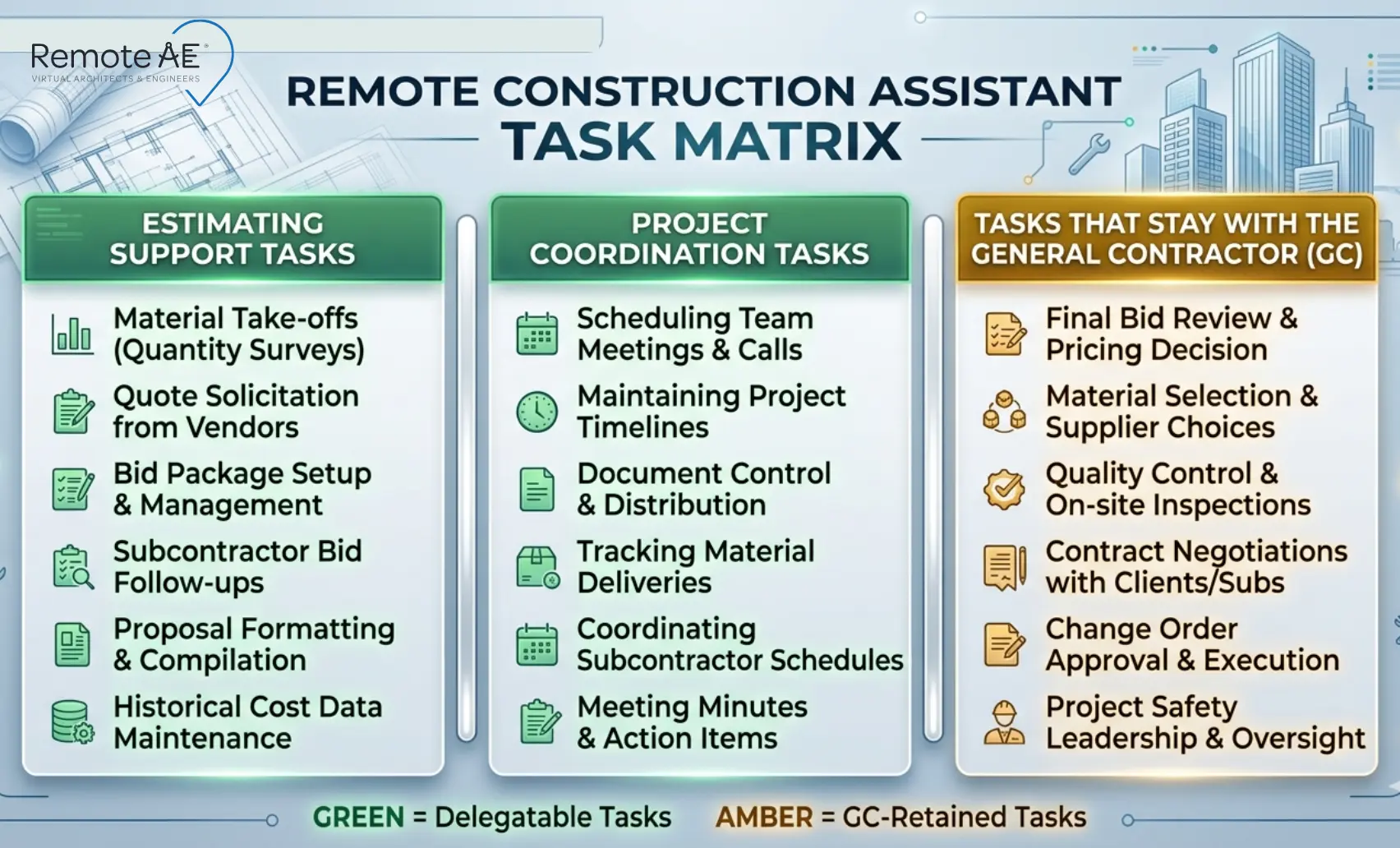
A remote construction assistant can serve in these areas:
Estimating Support Tasks
A remote estimating assistant handles the production work behind every bid, freeing the GC to focus on scope judgment and final pricing decisions.
- Review bid documents, drawing sets, and specifications for completeness before takeoff begins
- Organise RFPs and addenda, confirming the correct drawing revision is used for every takeoff
- Perform quantity takeoffs using Bluebeam Revu, PlanSwift, or AutoCAD measurement tools
- Prepare material lists from takeoff results, formatted for vendor quote requests
- Build estimate worksheets, organised by CSI division or trade category
- Track vendor and subcontractor quotes, logging received bids, identifying gaps, and following up on outstanding pricing
- Create bid comparison sheets, leveling multiple subcontractor quotes against the same scope description
- Help prepare proposal documents, formatting bid submissions with correct attachments and backup
- Update contact lists for vendors and subcontractors, maintaining accurate outreach records for future bids
Project Coordination Tasks
Once construction begins, the virtual construction assistant manages the administrative coordination workflow that keeps the project on track.
- Maintain RFI logs in Procore or equivalent, logging new RFIs, tracking response status, and flagging overdue items
- Track submittals, creating and updating the submittal register from receipt through architect approval and contractor distribution
- Update drawing logs, recording current drawing revisions, and distributing updated sets to the field team
- Organise meeting notes, documenting action items, decisions, and next steps from every project meeting
- Follow up with subcontractors, chasing outstanding deliverables, schedule confirmations, and open coordination items
- Maintain project document folders, enforcing naming conventions and folder structure across all project files
- Prepare weekly status updates, summarising project progress, open items, and upcoming deadlines
- Support closeout documentation, collecting as-builts, warranties, O&M manuals, and final lien releases
Tasks That Should Stay With the GC
Remote AE does not replace the GC’s judgment; it gives the GC more time to apply that judgment where it matters most.
These decisions stay with the general contractor:
- Final pricing decisions and estimate approval
- Contract negotiation with owners and subcontractors
- Field direction and site supervision
- Client commitments and project scope agreements
- Schedule risk decisions and recovery planning
- Final change order approval and dispute resolution
The remote construction assistant prepares, organises, and coordinates. The GC decides, approves, and leads.
How Remote AE Fits Into the Estimating Workflow
Step 1: Collect and Organize Bid Documents
Every estimate starts with organized inputs. A remote estimating assistant handles the document intake process before takeoff begins.
- Download and organize drawings, specifications, addenda, and RFPs into a structured bid folder
- Confirm drawing revision levels, flagging any addenda that supersede earlier sheets, before takeoff starts
- Compile scope notes and clarification requests from the invitation to bid
- Build and maintain the vendor and subcontractor contact list for quote distribution
- Create a bid checklist confirming all required submission documents are identified before the deadline
Step 2: Prepare Takeoffs and Quantity Checks
Quantity takeoff is the most time-intensive estimating task, and the one most directly suited to remote production support.
Tools the remote estimating assistant uses:
- Bluebeam Revu: On-screen measurement, area calculations, and count tools on PDF drawing sets
- PlanSwift: Trade-specific takeoff with live quantity linking to estimate worksheets
- AutoCAD: Measurement and area extraction from CAD drawing files where PDFs are unavailable
- On-screen takeoff: Manual digital measurement where project-specific tools are required
The remote assistant performs trade-specific measurements, concrete volumes, linear footage, fixture counts, and opening areas, and organises results in a format the GC or estimator can review and adjust quickly.
Step 3: Coordinate Vendor and Subcontractor Pricing
Chasing subcontractor and vendor quotes is one of the most repetitive and time-consuming tasks in preconstruction.
- Prepare and distribute scope-specific quote request packages to subcontractors and vendors
- Send follow-up emails at defined intervals, three days before bid day, one day before, morning of
- Track bid status, who has confirmed, who has declined, and who has not responded
- Flag missing scope coverage, trades where no quote has been received with enough time to source an alternative
- Build comparison sheets as quotes arrive, organising pricing by trade and scope for rapid bid-day leveling
Step 4: Support Bid Review
The GC needs a clean, organized picture of the estimate before making final pricing decisions.
- Prepare bid leveling sheets, comparing multiple subcontractor quotes against the same scope definition
- Create cost summary packages, total cost by division, with supporting detail available for reference
- Flag scope gaps and clarification needs, items where the drawings or specifications are ambiguous, and a clarification note should accompany the bid
- Organise clarification notes and exclusions for inclusion in the proposal
- Final review by the owner, estimator, or project manager, the GC makes the final pricing call
Step 5: Prepare Bid Submission Support
Bid submission errors cost GCs opportunities; missing attachments, wrong forms, and formatting inconsistencies all create problems at the deadline.
- Format the proposal document according to the owner’s required submission format
- Compile required attachments, bonding capacity letters, insurance certificates, reference lists, and qualification statements
- Organise estimate backup, quantity takeoff sheets, vendor quotes, and assumption logs
- Run a submission checklist against the RFP requirements before the package is sent
Before Remote AE vs After Remote AE
| Task | Before Remote AE | With Remote AE |
| Bid document organisation | GC principal spends 2–3 hours per bid | Remote assistant completes same day — organised and ready |
| Quantity takeoffs | GC or PM does takeoffs evenings/weekends | Remote estimating assistant produces takeoffs during business hours |
| Subcontractor quote follow-up | Inconsistent, often missed on busy site days | Systematic daily follow-up is tracked in the bid status log |
| Bid comparison sheets | Informal, often done in the last hour before the deadline | Clean comparison sheet ready for GC review the morning of bid day |
| Proposal formatting | Rushed, frequently missing attachments | Checklist-verified submission package assembled in advance |
| RFI log maintenance | Falls behind during field-heavy phases | Updated daily by a remote construction assistant |
| Submittal tracking | Tracked informally in email threads | Formal submittal register in Procore updated in real time |
How Remote AE Supports Project Coordination After the Job Is Won
RFI Tracking
Open RFIs are one of the most visible signs of a project coordination breakdown, and one of the easiest to prevent with a dedicated remote assistant owning the log.
- Log every new RFI in Procore or the project’s designated tracking platform, including the submitting party, date received, and the responsible party for the response
- Track open response status, following up with the architect, engineer, or owner’s representative when responses are overdue
- Attach relevant drawings, photographs, and reference documents to each RFI record
- Follow up with responsible parties at defined intervals, keeping the response cycle moving without requiring GC principal involvement in routine follow-up
- Flag overdue RFIs with aging alerts, surfacing items that need escalation before they affect the construction schedule
Submittal Tracking
Submittal management is a daily coordination function on active construction projects, and it is one of the most frequently neglected in small GC operations.
- Create and maintain the submittal register, itemized by specification section, responsible subcontractor, and required submission date
- Collect product data, shop drawings, and samples from subcontractors and vendors, logging receipt dates and confirming completeness before forwarding to the design team
- Track approval status: submitted, under review, approved, approved as noted, revise and resubmit
- Follow up with subcontractors on overdue submissions and with the design team on outstanding approvals
- Organise and distribute approved submittals to the field team and relevant subcontractors
Drawing and Document Control
Current drawings in the right hands at the right time prevent field errors, and a remote construction assistant owns this function completely.
- Maintain the current drawing set, tracking the latest issued revision for every sheet in the project
- Log and distribute addenda and drawing revisions as they are issued
- Enforce file naming rules, project number, drawing number, revision level, and issue date embedded in every file name
- Share updated documents with the correct parties, field superintendent, subcontractors, and owner’s representative, through Procore, Google Drive, SharePoint, or the project’s designated document control platform
Meeting and Schedule Support
- Prepare and distribute meeting notes within 24 hours of every project meeting, capturing decisions, action items, and responsible parties
- Maintain an action-item tracker, logging every open item from meeting minutes with the owner and due date
- Send schedule reminders to subcontractors and vendors for upcoming milestone dates and coordination requirements
- Prepare weekly project status updates, summarising progress, open RFIs, pending submittals, and upcoming deadlines for the GC’s review before distribution
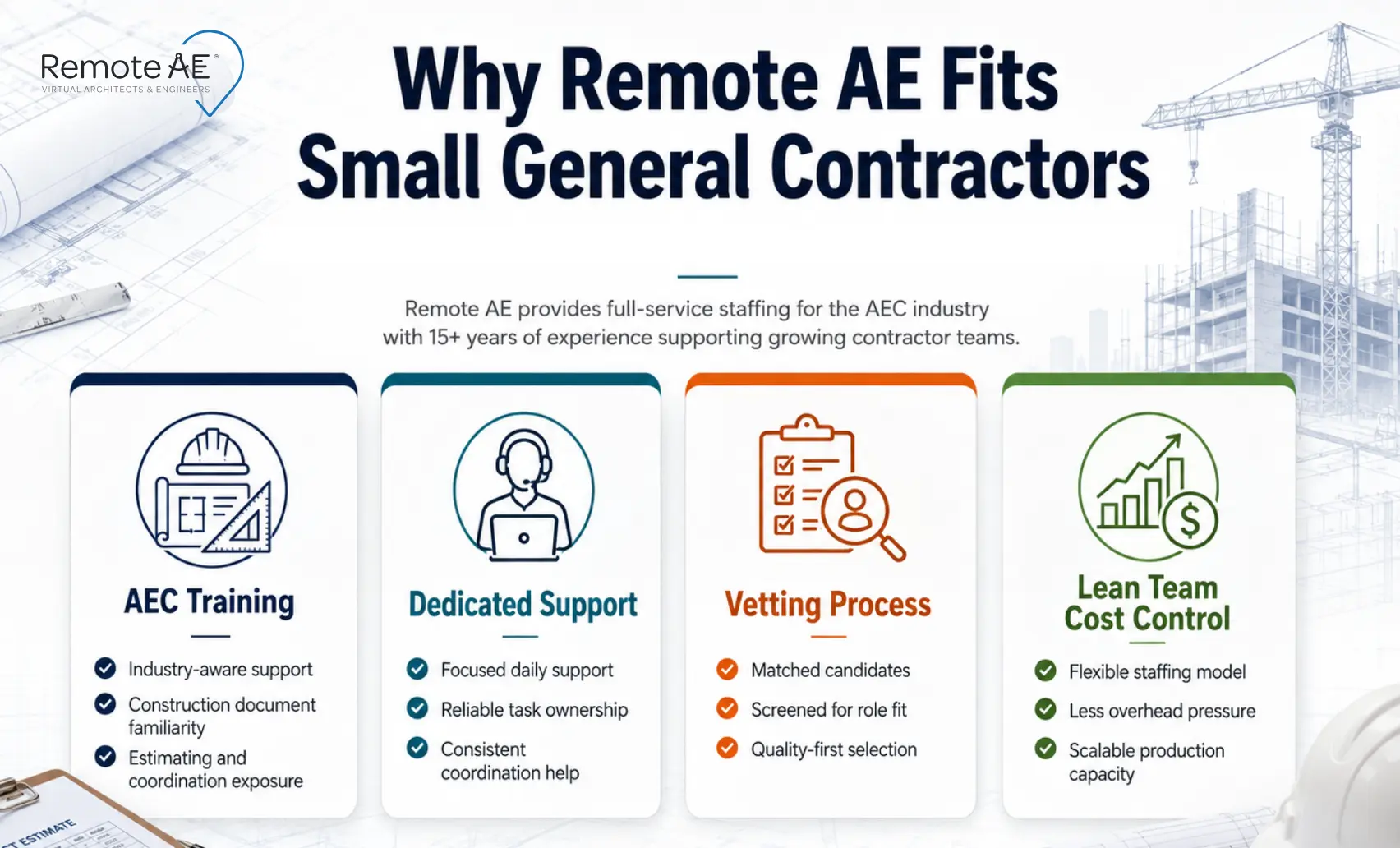
Why Remote AE Works Well for Small General Contractors
Construction coordination requires an industry context that generic virtual assistants simply do not have. A remote assistant who does not understand the difference between a submittal and an RFI, cannot read a drawing set, or does not know how change orders flow through a construction project creates more work than they save.
Remote AE staff exclusively for the Architecture, Engineering & Construction industry. Every virtual construction assistant placed by Remote AE carries genuine AEC production experience, understanding construction estimating workflows, preconstruction documentation, Procore log management, and the coordination language that active construction projects depend on.
Full-Time Support Without Local Hiring Delays
Most small general contractors do not need a senior estimator or a senior project manager; they need reliable execution support for the repeatable tasks that consume hours every day.
- A dedicated remote construction assistant owns estimating support, RFI tracking, submittal management, and document control, the functions that fall through the cracks when the GC is on site
- Full-time dedicated support means the assistant learns the firm’s vendors, subcontractors, project templates, and communication preferences over time
- No local recruitment cycle, Remote AE compresses the time from identifying a staffing need to having a productive assistant on live projects
Built-In Vetting and Onboarding Support
Remote AE manages the full hiring process, and the GC focuses on the work, not the recruitment.
- Three-stage candidate screening covers technical skills, software proficiency, and construction industry knowledge
- Remote AE presents two matched candidates for the GC to interview and select
- Onboarding support includes a structured transition meeting, schedule setup, tool access confirmation, and daily check-in protocols during the first 30 days
- Risk-free replacement, up to two replacements within the first year if the placement does not meet the GC’s standards
Cost Control for Lean Teams
Adding a remote construction assistant avoids the overhead stack that comes with a local hire.
- No employer payroll taxes or benefits contributions
- No workstation setup, office space allocation, or software seat costs beyond what the assistant already has
- No recruiting agency fees or extended vacancy periods while the role is unfilled
- Staffing flexibility, the engagement scales with project workload rather than carrying a fixed cost through slow periods
For a small GC managing tight project margins, this cost structure makes professional production support accessible without the financial risk of permanent headcount.
What to Delegate First: A 30-Day Starter Plan
Week 1: Set Up Systems
Build the foundation before delegating any live project tasks.
- Create a shared folder structure, active projects, bid files, templates, and archives, with consistent naming conventions
- Build a bid tracker, active opportunities, bid dates, status, and assigned subcontractor scope
- Set up an RFI log template, columns for RFI number, submitting party, date received, responsible party, response due date, and status
- Create a submittal log template, specification section, subcontractor, submission date, status, and approval date
- Compile and clean the vendor and subcontractor contact list, current contacts, trade categories, and preferred communication method
Week 2: Assign Estimating Support
Start with bid production tasks, the clearest, most measurable delegation category.
- Assign takeoff support on the next active bid, the remote estimating assistant measures quantities while the GC reviews the scope and prepares final pricing
- Set up quote tracking, the assistant distributes scope packages, follows up, and maintains the bid status log
- Prepare bid comparison sheets, leveled by trade, against a consistent scope description
- Build a proposal checklist, confirming all required submission attachments before every bid deadline
Week 3: Add Project Coordination
With the estimating support running smoothly, expand into active project coordination.
- Hand over RFI log ownership, the remote construction assistant logs new RFIs, tracks responses, and sends follow-ups on overdue items
- Assign submittal register management, the assistant maintains the log, chases subcontractor submissions, and tracks design team approvals
- Transfer meeting note responsibility, the assistant documents action items, and distributes notes within 24 hours of every project meeting
- Implement drawing distribution control, current drawing sets shared through the project’s document control platform
Week 4: Review, Improve, and Add More Scope
Use the final week of the first month to assess what is working and where to expand.
- Quality review: the GC checks a sample of RFI logs, submittal registers, bid comparison sheets, and meeting notes against the firm’s standards
- Task handoff updates, refine any SOP where the output does not match expectations
- Workflow adjustments, confirm which tools, naming conventions, and communication cadences are working, and formalise them
- Decide next responsibilities, document control ownership, change order log management, weekly status report preparation, or closeout documentation support
When a Small GC Should Consider Remote AE
Use this as a quick self-check. If two or more apply to your operation right now, a remote construction assistant is worth a serious look.
You Are Bidding More Than Your Team Can Handle
- Active bids are competing for the same hours as active construction projects
- Quantity takeoffs and bid comparison sheets are being prepared in the evenings because the workday is consumed by field coordination
- Your bid hit rate is suffering because rushed estimates contain errors or miss scope items that cost you on post-award
Your PM Is Buried in RFIs and Submittals
- The RFI log has open items that have not been followed up on in more than a week
- Submittals are sitting untracked because no one has time to maintain the register
- The design team is waiting on information from the GC that has not been compiled yet
You Need Better Document Control
- Field teams are working from outdated drawings because the current set has not been distributed
- Addenda and drawing revisions are coming in, and no one is confirming which version is current
- Project files are scattered across email threads, personal drives, and informal shared folders with no consistent naming structure
You Are Not Ready for Another Local Hire
- The project pipeline is busy enough to need support, but not stable enough to justify a permanent salary commitment
- Recruiting for an in-house coordinator or estimator has stalled, qualified candidates are scarce, or too expensive for the firm’s current overhead budget
- You need capacity now, not in six to twelve weeks after a full recruitment cycle
You Want Construction-Trained Support, Not a General VA
- Previous experience with generic virtual assistants produced more supervision work than capacity relief
- The tasks your firm needs to support, quantity takeoffs, RFI tracking, submittal management, and Procore administration, require a genuine AEC industry context
- You need someone who understands construction language, drawing sets, and coordination workflows from day one
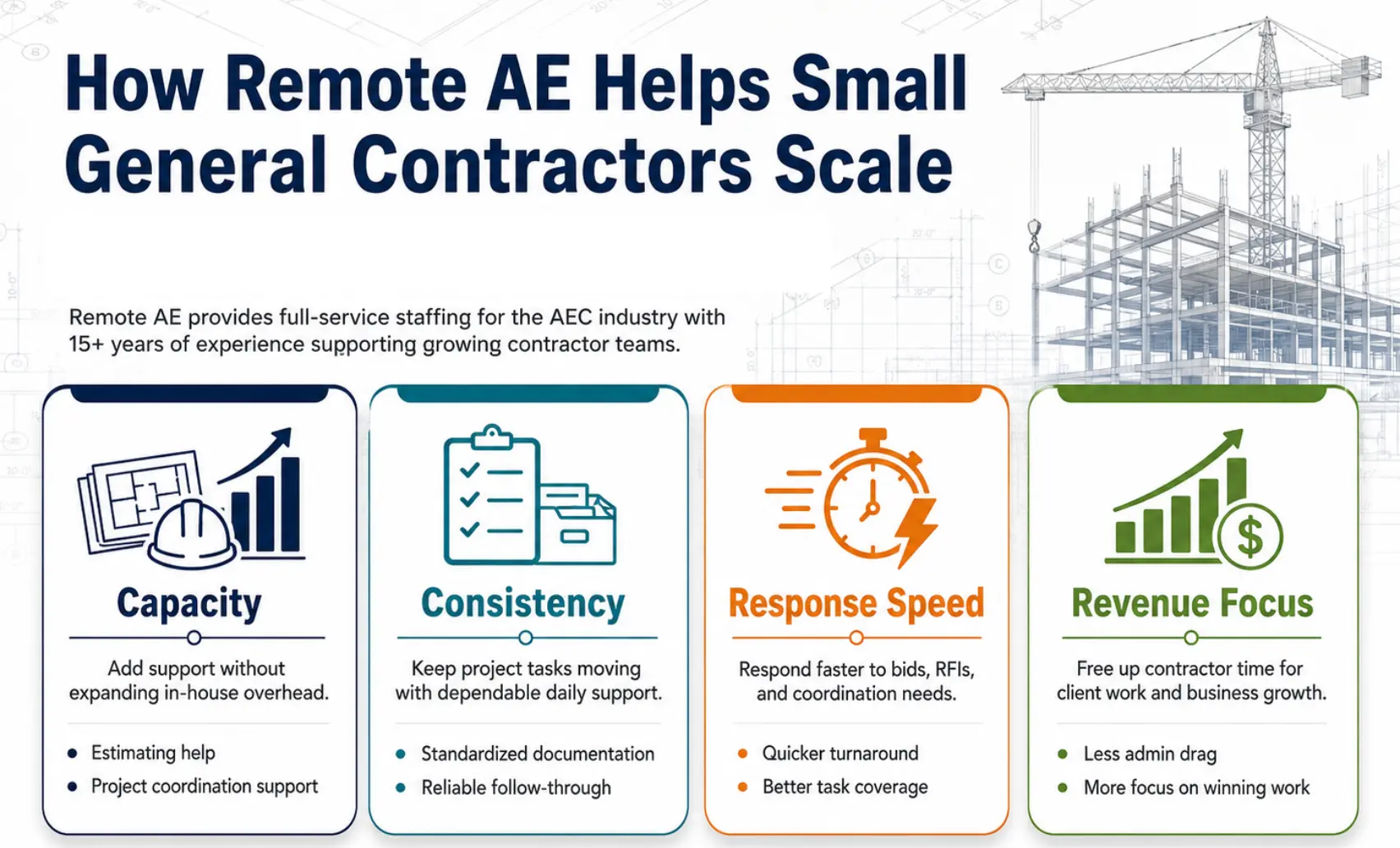
How Remote AE Helps Small Contractors Scale Without Adding Internal Chaos
More Capacity Without Expanding Office Space
- No desk, workstation, or additional software licence required
- Zero overhead increase alongside an immediate production capacity gain
- Every dollar saved on overhead stays in the project margin
Better Process Consistency Across Projects
- Small GCs often run each project with different folder structures, log formats, and document control approaches
- A dedicated remote construction assistant working across all active projects enforces the same naming conventions, log formats, and submittal structures on every job
- Consistency reduces onboarding time, prevents coordination errors, and makes handoffs cleaner
Faster Response Times During Active Projects
- RFIs logged and routed the same day, not when the GC finds time between site visits
- Submittal status updated in real time as design team approvals come back
- Drawing updates are distributed before the field team starts on the affected scope
Faster response times protect the schedule and protect the GC’s reputation with owners, architects, and subcontractors who judge professionalism by responsiveness.
More Time for Revenue-Producing Work
According to Autodesk and FMI, construction professionals spend 35% of their time on non-productive activities, information searches, conflict resolution, and rework. A remote construction assistant recaptures that time for work that actually grows the business:
- Client relationships: More time for owner meetings and relationship-building that generates repeat work
- Site supervision: More consistent field presence that protects quality and keeps subcontractors accountable
- Business development: More capacity to pursue new opportunities and grow the firm’s market position
Stop Running Your Construction Business Alone!
Small general contractors win more bids, deliver better projects, and grow faster when they have reliable production and coordination support behind them. The work is there. The capacity just needs to catch up.
Remote AE places dedicated virtual construction assistants with genuine AEC industry experience, trained in Procore, Bluebeam Revu, PlanSwift, AutoCAD, MS Project, and construction estimating and coordination workflows, ready to own your bid production, RFI tracking, submittal management, and document control from week one.
Book a Free Consultation With Remote AE, No Obligation, No Upfront Cost.
FAQs – How Small General Contractors Use Remote AE
What can a remote construction assistant do for a small general contractor?
A remote construction assistant can handle estimating support, bid tracking, RFI logs, submittals, document control, meeting minutes, scheduling updates, permit coordination, and vendor follow-up. This allows small GCs to spend more time managing the field, subcontractors, and client relationships.
Can a remote assistant help with construction estimating?
Yes. Remote assistants can support quantity takeoffs, bid package preparation, subcontractor outreach, scope reviews, and estimate organization. Final pricing decisions, risk assessments, and bid strategy should still be reviewed by the estimator or project manager.
Can a remote construction assistant manage RFIs and submittals?
Yes. RFI and submittal management are among the most common remote construction support tasks. A remote assistant can create logs, track due dates, route documents, follow up on responses, and maintain records within your project management platform.
Is remote construction support safe for project documents?
Yes, when proper controls are used. Best practices include NDAs, role-based permissions, multifactor authentication (MFA), audit logs, and secure cloud platforms. Most firms keep project files inside Procore, ACC, SharePoint, or similar controlled environments.
How fast can a small contractor hire through Remote AE?
Many small contractors can begin working with a remote construction assistant within a few days to two weeks. The timeline depends on the role, software requirements, onboarding process, and project workload.