


Outsourcing in AEC only works if the return is visible and repeatable. Measuring outsourcing ROI in the AEC Industry means understanding both cost savings and productivity gains, quality improvements, and scalability. This guide explains how to evaluate the true Return on Investment (ROI) from outsourcing architectural, engineering, and BIM services. Also, how to calculate ROI using practical benchmarks, billable hours, utilization rates, and earned value metrics, while accounting for total cost of ownership, quality assurance, and project turnaround improvements.
In AEC, Return on Investment (ROI) goes far beyond financial return. In AEC, “return” isn’t just dollars saved. It includes time efficiency (faster submittals), project accuracy (fewer re-reviews), and resource utilization (more billable hours for core staff). ROI is calculated using a simple formula:
ROI (%) = (Net Benefit ÷ Total Cost) × 100
What to measure.
Global studies flag persistent margin headwinds. According to McKinsey & Company, productivity in construction has increased by less than 1% annually over the past two decades, far behind manufacturing or tech.
Rising software costs, skilled labor shortages, and project complexity now demand smarter resource allocation. Outsourcing helps firms shift fixed costs into variable costs, giving financial flexibility while maintaining project throughput.
Today, AEC firms integrate outsourcing into core workflows across CAD drafting, BIM modeling, visualization, quantity surveying, and project coordination.
Outsourced BIM support ensures clash detection, RFI turnaround, and Common Data Environment (CDE) updates happen faster, directly improving ROI by reducing downtime and rework.
If scope changes daily, drawings contain export-controlled data, or the work requires rare local codes, the ROI may turn negative. In those cases, keep in-house or use a hybrid model with tighter governance.
Outsourcing has become a strategic lever for AEC firms seeking higher efficiency and lower costs without expanding headcount. Beyond immediate cost savings, it allows firms to access specialized skills and scale operations faster than traditional hiring can support.
| Function | Role | ROI Impact |
| Architecture | CAD & Revit Drafters | Boost utilization, reduce design delays |
| Structural | Design Support Engineers | Lower rework and QA/QC time |
| MEP | Coordinators and Drafters | Enhance BIM accuracy and clash detection |
| Project Management | Virtual Coordinators | Improve RFI turnaround, schedule control |
Measuring ROI in AEC outsourcing requires more than a financial ledger. It’s a blend of cost metrics, performance outcomes, and strategic flexibility.
The most visible benefit. Compare in-house hourly rates (including benefits, space, and software) with outsourced labor costs. Recent surveys show outsourcing can cut costs, but typical reported savings are ~15% on average (ISG 2024), and only ~25% of leaders report vendor-cost reductions (Deloitte 2024).
Quicker project cycles mean improved cash flow. ROI improves when teams measure turnaround time, RFI response rates, and billable utilization.
CII and literature reviews show rework often averages ~5% of project cost (with wide ranges). Cutting rework requires robust QA/QC and information management, regardless of sourcing. Using defined SLAs, QA/QC checklists, and ISO 19650-aligned workflows confirms consistent standards. CII finds rework can consume 2–20% of contract value; reducing rework is pure ROI (CII).
Outsourcing gives firms the agility to scale resources instantly without breaching project budgets or timelines.
When drafting or coordination is handled externally, in-house teams can focus on new pursuits, improving net profit margin, and innovation capacity.
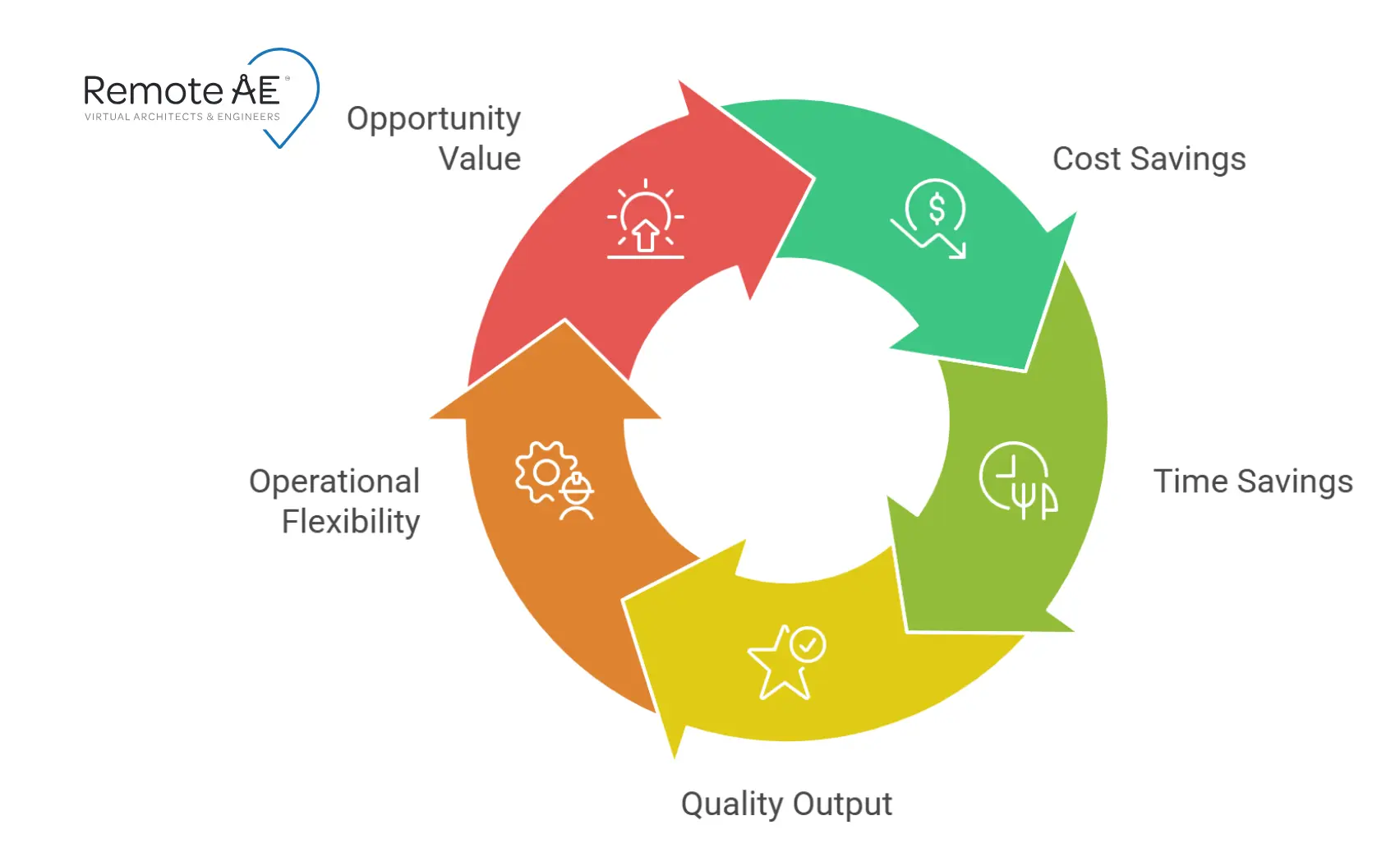
AEC leaders measure outsourcing ROI most effectively when they break it down into structured components. A framework guarantees you capture both costs and returns, not just immediate savings.
Start with a simple foundation:
ROI (%) = (Return – Cost) ÷ Cost × 100
In AEC outsourcing, Return represents measurable project benefits, faster delivery, fewer change orders, reduced rework, and improved billable utilization.
Your baseline should include:
This establishes the “before” snapshot needed to quantify actual outsourcing gains.
Include every cost element tied to outsourced work:
Accurate TCO accounting prevents inflated ROI figures and helps identify genuine savings over time.
Link your outsourcing results to measurable Key Performance Indicators (KPIs):
Tracking these metrics reveals both efficiency and quality improvements, which are core to sustainable ROI.
Outsourcing ROI must factor in non-financial elements such as quality consistency, data integrity, and security compliance.
When outsourcing partners meet these standards, risk is minimized, and ROI remains predictable across multiple projects.
Consistent measurement drives long-term results. Firms that regularly track output and efficiency data can optimize outsourcing relationships faster.
Routine review of these reports verifies that your outsourcing strategy aligns with project goals, quality standards, and profitability targets.
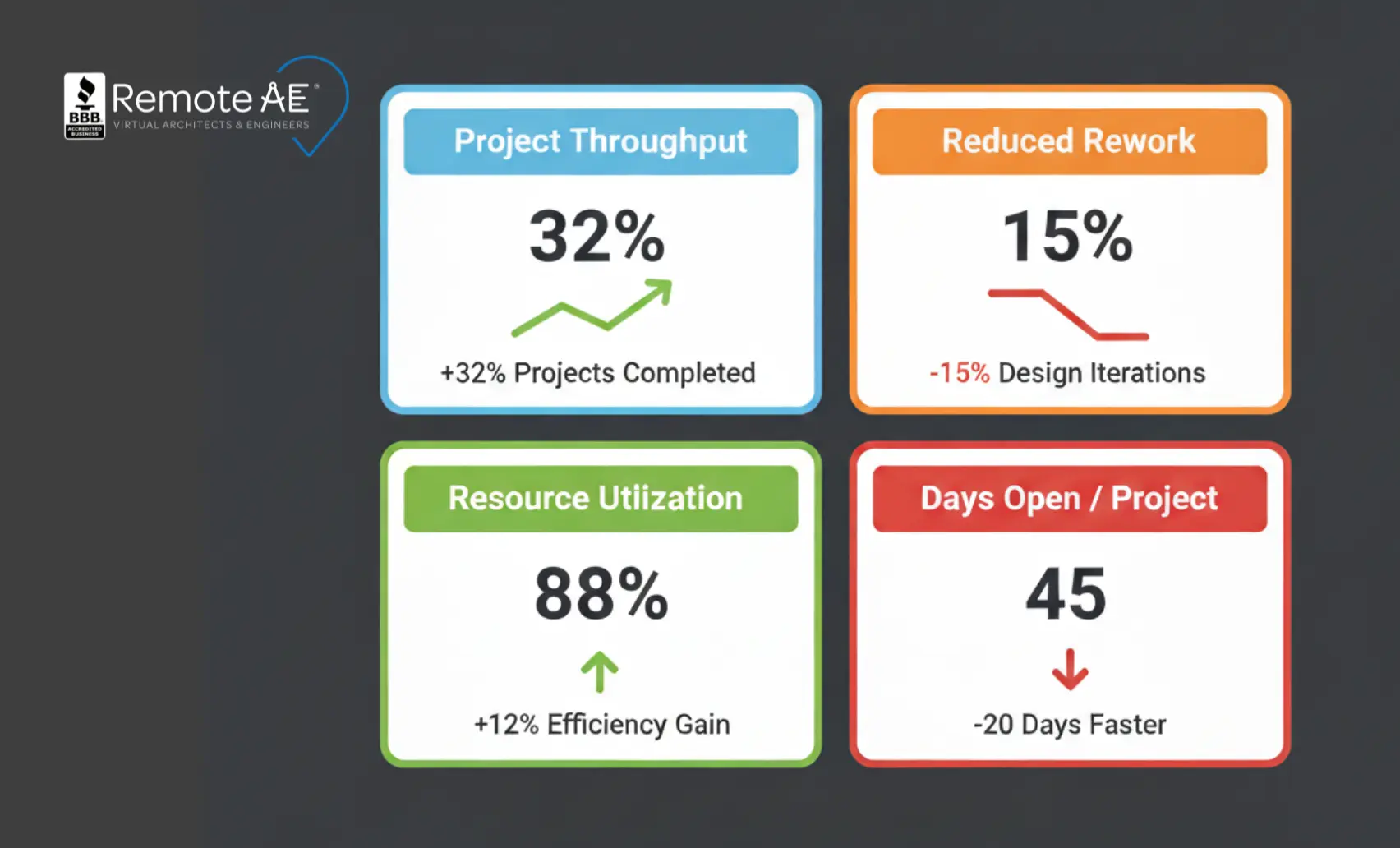
Outsourcing ROI can only be accurate when all cost components are included. Many AEC firms underestimate indirect costs when comparing internal and outsourced resources. To ensure clarity, build a complete cost model before calculating returns.
Don’t just compare hourly rates. Add overheads such as benefits, HR, recruitment time, software, and management hours.
Example: An in-house CAD drafter earning $40/hour can cost $65–$70/hour after overhead, compared to an outsourced rate of $28–$35/hour for similar quality and output.
AEC outsourcing often involves tools like Revit, BIM 360, CDEs, and Procore. These platforms carry licensing and storage fees that must be allocated correctly. Using a shared Common Data Environment (CDE) also requires secure setup and data governance to prevent version errors or rework.
Factor in the time spent on:
While outsourcing reduces direct staffing effort, there’s always a small portion of project management overhead, typically 5–10% of total cost, to maintain communication and quality.
Budget initial setup: template load, shared parameters, view templates, and “gold” sample sheets. One clean setup reduces long-tail rework (CII 2–20% band is your risk buffer).
Now, let’s look at the measurable gains that prove real outsourcing ROI in AEC.
When administrative or drafting tasks are delegated, in-house teams can focus on billable design and coordination work. Deltek Clarity places recent overall utilization around ~61%, while many firms target 75–85% for technical staff rather than firm-wide averages.
According to Construction Industry Institute (CII) data, rework can consume 5–10% of total project cost. A cleaner BIM/CAD pipeline that halves rework, through template control, clash audits, and first-pass QA, returns real money to the margin.
Thin margins heighten the value of time. McKinsey pegs sector EBIT around ~5% and notes productivity trailing the broader economy; shaving days off submittals or RFI cycles improves cash flow and claim risk (McKinsey). Use clash issues closed/week and days-open for RFIs/submittals as your schedule proxies.
Remote AE helps AEC firms realize measurable, consistent ROI from outsourcing. With over 15 years of domain experience, we specialize in pairing firms with virtual assistants trained in AutoCAD, Revit, Civil 3D, BIM 360, and Procore.
Every assistant is equipped with ISO 19650 familiarity, CDE discipline, and a strong quality assurance understanding. Dedicated project coordinators confirm deliverables meet your scope of work, acceptance criteria, and schedule targets.
Example: A U.S.-based engineering firm improved project delivery speed by 25% and reduced rework costs by 40% after integrating Remote AE’s remote drafting team.
Our clients receive transparent ROI reports, showing productivity data, utilization metrics, and measurable outcomes from every engagement.
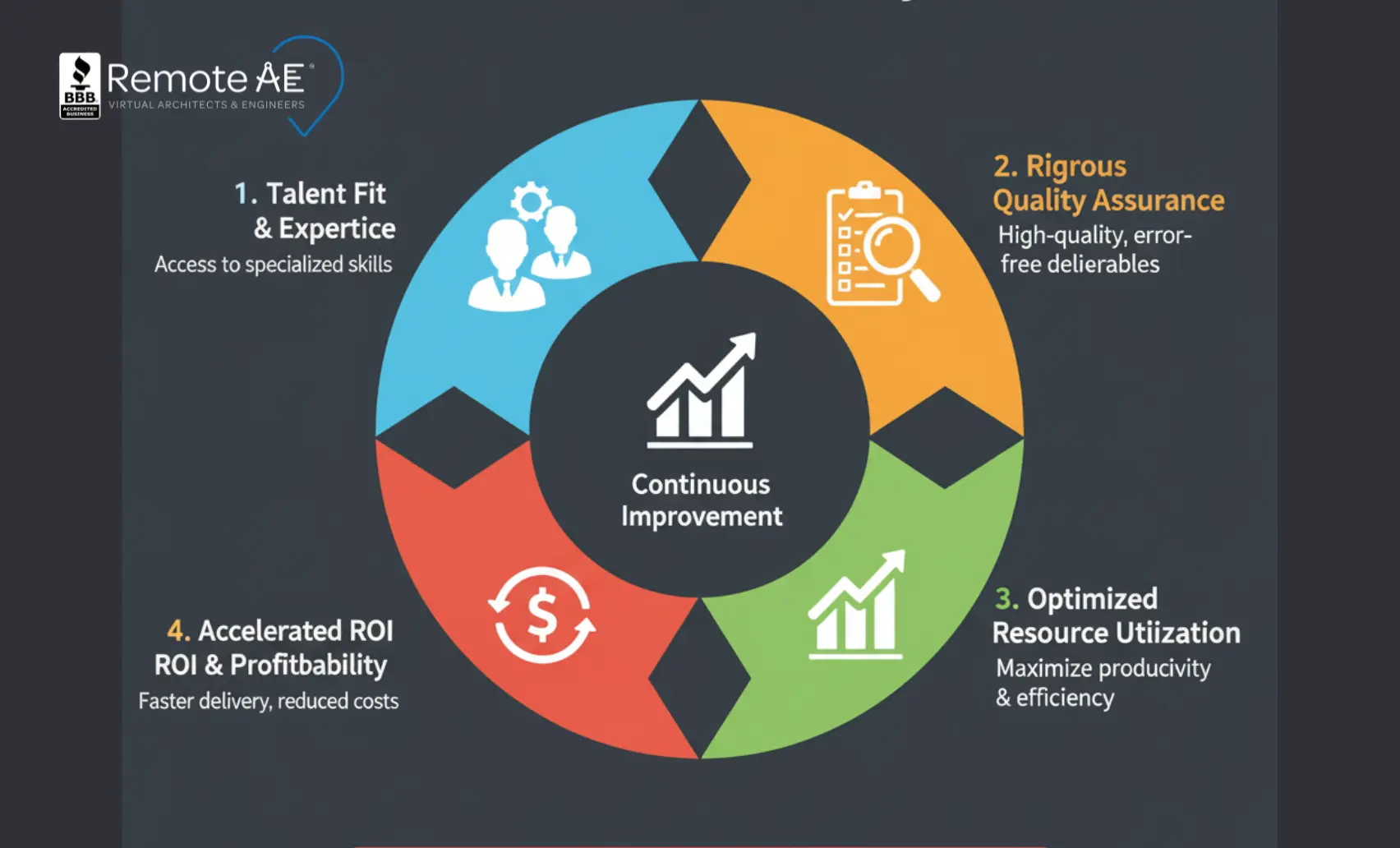
Remote AE helps AEC firms measure and improve ROI, not just add bodies. Contact Remote AE today to discuss your project goals and discover how you can achieve measurable ROI with remote AEC specialists who deliver on performance, cost, and quality.
ROI compares savings from outsourced work to total costs, including training, seats, and management time. A simple formula:
ROI = (Net Savings ÷ Total Cost) × 100.
Teams often forget software seats, management time, QA/QC reviews, and handoff rework. Total Cost of Ownership (TCO) should include onboarding, licenses, communication tools, and support hours.
Expect measurable ROI in 60–90 days. Initial weeks cover setup and training, while steady savings start after workflow alignment. Full optimization, when staff hit target productivity and rework drops, usually happens by the third month of engagement.
Key performance indicators include error rate, rework hours, on-time delivery, clash-free submissions, and RFI closure rate. Tracking quality KPIs ensures outsourcing delivers consistent results and not just lower labor costs, aligning with ISO 9001 and 19650 quality goals.
Other articles you may like:

