
Outsourcing CAD or BIM work can speed delivery, but it can also create IP risk if ownership and reuse rights are unclear. Many AEC teams assume paying for drawings means they own them. That is often wrong. In U.S. law, copyright ownership and transfers follow specific rules, and transfers typically must be in a signed writing (17 U.S.C. § 204(a)). In parallel, AEC contracts often treat drawings, specs, and models as “Instruments of Service,” where the designer keeps ownership, and the client receives a license for defined uses (AIA guidance). This guide explains IP protection, what IP is in AEC, what most people get wrong, and how to protect rights when you outsource.
What Is Intellectual Property in AEC?
Intellectual property in AEC refers to creations of the mind used to design and construct buildings.
In practical terms, IP includes:
- Architectural drawings
- BIM models (Revit, IFC)
- CAD files (DWG, RVT)
- Engineering calculations
- Specifications
These deliverables are not just project outputs. They are valuable design assets that can be reused, adapted, or misused if not protected.
Types of IP Relevant to AEC
Several forms of intellectual property apply in AEC projects:
- Copyright (most important): Protects drawings, BIM models, and documentation
- Trade secrets: Covers proprietary workflows, templates, and detailing standards
- Design rights: Protect the visual appearance of structures
- Patents (rare but possible): Applies to unique systems or structural innovations
Among these, copyright is the primary protection mechanism for ownership of CAD files (DWG) and Revit model ownership.
Why IP Matters in AEC Projects
IP matters because it ties directly to:
- Business value (your differentiators live in your details and models)
- Competitive advantage (unique concepts get copied when controls are weak)
- Reusability (multi-site rollouts and future phases)
- Legal liability (misuse or unauthorized reliance can create claims)
For example, if a BIM model is reused without permission, the original designer may still carry responsibility for errors, even without control over changes.
The Short Answer (What Most People Get Wrong)
Paying for Drawings ≠ Automatically: Owning the Copyright
One of the biggest misunderstandings in AEC is simple:
Paying for drawings does not mean you own them.
When a client pays for design services, they usually receive a license to use the drawings, not ownership of the copyright. This is why questions like “who owns construction drawings” often lead to disputes.
Ownership depends on:
- The contract
- The scope of use
- Whether rights were transferred in writing
Without a written transfer, the creator retains ownership.
“Instruments of Service” Explained
In AEC, drawings and models are called Instruments of Service.
This includes:
- Plans and sections
- Specifications
- BIM models (Revit, IFC)
- Details and libraries
Standard agreements, such as AIA B101, and digital data protocols like E203 treat these deliverables as protected works.
Typical structure:
- The designer owns the Instruments of Service
- The client receives a nonexclusive license to use them
This license usually allows:
- Construction of the project
- Operation and maintenance
- Limited modifications
It does not allow:
- Reuse on other projects
- Resale
- Distribution to third parties
Unless explicitly stated.
What “Ownership” Really Means in AEC Deliverables
“Ownership” in AEC usually means copyright ownership, not possession of a file. You can have the RVT/DWG on your drive and still not own the copyright.
Copyright vs Physical Files vs the Building
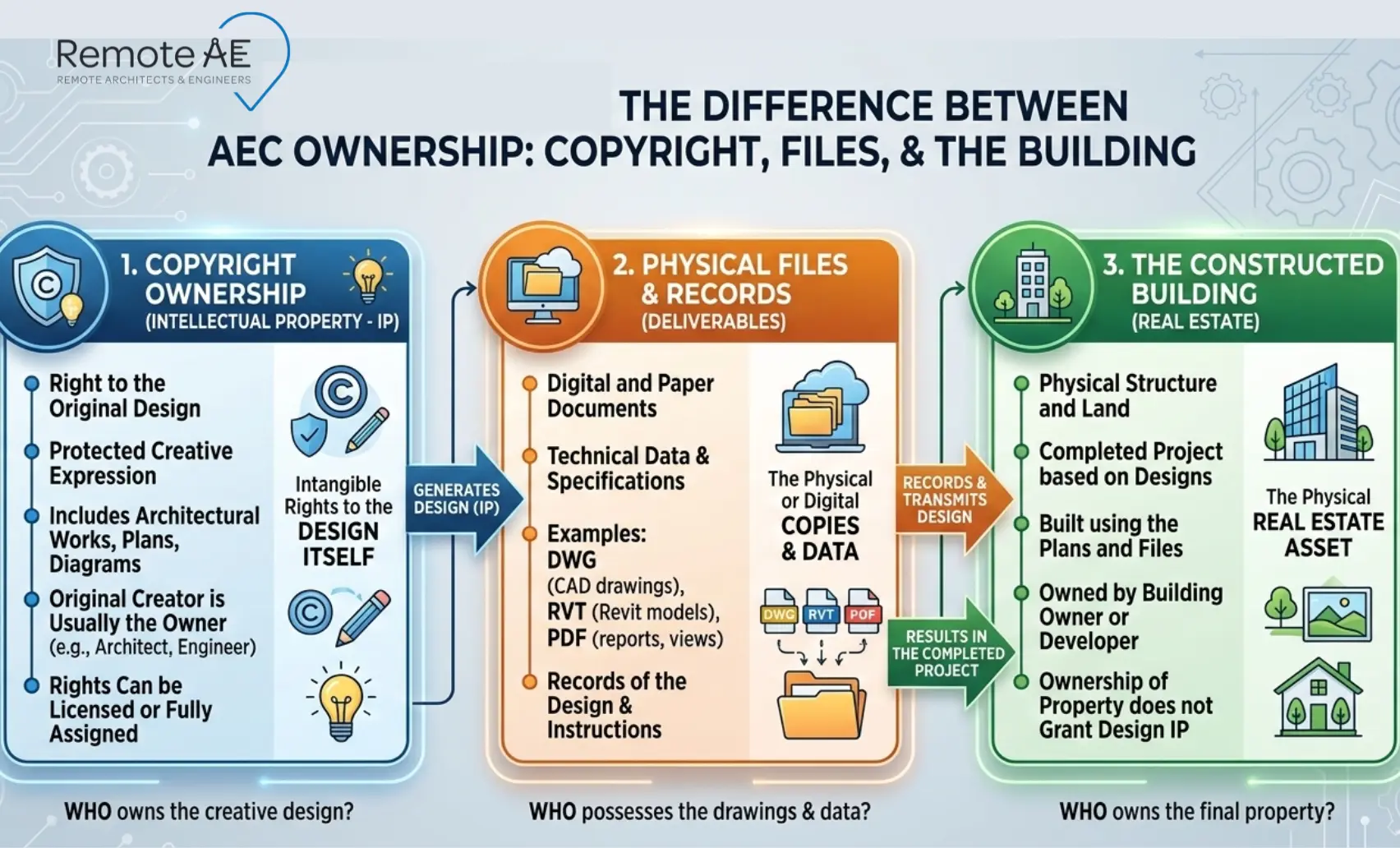
Ownership in AEC is often confused because there are three different layers:
- Copyright: Legal ownership of the design
- Physical or digital files (DWG, RVT, PDF): The deliverable formats
- The constructed building: The physical outcome
A client may own the building and possess the DWG or RVT files. But the designer may still own the copyright. This distinction is central to IP protection when outsourcing AEC work.
Reuse Rights: One Project vs Future Use
Most AEC contracts limit usage to one project.
That means:
- You can build the project
- You can maintain it
- You may be able to alter it
But you cannot:
- Reuse the same design on another site
- Share it with another contractor
- Replicate it for future developments
Unless the contract grants broader rights. This is where the architect’s copyright license to the owner becomes critical.
Derivative Works and Liability
Derivative works create another layer of risk. If someone modifies a model or drawing:
- Who owns the changes?
- Who is responsible for errors?
For example:
- A contractor modifies a Revit model
- A new engineer uses outdated DWG files
Without clear rights, liability becomes unclear. This is why contracts often restrict modification or require approval before changes.
Default Rules (Without a Contract Clause)
If you don’t write the clause, the default rules fill the gap. That’s where many outsourcing disputes begin.
Employee Work vs Independent Contractor Work
Ownership rules change depending on who created the work.
- Employees: Work is usually owned by the employer
- Independent contractors: They own the work unless rights are transferred
This is why outsourcing requires clear agreements.
Why “Work Made for Hire” Is Tricky for AEC
Many firms try to use work-made-for-hire clauses. However, this concept is limited under copyright law.
To qualify:
- The work must fall into specific categories
- The agreement must clearly state it
Most AEC deliverables do not automatically qualify. This creates confusion around ownership of CAD files (DWG) and Revit model ownership.
Why Written Transfers Matter
U.S. law generally requires a written instrument of conveyance that is signed to transfer copyright ownership (17 U.S.C. § 204(a)).
What “signed writing” means in practice
- a signed contract section that assigns rights
- An addendum signed by the rights holder
- a properly executed SOW with assignment language
Common IP Risks When Outsourcing AEC Work
Outsourcing brings speed and flexibility. It also introduces real IP risk if contracts and controls are not clear. Most disputes around IP protection when outsourcing AEC work come from missing clauses, unclear ownership, or poor file control.
Reuse of Your Designs
One of the biggest risks is unintended reuse.
An outsourced team may:
- Reuse your architectural drawings on another project
- Adapt your BIM model for a different client
- Repurpose details, templates, or families
This is especially common when teams work across multiple clients. Without clear restrictions, your design work can become someone else’s deliverable.
This directly impacts:
- Competitive advantage
- Brand differentiation
- Future revenue
Unauthorized Sharing
Data leaks are another common issue.
Files can be shared through:
- Subcontractors without approval
- Cloud links with open access
- Email forwarding or downloads
This includes sensitive assets like:
- DWG and RVT files
- Specifications
- BIM coordination models
Without proper NDA, confidentiality, and subcontractor flow-down clauses, control over your data is lost.
Ownership Disputes
Ownership confusion usually appears when:
- Projects expand
- New stakeholders join
- Contracts were unclear at the start
Typical disputes include:
- Who owns the final Revit model
- Whether editable CAD files must be provided
- Whether the client can reuse the design
These disputes often escalate because ownership was never clearly defined in writing.
Loss of Competitive Advantage
Your design process is part of your value.
If your details, templates, or BIM workflows are reused:
- Competitors gain access to your methods
- Your differentiation decreases
- Your internal standards lose value
This is especially true for:
- Custom Revit families
- Parametric BIM workflows
- Specialized detailing libraries
Cross-Border Legal Complexity
Outsourcing often involves teams in different countries.
This creates legal challenges:
- Different copyright laws
- Different enforcement standards
- Different interpretations of moral rights
Without clear choice of law and venue clauses, enforcing ownership becomes difficult.
Common Contract Models (Pick One, Don’t Wing It)
There is no single “correct” ownership model. But you must choose one deliberately.
Model A: Designer Owns; Client Gets a License (Most Common)
This is the standard AEC model.
- Designer retains ownership of Instruments of Service
- Client receives a nonexclusive license
Typical license allows:
- Construction of the project
- Operation and maintenance
- Limited modifications
This aligns with AIA B101 and digital data protocols like E203.
It balances:
- Designer’s IP protection
- Client’s project needs
Model B: Client Owns Everything (Assignment)
In this model, ownership is transferred to the client.
This requires:
- Copyright assignment/transfer in writing
- Clear definition of deliverables
Typical use cases:
- Public sector projects
- Design-build contracts
- Large organizations standardizing assets
This model gives full control to the client, but may increase:
- Fees
- Liability expectations
Model C: Split Rights (Hybrid Model)
Many firms use a hybrid approach.
Example:
- Client owns project-specific files
- Firm retains reusable elements
This includes:
- Families
- Templates
- Scripts
- Standards
This model protects both parties:
- Client gets project deliverables
- Designer keeps reusable IP
Outsourcing Scenarios That Trigger Disputes
Disputes usually appear when expectations shift midstream: a bigger project, more reuse, more editable files, or a relationship that ends unexpectedly.
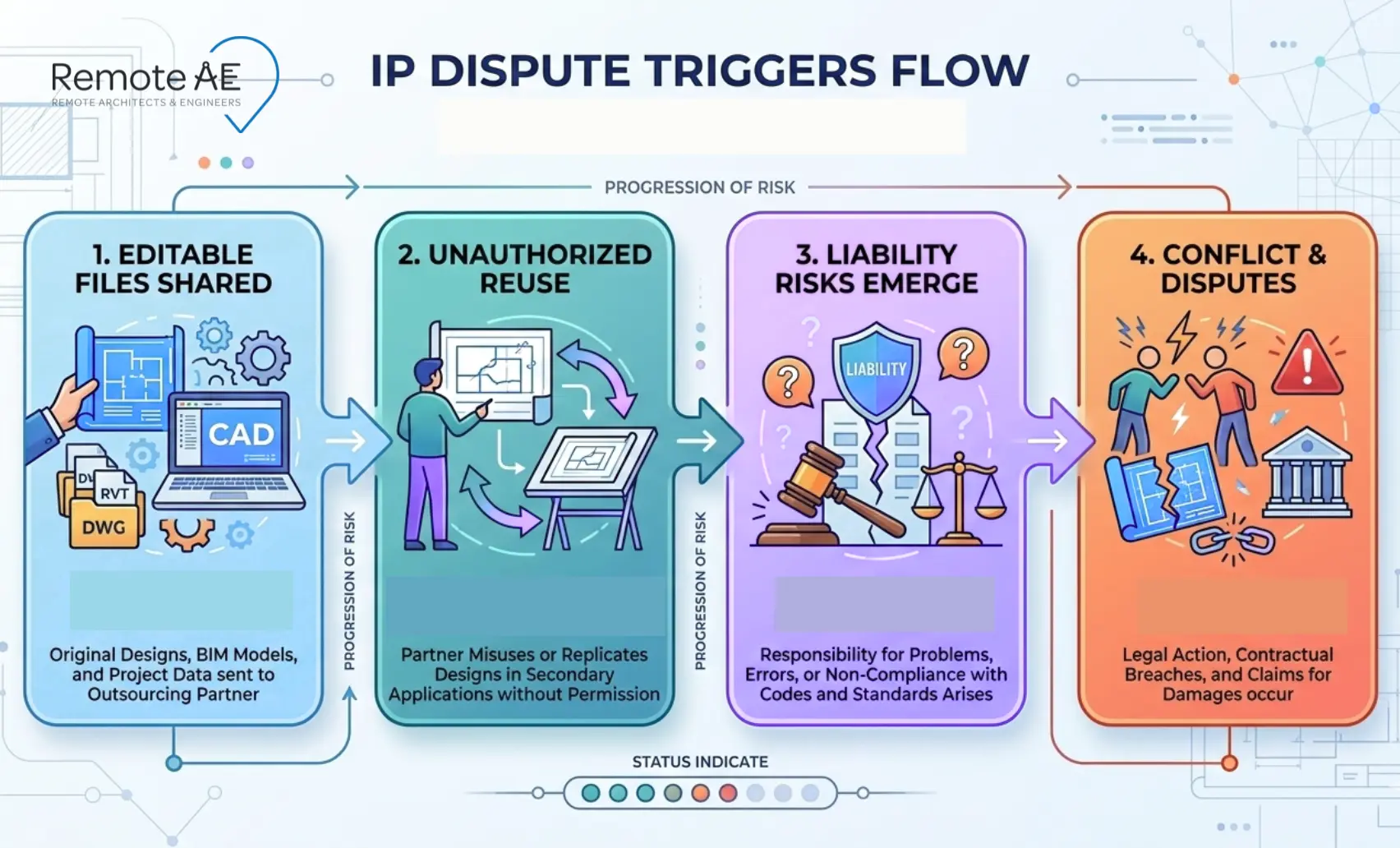
Remote Drafting Teams Using Firm Standards
When outsourcing drafting:
- Your templates
- Your naming standards
- Your BIM workflows
are shared externally.
Without clear agreements:
- Who owns the output?
- Can the vendor reuse your standards?
This is a common issue in the construction industry’s outsourcing.
Subconsultants and “Chain-of-Title”
Projects often involve multiple parties:
- Architects
- Engineers
- Consultants
Each party creates IP. If ownership is not aligned:
- Rights may not transfer correctly
- Licensing conflicts may occur
This creates gaps in the chain-of-title, which can delay projects.
Owner Requests Editable CAD/Revit Files
A frequent request:
“Can we get the DWG or RVT files?”
This raises key questions:
- Is delivery included?
- Are there restrictions on use?
- Who carries liability for modifications?
Providing editable files without restrictions can create long-term risk.
Relationship Ends Mid-Project
When outsourcing ends early:
- Access to files may be unclear
- Licenses may terminate
- Work-in-progress may be disputed
Many agreements tie usage rights to:
- Payment completion
- Contract obligations
Project continuity is at risk if terms are not clear.
BIM/CAD and Digital Data: Where IP Fights Actually Happen
Most disputes are not about the printed PDF. They’re about the editable model and who can rely on it.
Who Owns the BIM Model and Its Components?
A BIM model is not a single asset.
It includes:
- Geometry
- Data
- Families
- Linked models
Ownership can differ across these elements.
For example:
- Project model → client
- Families → designer
- Templates → firm
Without clarity, disputes arise around Revit model ownership.
“Authorized Uses” and Digital Data Protocols
Digital data protocols define how models can be used.
Standards such as:
- AIA E203
- Digital Data Protocols
introduce the concept of Authorized Uses.
Example clause:
The model may be used for coordination only, not fabrication.
This limits risk and defines responsibility.
Model Reliance and Risk Allocation
BIM introduces reliance risk.
Questions include:
- Can a contractor rely on the model for fabrication?
- Is the model coordinated or schematic?
- What is the Level of Development (LOD)?
For example:
- LOD 200 → conceptual
- LOD 350 → coordinated
- LOD 400 → fabrication
If reliance is not defined, liability increases.
Key Clauses You Must Include in Contracts
A strong AEC outsourcing contract protects your IP before problems happen. Without clear clauses, ownership, usage rights, and liability become unclear.
Below are the core clauses every AEC outsourcing service agreement should include.
Work-for-Hire Clause
A work made for hire clause states that the client owns the work created. However, in AEC, this is not always straightforward.
Under U.S. law, work-for-hire only applies if:
- The work fits specific categories
- The agreement is in writing and signed
Because of this, relying only on a work-for-hire clause can be risky. Most contracts pair it with a separate assignment clause for clarity.
IP Assignment Clause
This clause transfers ownership from the service provider to the client.
It should explicitly cover:
- All drawings
- BIM models
- CAD files (DWG, RVT, IFC)
- Revisions and updates
- Associated documentation
To be valid, it must comply with:
- Copyright assignment/transfer in writing (17 U.S.C. § 204)
Without this clause, the creator typically retains ownership—even if paid.
Confidentiality / NDA
An NDA protects your project information.
It should define:
- What is considered confidential
- Who can access the data?
- How long protection lasts
It should also include:
- Subcontractor flow-down requirements
- Restrictions on sharing with third parties
This is critical when working with distributed teams.
Usage Restrictions
Even when files are delivered, usage must be defined.
Example restrictions:
- Use is limited to a specific project
- No resale or reuse
- No modification without approval
This aligns with the standard architect copyright license to the owner structures.
Moral Rights Waiver
In some countries, creators retain moral rights.
These include:
- Right to attribution
- Right to object to modifications
A moral rights waiver ensures the client can:
- Modify the work
- Use it without attribution requirements
This is especially important in cross-border outsourcing.
Data Security Clause
Your contract should define how data is handled.
Include:
- Storage requirements
- Access control
- File transfer methods
Tie this to:
- Role-based permissions
- Secure collaboration tools
- Audit tracking
This protects Instruments of Service from misuse or loss.
Best Practices to Protect Your IP When Outsourcing
Strong clauses help, but daily behavior protects IP. Treat IP like a workflow, not a one-time signature.
Always Use Written Agreements
Never rely on verbal agreements. Every project should have:
- Signed contracts
- Defined ownership
- Clear usage rights
This avoids disputes later.
Work with Trusted AEC Staffing Providers
Experienced providers like Remote AE understand:
- BIM workflows
- CAD standards
- IP protection
They follow structured processes, not ad-hoc workflows.
Limit Access to Sensitive Files
Use least-access principles:
- Provide only the required files
- Restrict editing rights
- Control downloads
This reduces the risk of misuse.
Use Secure Collaboration Tools
Use platforms that support:
- Access control
- Audit trails
- Version control
Examples include:
- BIM platforms
- Secure cloud storage
This protects Revit, CAD, and BIM data.
Watermark or Track Files
For early-stage designs:
- Add watermarks
- Track file versions
- Control distribution
This discourages unauthorized use.
Keep Version Control
Version control helps track:
- Changes
- Authors
- Revisions
It also supports accountability.
Regular Audits
Review your system regularly:
- Who accessed files
- What changes were made
- Where files were shared
This ensures compliance.
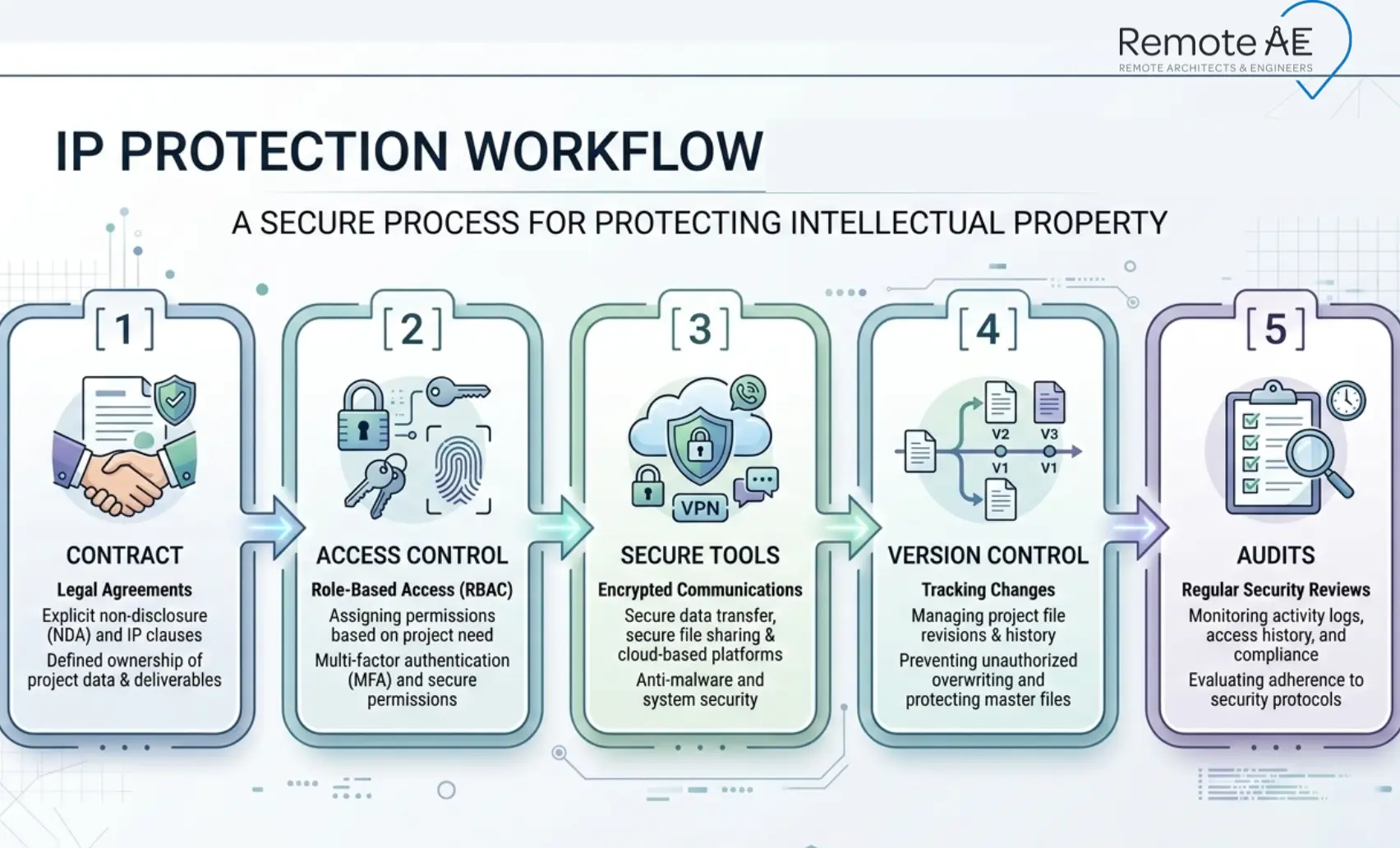
How Professional AEC Staffing Firms Handle IP Protection
Working with a specialized partner reduces risk. They already have systems in place.
Structured Contracts
Professional firms use standardized agreements with:
- clear IP ownership and license terms
- assignment language when needed
- reuse restrictions and confidentiality terms
Dedicated Teams
With dedicated resources:
- Access is controlled
- Work is traceable
- Accountability is clear
Remote AE, for example, provides virtual assistants tailored for the AEC industry with structured access to your data.
Secure Infrastructure
Remote AE use:
- Controlled systems
- Secure file sharing
- Restricted permissions
This reduces data exposure.
Long-Term Relationships
Long-term teams reduce risk.
They understand:
- Your standards
- Your workflows
- Your expectations
This is safer than rotating freelancers.
Compliance with Global Standards
Remote AE assistants follow:
- NDA protocols
- Data protection practices
- Contract compliance
Checklist: Protect Your AEC IP Before You Outsource
Use this checklist before starting any outsourcing engagement:
- Use a written contract
- Include an IP assignment clause
- Add NDA and confidentiality terms
- Define usage rights clearly
- Control access to files
- Use secure tools and systems
- Maintain version control
- Work with a trusted AEC provider
This simple list prevents most IP disputes.
Protect Your Designs Before You Outsource!
Your drawings, models, and details are not just files. They are your competitive advantage. Without the right structure, outsourcing can expose your Instruments of Service, create ownership disputes, and put your business at risk. Here comes Remote AE. Remote AE provides AEC-trained virtual assistants who work under your standards, follow secure processes, and protect your project data at every step.
You keep ownership.
You control the decisions.
We handle the production with discipline and accountability.
Schedule a call today for a fast scope review and a clear weekly quote.
FAQs – IP Protection When Outsourcing AEC Work
Who owns architectural drawings if I paid for them?
Paying for drawings does not automatically transfer ownership. In most cases, the architect or designer retains copyright. The client usually receives a license to use the drawings for the specific project.
Do clients have the right to CAD/Revit files?
Not by default. Clients typically receive PDFs or prints, while native CAD or Revit files require a separate agreement. Access to source files depends on what is written in the contract.
What are “Instruments of Service” in AIA contracts?
“Instruments of Service” are the drawings, models, specifications, and other documents created by the architect. Under AIA contracts, the architect usually retains ownership but grants the owner a limited license to use them.
Can an owner reuse drawings on another project or site?
Usually no. The license is often limited to one project and location. Reuse without permission can violate copyright and expose the owner to liability.
Who owns the BIM model after construction?
Ownership usually remains with the creator unless assigned in writing. The owner often gets a license for use in operations or facility management. Terms should be clearly defined in the contract.
What happens to usage rights if the owner stops paying?
Usage rights can be suspended or revoked if payment terms are not met. Many agreements link the license to full payment. Continued use without payment may be a breach of contract.