

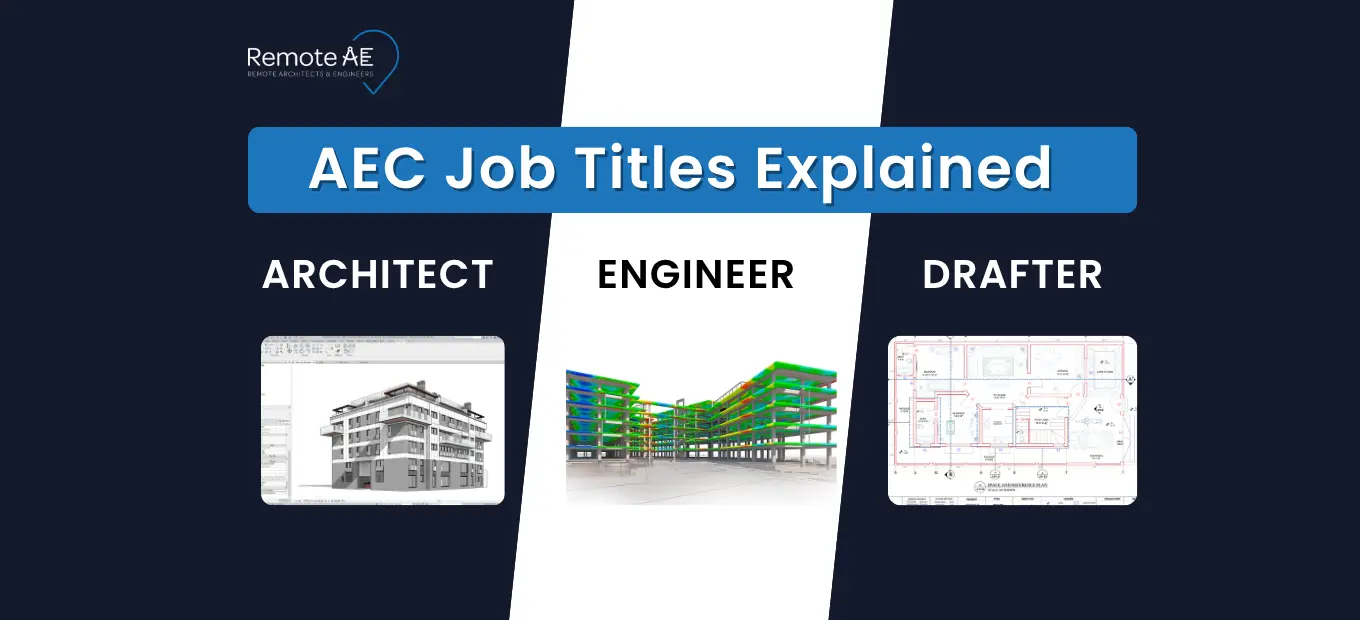
AEC leaders often use the same few job titles to describe very different kinds of work. That creates hiring mistakes, client confusion, and project delays. An architect usually leads design intent and building planning. An engineer validates safety, systems, and performance. A drafter turns approved ideas into technical drawings that teams can price, permit, and build from.
This guide explains where each role fits, how they overlap, and how they work together across a project lifecycle. It also helps project managers decide which role to hire first and where remote support can reduce pressure during deadlines, drawing backlogs, and coordination-heavy phases without increasing long-term fixed overhead.
Why AEC Job Titles Confuse Clients, Candidates, and Hiring Teams
AEC job titles sound clear on paper, but they often break down in real projects. A client may ask for an architect when the immediate need is drafting support. A hiring team may post for a drafter when they really need engineering documentation help. A candidate may have BIM coordination skills but carry a title that does not reflect that scope.
This confusion is common because most AEC firms are small and lean. According to the American Institute of Architects, about 75% of architecture firms have fewer than 10 employees, which means many people wear multiple hats and titles shift from firm to firm
Why the Same Work Can Have Different Titles Across Firms
In the AEC industry, job titles are not always standardized. One firm may call someone a drafter, while another uses the title design technician for the same work.
This happens because:
- Firms define roles based on internal structure
- Project size and complexity influence responsibilities
- Some companies combine multiple roles into one position
This creates confusion, especially when comparing architect vs engineer roles across organizations. This confusion is common because most AEC firms are small and lean.
Why “Designer,” “Technician,” and “Assistant” Blur the Picture
Titles like designer, technician, and assistant often create the most confusion because they do not tell you whether the role is creative, technical, support-based, or licensed.
- A designer might build early concepts.
- A technician might produce detailed documentation.
- An assistant might support architects or engineers across many tasks.
This matters because legal authority does not always follow the title. In many projects, design decisions and stamped work must stay with licensed professionals, while support staff handle documentation, revisions, modeling, and coordination.
That distinction matters even more when rework is expensive. Autodesk reports that poor project data and miscommunication cause 52% of rework, a reminder that role clarity and clean documentation directly affect project cost and schedule
Architect vs Engineer vs Drafter: Quick Comparison
Side-by-Side Comparison Table
Here’s a clear comparison to simplify architect vs drafter and engineer roles:
| Category | Architect | Engineer | Drafter |
| Role Focus | Design and planning | Technical systems and safety | Documentation and detailing |
| Core Responsibility | Building design, space planning, aesthetics | Structural engineering, MEP engineering, civil engineering | Create construction documents and technical drawings |
| Tools Used | Revit, AutoCAD, BIM tools | Engineering software + Revit MEP | CAD, AutoCAD, BIM tools |
| Education and Training | Architecture degree | Engineering degree | Technical diploma or certification |
| Licensure and Legal Authority | Licensed via NCARB | Licensed Professional Engineer (PE) via NCEES | No licensure required |
| Best-Fit Projects and Deliverables | Concept design, permit set, design plans | Structural calculations, system layouts | Blueprint / technical drawing, shop drawings |
A fast market example helps here. The U.S. Bureau of Labor Statistics projects about 7,800 openings for architects and 16,200 openings for drafters each year on average over the 2024–2034 decade, which shows that both design leadership and documentation capacity remain important in the market.
What Does an Architect Do?
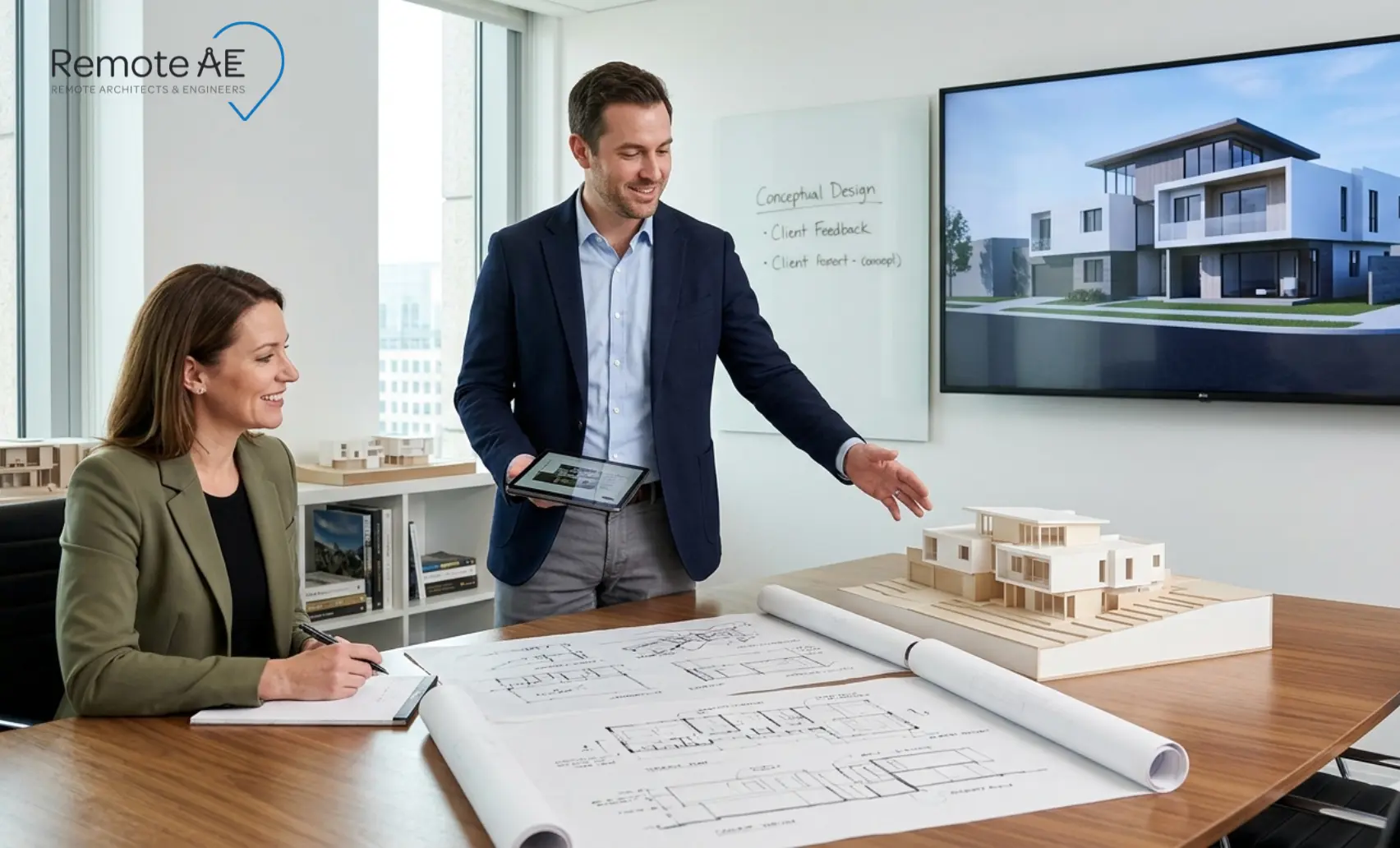
An architect leads the design of a building from early concept through coordinated plans. The role combines creative thinking with technical judgment. In practice, architects balance client goals, space use, appearance, code requirements, and buildability.
Core Responsibilities
Architects handle several responsibilities that shape the project at the front end and through design development.
Their responsibilities include:
- Building design and concept development
- Client communication and presentations
- Space planning and aesthetics
- Ensuring compliance with building codes
They also guide the project from early concept to the permit set stage.
Key Skills
Architects need a mix of creativity and technical understanding.
Key skills include:
- Strong design thinking
- Proficiency in tools like AutoCAD and Revit
- Clear communication with clients and teams
This mix matters because architecture is not just visual work. It is decision-making under constraints. According to the U.S. Bureau of Labor Statistics, employment of architects is projected to grow 4% from 2024 to 2034, with about 7,800 openings each year on average, showing steady demand for skilled design professionals.
Typical Deliverables
Architects produce design-focused outputs.
These include:
- Concept drawings
- Design plans
- 3D visualizations
These deliverables form the foundation for further development by engineers and drafters.
When You Need an Architect
You should hire an Architect when:
- You are in the early-stage project phase
- The project requires a custom design
- A strong visual and functional concept is critical
Architects are essential for shaping the direction of the project.
What Does an Engineer Do?
An engineer makes sure the design works in the real world. While the architect defines the vision, the engineer tests whether the structure, site, and building systems can perform safely and reliably.
On a mid-sized commercial building, that may mean checking steel loads, grading the site for drainage, sizing HVAC equipment, and coordinating power distribution. Without that layer, a design may look good on paper but fail during permitting, construction, or operation.
Types of Engineers in AEC
AEC projects may involve several engineering disciplines.
Common types include:
- Structural engineering → verify the building can handle loads safely
- Civil engineering → handles site design, grading, drainage, and infrastructure
- Mechanical, Electrical, Plumbing (MEP) engineering → designs HVAC, electrical, and plumbing systems
Each discipline works together to support the overall design created by the Architect.
Core Responsibilities
An Engineer is responsible for safety, performance, and technical accuracy.
Their work includes:
- Ensuring the structural integrity of the building
- Designing systems such as HVAC, electrical, and plumbing
- Meeting safety standards and building codes
Engineers validate whether a design can actually be built and perform as expected.
Key Skills
Engineering requires strong analytical thinking.
Key skills include:
- Deep understanding of math and physics
- Problem-solving and analytical reasoning
- Proficiency in engineering tools and BIM platforms
Many engineers also use tools like Revit MEP along with specialized software for analysis.
Typical Deliverables
Engineers produce technical outputs that guide construction.
These include:
- Structural calculations
- Technical specifications
- System layouts
These deliverables are critical for construction documents and approvals.
When You Need an Engineer
You need an Engineer when:
- The project involves load-bearing structures
- Infrastructure or site design is required
- Systems like HVAC, electrical, or plumbing must be designed
- Safety-critical decisions are involved
A licensed Professional Engineer (PE), certified through NCEES, is often required for approval and compliance.
What Does a Drafter Do?
A drafter, also known as a Draftsperson or Draftsman, turns ideas, calculations, and markups into technical drawings that builders can follow. This role is central during documentation. Without accurate drawings, even a strong design and sound engineering package can stall in permitting, pricing, or construction.
Core Responsibilities
Drafters support the project by producing drawing sets that reflect approved design intent and technical direction.
Their responsibilities include:
- Converting concepts into detailed technical drawings
- Preparing construction documents
- Updating drawings based on revisions from architects and engineers
They play a key role in making designs buildable.
Key Skills
A drafter needs strong production discipline and a sharp eye for errors. Even small mistakes in dimensions, annotations, or references can trigger field issues.
Key skills include:
- Attention to detail
- Strong knowledge of CAD workflows
- Understanding of construction standards and documentation
They must ensure that drawings are accurate and easy to interpret on-site.
Tools Used
Drafters rely heavily on digital tools.
Common tools include:
- AutoCAD for drafting
- Revit for BIM-based modeling
- Other BIM tools for coordination
These tools help produce clear and accurate blueprint / technical drawing sets.
Typical Deliverables
Drafters produce the drawings used during construction.
These include:
- Construction drawings
- Shop drawings
- As-built drawings
These documents are essential for contractors and project execution.
When You Need a Drafter
A drafter is often the right hire when the design direction is already set but the team needs documentation capacity.
- The project reaches the documentation phase
- Large volumes of drawings are required
- Frequent revisions and updates are needed
Drafters support both architects and engineers during production.
How Drafters Translate Architect and Engineer Intent into Buildable Drawings
Drafters act as the bridge between design and construction.
They take input from the Architect and Engineer and convert it into:
- Clear construction documents
- Detailed layouts and dimensions
- Coordinated drawings across disciplines
Without this step, designs cannot be executed accurately.
Drafter vs CAD Technician vs BIM Technician
These roles are closely related but slightly different.
- A Drafter focuses on producing drawings
- A CAD technician works mainly in CAD environments
- A BIM technician works within BIM models, often using Revit
All three contribute to documentation, but BIM technicians handle more data-rich workflows.
Key Differences Between Architect, Engineer, and Drafter
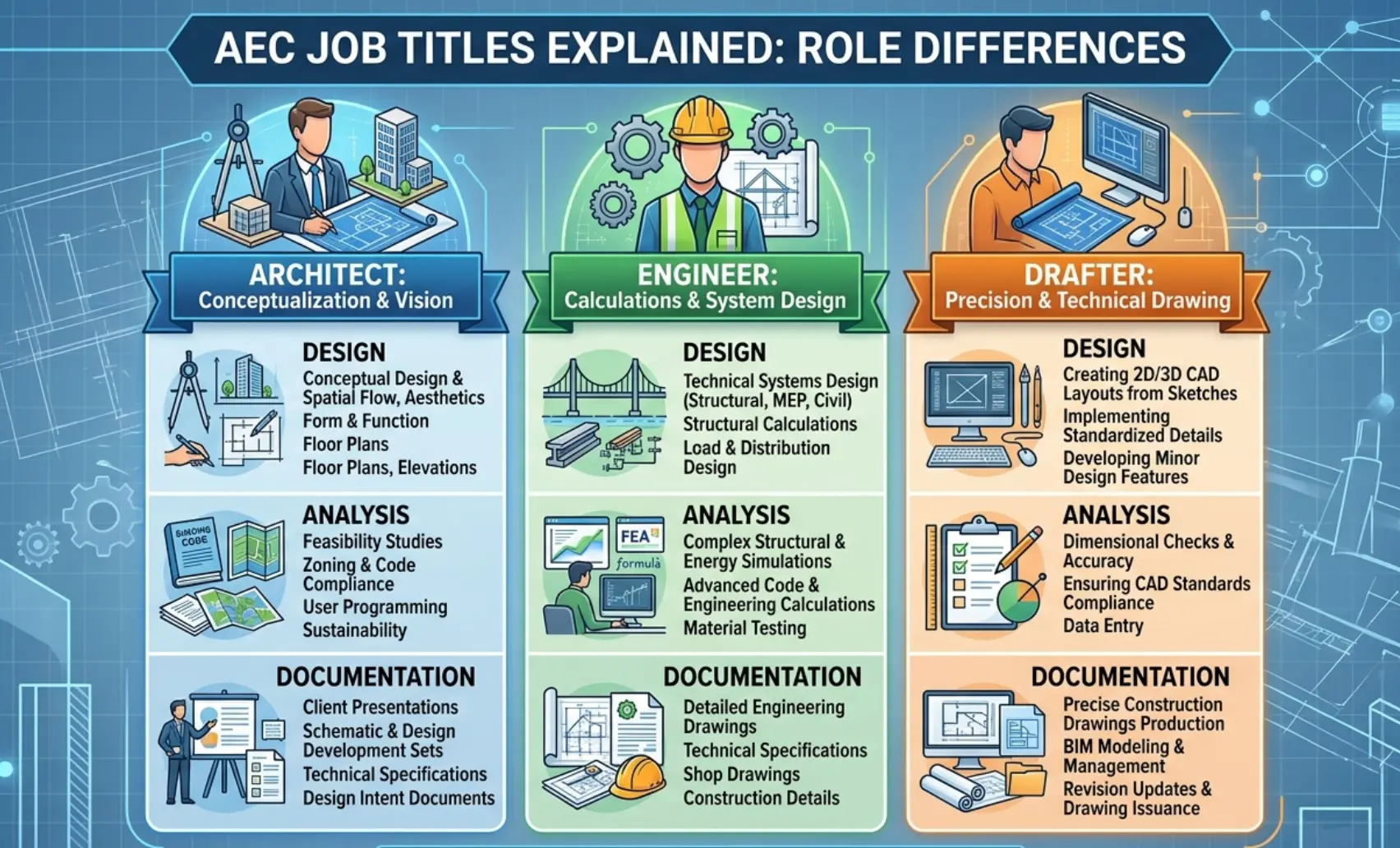
These three roles support the same project, but they do not solve the same problem. The clearest way to separate them is by looking at design intent, technical validation, and documentation output.
Design vs Analysis vs Documentation
The easiest way to understand architect vs engineer vs drafter is by looking at their core function.
- Architect → focuses on creative vision and spatial design
- Engineer → handles technical validation and system performance
- Drafter → produces detailed documentation and drawings
Each role depends on the other. Without design, there is nothing to build. Without engineering, the design may fail. Without drafting, the project cannot be executed.
Decision-Making Authority
Decision-making authority varies across roles. Architects and engineers have the authority to make key project decisions. They are responsible for design intent, safety, and compliance with building codes.
Drafters support execution. They follow instructions and translate decisions into construction documents. They do not typically approve or sign off on designs.
Education and Licensing
Education and licensure clearly separate these roles.
- Architect → requires a formal architecture degree and licensure through NCARB
- Engineer → requires an engineering degree and licensure as a Professional Engineer (PE) through NCEES
- Drafter → typically requires technical training, certification, or a diploma
Licensure is critical for legal responsibility, especially when submitting a permit set for approval.
How These Roles Work Together on a Project
AEC projects work best when architects, engineers, and drafters move in sequence and stay aligned during revisions. Each role depends on the others.
Step-by-Step Workflow
A typical project follows a structured workflow.
- First, the Architect develops the concept and overall layout. This includes spatial planning and early design decisions.
- Next, the Engineer reviews the design. They validate structural integrity, system performance, and compliance with building codes.
- Then, the Drafter converts these inputs into detailed construction documents. These include drawings that contractors use on-site.
- Finally, the team collaborates during revisions. Updates from architects and engineers are reflected in the drawings to maintain accuracy.
This sequence is not strictly one-way. Projects loop back often. A structural issue may force a design change. A documentation clash may reveal a system’s conflict. A client revision may affect all three roles at once.
Which Role Should You Hire First?
The first hire depends on your bottleneck. If the project is still taking shape, hire for design thinking first. If safety, systems, or infrastructure are the issue, engineering comes first. If the design is approved but the drawing queue is piling up, drafting support may create the fastest relief.
A useful hiring checklist is:
- Hire an architect first for early-stage planning and design-heavy work
- Hire an engineer first for technical validation and regulated systems
- Hire a drafter first for documentation backlogs, revisions, and sheet production
When a remote AEC assistant is the smarter first hire
Sometimes the best first move is not a full local hire. A remote AEC assistant can help when the workload is real, but the role is still narrow, variable, or deadline-driven.
This is often the smarter first hire when:
- You have overflow work
- You are under tight deadlines
- You need long-term support without immediate full-time overhead
For example, a firm with signed projects but inconsistent documentation peaks may not need a permanent local addition yet. In that case, remote drafting or engineering support can relieve pressure without slowing hiring decisions.
How Remote AE Supports These Roles
Remote AE supports AEC firms that need targeted help across architecture, engineering, and drafting functions. This is useful for firms that want more production capacity without carrying fixed in-house staffing for every peak or specialty gap.
Virtual AEC Staffing Solutions
Remote AE has supported the AEC industry for over 15 years by providing skilled virtual assistants who fit directly into your team.
You can extend your team with:
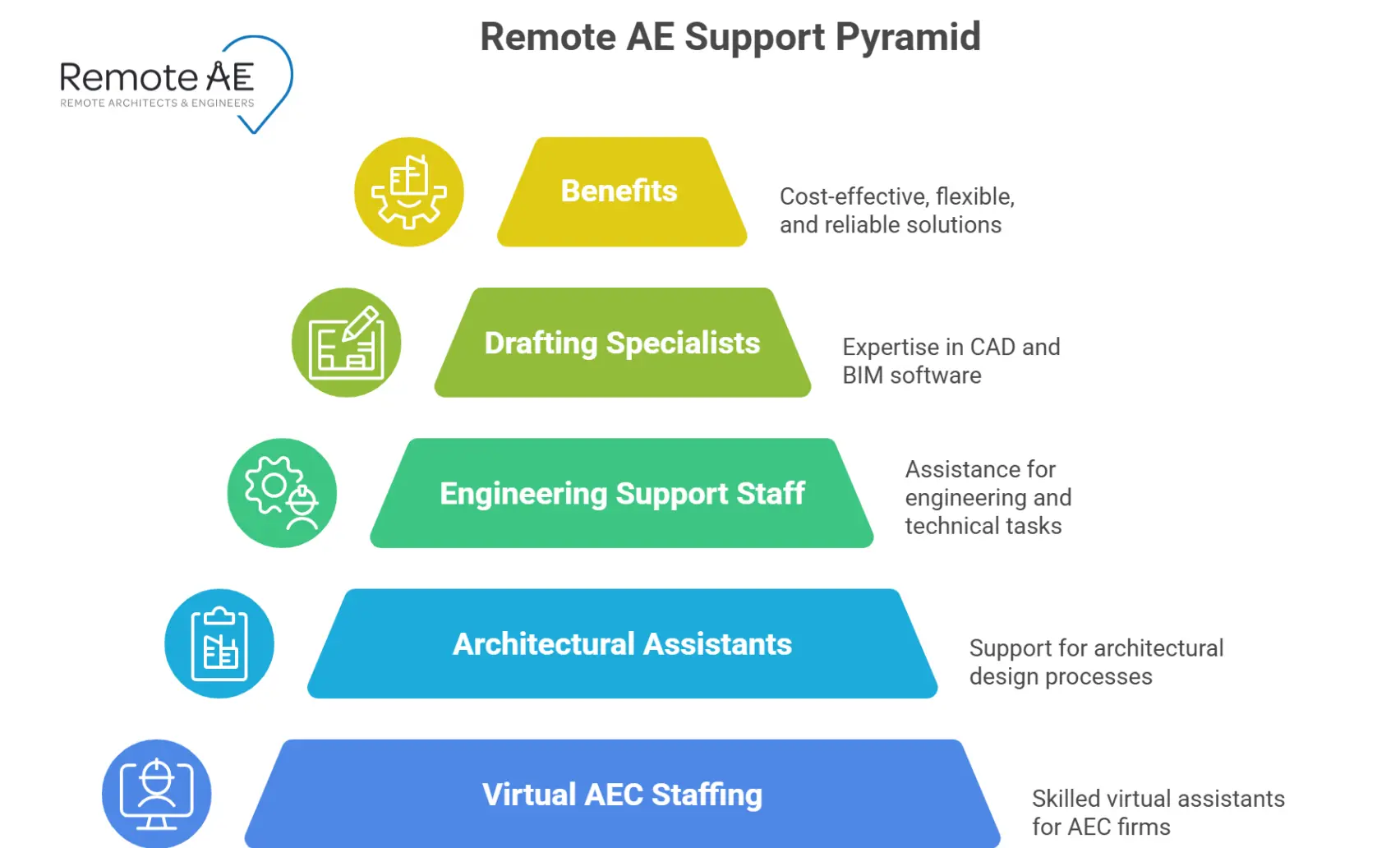
- Architectural assistants
- Engineering support staff
- Drafting specialists
These professionals work within your existing processes, whether you use CAD, BIM, Revit, or AutoCAD, ensuring smooth collaboration without disruption.
Benefits
Working with Remote AE helps you stay flexible while maintaining high standards.
Key advantages include:
- A cost-effective staffing approach
- Teams that scale up or down based on workload
- Access to experienced AEC professionals
- Strong domain expertise across projects
- Consistent quality and reliability
- No long-term contracts
- Pricing starting from 499$/week
You also get:
- No upfront costs before starting
- Risk-free replacement of up to two virtual assistants within the first year
Use Cases
Remote AE support is useful in several scenarios.
- Overflow work during busy periods
- Tight deadlines that require faster turnaround
- Long-term support without full-time hiring
This flexibility helps firms manage projects more efficiently.
Build the Right AEC Team Without Hiring Delays!
Are you still trying to decide between hiring an Architect, Engineer, or Drafter? The smarter move may be to start with flexible support.
Remote AE helps you access:
- Skilled virtual architects and engineering assistants
- Reliable drafting specialists for construction documents
- Scalable teams without long-term commitments
Even if you need a Remote drafting assistant for high-volume drawings or a Virtual architect assistant to support design and BIM workflows, Remote AE fits into your process without disruption.
Schedule a call today to explore how remote AEC staffing can help you reduce workload, improve output, and stay competitive.
FAQs – AEC Job Titles Explained
What is the difference between an architect and an engineer?
An architect focuses on building design, layout, aesthetics, and code compliance. An engineer ensures the building works structurally and technically, handling systems like structure, HVAC, electrical, and plumbing. Architects lead overall design; engineers validate safety, performance, and calculations behind it.
What is the difference between an architect and a drafter?
An architect makes design decisions and is licensed to take responsibility for them. A drafter converts ideas and markups into drawings using CAD or BIM tools. Drafters support production, while architects guide design, coordination, and approvals.
Can a drafter design a building?
A drafter can contribute ideas or layouts, but they typically do not lead or take responsibility for building design. Design decisions, especially those affecting safety, code, and structure, must be handled or approved by a licensed architect or engineer.
Can a drafter stamp drawings?
No. Only licensed professionals, architects, or engineers can stamp or seal drawings, depending on jurisdiction. A drafter can prepare drawings, but cannot take legal responsibility for them.
Who makes construction drawings: architect, engineer, or drafter?
Construction drawings are a team effort. Architects and engineers define design intent and technical requirements, while drafters or BIM modelers produce the drawings under their direction. Final approval and responsibility remain with the licensed professionals.