
Hiring a remote assistant sounds simple until you realize the engagement model you choose shapes your cost, output quality, and workflow continuity for months. For architecture firms, engineering firms, and construction companies, the wrong choice means either paying for idle hours or scrambling to cover workload spikes without consistent support.
This article breaks down the real cost of both models, project-based vs full-time remote assistant, using verified numbers, AEC-specific task mapping, and a straight break-even formula. If you need burst support for a submittal deadline or a dedicated assistant managing daily document control and RFI logs, you’ll find the right model here.
Project-Based or Full-Time? Here’s the Short Answer
The answer depends on one variable: how consistent is your workload?
Inconsistent, deadline-driven work favors a project-based approach. Steady, recurring daily tasks favor full-time. Most AEC firms don’t sit cleanly in one camp, which is why this decision deserves more than a gut call.
The Fast Rule for AEC Firms
- Under 60 hours/month of remote support needed? Project-based wins on cost.
- Over 80 hours/month of consistent, recurring work? Full-time delivers better value.
This rule holds across firm types, whether you’re a boutique architecture firm managing permit packages or a mid-size engineering firm running concurrent infrastructure projects.
Why Hourly Rate Alone Gives the Wrong Answer
A project-based remote assistant billing at $15/hr looks cheaper than a full-time assistant at $2,000/month. But at 160 hours of monthly work, the project-based model costs $2,400, 20% more than full-time.
The hourly rate is an input, not a conclusion. Total monthly cost at your actual usage volume is the only number that matters for this decision.
Quick Stat: Businesses save 40–70% on operational costs by using remote assistants compared to equivalent in-house hires. (Global Workplace Analytics)
What a Project-Based Remote Assistant Actually Costs
Project-based remote assistants charge per hour or per deliverable. Rates vary by skill level, geography, and AEC tool proficiency.
Typical Hourly Marketplace Range – $10–$20/hr
- $10–$14/hr: General administrative support, basic formatting, data entry
- $15–$18/hr: CAD drafting support, AutoCAD redlines, submittal log management
- $18–$25/hr: BIM support, Revit coordination, Procore administration, QA/QC review
Rates above $25/hr typically signal specialists, BIM 360 / Autodesk Construction Cloud administrators, or senior document control professionals with multi-project experience.
Example Monthly Costs at 40, 80, and 160 Hours
| Monthly Hours | Rate ($15/hr) | Rate ($18/hr) | Rate ($22/hr) |
| 40 hrs/month | $600 | $720 | $880 |
| 80 hrs/month | $1,200 | $1,440 | $1,760 |
| 160 hrs/month | $2,400 | $2,880 | $3,520 |
These figures assume pure hourly billing with no platform fees, software costs, or onboarding overhead. Add those, and the real cost climbs.
Best-Fit AEC Tasks: Project-Based Model
Project-based remote assistants perform best on time-boxed, well-defined scopes:
- Redlines and markup consolidation using Bluebeam
- Permit package assembly and formatting
- Submittal burst support during construction administration phases
- Shop drawings, log cleanup, and backlog processing
- One-off AutoCAD or CAD drafting tasks with clear deliverable specs
These tasks have a defined start and end. You don’t need continuity, you need throughput.
What a Full-Time Remote Assistant Actually Costs
Full-time remote assistants work a consistent schedule, typically 40 hours per week, for a fixed monthly rate. For AEC firms with recurring workload, this model delivers better value and stronger output quality over time.
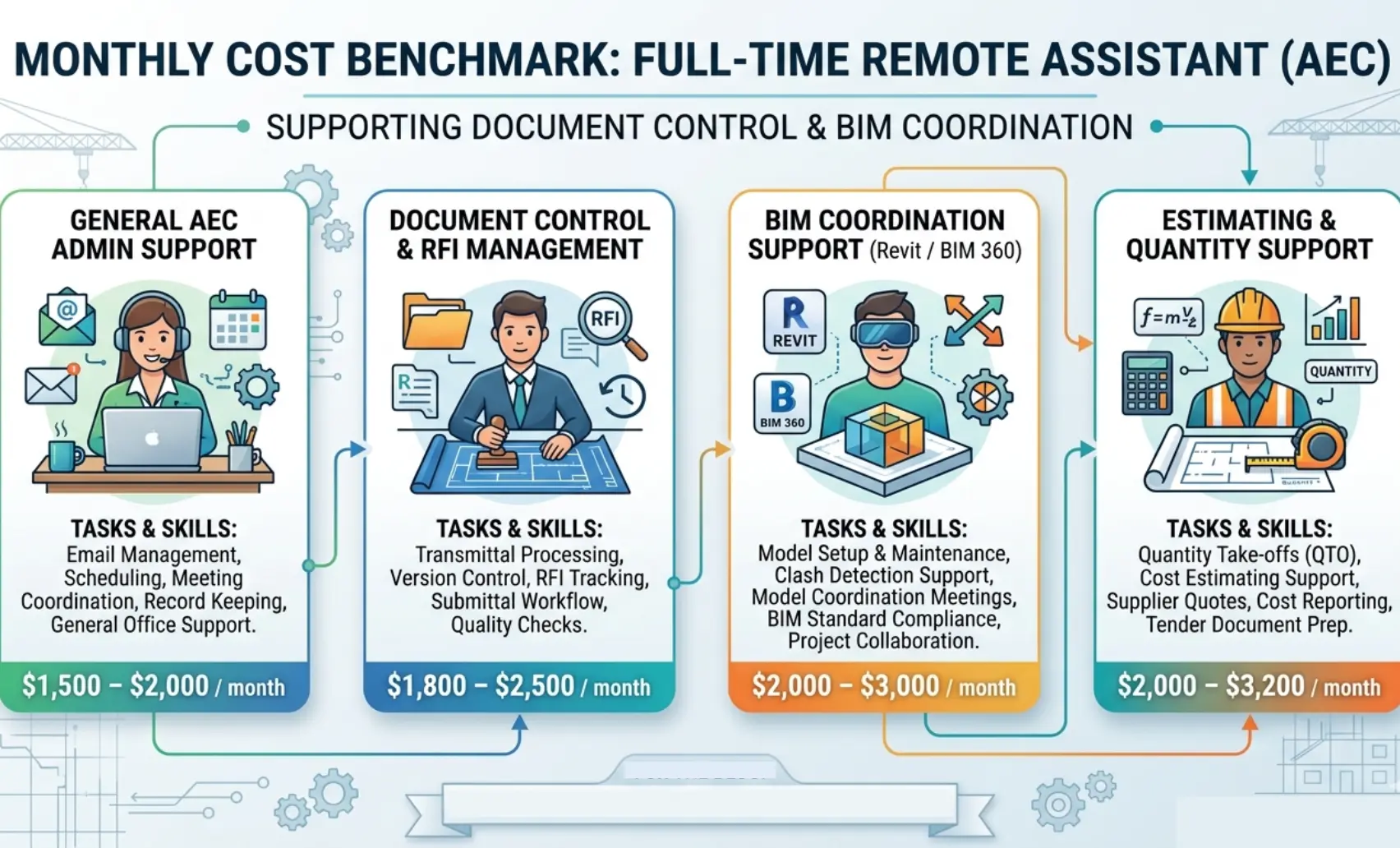
Dedicated Monthly Support Benchmarks
Based on published remote staffing market data and AEC-specific platforms:
- General AEC admin support: $1,500–$2,000/month
- Document control and RFI management: $1,800–$2,500/month
- BIM coordination support (Revit / BIM 360): $2,000–$3,000/month
- Estimating and quantity support: $2,000–$3,200/month
For context, the U.S. Bureau of Labor Statistics reports the median hourly wage for architectural and civil drafters at $29.72/hr in 2023, making a full-time in-house equivalent cost of $51,100/year before benefits.
When Steady Weekly Workload Beats Ad-Hoc Hiring
Full-time makes sense when work doesn’t stop between projects. If your architecture firm processes RFIs, tracks submittals, and manages drawing revisions every week, not just during deadline spikes, project-based billing penalizes you. You pay a flexibility premium for optionality you never actually use.
Best-Fit AEC Tasks: Full-Time Model
- Document control: Drawing registers, revision tracking, distribution logs
- BIM coordination support: Revit model updates, clash coordination logs, BIM 360 administration
- Recurring PM admin: Meeting minutes, action item tracking, procurement follow-up
- Estimating support: Quantity takeoffs, bid comparisons, cost database maintenance
- RFI and submittal management across multiple active projects simultaneously
These tasks require process familiarity. A virtual assistant who touches your RFI log every day builds context that a rotating project-based hire never accumulates.
Quick Cost Comparison Table
| Factor | Project-Based | Full-Time |
| Payment model | Hourly or per-deliverable | Fixed monthly rate |
| Average cost | $600–$3,500/month (usage-dependent) | $1,500–$3,200/month (role-dependent) |
| Commitment | None, task by task | Ongoing engagement |
| Flexibility | large-scale up or down instantly | Moderate – adjustments need notice |
| Scalability | Easy for burst demand | Better for sustained growth |
| Best for | Deadline spikes, defined scopes | Daily delivery, recurring workflows |
| AEC Tool continuity | Low — varies by hire | High – builds over time |
| QA/QC consistency | Variable | Consistent |
The cost columns overlap intentionally. At 80+ hours per month, full-time pricing is almost always lower. Below 60 hours, project-based work keeps costs lean.
The Hidden Costs Mostly Missed
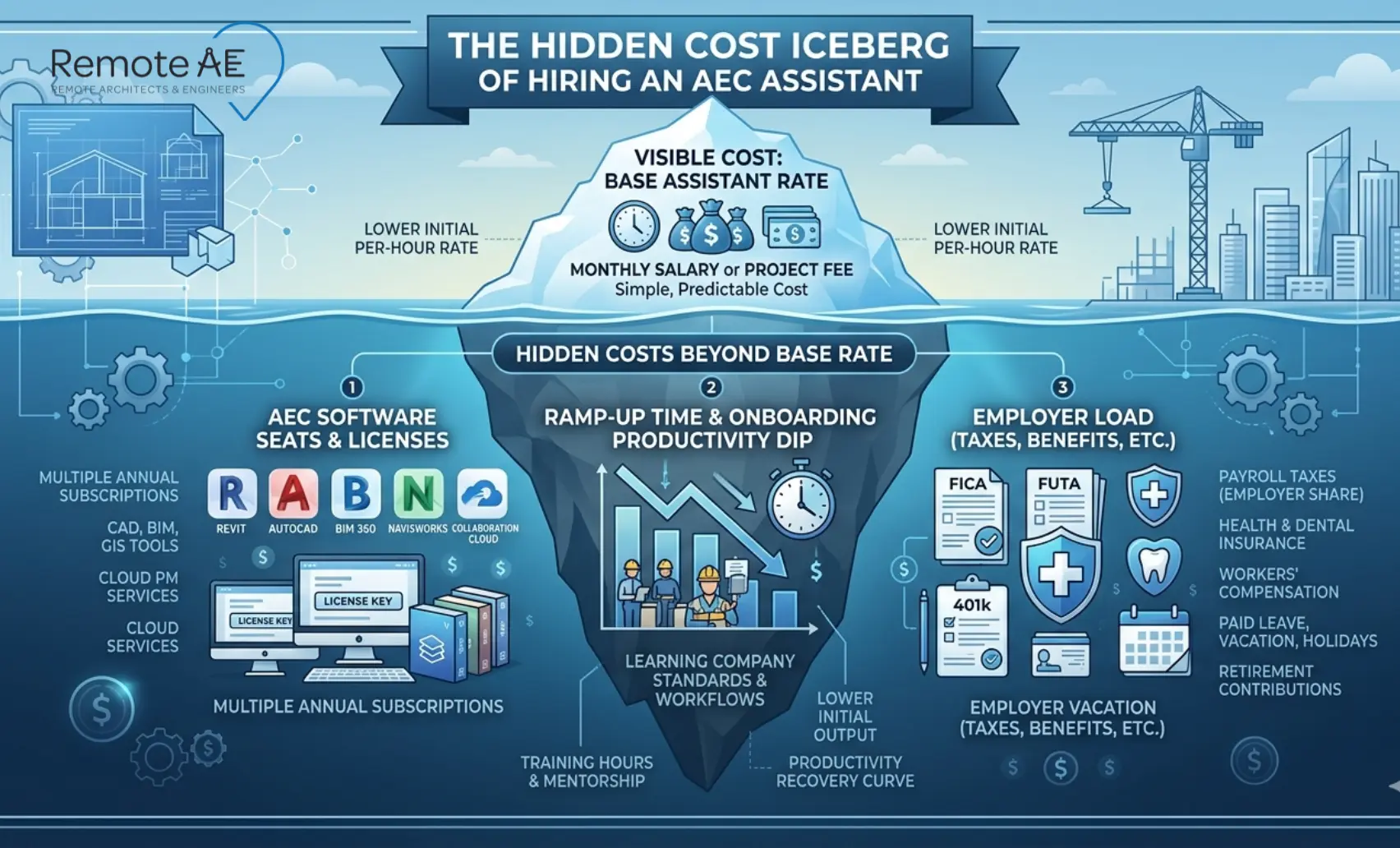
The headline rate of any remote assistant engagement, hourly or monthly, is never the full cost. Three categories of hidden costs consistently catch AEC firms off guard.
Employer Load on U.S. Hires
If you hire a U.S.-based virtual assistant as a W-2 employee or direct contractor, the employer cost stack adds up fast.
- Payroll taxes: 7.65% of gross wages
- Workers’ compensation insurance: 1–3% of payroll, depending on state and role classification
- Health benefits: $6,000–$8,000/year per employee for single coverage
- Paid time off, sick leave, and holiday pay: adds 10–15% to effective annual cost
A remote assistant earning $45,000/year costs your engineering firm closer to $58,000–$62,000 fully loaded. That gap matters when you’re comparing against a managed outsourcing model where these costs sit with the provider.
AEC Software Seats and Collaboration Tools
Software licenses are a legitimate hidden cost that most cost comparisons ignore entirely.
- Autodesk Construction Cloud / BIM 360 seats: $500–$1,200/user/year, depending on plan tier.
- Revit or AutoCAD license: $2,545/year per seat.
- Bluebeam Revu: $260–$490/year per user, depending on edition.
- Procore pricing: project-volume-based; additional users carry an incremental cost
If your remote assistant needs access to Procore, Bluebeam, and Autodesk Construction Cloud to do their job, budget for it explicitly. Managed AEC outsourcing providers often bundle software access into the engagement fee, eliminating this cost from your balance sheet entirely.
Ramp-Up Time, Underused Capacity, and Management Overhead
These three costs are real, but rarely appear in a cost comparison.
Ramp-up time is the period between a remote assistant’s first day and their first fully productive output. For AEC-specific workflows, RFI logging, submittal tracking, and shop drawings coordination, this typically runs two to four weeks. At $18/hr, four weeks of partial productivity costs your firm $700–$1,000 in paid but underdelivered hours.
Underused capacity hits project-based engagements hardest. When a deadline passes, and the next scope isn’t ready, you’re either paying for idle hours or losing the assistant to another client.
Management overhead is invisible but real. Every remote assistant, project-based or full-time, requires direction, review, and feedback. Estimate one to two hours of internal project manager time per week per assistant.
Break-Even Math: At What Point Does Full-Time Win?
This is the calculation most AEC firms skip, and then overpay for months as a result. Here’s how the math actually works.
Below 40–60 Hours/Month
At this usage level, project-based wins clearly.
- Project-based cost at 50 hrs × $18/hr = $900/month
- Full-time cost (entry level) = $1,600–$2,000/month
- Savings from project-based: $700–$1,100/month
Project-based keeps costs proportional to actual output, if your architecture firm only needs burst support for a permit package or a submittal backlog cleanup.
Around 80 Hours/Month
This is the break-even zone. The two models cost roughly the same, but the full-time model delivers more.
- Project-based cost at 80 hrs × $18/hr = $1,440/month
- Full-time cost (document control level) = $1,600–$1,800/month
- Cost difference: $160–$360/month
At this volume, the full-time model buys you process continuity, QA/QC consistency, and a virtual assistant who builds institutional knowledge of your RFI and document control workflows. The marginal cost difference is easily recovered in reduced rework and faster turnaround.
Near 160 Hours/Month
Full-time wins by a significant margin.
- Project-based cost at 160 hrs × $18/hr = $2,880/month
- Full-time cost (BIM coordination support) = $2,000–$2,500/month
- Savings from full-time: $380–$880/month
At full-time volume, project-based billing is simply a premium you’re paying for flexibility you no longer need.
Project-Based Is Better When…
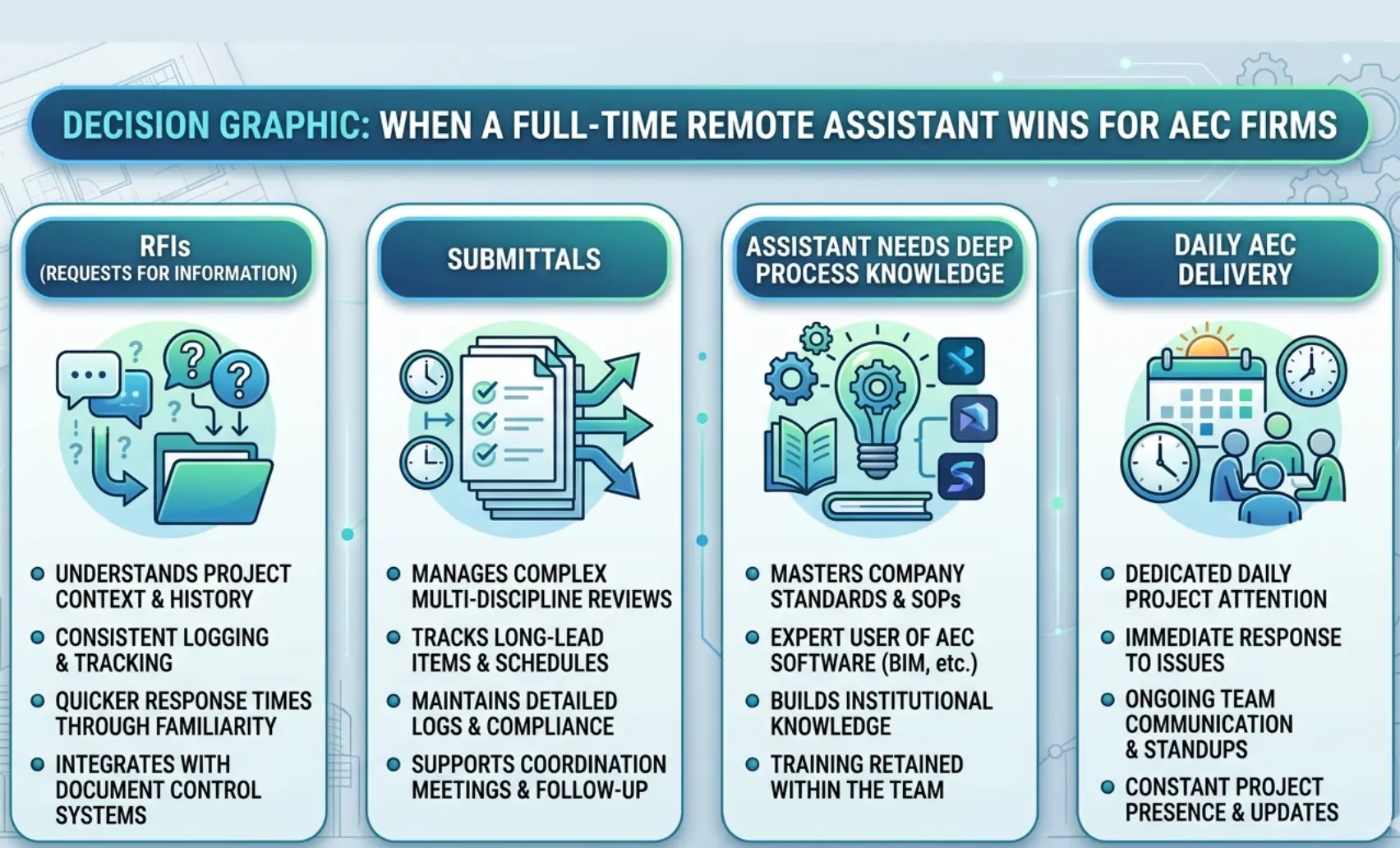
- Work Is Tied to a Deadline Spike: Your construction company just entered construction administration on a large project. Submittal volume triples for six weeks, then drops. That’s a project-based scenario.
- Scope is Narrow and Well-Defined: Redlining a set of AutoCAD drawings in Bluebeam. Processing a backlog of shop drawings before a contractor deadline. Assembling a permit package with defined deliverables and a hard submission date
- You Don’t Want to Carry Software-Seat, and Idle-Time Cost All Year: If your architecture firm runs lean between project phases, a full-time remote assistant sitting underutilized is a fixed cost with variable output. Project-based keeps your spending in line with actual production demand.
Full-Time Is Better When…
- The Role Touches Daily Delivery: RFI logs don’t pause between milestones. Document control runs continuously across every active project. If a task recurs daily, drawing distribution, Procore updates, coordination logs, a full-time virtual assistant is the only model that keeps pace without constant re-onboarding.
- The Assistant Needs Deep Process Knowledge: BIM 360/ Autodesk Construction Cloud administration, Revit model management, and multi-project QA/QC oversight all require institutional knowledge that deepens over time. A rotating project-based hire resets that knowledge with every engagement. A full-time remote assistant builds it.
- You Want Continuity Across RFIs, Submittals, Drawing Revisions, and Client Follow-Up. That continuity is only possible with a full-time engagement. Project-based models fragment ownership across multiple hires and create coordination risk.
Where a Dedicated AEC Remote Assistant Fits (Remote AE Approach)
Remote AE places dedicated remote assistants trained specifically in AEC workflows, not repurposed general VAs.
Assistants are pre-trained in:
- CAD drafting and AutoCAD redline production
- BIM modeling and Revit coordination support
- Construction documentation, RFIs, submittals, shop drawings, document control
- Project coordination across Procore and BIM 360 / Autodesk Construction Cloud
Every assistant signs an NDA before accessing any project data. Access control and QA/QC standards are established at onboarding, not retrofitted after problems surface.
Cost Efficiency Through Specialization
No repeated onboarding costs. No tool training delays. No rework from assistants who don’t understand AEC delivery standards.
- Industry-specific expertise – assistants understand construction workflows from day one
- Guaranteed quality and reliability – deliverables meet your standards or get resolved immediately
- No long-term commitment – monthly or project-based, the model fits your pipeline
- AEC-specific pricing: $1,600–$2,000/month for specialized remote technical support, depending on experience and software skill
- Staffing from $499/week – accessible for firms at every growth stage
Stop Guessing: Start With the Right Model!
You now have the numbers, the break-even formula, and the task mapping to make this decision confidently.
Remote AE places dedicated AEC remote assistants, trained in CAD, BIM, Revit, AutoCAD, Bluebeam, Procore, and BIM 360 / Autodesk Construction Cloud, ready to own your document control, RFI logs, submittals, and shop drawings coordination from week one.
Book a Free Consultation with Remote AE Today, no obligation, no pressure. Just a straight conversation about which model fits your firm right now.
FAQs – Project-Based vs Full-Time Remote Assistant
Is a project-based remote assistant cheaper than a full-time remote assistant?
For short or irregular work, project-based work is usually cheaper because you only pay for deliverables. Once the workload becomes steady, a full-time assistant often costs less per hour and reduces coordination overhead, making it more efficient for ongoing production.
At how many hours per month does full-time support make more sense?
A common threshold is around 80–120 hours per month. Below that, project-based or part-time is more flexible. Above that, full-time support usually provides better value, consistency, and faster turnaround since the assistant is dedicated to your workflows.
What AEC tasks are best for project-based support?
Best-fit tasks include one-off drafting packages, permit sets, takeoffs, rendering, sheet updates, and backlog cleanup. These have clear start and end points, making them easier to scope, price, and review without needing continuous oversight.
Do I still pay for Revit, Bluebeam, or Microsoft 365 licenses for a remote assistant?
Usually yes. Most firms provide software licenses and CDE access to maintain control, security, and standards. Some outsourcing providers include licenses in their pricing, but many teams prefer using their own accounts for consistency and audit control.
Is Upwork enough, or do AEC firms need a managed outsourcing partner?
Upwork can work for small, well-defined tasks. For ongoing production, many firms prefer a managed partner for consistency, QA, backup resources, and process control. The choice depends on workload stability and how much management time you can dedicate.