

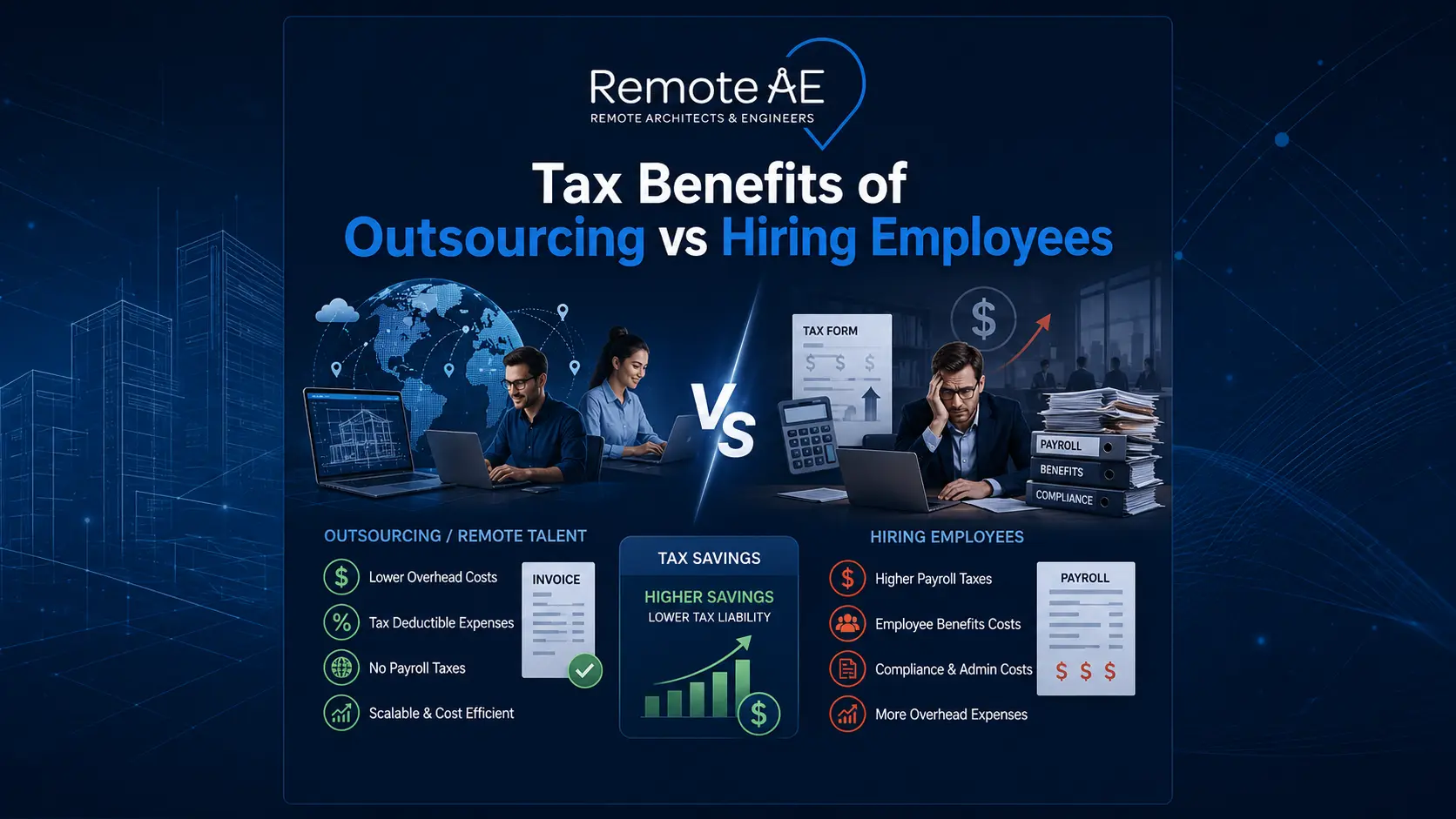
Every W-2 employee your AEC firm hires costs significantly more than their salary suggests. In December 2023, the Bureau of Labor Statistics reported that private-industry benefits were 29.6% of employer compensation costs, before you add recruiting, equipment, software, and management overhead. For architecture firms, engineering firms, and construction companies managing variable project pipelines, the tax treatment of outsourced staffing versus W-2 employment creates a material cost difference, one that compounds across every project cycle. This article breaks down the tax implications of both models and maps them to the real staffing decisions AEC firms face.
This article provides general information only. Consult a qualified CPA or tax attorney before making staffing or classification decisions.
Quick Answer: Which Option Has Better Tax Benefits?
Hiring a W-2 employee creates payroll tax obligations, benefit costs, withholding duties, unemployment insurance, and HR reporting requirements, all on top of the base salary.
Outsourcing typically converts that labor cost into a professional services expense, a vendor invoice with no employer-side payroll tax stack attached.
For most AEC firms managing variable project workloads, outsourcing delivers a lower total tax and overhead burden per dollar of output.
The savings only work when the worker relationship is structured correctly. Misclassification of an employee as an independent contractor triggers IRS and Department of Labor penalties that can exceed the savings.
In December 2023, the BLS reported private-industry benefits were 29.6% of employer compensation costs, meaning a $70,000 salary already carries roughly $20,000 in benefit obligations before taxes, recruiting, or equipment.
That gap is the financial case for outsourcing, but it only holds when the engagement is structured to satisfy IRS worker classification standards.
Outsourcing vs Hiring Employees: The Tax Difference
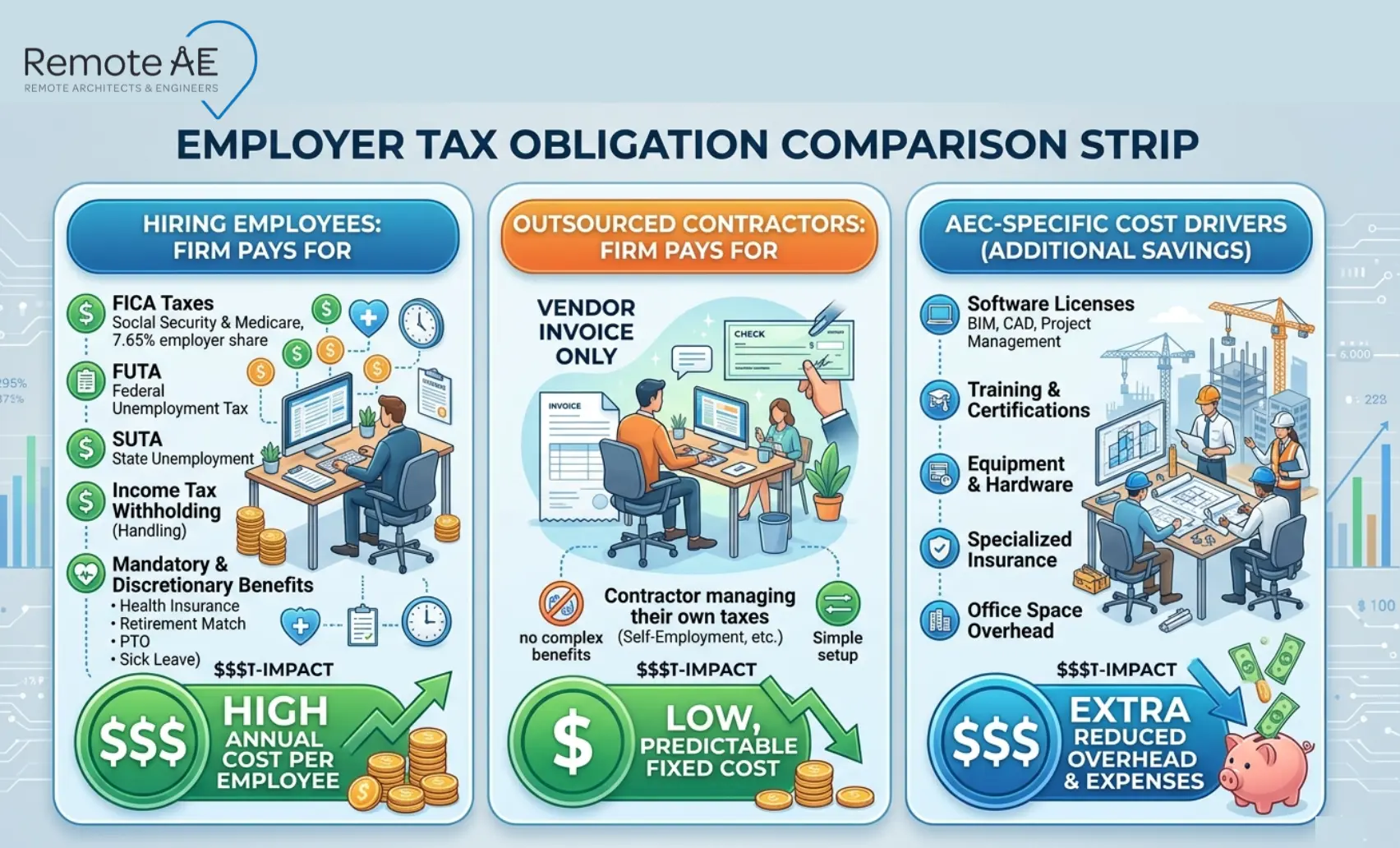
What Businesses Pay When Hiring Employees
When your architecture firm, engineering firm, or construction company hires a W-2 employee, the tax and compliance obligations begin immediately, and they extend well beyond the paycheck.
The IRS requires employers to deposit and report federal income tax withheld, Social Security and Medicare taxes, and other compensation-related taxes on a defined schedule.
The employer tax stack on every W-2 hire includes:
- Federal income tax withholding: Withheld from employee wages and remitted to the IRS, the administrative burden sits with the employer
- Social Security tax: 6.2% employer share on wages up to the annual wage base ($168,600 in 2024)
- Medicare tax: 1.45% employer share on all wages, no wage base cap
- Federal Unemployment Tax Act (FUTA): 6% on the first $7,000 of each employee’s wages annually, offset by state unemployment credits to an effective rate of 0.6% in most states
- State unemployment insurance: Rates vary by state and industry. Construction companies typically face higher rates than office-based firms due to occupational risk classifications
- State and local income tax withholding: Multi-state payroll obligations apply when remote employees work across state lines, a growing complexity for distributed AEC teams
- Fringe benefits reporting: The IRS notes that fringe benefits are generally taxable unless specifically excluded by law and can be subject to withholding and employment taxes.
What Businesses Usually Pay When Outsourcing
When an AEC firm engages an outsourced staffing provider or a properly classified independent contractor, the tax picture simplifies considerably.
- Vendor invoice or contractor payment: A single line item, the agreed service fee, with no payroll tax withholding obligation on the paying firm’s side
- No employer-side payroll taxes: In a properly structured contractor or vendor relationship, the firm does not pay Social Security tax, Medicare tax, FUTA, or state unemployment insurance on the payment
- No employer-provided benefits: No health insurance contribution, no retirement plan matching, no paid leave accrual, no workers’ compensation premium on the outsourced role
- Service cost as a business expense: Payments to outsourced staffing providers and independent contractors are generally deductible as an ordinary and necessary business expense under IRC Section 162. Confirm the specific treatment with a CPA based on your firm’s chart of accounts and business structure
Why This Matters More in AEC
AEC firms carry a cost structure that amplifies the employee vs outsourcing tax gap beyond what most industries experience.
- CAD and BIM software seats: Autodesk Revit, AutoCAD, Civil 3D, Bluebeam, Procore, and Autodesk Construction Cloud licenses add $3,000–$8,000 per user annually, costs that disappear when the outsourced provider supplies their own licensed software
- High-performance workstations: BIM modeling and CAD production require hardware that costs $2,500–$5,000 per workstation, employer-provided for W-2 staff, provider-supplied for outsourced roles
- Project-based workload swings: Architecture and engineering firms experience intense production phases, schematic design, construction documents, and permit submissions, followed by quieter periods. A W-2 employee carries a fixed cost through both. Outsourced staffing scales with the work.
- Idle time between project phases: A BIM modeler sitting underutilized between design phases is a fixed payroll cost with variable output. That idle time cost disappears entirely with an outsourced engagement.
- Rework risk when teams are overloaded: Overloaded in-house teams produce more errors, and rework in AEC is expensive. Outsourced production support during peak phases reduces rework by keeping workloads manageable.
The Main Tax Benefits of Outsourcing
Lower Payroll Tax Burden
Every employee’s salary carries an employer-side payroll tax obligation that most AEC firm principals underestimate until they see the quarterly tax deposit.
The employer FICA contribution, 6.2% Social Security tax plus 1.45% Medicare tax, adds 7.65% to every dollar of W-2 wages before benefits, insurance, or overhead enter the calculation.
The same output from an outsourced CAD technician or remote AEC staffing provider costs the firm the vendor invoice, with zero employer payroll tax obligation on top.
That gap, $7,000–$9,000 per role per year in payroll taxes alone, scales directly with headcount. Ten outsourced roles instead of ten W-2 hires saves $70,000–$90,000 in payroll tax annually before any benefit or overhead comparison begins.
Fewer Benefit Costs
Fringe benefits represent the highest hidden cost in W-2 employment, and the IRS notes they are generally taxable unless excluded by law, adding withholding and employment tax complexity on top of the direct benefit cost.
Benefit costs are eliminated when outsourcing instead of hiring:
- Health insurance: Employer contributions to group health plans average $7,034 per employee for single coverage and $20,576 for family coverage annually.
- Retirement contributions: 401(k) employer matching, typically 3–6% of salary, adds $2,100–$4,200 annually on a $70,000 salary
- Paid leave: In June 2025, the BLS reported that private-industry paid leave costs $3.44 per hour worked, approximately $6,700 annually on a full-time schedule
- Workers’ compensation: Premiums in construction-adjacent roles run $3–$8 per $100 of payroll, depending on state and job classification
- Training and certification: AEC software training, Revit, Bluebeam, Procore, adds $1,500–$4,000 per new hire in the first year
Stack these against an outsourced staffing invoice, and the cost difference is not marginal. It is structural.
Cleaner Expense Categorization
Outsourced AEC support payments sit cleanly in expense categories that simplify bookkeeping and tax filing, without the multi-line payroll journal entries, benefit accruals, and fringe benefit reporting that employment generates.
Depending on your firm’s chart of accounts and business structure, outsourced AEC staffing costs are typically categorized as:
- Professional services for outsourced design, engineering, or technical support
- Contract labor for project-specific production support
- Subcontracted services for construction administration or BIM coordination are outsourced to a third party
- Drafting support for CAD technician and Revit modeling services
- Project admin support for virtual assistant, document control, and project coordination services
CPA note: The correct expense category depends on your firm’s chart of accounts, business structure, and the nature of the services received. Confirm the treatment with your accountant before categorizing outsourced staffing costs, particularly if the firm operates as an S-Corp or partnership where expense classification affects pass-through income reporting.
Less Administrative Tax Work
Every employee multiplies your firm’s tax administration burden, not just the cost, but the time and compliance risk associated with payroll processing, filing, and reporting.
Administrative obligations are eliminated or reduced when outsourcing:
- Payroll filings: Form 941 quarterly payroll tax returns, annual Form 940 FUTA return, one per firm regardless of headcount, but preparation complexity scales with employee count
- W-2 preparation and distribution: Annual W-2 filing for every W-2 employee, with state filing requirements that vary by jurisdiction
- Benefit reporting: ACA reporting on Form 1095-C for firms with 50+ full-time equivalent employees, fringe benefit value reporting on W-2 Box 12
- State registrations: Each state where a W-2 employee works requires separate employer registration, state unemployment insurance account setup, and state income tax withholding compliance
- Multi-state payroll complexity: Remote W-2 employees working across state lines trigger nexus in each state, creating payroll tax, unemployment insurance, and income tax withholding obligations in every state where an employee is present
Better Cost Matching to Project Revenue
The most financially damaging characteristic of W-2 employment for AEC firms is the fixed cost against variable revenue. Project fees are lumpy, large during design and construction documentation, quiet during approvals, and between phases. Payroll is not.
Outsourced AEC staffing matches cost to revenue cycle:
- Engage a BIM modeler during schematic design and construction documentation, scale back during permit review
- Add a virtual assistant for RFI-heavy construction administration phases, release when the project closes out
- Bring in an estimator for bid season, not as a permanent overhead line item carried through quiet months
- Scale Revit drafting support during design development, without carrying that headcount through the post-construction phase
The Tax Benefits of Hiring Employees
Outsourcing is not always the better financial decision. Employment carries its own tax advantages, and for certain AEC roles, those advantages outweigh the flexibility and overhead savings of outsourcing.
Employee Costs May Still Be Deductible
Every direct cost of W-2 employment is generally deductible as an ordinary and necessary business expense under IRC Section 162, the same provision that covers outsourced staffing costs.
Deductible employee cost categories for AEC firms include:
- Salaries and wages: Fully deductible in the year paid for cash-basis firms
- Employer payroll taxes: FICA, FUTA, and state unemployment contributions are deductible business expenses
- Employee benefits: Health insurance premiums, retirement plan contributions, and qualifying fringe benefits are generally deductible
- Training and professional development: Revit, AutoCAD, Civil 3D, Bluebeam, and Procore training costs are deductible when directly related to the employee’s current role
- Work equipment and software: Computers, workstations, software licenses, and cloud storage, all deductible as business expenses or depreciable assets
- Office costs: Desk space, IT support, cybersecurity, and related overhead attributable to W-2 employees are deductible
The deductibility of employee costs does not make them equivalent to outsourced costs; the total outlay is still higher. But it does mean that the after-tax cost of a hire is lower than the gross cost suggests.
When Employees Make More Tax and Business Sense
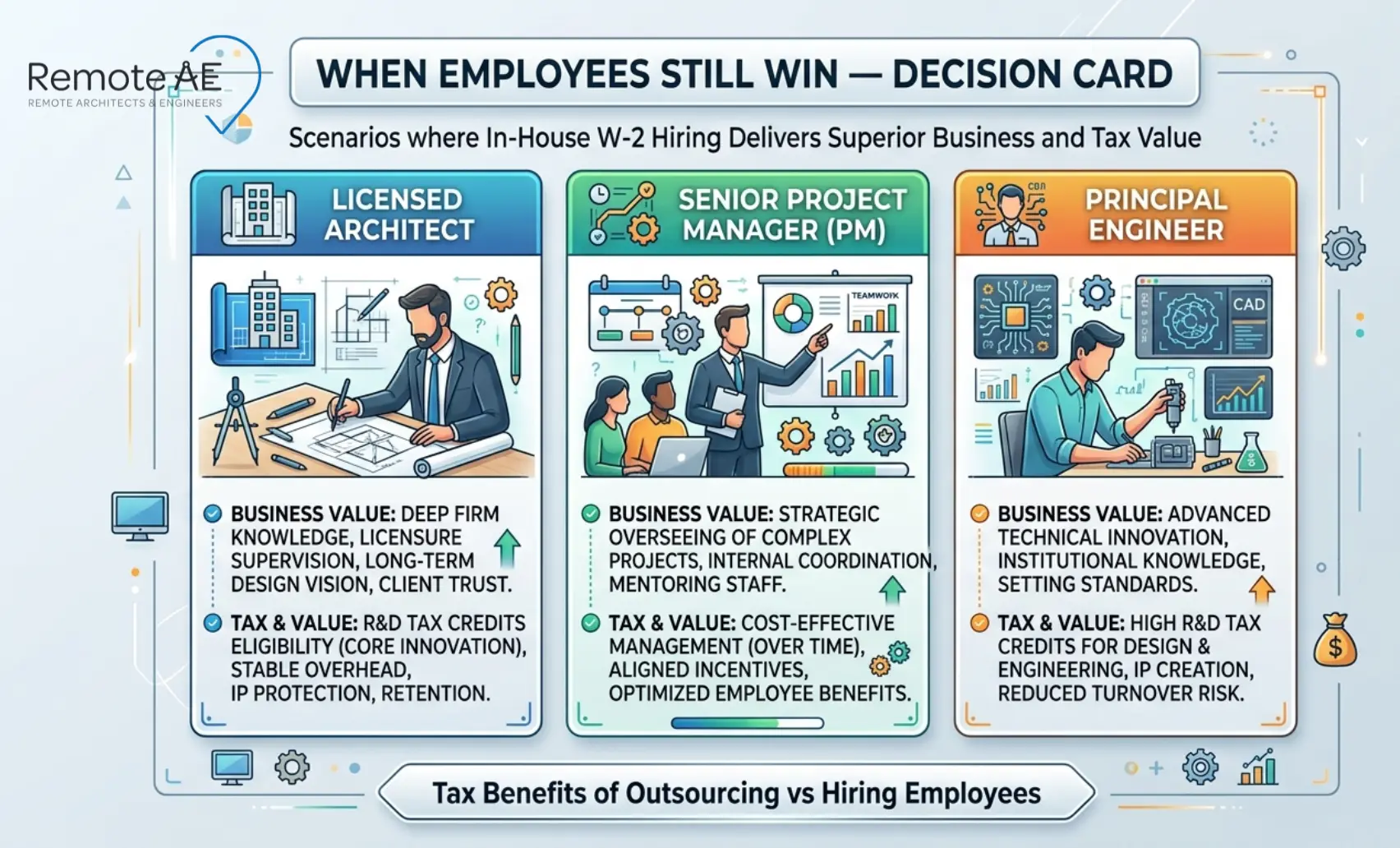
For specific AEC roles, W-2 employment is not just defensible, it is the right structural choice.
- A full-time licensed architect leading client relationships: Client trust is built on continuity. A principal architect who owns the client relationship, attends every design meeting, and carries the firm’s professional liability cannot be rotated through an outsourced staffing arrangement without real business risk.
- A senior project manager maintaining internal standards: Institutional knowledge of how the firm manages QA, how it structures CDs, and how it handles RFI workflows in Procore is embedded in long-term W-2 employees, not in project-based contractors.
- A principal-level engineer reviewing sealed deliverables: Professional licensing requirements in architecture and engineering mean that stamped documents require a licensed professional employed or contracted by the firm. The liability and supervision requirements for seal-bearing professionals typically favor employment.
- Roles needing direct daily supervision: The Department of Labor and IRS both consider behavioral control, whether the firm controls how, when, and where work is performed, as a primary factor in worker classification. If a role requires daily direct supervision, W-2 employment is the safer classification.
Hidden Costs That Make Employees More Expensive Than They Look
The salary line on a job offer is the starting point, not the ending point, of what a hire actually costs your AEC firm.
Payroll Taxes and Legally Required Benefits
Stack these costs against a $70,000 base salary, and the true employer cost becomes clear:
| Cost Category | Estimated Annual Cost |
| Base salary | $70,000 |
| Employer FICA (7.65%) | $5,355 |
| FUTA (effective 0.6%) | $420 |
| State unemployment insurance | $1,400–$2,800 |
| Health insurance (single coverage) | $7,034 |
| Paid leave (avg. $3.23/hr) | $6,700 |
| Workers’ compensation | $2,100–$5,600 |
| Recruiting and onboarding | $3,500–$7,000 |
| Equipment and workstation | $2,500–$5,000 |
| AEC software licenses | $3,000–$8,000 |
| Management time (est.) | $2,000–$4,000 |
| Total estimated employer cost | $103,000–$124,000 |
A $70,000 salary is a $103,000–$124,000 cost. That gap, 47–77% above base salary, is what the outsourcing vs hiring tax comparison is really about.
Recruiting, Onboarding, and Training
The cost of getting an employee to productive output is a front-loaded expense that rarely appears in staffing budget comparisons.
- Job advertising: Indeed, LinkedIn, and AEC-specific job boards run $300–$1,500 per posting cycle
- Interview hours: A hiring manager spends 15 hours across screening, interviews, and debrief sessions at $85/hr internal cost, which adds $1,275 before an offer is extended
- HR setup: Payroll enrollment, benefits onboarding, IT provisioning, and compliance documentation add two to four days of administrative time per new hire
- Ramp-up time: A new BIM modeler or CAD technician typically reaches full independent productivity in four to eight weeks, during which the firm pays full salary for partial output
- Rework during training: Errors during the ramp-up period, misconfigured Revit worksets, incorrect AutoCAD layer standards, and Procore log formatting mistakes carry a real correction cost that never appears on the recruiting budget line
AEC Tools and Workstation Costs
Every in-house AEC hire requires a fully provisioned software and hardware environment, costs that outsourced staffing providers absorb on your behalf.
Software license costs per seat annually:
- Autodesk Revit / AutoCAD / Civil 3D: $2,095/year
- Bluebeam Revu: $3,005/year
- Procore: Volume-based pricing, additional users carry an incremental cost
- Autodesk Construction Cloud / BIM 360: $500–$1,200/user/year, depending on plan tier
- Navisworks Manage: $2,545/year per seat
Hardware costs:
- BIM-capable workstation or high-spec laptop: $2,500–$5,000 per seat
- Secure cloud storage and backup: $300–$600/user/year
- VPN and cybersecurity licensing: $150–$400/user/year
Total AEC software and hardware cost per W-2 seat: $6,000–$10,000 annually, eliminated when an outsourced provider supplies their own licensed environment.
Side-by-Side Cost and Tax Comparison
Employee vs Outsourced AEC Assistant
| Factor | Employee | Outsourced AEC Assistant | Advantage |
| Payroll Taxes | Employer pays FICA, FUTA, and state unemployment on every dollar of wages | No employer payroll tax obligation | Outsourcing |
| Benefits Costs | Health insurance, paid leave, workers’ compensation, and retirement are all employer-funded | No benefits obligation | Outsourcing |
| Tax Deductions | Salaries, taxes, and benefits are deductible under IRC Section 162 | Service fee deductible as a professional services expense | Equal |
| Compliance Burden | Quarterly filings, W-2s, ACA reporting, and multi-state payroll obligations | Vendor invoice only, minimal filing requirements | Outsourcing |
| Flexibility | Fixed payroll regardless of project volume | Scales with project demand, no idle time cost | Outsourcing |
AEC Roles That Are Strong Candidates for Outsourcing
Architecture Support
These tasks are deliverable-based, tool-dependent, and fully executable remotely.
- Drafting and sheet setup in Revit or AutoCAD
- Revit modeling floor plans, elevations, sections, details
- Redline incorporation and drawing revision management
- Construction document production and coordination
- Permit package assembly and submission support
- Rendering preparation and visualization support
A virtual assistant handling sheet setup and redline turnaround in Revit frees a licensed architect to focus on design decisions, client communication, and stamped deliverable review, the roles that cannot be outsourced.
Engineering Support
Engineering production work is highly structured, tool-specific, and output-measurable, exactly the profile that outsourced staffing handles most effectively.
- CAD drafting in AutoCAD and Civil 3D
- BIM modeling and coordination support
- Quantity support and material takeoffs
- Submittal preparation and log management
- Model coordination and clash detection support in Navisworks or BIM 360
- Data entry and drawing register maintenance
Remote AE’s virtual engineering assistants cover CAD drafting, project management support, data analysis, and administrative tasks, pre-trained in the tools your engineering firm runs on.
Construction Support
Construction administration generates a high volume of documentation, RFIs, submittals, daily logs, and vendor follow-ups that consume project manager time without requiring licensed professional judgment.
- Estimating support and quantity takeoffs
- Scheduling coordination and update management
- RFI logging, tracking, and routing in Procore
- Submittal processing and register maintenance
- Document control and CDE folder management
- Project closeout documentation and punch list support
- Vendor follow-up and procurement coordination
Remote AE’s virtual construction assistant roles cover project management, communication, scheduling, documentation, and administrative support, structured around the workflows that slow construction teams down most.
How to Decide: Outsource or Hire?
Use This 7-Point Decision Checklist
Answer yes or no to each question before making a staffing decision:
- Is the workload steady and consistent year-round?
- Is the role core to direct client trust and relationship management?
- Does it require daily direct supervision over how work is performed?
- Does it need AEC software that your firm would license and manage?
- Is long-term institutional knowledge more important than immediate speed?
- Will the role sit idle between project phases and still carry payroll cost?
- Can a vetted remote AEC assistant handle 70–80% of the workload?
Scoring: More yes answers on questions 1–4 point toward in-house hiring. More yes answers on questions 5–7 point toward outsourcing. A mix suggests the hybrid model.
Recommended AEC Staffing Mix
| Employment Type | Roles |
| In-house employee | Principals, licensed PMs, engineers of record, client leads, and QA directors |
| Outsourced | BIM modeling, CAD drafting, estimating, document control, RFI/submittal processing, admin |
| Flexible / project-based | Project coordination, scheduling, procurement, QA support, workload spikes |
How Remote AE Helps Firms Reduce Staffing Overhead
Remote AE is not a generalist staffing platform. Every virtual assistant in the Remote AE talent pool is selected and vetted specifically for architecture, engineering, and construction workflows, pre-trained in Revit, AutoCAD, Civil 3D, Bluebeam, Procore, and Autodesk Construction Cloud before placement.
Remote AE has provided virtual assistants tailored for the AEC industry for more than 15 years, delivering the institutional knowledge of AEC workflows that generalist platforms cannot replicate.
No tool training. No workflow orientation. Production output from week one.
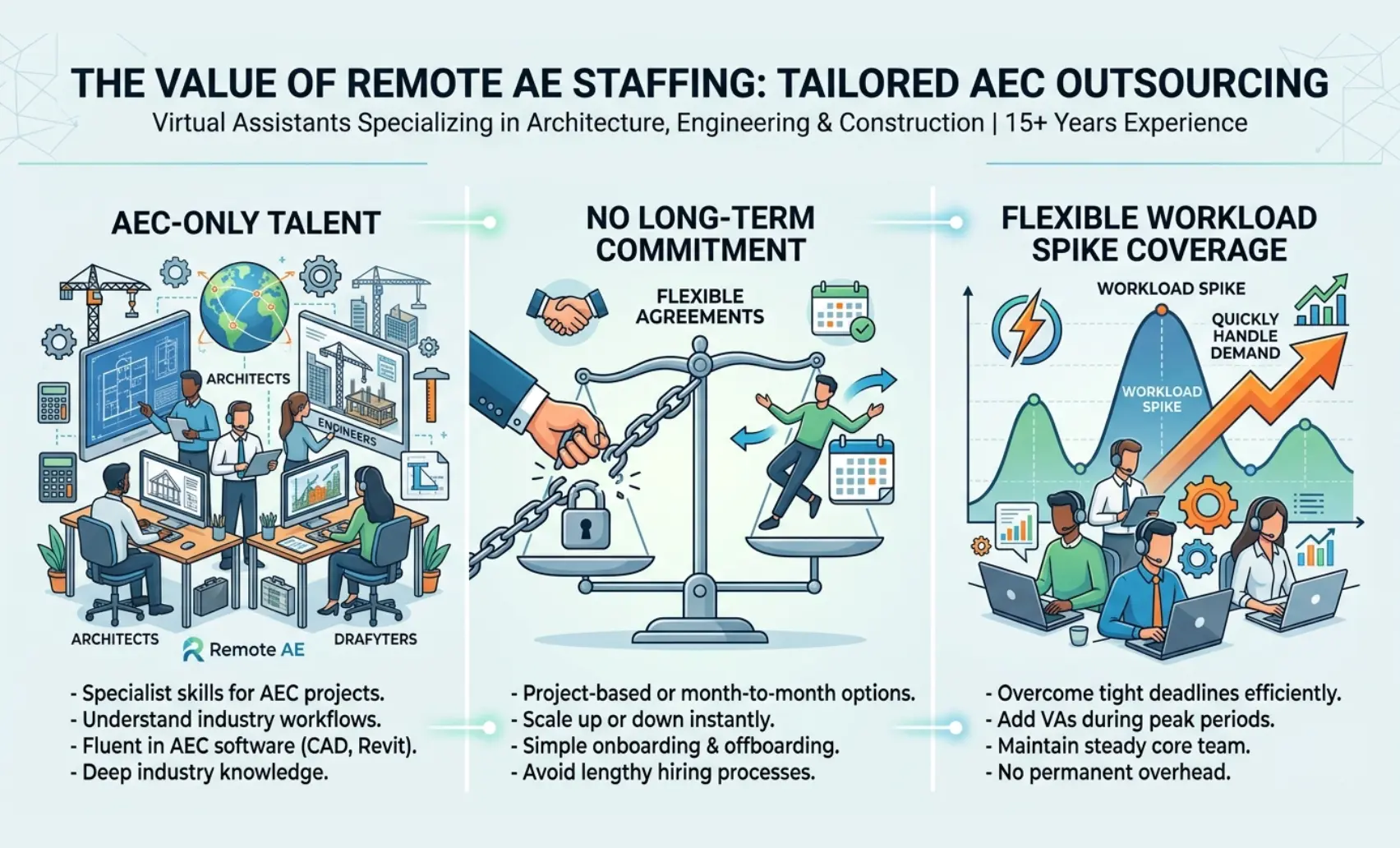
No Long-Term Hiring Burden
Every Remote AE engagement is structured to eliminate the financial and administrative commitments that make employment expensive.
- No employer payroll tax obligations, the staffing cost is a professional services expense
- No benefit administration, no health insurance, retirement, or paid leave obligations
- No long-term commitment, engage monthly or project-based, scale up or down as the pipeline demands
- No upfront costs, consult with Remote AE without any initial financial burden. No cost or obligation until the contractual phase begins
- Risk-free replacement in year one, Remote AE provides risk-free replacements for up to two virtual assistants if a placement does not meet your standards
Better Fit for Workload Spikes
AEC project pipelines are not linear. Bid season, permit pushes, construction documentation phases, RFI bursts, and BIM model cleanup all create demand spikes that W-2 headcount cannot efficiently absorb. Remote AE provides on-demand capacity for exactly these scenarios.
The cost sits cleanly as a professional services expense. The payroll tax stack, Social Security, Medicare, FUTA, and state unemployment never appear. And the capacity scales back the moment the project phase closes.
Reduce Your Staffing Tax Burden Without Reducing Output!
The tax math is clear. A $70,000 employee salary costs your AEC firm $103,000–$124,000 fully loaded. An outsourced AEC assistant delivering equivalent production output costs a fraction of that, with no payroll taxes, no benefit obligations, and no idle time cost between project phases.
Remote AE places pre-vetted virtual assistants trained in the AEC workflows, tools, and delivery standards your firm depends on, structured as professional services engagements that eliminate the employer tax stack from your production staffing budget.
Stop carrying W-2 overhead on production roles that don’t require it.
Book a Free Consultation with Remote AE Today, no obligation, no pressure. Just a direct conversation about restructuring your AEC staffing for better tax efficiency and lower overhead.
FAQs – Tax Benefits of Outsourcing vs Hiring Employees
Is outsourcing tax-deductible for a business?
Yes. Outsourcing costs are generally deductible if they are ordinary and necessary business expenses. For AEC firms, this may include drafting, BIM support, estimating, admin help, and consultant services. Keep invoices, contracts, and payment records to support deductions. Confirm treatment with your tax advisor.
Is it cheaper for tax purposes to hire contractors instead of employees?
Not always. Contractors may reduce payroll tax and benefits costs, but tax savings alone should not drive the decision. The IRS looks at worker classification rules. If the worker functions like an employee, treating them as a contractor can create tax and legal risk.
What are the tax benefits of outsourcing AEC work?
Potential benefits include deductible contractor costs, fewer payroll tax obligations, and lower benefit-related expenses. Outsourcing can also convert fixed staffing costs into variable project costs. The main requirement is proper documentation and correct worker classification.
Can outsourcing reduce employee benefit costs?
Yes. Contractors and outsourcing partners usually do not receive company benefits such as health insurance, PTO, retirement contributions, or workers’ compensation coverage from your firm. That can reduce labor costs, but you still need proper contracts and classification controls.
What AEC roles should stay in-house?
Keep licensed design decisions, stamping, final code interpretations, client strategy, contracts, and high-liability approvals in-house. Outsourced teams can support drafting, modeling, takeoffs, estimating, and admin workflows, but responsible professionals should keep control over risk-heavy decisions.