


Most small AEC firms that need remote help already know they need it. The barrier is not awareness; it is a cash flow question that never gets answered clearly enough to act on. According to the AIA findings in the February 2025 ABI report, 35% of firm leaders selected tightly managing overhead expenses as among their top three profitability factors. This article answers the cash flow question directly, with a break-even analysis built for AEC firms. These practical billing strategies create capacity to fund remote staffing and a realistic framework for choosing the engagement model that fits the firm’s current financial position. The goal is not to convince you that remote help is valuable. It is to show you how to afford it.
Why Small AEC Firms Feel They “Can’t Afford” Help
Revenue and Cash Flow Are Not the Same Thing
A signed contract does not put cash in the bank. In the AEC industry, the gap between earned revenue and available working capital is one of the most consistent financial stressors for small firms.
- Milestone billing means the architecture firm invoices at schematic design completion, design development, and permit submission, not when the work is done week by week
- Accounts receivable can sit outstanding for 30, 60, or 90 days after an invoice is issued, especially when working with public agencies or large development clients
- Payroll, software subscriptions, and overhead obligations are hit on a fixed monthly schedule, regardless of when client payments actually arrive
The result is a firm that looks profitable on a project basis but feels cash-constrained in practice. Signing more work makes it worse before it makes it better.
Growth Creates Hidden Labor Debt
When a small AEC firm is busy, someone absorbs the production overflow. That someone is almost always the owner.
- Principal architects work nights on Revit and AutoCAD drawings that should sit with a drafter
- Senior engineers handle quantity takeoffs and submittal tracking that do not require senior judgment
- Project managers handle meeting notes, RFI logging, and document control alongside active project management responsibilities
The firm appears lean. The overhead looks manageable. But the owner is absorbing real labor cost in the form of personal time, and that cost does not appear on any financial statement.
The Wrong Question Is “Can I Afford Help?”
Replace it with: “What is the cost of not getting help?”
The real costs of operating without remote support are measurable:
- Delayed drawing sets, slowing the project schedule, and deferring the next milestone invoice
- Missed bid deadlines, losing project opportunities that never come back
- Late RFI responses, creating field delays that lead to change orders, contractor claims, and strained client relationships
- A principal architect spending eight hours per week on repeatable Revit production, eight hours not available for client development, design, or fee proposal work
- Burnout causes slower delivery, the most expensive cost because it is invisible until it is too late
The Cash-Flow Case for Remote AEC Support
Remote Help Turns Fixed Hiring Pressure Into a More Controllable Staffing Decision
A local full-time hire commits the firm to a fixed monthly cost, salary, payroll taxes, benefits, software seats, and office overhead, regardless of project volume. Remote staffing converts that fixed commitment into a more variable and controllable cost structure.
- No local office expansion required; the remote assistant works within the firm’s existing tool environment
- No recruitment burden, Remote AE manages sourcing, screening, and candidate matching
- Lower overhead compared with a local full-time hire, no employer tax contributions, benefits packages, or workstation costs
- Access to AEC-trained remote assistants who understand drawing sets, BIM workflows, construction documentation, and project coordination from day one
Why AEC-Specific Remote Help Matters
Not all remote assistants are equal, and for AEC firms, the difference between a generic virtual assistant and an AEC-trained remote assistant is measured in supervision hours and rework.
Remote AE provides remote assistants specifically for architecture, engineering, and construction firms:
- Architecture support, Revit drafting, AutoCAD production, permit sets, and construction documentation
- Engineering support, BIM coordination, drawing package production, and technical documentation
- Construction support, quantity takeoffs, RFI tracking, submittal management, and project coordination
- Estimating support, bid packages, drawing review, and vendor quote coordination
- Permit and compliance support, document organisation, code research, and submission preparation
Do Not Compare Remote Help Only to Salary
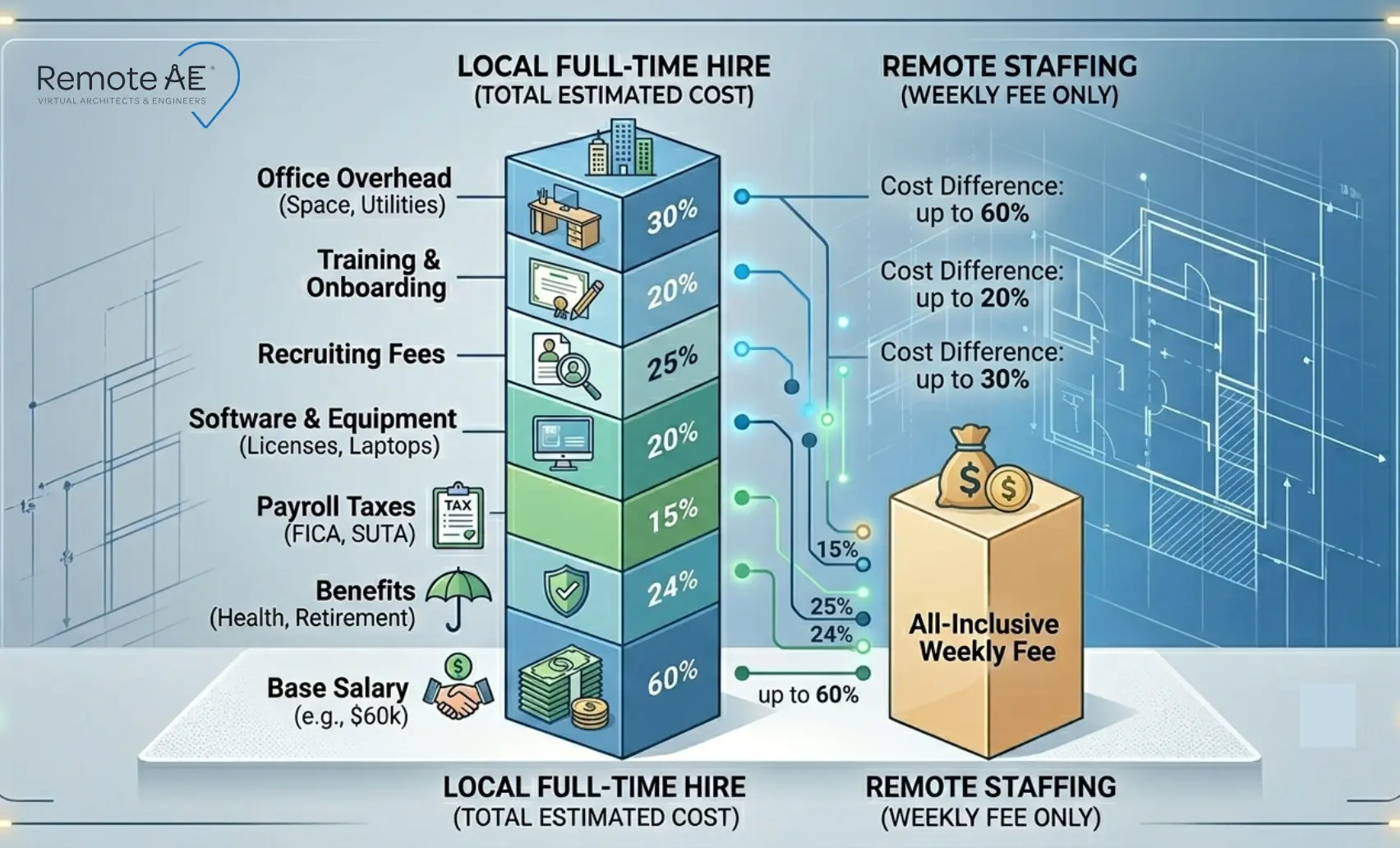
The honest financial comparison is not remote staffing fee versus local salary. It is the remote staffing fee versus the full cost of a local hire, which consistently exceeds the base salary by 30–40%.
The full local hire cost stack includes:
- Base salary, the starting point
- Employee benefits, health insurance, retirement, paid leave
- Payroll taxes, employer FICA, FUTA, and state unemployment
- Recruitment cost, job boards, interview hours, agency fees
- Software seats, Revit, AutoCAD, Bluebeam, Procore licences
- Training time, weeks of ramp-up before independent productivity
- Underused capacity, fixed cost during slow project periods
- Lost senior billable hours, principal architect time spent supervising and correcting output
Against this full cost picture, remote AEC staffing looks different from a simple salary comparison.
The Biggest Hiring Myth: “I Can’t Afford Help Right Now”
Why Most Owners Only Look at Cost
When cash flow is tight, the instinct is to treat every new expense as a risk, including staffing. Most small AEC firm principals evaluate remote help as a line-item cost rather than a revenue-generating investment.
- Staffing feels like an expense when the firm is stretched, even when it directly unlocks additional billable capacity
- Fear of commitment during uncertain project periods makes owners defer decisions that would actually reduce financial risk
- The framing of “I can’t afford it” prevents the more useful analysis: what does not having support actually cost the firm each week?
The Questions Firm Owners Should Be Asking Instead
- Which projects are currently delayed due to the production team not having enough hours?
- How many hours per week is the owner or a senior engineer spending on tasks that a trained remote assistant could handle?
- How much revenue is sitting in the project backlog that the firm cannot pursue because current capacity is fully committed?
These questions reframe staffing from a cost decision into a capacity decision, and the math changes significantly when capacity is the variable being optimised.
The Opportunity Cost Most Firms Never Calculate
A principal architect billing at $150/hour who spends 10 hours per week on Revit drafting, submittal tracking, and document control incurs an opportunity cost of $1,500 per week, not because those tasks have no value, but because the principal’s time is more valuable elsewhere.
- Every hour spent on delegable production work is an hour not available for client meetings, fee proposals, and new business development
- Client opportunities that require fast response, RFPs, developer introductions, and referral conversations get deprioritized when the principal is buried in production
- Long-term growth slows because the firm cannot invest principal time in the relationships and strategy that generate the next project pipeline
Part-Time, Full-Time, or Project-Based, Which Budget Model Fits?
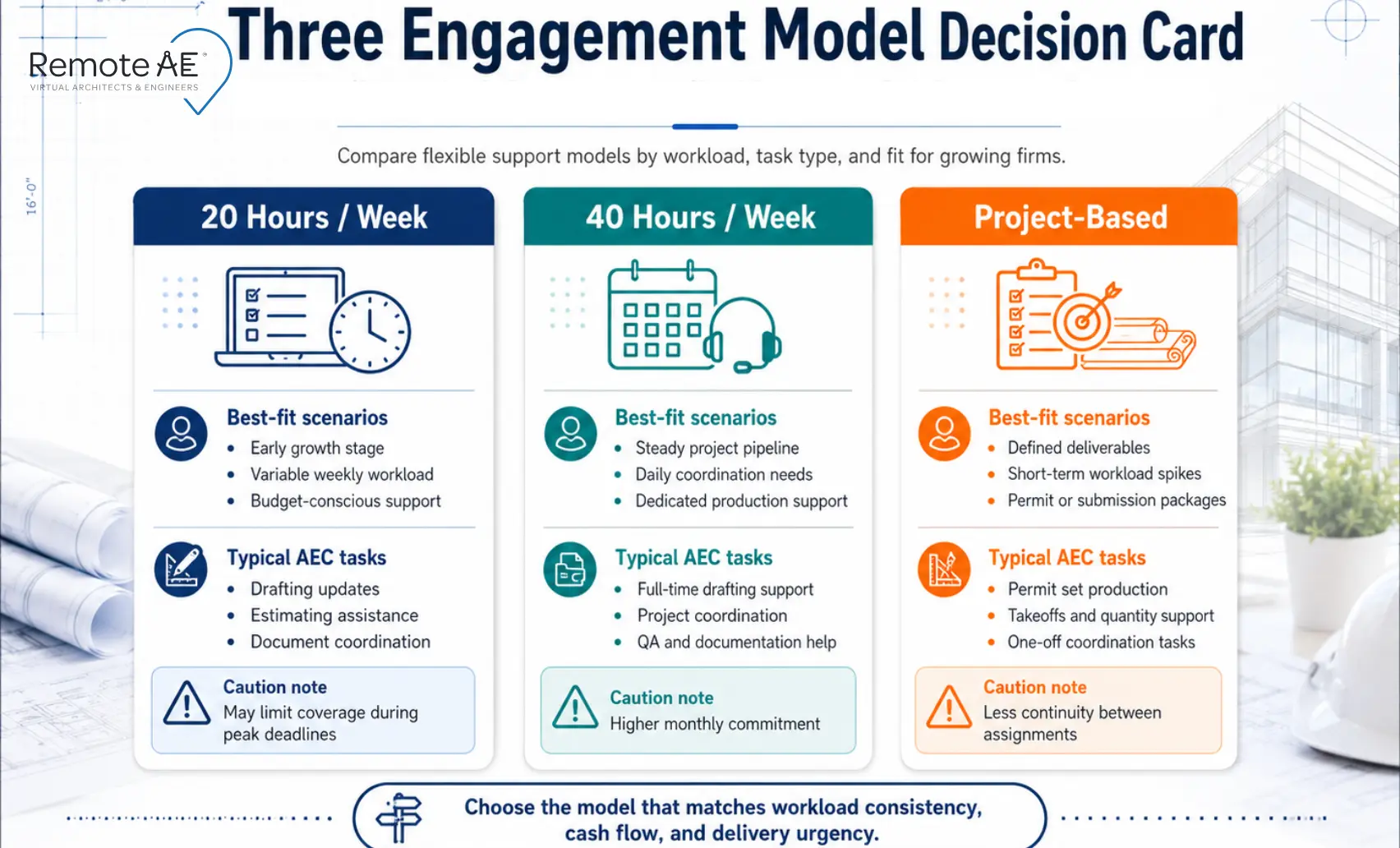
When 20 Hours Per Week May Be Enough
Part-time remote support is the lowest-risk starting point for small AEC firms testing delegation for the first time.
Best fit for:
- Light admin support, inbox management, scheduling, and meeting notes
- Small documentation cleanup, drawing schedule updates, file organisation, and naming convention enforcement
- Occasional CAD or Revit drafting help during a specific project phase
- Short-term project overflow during a busy period
- Firms with irregular workloads where 40 hours of support would carry idle time
Caution: Part-time support may not be enough during heavy production cycles. Revit modeling, RFI tracking, and submittal management are daily tasks that benefit from full-time dedicated attention.
Handoff gaps are more frequent with part-time arrangements, and turnaround times are slower when the assistant is not available for daily project communication.
When 40 Hours Per Week Makes More Financial Sense
Full-time dedicated support is the right model when production bottlenecks are recurring, not occasional.
Best fit for:
- Ongoing BIM and CAD production, Revit modeling, AutoCAD drafting, and drawing updates
- Estimating support, quantity takeoffs, bid package preparation, and vendor quote tracking
- Submittal and RFI tracking across multiple active projects simultaneously
- Construction documentation, permit sets, as-builts, and closeout packages
- Active project coordination, meeting notes, drawing distribution, and subcontractor follow-up
Remote AE’s dedicated full-time model means one consistent remote assistant working exclusively for the firm, learning its Revit templates, drawing standards, vendor relationships, and communication preferences over time.
This continuity produces better output quality and less supervision burden than rotating project-based freelancers.
When Project-Based Support Makes Sense
Project-based remote support addresses specific, defined bursts of work, without a continuing weekly commitment.
Best fit for:
- Bid-day quantity takeoff spikes, additional estimating support in the final 48 hours before a submission deadline
- One-off drawing package cleanup, updating a legacy drawing set before reuse on a new project
- Takeoff backlog, processing a backlog of incomplete estimates before bid season begins
- Permit submission support, assembling and formatting a complete drawing set for a specific building department submission
- Model update sprint, a concentrated Revit modeling effort ahead of a design review milestone
Project-based budgeting can also be used internally, even when the remote assistant is full-time. The firm assigns the support cost to active projects, billable phases, or specific backlog categories, making the staffing cost directly traceable to project revenue rather than treating it as general overhead.
Weekly Cost Thinking: Why Smaller Payment Intervals Help Cash Flow
Weekly Cost Is Easier to Compare Against Active Work
A monthly salary figure is psychologically harder to absorb when cash flow is variable. A weekly cost is easier to evaluate against the specific work the firm is actively billing.
- Weekly cost versus monthly salary pressure, the financial commitment feels proportional to the work happening right now, not to a future projection
- Easier forecasting, weekly remote staffing cost maps directly to weekly project billing cycles
- Easier project matching, the firm can allocate the remote support cost to specific active projects or phases
- Easier owner decision-making, the question becomes “does this week’s work justify this week’s cost?” rather than “can I sustain this annual commitment?”
Map the Cost to One Revenue-Driving Outcome
The weekly cost of remote staffing becomes financially straightforward when it is mapped to a single measurable outcome.
Examples:
- One additional proposal submitted this week, fee proposals that do not get written do not generate revenue
- One delayed drawing set has been completed, unlocking the next milestone invoice that has been waiting on the production backlog
- One estimator freed for higher-value bid review, instead of spending time on quantity takeoffs that a remote estimating assistant can handle
- One project manager saved from admin overload, RFI logging and submittal tracking handled by a remote construction assistant, PM focuses on field coordination
- One principal freed for client meetings, the highest-value use of a principal architect’s time
Build a 4-Week Remote Help Budget
Use this five-step framework before committing to any remote staffing engagement:
- Step 1: List the top 10 repeatable tasks currently slowing the firm down: Revit drafting, quantity takeoffs, RFI tracking, submittal management, and meeting notes
- Step 2: Estimate weekly hours lost on each task, be honest about how much principal or senior engineer time these tasks actually consume
- Step 3: Assign a value to the senior person doing those tasks, principal architect at $150/hour, senior engineer at $120/hour, project manager at $95/hour
- Step 4: Estimate what a remote assistant could take over, which tasks require licensed judgment, and which are delegatable production work
- Step 5: Compare the weekly remote staffing cost against the value of recovered capacity. The break-even analysis in H2 #6 makes this calculation concrete
The “Too Expensive Not to Hire” Math
Start With the Value of the Owner’s Time
The opportunity cost of not hiring is calculable, and for most small AEC firm principals, the number is larger than expected.
Formula:
Owner hourly value × hours spent on delegable work = weekly opportunity cost
Worked example:
- Principal architect value: $150/hour
- Delegable production work per week: 8 hours, Revit sheet updates, submittal tracking, meeting notes, quantity takeoffs
- Weekly opportunity cost: $1,200
If remote AEC staffing costs less than the value of the time it recovers, the decision starts to make financial sense before any additional revenue is considered. At 8 recovered hours per week, a principal architect generating $150/hour in billable work recovers more than the weekly remote staffing cost within the first week.
Add Missed Revenue, Not Just Saved Time
Recovered hours are only half the financial picture. The other half is revenue that was never generated because capacity was consumed by delegable tasks.
- Missed RFPs: A firm that cannot respond to every qualified opportunity because the principal is buried in production loses project revenue that never appears in any financial report, but represents real, calculable loss
- Slower proposal turnaround: Every day between a client enquiry and a fee proposal delivery reduces win probability; remote admin support accelerates proposal production directly
- Delayed change orders: Change orders that sit unprocessed because no one has time to prepare them delay revenue recognition that the firm has already earned
- Lost repeat work from slow response times: Clients who wait days for an RFI response or a drawing revision develop a perception of the firm’s responsiveness that affects future work allocation
- Project delays that hurt client trust: Late delivery on one project affects referral generation on the next, an indirect revenue cost that compounds over time
Use a Break-Even Point
The break-even calculation makes the financial decision concrete without requiring a detailed business case.
Formula:
Remote staffing cost ÷ gross profit per recovered billable hour = hours needed to break even
If the principal architect recovers more than 7 billable hours per week by delegating production tasks, the remote staffing engagement pays for itself before any additional revenue from new projects is counted.
Most small AEC firm principals are spending significantly more than 7 hours per week on tasks that a trained remote assistant can handle.
Financing Strategies for Small Firms That Need Help Now
Start With a 12-Week Cash-Flow Forecast
Before adding any staffing cost, build a 12-week cash flow forecast. It does not need to be sophisticated; it needs to be honest.
Include:
- Expected client payments, by project, phase, and anticipated receipt date
- Payroll, fixed weekly or bi-weekly obligation
- Software subscriptions, Revit, AutoCAD, Bluebeam, Procore, and project management tools
- Rent and facilities overhead
- Estimated tax payments, quarterly obligations
- Contractor and vendor payments
- Remote staffing cost, weekly, starting from the first week of engagement
- Project start dates, when new work will begin generating invoices
- Milestone billing dates, when the next phase invoice becomes issuable
A 12-week view often reveals that the cash constraint is a timing problem, not a profitability problem. The revenue exists; it just has not arrived yet.
Use Deposits and Milestone Billing to Fund Capacity
The fastest way to create working capital for remote staffing is to restructure how and when the firm invoices.
- Collect a project deposit before starting any major scope. 10–20% of the total fee at contract execution provides immediate working capital
- Bill at phase completion rather than project completion, schematic design, design development, permit submission, and construction administration each represent a billable milestone
- Avoid waiting until the end of a long project to invoice; the cash flow gap that results is the primary reason firms feel they cannot afford ongoing support costs
- Tie the remote support cost directly to funded project phases. When a phase is invoiced, and payment is expected, that cash flow covers the remote staffing cost for the same period
Invoice Faster and Tighten Receivables
Accounts receivable is the most controllable cash flow lever available to small AEC firms, and the most frequently neglected.
- Invoice on the same day a milestone is completed, not at the end of the month or when it is convenient
- Set clear payment terms at contract execution. Net 15 or Net 30 is reasonable for most AEC clients; Net 60 or Net 90 is a cash flow liability
- Build a follow-up schedule, a reminder email at day 7, a call at day 14, and a formal late notice at day 30
- Assign accounts receivable follow-up to a remote admin assistant, where appropriate, a virtual assistant who tracks outstanding invoices and sends payment reminders, and recovers cash faster than an owner who follows up inconsistently between project tasks
Use Financing Carefully
When cash flow timing cannot be bridged through billing restructuring alone, financing can cover the gap, but only with a clear revenue path.
Options for small AEC firms:
- Business line of credit: Flexible working capital that can be drawn and repaid as project payments arrive, the most appropriate financing tool for bridging milestone billing gaps
- Invoice financing: Using outstanding accounts receivable as collateral to access cash before client payment, useful for firms with reliable clients but long payment cycles
- SBA-backed funding: Small Business Administration loan programmes available to qualifying AEC firms for working capital and growth investment
- Short-term working capital loans: Available through online lenders with faster approval timelines than traditional bank financing
Caution: Financing should bridge a timing gap between earned revenue and received payment, not fund a staffing role with no clear revenue path. If the remote assistant’s work directly enables additional billable output, the revenue case exists. If the role is purely speculative, the financing risk outweighs the benefit.
What to Delegate First So Remote Help Pays Back Faster
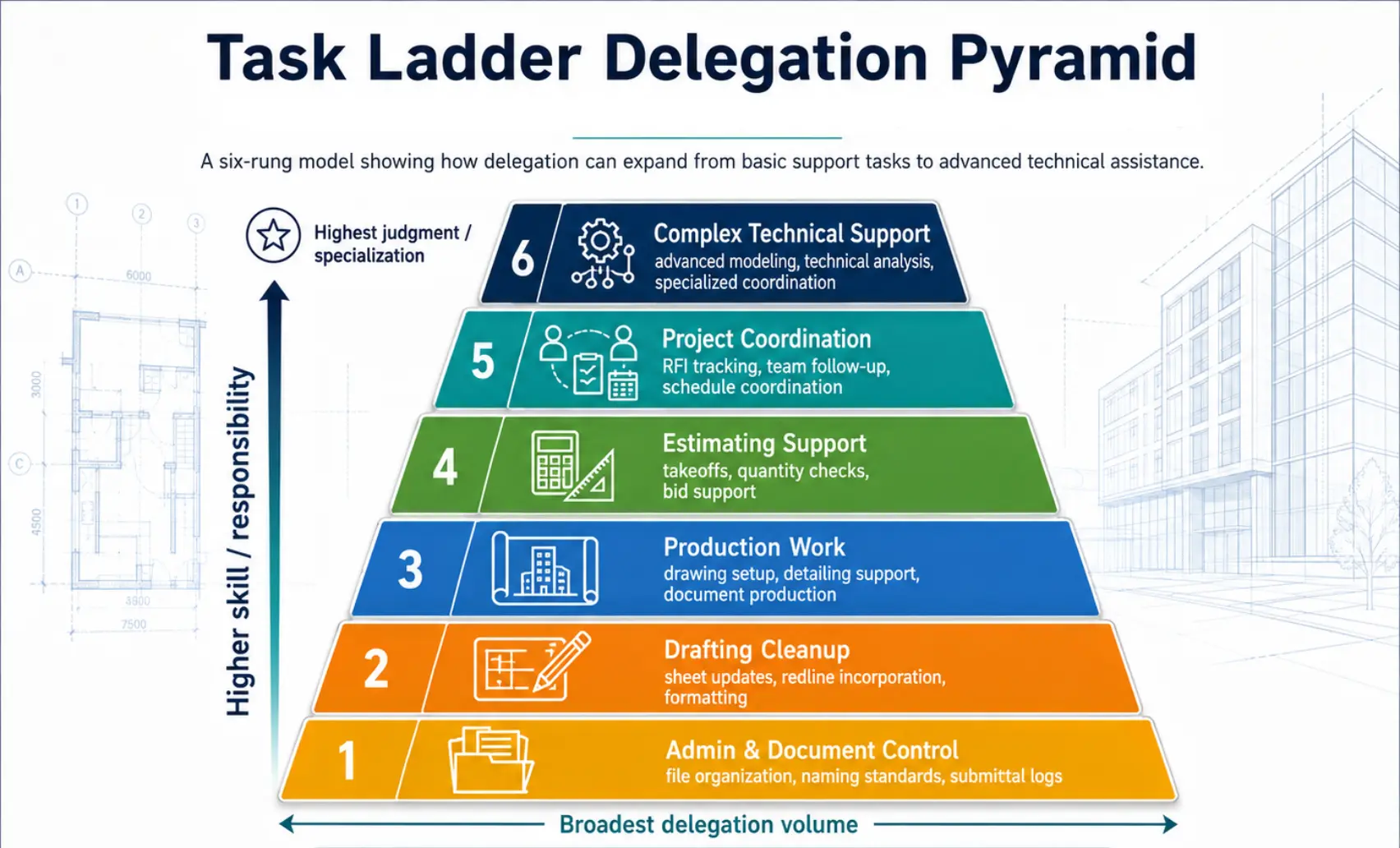
Delegate Repeatable Production Tasks First
The fastest path to a positive return on remote staffing investment is delegating tasks that are high-volume, repeatable, and currently consuming senior staff time.
- CAD and Revit drafting, floor plan updates, elevation revisions, and sheet cleanup
- BIM modeling support, view setup, sheet population, and family management
- Markup updates, incorporating Bluebeam redlines into current drawing sets
- Quantity takeoffs, trade-specific measurement for active bids
- Drawing schedule updates, door, window, finish, and equipment schedules
- Submittal logs, maintaining the register from receipt through approval
- RFI tracking, logging, routing, and following up on open items
- Meeting notes, documenting decisions, and action items within 24 hours
- Permit package support, assembling, and organising submission documents
- Research and documentation, code compliance research, and product specification support
Keep High-Risk Decisions In-House
Delegation works because the boundary is clear, not because everything is delegated.
These stay with the licensed professional:
- Final design judgment and concept direction
- Stamping and sealing of construction documents
- Licensed professional review and code interpretation requiring sign-off
- Client approval decisions and contract commitments
- Engineering judgment on structural, MEP, or civil design matters
The remote assistant prepares, organises, and coordinates. The licensed professional decides, approves, and seals.
How Remote AE Helps Small AEC Firms Control Hiring Risk
AEC-Specific Talent Instead of Generic Admin Help
Generic virtual assistant platforms place administrative support staff into roles that require genuine AEC industry context. A remote assistant who cannot read a drawing set, does not understand the difference between a submittal and an RFI, and has never worked inside Procore or Bluebeam creates more management burden than capacity relief.
Remote AE provides dedicated staffing exclusively for architecture, engineering, and construction firms:
- Architecture assistants, Revit drafting, AutoCAD production, permit documentation, and construction drawing support
- Engineering assistants, BIM coordination, technical drawing production, and engineering documentation
- Construction assistants, quantity takeoffs, RFI tracking, submittal management, and project coordination
- Estimating support, bid package preparation, drawing review, and vendor quote coordination
- Documentation and coordination roles, construction documentation, specification review, and project administration
Every remote assistant arrives with AEC industry experience, understanding project delivery workflows, drawing set conventions, and the construction documentation standards that small firms depend on.
Dedicated Support for Firms With Steady Workload
A dedicated full-time remote assistant who works exclusively for one firm delivers fundamentally better results than a rotating pool of freelancers or a shared-resource platform.
Benefits of the dedicated model:
- Better continuity: The assistant learns the firm’s Revit templates, CAD standards, vendor list, and client communication preferences, and applies that knowledge consistently across every project
- Easier onboarding into firm standards: One structured onboarding process versus re-explaining standards to a new freelancer every project
- More ownership: A dedicated assistant takes responsibility for their workflow lane, submittal tracking, RFI logs, or drawing production, rather than completing isolated tasks without context
- More predictable output: Consistent quality from a professional who knows the firm’s standards reduces senior staff review time over time
- Less time re-explaining projects: Accumulated project knowledge means the assistant asks fewer questions and produces more reliable first-draft work as the engagement matures
Lower-Friction Hiring Path
Remote AE removes the most time-consuming elements of the hiring process from the firm’s plate.
The process:
- Remote AE consults with the firm to define the role, skills, tools, AEC workflow experience, and communication requirements
- Three-stage candidate screening covers technical skills, software proficiency, and construction industry knowledge
- Remote AE presents two matched candidates for the firm to interview and select
- No cost before the decision stage, the consultation and matching process carries no financial obligation until the firm confirms its selection
- Structured onboarding support, 30-minute transition meeting, schedule setup, tool access confirmation, and check-in protocols during the first 30 days
- 30-day money-back guarantee, if the engagement does not meet expectations in the first month, the investment is returned
- Weekly payment structure, the firm pays week by week rather than committing to a monthly or annual contract upfront
- Risk-free replacement, up to two replacements within the first year if the placement does not meet the firm’s standards
The Cost of Waiting Is Higher Than the Cost of Starting!
Every week, a small AEC firm defers remote staffing support, which is a week of opportunity cost, principal time on delegable tasks, delayed drawing sets, missed bid deadlines, and revenue sitting in the project backlog.
Remote AE places dedicated remote assistants trained in AEC workflows, Revit, AutoCAD, Bluebeam, Procore, quantity takeoffs, RFIs, submittals, and construction documentation, ready to take the production and coordination work off your plate from week one.
Book a Free Consultation With Remote AE, No Obligation, No Upfront Cost!
FAQs – Small Firm Cash Flow
How can a small architecture firm afford remote help?
Start with a weekly budget, not a full-time hire. Delegate repeatable work like redlines, sheet cleanup, takeoffs, and admin tied to active projects. The goal is to recover billable owner or project architect time. If remote help frees 5–10 hours weekly for paid design work, it can fund itself.
Is remote help cheaper than hiring a local AEC employee?
Often, yes, but compare total cost, not salary alone. Local hiring includes benefits, recruiting, payroll taxes, office space, software, hardware, tools, and management time. Remote support can reduce fixed overhead and let firms add capacity only when the workload justifies it.
Should I hire a part-time or full-time remote assistant?
Use 20 hours/week for light workloads, pilot support, or admin-heavy tasks. Use 40 hours/week when you have steady project support needs, production drafting, BIM updates, and daily coordination. Part-time gives flexibility; full-time gives continuity and faster workflow familiarity.
Can a remote assistant replace a licensed architect or engineer?
No. A remote assistant supports production, coordination, documentation, modeling, takeoffs, and technical prep. Licensed architects and engineers keep final responsibility for design intent, code decisions, stamping, and approvals. Remote support adds capacity; it does not transfer professional liability.
What AEC tasks should I delegate first?
Start with tasks that are repeatable and easy to review: drafting cleanup, documentation, quantity takeoffs, BIM support, submittal logs, RFI tracking, schedules, meeting notes, file organization, and admin follow-ups. Keep design decisions and final approvals with licensed staff.