
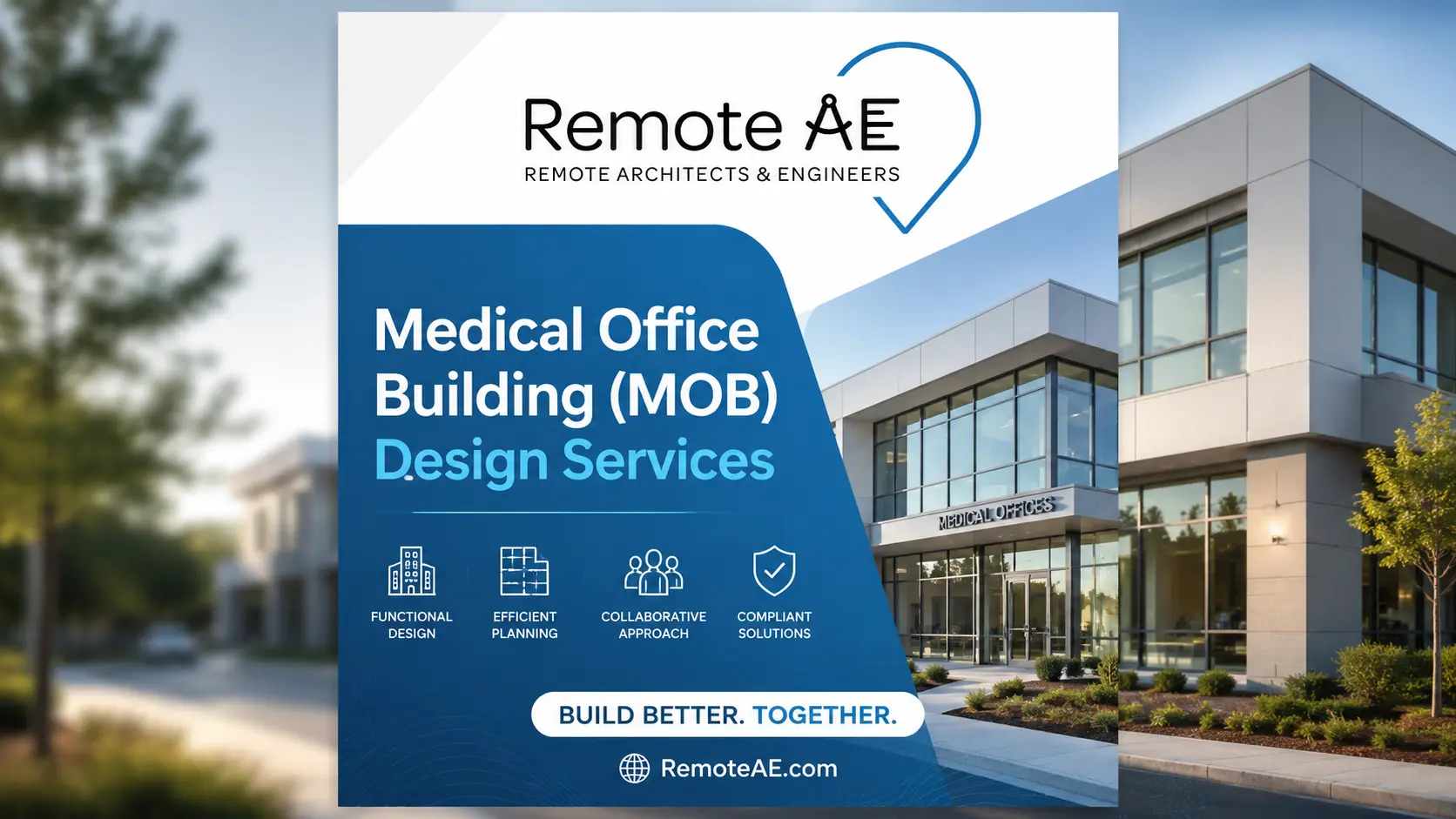
Medical office building design services help AEC firms turn complex clinical programs into buildable, code-compliant healthcare spaces without adding full-time headcount. The global medical office buildings market is projected to grow from $39.79 billion in 2023 to $62.18 billion by 2030, a 6.64% CAGR (Grand View Research, 2024). That growth means more architecture and engineering firms are picking up MOB, outpatient clinic, and medical tenant improvement projects, often without dedicated healthcare design experience on staff.
Remote AE places remote architects, engineers, and BIM specialists inside AEC firms to handle space planning, Revit modeling, MEP coordination, and construction documents. This guide covers what MOB design services include, the challenges unique to the healthcare space, and how remote AEC staffing solves them.
What Are Medical Office Building Design Services?
A Medical Office Building (MOB) is a commercial structure built or leased primarily for outpatient medical use, physician offices, diagnostic services, and minor procedures. It differs from related types of healthcare facilities in scope and regulation.
| Facility Type | Primary Use | Design Focus |
| Medical Office Building (MOB) | Physician groups, multi-specialty tenants | Exam rooms, flexible tenant suites, shared base building systems |
| Outpatient Clinic | Single-specialty or primary care practice | Compact exam-to-support room ratio, fast patient turnover |
| Ambulatory Surgery Center (ASC) | Same-day surgical procedures | Sterile core, OR suites, recovery bays, strict life-safety code |
| Hospital | Inpatient, emergency, and surgical care | 24/7 operations, complex MEP, redundant building systems |
MOBs also split into two delivery models. A freestanding MOB is a standalone building, often developer-built and leased to multiple healthcare tenants. A hospital-adjacent MOB sits on or near a hospital campus and ties into existing infrastructure and code requirements.
Project scope further breaks into core and shell work (the building’s structure, envelope, and base systems) and tenant improvement work (the buildout of an individual practice’s space). Most medical tenant improvement design projects start once the core and shell is complete.
What MOB Design Services Usually Include
A full medical office building design services scope typically covers:
- Site planning support for parking, access, and visibility
- Programming to define room counts and adjacencies
- Space planning and medical office space planning for tenant layouts
- Test fits to confirm a prospective tenant’s program fits the shell
- Revit modeling and Revit support for healthcare projects
- CAD drafting for plans, elevations, and details
- Interior layouts for exam, procedure, and support areas
- MEP coordination support for power, plumbing, and ventilation
- Medical office construction documents for permitting and bidding
- As-built drawing updates after construction
- Code and accessibility review support tied to ADA and FGI Guidelines
A remote architect assistant from Remote AE can take on each of these tasks directly inside a firm’s existing Revit or AutoCAD environment, working as healthcare drafting and BIM support rather than a separate outside vendor.
Why MOB Design Requires Specialized AEC Support
Ambulatory care now makes up 41.2% of the global medical office building market (Fact.MR, 2026). That shift packs more clinical complexity into buildings that used to function like standard commercial offices. This is why healthcare facility design support has become its own AEC specialty.
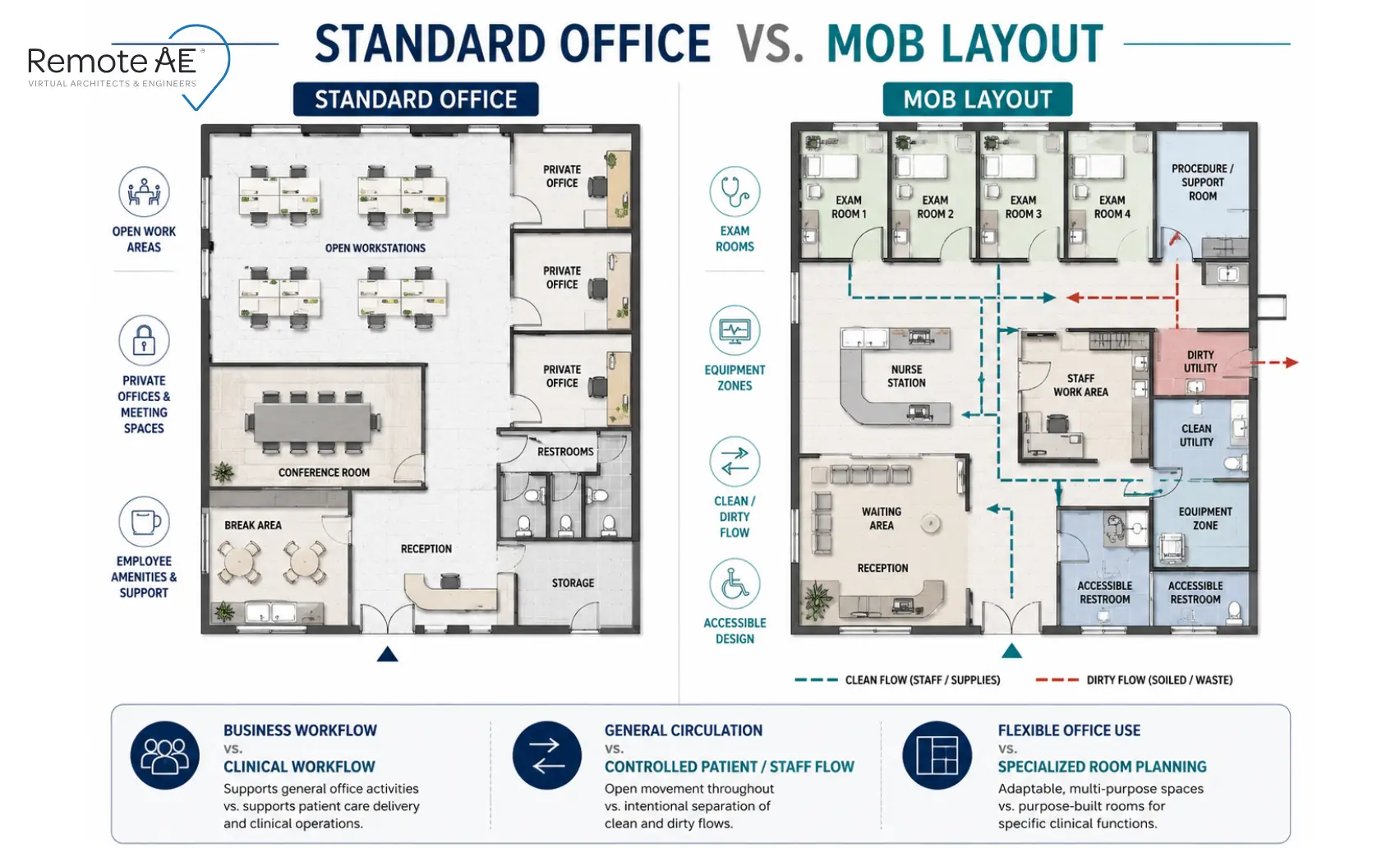
MOBs Are Not Standard Office Buildings
A standard office floor plan rarely survives a healthcare fit-out untouched. Clinic design and MOB design both have to account for:
- Healthcare workflow between providers, staff, and patients
- Patient privacy at check-in, exam rooms, and consults
- Exam room planning sized for equipment and clearances
- Waiting area capacity, separated from clinical zones
- Clinical support areas like nurse stations and supply rooms
- Infection control, including clean and dirty separation
- Equipment coordination for diagnostic and treatment tools
The Main Design Challenge: Flexible Clinical Space
Most MOBs lease to more than one specialty, so outpatient clinic design services have to flex across several room types in one shell:
- Primary care, standard exam rooms, light equipment
- Imaging, shielded walls, and larger equipment footprints
- Lab, specimen handling, and ventilation needs
- Urgent care, faster turnover, more procedure rooms
- Specialty clinics, equipment-specific layouts
- Physical therapy, open treatment bays
- Pharmacy, secure storage, and dispensing counters
- ASC adjacency, where outpatient surgery support applies
Why Layout Mistakes Cost More in Healthcare Projects
A layout error in a standard office means moving a desk. In a MOB, the same mistake can trigger rework on sealed walls, delayed permits, poor patient flow, inefficient staff movement, MEP clashes, or accessibility retrofits. Catching these issues during design, not construction, is where specialized support pays for itself.
Core MOB Design Considerations
Patient Flow and Wayfinding
Stratus says more than 85% of patients ask for directions in healthcare facilities and 30% of first-time visitors get lost. Strong MOB design solves this before move-in:
- A clear entry sequence from parking to reception
- Reception and waiting areas sized for peak volume
- Simple check-in and check-out circulation
- Wayfinding is built into the layout, not added as signage
Staff Workflow and Back-of-House Planning
- Nurse stations positioned with sightlines to exam rooms
- Provider work areas near, not inside, exam rooms
- Clean and dirty supply separation
- Dedicated storage for equipment and consumables
- Staff-only routes that avoid patient corridors
- Exam room adjacency that cuts walking distance
Exam Rooms, Procedure Rooms, and Clinical Support Areas
- Standardized exam room dimensions and casework
- Handwashing stations placed per code
- Equipment clearances for mobile and fixed devices
- ADA-compliant turning radii and door widths
- Layouts built to allow future room conversion
Parking, Drop-Off, and Site Access
- Patient drop-off close to the main entrance
- ADA parking counts that meet local code
- Ambulance or service access where the tenant mix needs it
- Separate staff access where security or flow demands it
- Visibility from the main road
MEP, HVAC, and Medical Equipment Coordination
- Power loads for diagnostic and treatment equipment
- Plumbing for exam rooms, labs, and sterilization
- Ventilation rates tied to room function
- Medical gas lines were required
- Imaging equipment shielding and structural loads
- IT and low-voltage coordination for EHR and monitoring
- Early clash detection between architecture, structure, and MEP
Common MOB Design Challenges
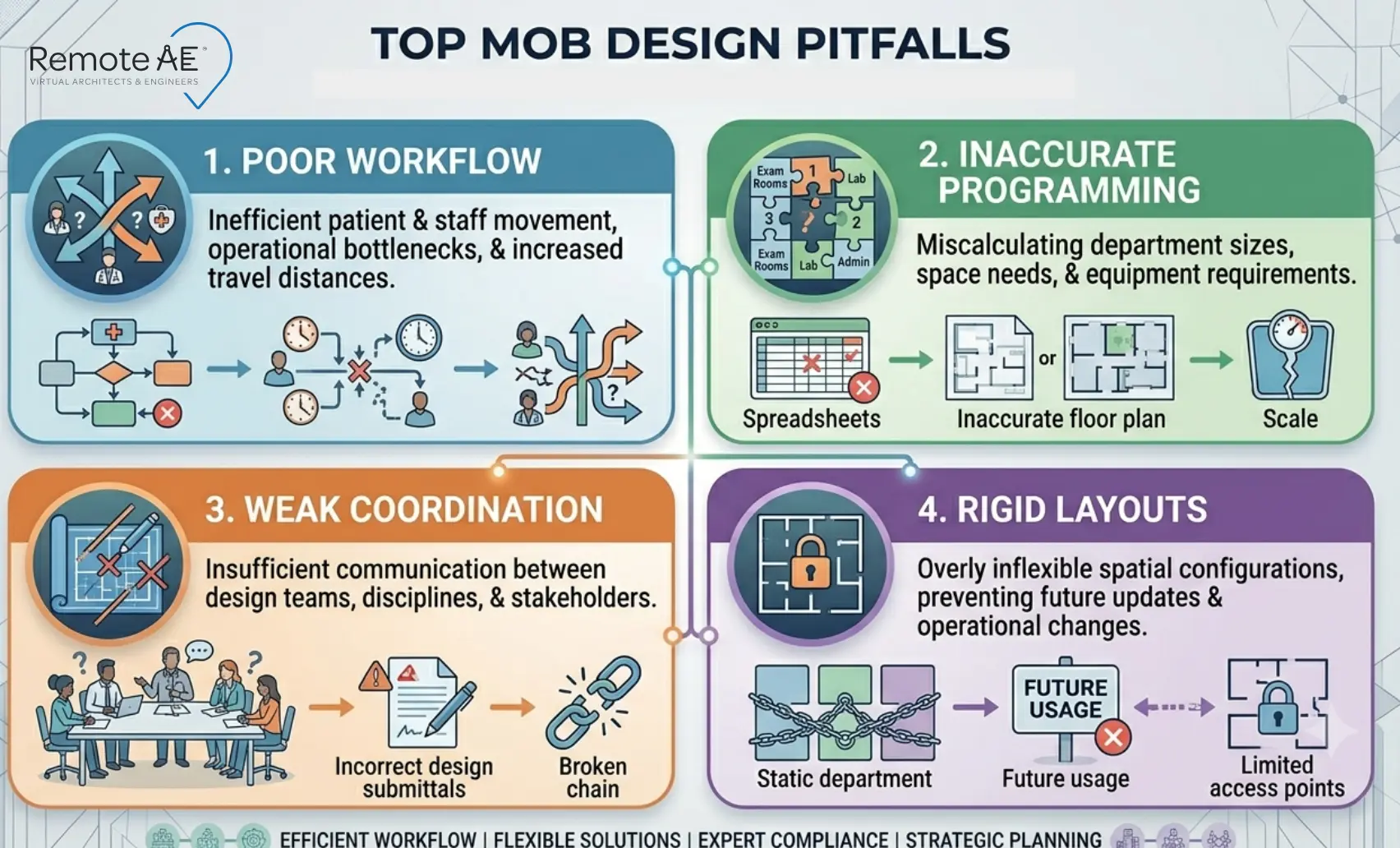
Poor Workflow Planning
A common example: staff walk too far between exam rooms and support areas, adding minutes to every patient visit and hours to every shift.
Inaccurate Space Programming
- Too much waiting space, not enough clinical room
- Undersized storage for supplies and equipment
- Undersized exam or procedure rooms that limit equipment placement
Weak Coordination Between Disciplines
Poor project data and miscommunication cause 48% of all rework in U.S. construction, totaling $31.3 billion a year (PlanGrid/FMI, 2018). On MOB projects, this shows up as architecture-structure-MEP conflicts, late drawing revisions, and construction delays.
Designing Without Future Growth in Mind
Rigid layouts force expensive renovations later and limit flexibility when a tenant practice grows or a specialty changes.
How Remote AE Supports Medical Office Building Design
Ninety-two percent of construction and AEC firms report difficulty filling open positions (AGC/NCCER 2025 Workforce Survey). Remote AE fills that gap with dedicated remote talent trained on healthcare projects.
Dedicated Remote Design Teams
- Architecture assistants for design support
- BIM modelers for Revit production
- Drafting support for CAD documentation
- Engineering assistants for MEP and structural coordination
- Construction documentation support through CDs and CA
Remote MOB Design Services: Remote AE Can Support
- CAD Drafting and Drawing Production: floor plans, RCPs, elevations, interior details, door/window schedules, finish plans, and life safety plans under the architect’s direction.
- Revit Modeling and BIM Support: existing conditions modeling, BIM updates, model cleanup, sheet setup, clash coordination support, and family creation for medical casework and equipment.
- Space Planning and Test Fits: tenant layouts, multi-specialty planning, exam room count testing, core-and-shell planning support, and developer presentation packages.
- Design Development and Construction Document Support: drawing coordination, redline updates, specification support, code note organization, detail drafting, and QA/QC checklist support.
- Construction Administration Support: RFI tracking, submittal logs, drawing revisions, ASI updates, as-built markups, and field note cleanup.
How Remote MOB Design Support Works
Step 1: Share Scope, Standards, and Project Files
Share your CAD/Revit files, BIM standards, drawing templates, design brief, tenant requirements, and deadline so Remote AE can scope the right support.
Step 2: Match With AEC-Trained Remote Talent
Remote AE matches you with vetted talent in architecture, engineering, drafting, BIM, and construction support, with healthcare experience where available.
Step 3: Integrate Into Your Workflow
Your remote team works inside your existing systems: daily check-ins, your file naming standards, your markup workflow, and tools like BIM 360/ACC, Revit, AutoCAD, Bluebeam, Teams, and Slack.
Projects using cloud-based Revit-Navisworks coordination see up to 40% fewer design-related RFIs during construction
Step 4: Review, Revise, and Scale Support
Your team reviews every deliverable. Drawing updates, extra support during deadline crunches, and dedicated long-term remote support scale with your project load.
What to Look For in a Remote MOB Design Partner
AEC-Specific Experience
Look for healthcare architecture knowledge, CAD/Revit skills, real drawing set experience, and exposure to actual MOB projects, not just commercial office work.
Familiarity With Healthcare Codes and Design Standards
Forty-two states have adopted some edition of the FGI Guidelines as a minimum standard for healthcare facility design. A qualified partner should know FGI, ADA, and NFPA/CMS life-safety basics, plus local codes and your own firm standards.
Strong Communication and File Discipline
Clear markup workflows, version control, drawing logs, fast response times, and a consistent meeting cadence separate a reliable remote partner from a risky one.
Ability to Work Across Project Phases
A strong partner supports feasibility, programming, SD, DD, CD, CA, and as-builts, not just one phase in isolation.
Why AEC Firms Choose Remote AE
The median U.S. architect salary is $96,690 a year before benefits and overhead (U.S. Bureau of Labor Statistics, May 2024), and that’s before recruiting and onboarding costs. AEC firms choose Remote AE for:
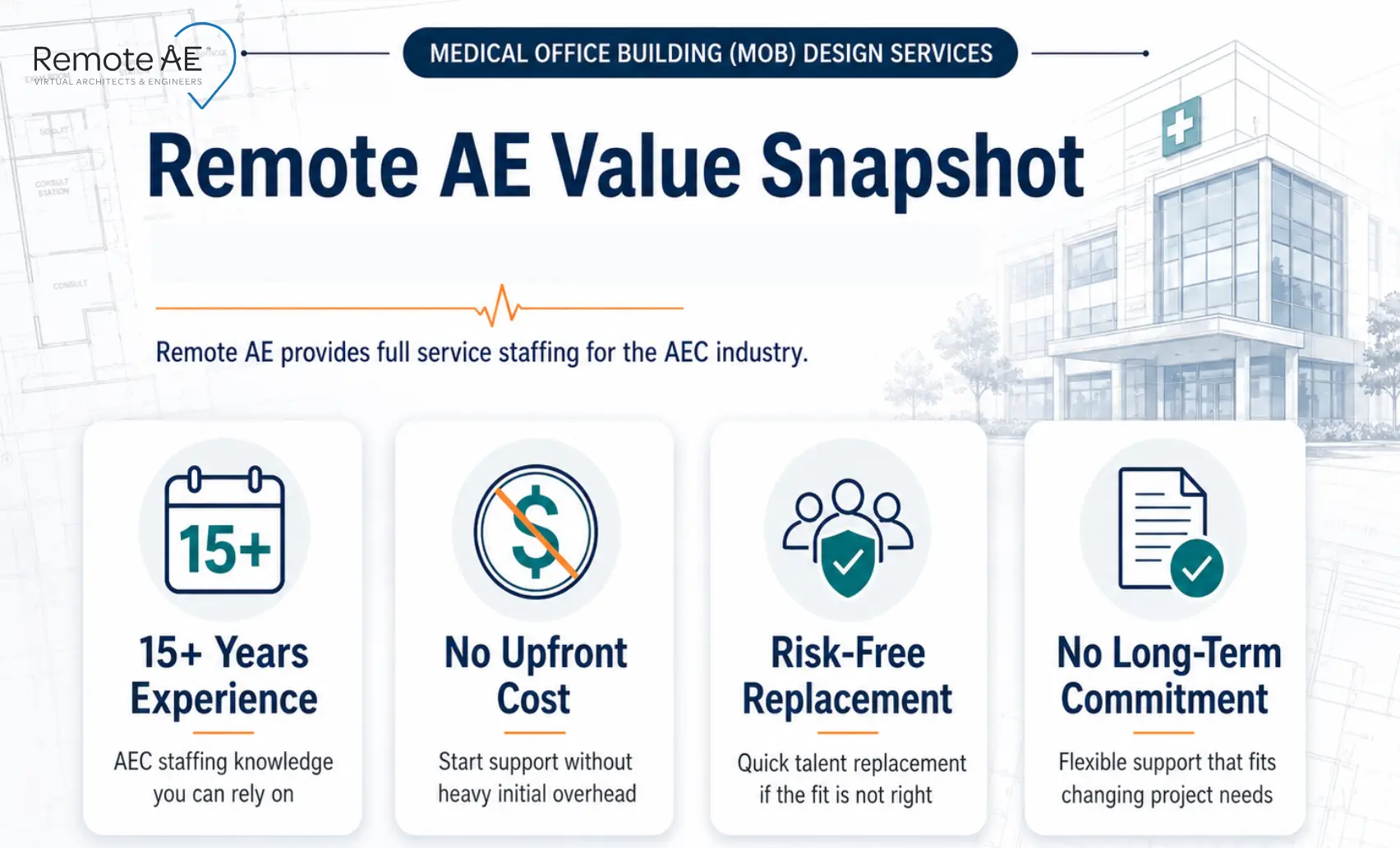
- More than 15 years serving the AEC industry
- Dedicated remote design staff, not freelancers
- Support across architecture, engineering, and construction teams
- Flexible staffing for MOB and healthcare projects
- Reliable production capacity built for deadline pressure
- Guaranteed quality and reliability
- No long-term commitment
- No upfront costs
- Risk-free replacement up to two virtual assistants
When Should You Hire Remote MOB Design Support?
Forty-five percent of AEC and construction firms report project delays tied directly to labor shortages (AGC, 2025). These three signs usually mean it’s time to bring in support.
- You Have a Drawing Deadline Coming Up: SD, DD, or CD package deadlines, permit deadlines, and client presentation dates don’t move. Remote support adds capacity without a hiring cycle.
- Your Senior Team Is Stuck Doing Drafting: When licensed architects spend their week drafting instead of designing, firms lose design time, delay client work, and risk burnout.
- You Need Healthcare Project Support Without a Full-Time Hire: Project-based demand, lower fixed overhead, faster onboarding, and flexible team size all favor remote support over a permanent new hire.
Ready to Add MOB Design Capacity?
Remote AE places vetted remote architects, engineers, and BIM specialists inside AEC firms handling medical office building, outpatient clinic, and ambulatory care projects. Share your scope, and Remote AE will match you with AEC-trained talent within two weeks. No upfront cost, and a risk-free replacement guarantee if the fit isn’t right.
Book a free consultation with Remote AE today to start scoping your remote MOB design support.
FAQs – Medical Office Building (MOB) Design Services
What is a medical office building?
A medical office building (MOB) is a facility used for outpatient healthcare services, such as clinics, physician offices, imaging, urgent care, labs, or specialty care. It is not always classified like a hospital; the exact occupancy depends on services, patient acuity, and local code review.
What are MOB design services?
MOB design services include space planning, exam room layouts, Revit/CAD drawings, accessibility coordination, MEP planning, equipment layouts, permit documents, and code coordination.
How is a medical office building different from a regular office building?
An MOB needs healthcare-specific planning: patient flow, exam rooms, infection control, medical gases, imaging needs, accessibility, privacy, and higher MEP coordination. A regular office usually focuses on workplace layout, not clinical operations or patient-care requirements.
Can remote architects or drafters support MOB design projects?
Yes. Remote teams can support Revit modeling, CAD drafting, redlines, room data sheets, equipment schedules, and permit documentation. Licensed architects and engineers still review the work and keep final responsibility for code, design, and approvals.
Can RemoteAE support Revit and CAD work for healthcare projects?
RemoteAE provides outsourced staffing for architecture, engineering, and construction firms, including skilled remote assistants for AEC workflows. For healthcare projects, remote staff can support Revit, CAD, documentation, and coordination, while your licensed team keeps project responsibility.