

Healthcare construction is one of the most complex and heavily regulated sectors in the AEC industry, and demand shows no sign of slowing. U.S. healthcare construction spending was about $46B in 2023, with spending shifting toward medical buildings and outpatient-oriented facilities.
For architecture firms managing hospital design, medical facility planning, and healthcare renovation projects, the documentation burden is significant. Revit BIM coordination, as-built drawing maintenance, construction documentation, and project coordination all compete for the same limited production hours. Healthcare architecture outsourcing gives AEC firms the drafting and BIM support to deliver more, faster, without compromising the licensed professional oversight that healthcare projects demand.
What Is Healthcare Architecture Outsourcing?
Healthcare architecture outsourcing means assigning selected design support, drafting, BIM, documentation, or coordination tasks to trained external AEC professionals. However, the licensed architect of record, healthcare planner, and clinical leadership retain full responsibility for design decisions, regulatory compliance, and professional accountability.
In practice, it looks like this:
- A remote Revit assistant updates exam room layouts after a clinical planning session, incorporating furniture clearances, door swings, and casework changes into the current BIM model
- A CAD drafter prepares construction drawing revisions after a coordination review, updating floor plans, reflected ceiling plans, and interior elevations from redlined PDFs
- A BIM modeler coordinates architectural models with MEP inputs, managing linked model updates, checking coordination views, and preparing clash review packages
- A project assistant tracks RFIs, submittals, and drawing logs, keeping the project administration current so the project architect can focus on design and clinical coordination
What It Is Not
Healthcare architecture outsourcing does not replace the roles and responsibilities that require licensed professional judgment, clinical expertise, and regulatory authority.
Remote production support is not a substitute for:
- The licensed Architect of Record, who stamps documents, interprets code, and carries professional liability
- Clinical planning leadership, which translates patient care operations into space and equipment requirements
- Authority Having Jurisdiction approval, which requires direct engagement between the firm’s licensed professionals and the reviewing agency
- Local code interpretation, particularly in healthcare, where state health departments, CMS conditions of participation, and The Joint Commission add regulatory layers beyond standard building codes
- Medical equipment vendor sign-off on room layouts, utility rough-ins, and equipment clearances
- Infection control leadership, which directs the Infection Control Risk Assessment process for construction in occupied facilities
This boundary is not a limitation of healthcare architecture outsourcing; it is the structure that makes it professionally sound.
Why Healthcare Architecture Projects Need Specialized Support
Hospitals Are Complex, High-Risk Buildings
Healthcare facilities operate 24 hours a day, seven days a week, under conditions that make construction and renovation uniquely challenging. Every design decision in a hospital or medical facility affects multiple interconnected systems.
Design complexity factors in healthcare architecture:
- Life safety requirements, egress, fire compartmentalization, and emergency power systems
- Sterile and non-sterile zone relationships, separation requirements for surgical, procedure, and support areas
- HVAC pressure relationships, positive and negative pressure rooms governed by ASHRAE 170 (Ventilation of Health Care Facilities)
- Medical gas routing, oxygen, medical air, vacuum, and specialty gas systems with strict clearance and access requirements
- Patient privacy, acoustic separation, visual privacy, and HIPAA-compliant space configuration
- Staff productivity, nursing unit layouts, clean and soiled utility routing, and supply chain flow
- Equipment-heavy rooms, imaging suites, operating rooms, and procedure rooms with specialized structural, electrical, and plumbing requirements
The Facility Guidelines Institute publishes the Guidelines for Design and Construction of Health Care Facilities, the primary reference document for healthcare facility planning used by architects, engineers, and AHJs across the United States. Every production task in a healthcare project must be executed within this regulatory and clinical framework.
Small Design Changes Can Affect Many Systems
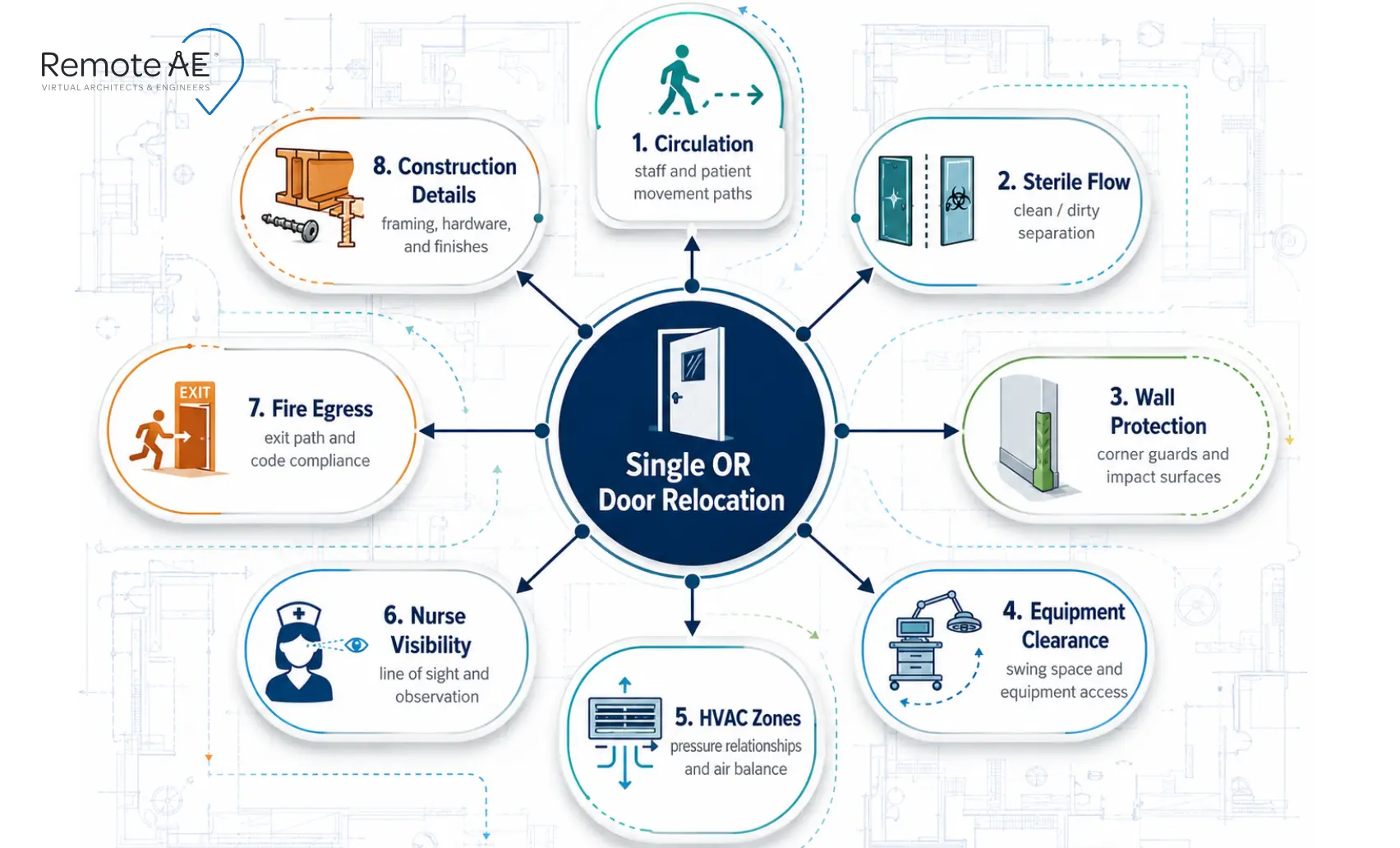
In a hospital, no design change is isolated. A single door relocation in an operating room may affect:
- Circulation, sterile corridor access, and cross-contamination risk
- Sterile flow, the path from sterile core to OR table
- Wall protection, door protection requirements, and impact resistance ratings
- Equipment clearance, C-arm positioning, boom placement, and equipment storage access
- HVAC zones, supply diffuser placement, and pressure relationship maintenance
- Nurse visibility, direct sight lines from scrub sink to OR entry
- Fire egress, corridor width compliance, and exit access continuity
- Construction details, head, jamb, and sill conditions for a hospital-grade door assembly
This interdependency is why healthcare architecture documentation quality matters so much, and why well-trained remote architect assistants, who understand how healthcare spaces work, deliver better output than generic drafters applied to the same tasks.
Documentation Quality Matters
Clean, coordinated construction documentation reduces every downstream cost in a healthcare project.
Well-maintained drawings and BIM models reduce:
- RFIs, contractors asking for clarification that a better drawing set would have answered
- Rework, field changes required because drawings did not reflect current coordination decisions
- Field delays, work stoppage while the design team resolves conflicts that should have been caught in coordination
- Permit issues, plan review corrections triggered by incomplete or inconsistent documentation
- Miscommunication between the architect, MEP consultants, contractors, and the healthcare owner’s facilities team
- Change orders and scope additions are driven by missing information in the issued construction documents
The American Society for Health Care Engineering (ASHE) and the AIA Academy of Architecture for Health both emphasize the quality of coordination as a primary driver of successful healthcare project delivery.
Outsourced production support that keeps drawings current and coordinated throughout the project lifecycle directly reduces these costs.
Hospital and Medical Facility Design Services That Can Be Outsourced
CAD Drafting and Drawing Production
CAD drafting is the highest-volume, most clearly delegatable production task in healthcare architecture, and one where trained remote support delivers immediate time savings.
- Floor plans, room layout updates, partition changes, and department reorganization
- Reflected ceiling plans, ceiling grid coordination with HVAC, lighting, and medical gas outlets
- Interior elevations, casework, equipment alcoves, and wall protection details
- Finish plans, flooring, wall, and ceiling finish zones updated for infection control compliance
- Door and hardware schedules, hardware group assignments, and door type coordination
- Life safety plan support, egress path updates, and fire compartment boundary documentation
- Markup conversion, translating redlines and Bluebeam markups into updated AutoCAD drawings
- As-built drawing updates, incorporating field changes into the current record set
Revit Modeling and BIM Support
Healthcare BIM outsourcing covers the full range of Revit model maintenance tasks that consume project team hours without requiring licensed architect judgment.
- Model setup support, Revit template configuration, workset structure, and linked model organisation
- Existing conditions modeling, documenting current facility conditions from field measurements and legacy drawings
- Family placement, medical equipment families, casework, and specialty fixture placement per equipment lists
- Room data updates, updating room names, numbers, and parameters after clinical planning revisions
- Sheet setup, creating, organising, and maintaining the Revit sheet set across design phases
- View templates, applying, and updating view templates for a consistent drawing presentation
- Clash review support, preparing coordination views, and exporting clash detection packages
- Model cleanup, purging unused elements, correcting warnings, and maintaining model health
- Coordination exports, IFC exports, linked model updates, and consultant coordination packages
Construction Documentation Support
Healthcare construction documents require exceptional coordination across architecture, MEP, structural, and medical equipment disciplines, and the production workload is significant.
- SD, DD, and CD drawing updates, incorporating design decisions at each phase transition
- Detail drafting, wall sections, head/jamb/sill conditions, and healthcare-specific construction details
- Sheet indexing, maintaining a current drawing index across all disciplines and phases
- Drawing coordination, cross-referencing architectural drawings with consultant drawings for consistency
- Revision clouds, marking changes on updated sheets with correct revision sequencing
- Consultant markup incorporation, updating architectural drawings from structural and MEP consultant markups
- Issue set preparation, compiling, naming, and organising drawing sets for permit, coordination, and construction issues
Healthcare Space Planning Support
Remote architect assistants can document and test space planning options across the full range of medical facility design program types.
- Exam rooms and treatment rooms, clearance verification, equipment placement, and accessibility compliance
- Waiting areas, seating capacity, visibility, and patient flow studies
- Nurse stations and team work areas, proximity analysis, and staff circulation options
- Imaging areas, equipment clearance zones, radiation shielding room boundaries, and utility requirements
- Labs, pharmacies, and procedure rooms, workflow layouts, and utility coordination zones
- Outpatient centers and ambulatory surgery centers, department adjacency options, and phasing studies
Project Coordination and Admin Support
Healthcare projects generate a continuous stream of administrative coordination tasks that consume project team time without requiring senior design judgment.
- Drawing logs, maintaining current issue status for all drawings across all disciplines
- RFI tracking, logging, routing, and following up on open requests during construction administration
- Submittal logs, maintaining the register from receipt through architect review and contractor return
- Meeting notes, documenting decisions, and action items from clinical, design, and construction meetings
- Vendor coordination, collecting and organizing medical equipment data, product submittals, and installation requirements
- Permit checklist support, assembling and organizing permit application packages for AHJ submission
- Document control, enforcing naming conventions and folder structure across the full project file system
Where Outsourcing Helps Most in Healthcare Architecture
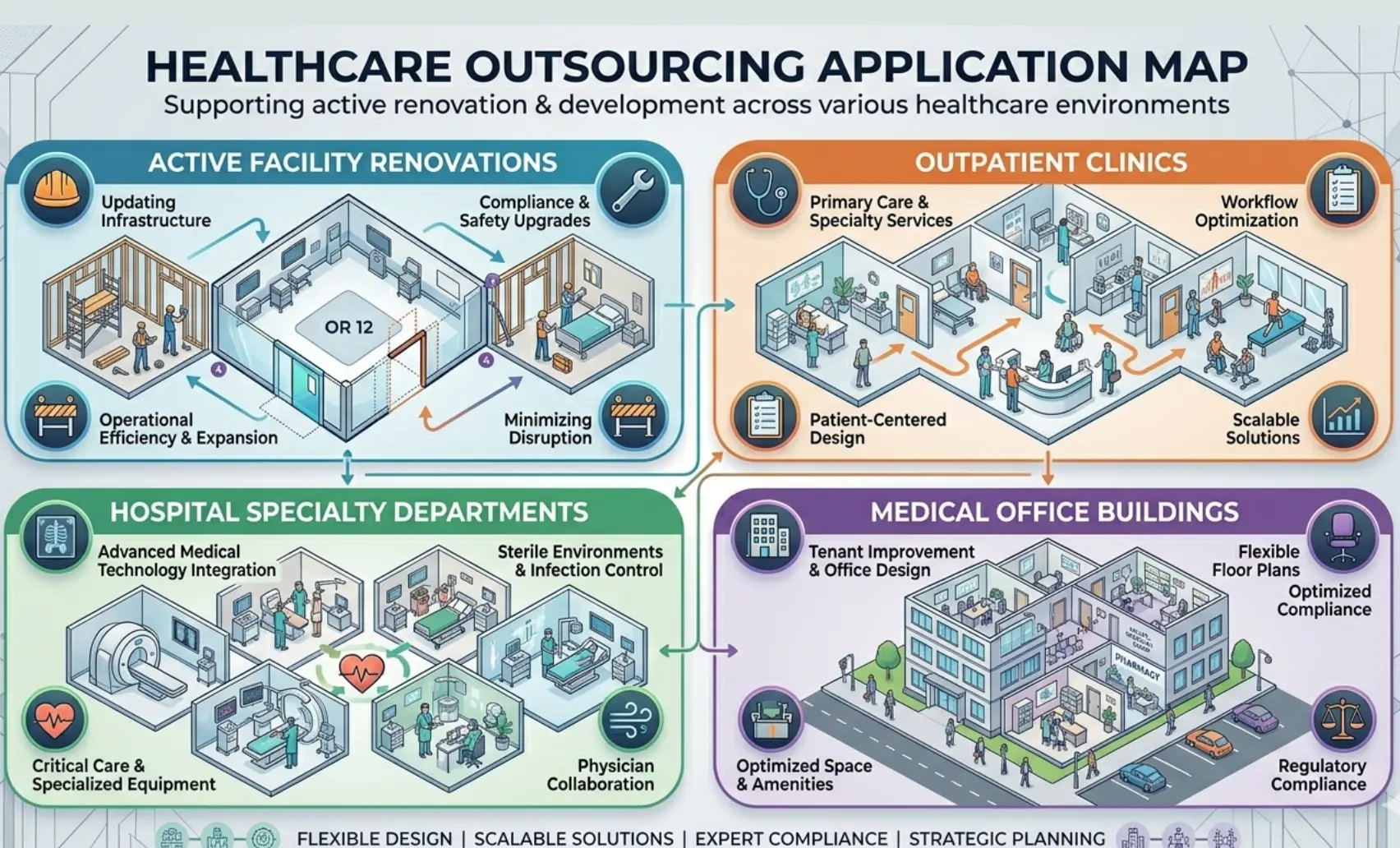
Renovations in Active Healthcare Facilities
Active facility renovations are the most operationally demanding healthcare project type, and the one where outsourced drafting support delivers the clearest time savings.
- Phasing plans, documenting construction phases that maintain patient care operations throughout the project
- Existing condition drawings, as-built documentation from field measurements, laser scans, and legacy drawings
- Department relocation diagrams, mapping temporary department locations during renovation phases
- Night and weekend update needs, incorporating field changes from weekend construction into Monday morning drawings
- Quick response to field changes, the Infection Control Risk Assessment process for active facility construction requires fast drawing updates when construction scope or barrier locations change
Outpatient Clinics and Urgent Care Centers
Outpatient and urgent care projects often involve multiple locations, repeatable room templates, and fast permit timelines, making them well-suited for remote drafting support.
- Repeatable room templates, standard exam rooms, treatment rooms, and waiting areas adapted for each location
- Fast rollout schedules, multiple simultaneous permit packages across different jurisdictions
- Brand standards, consistent finish selections, casework configurations, and signage placement
- Permit-ready drawings, organised, coordinated drawing sets formatted for AHJ submission
- Multi-location updates, applying design changes consistently across all sites in a rollout program
Hospitals and Specialty Departments
Large hospital projects and specialty department renovations generate the highest documentation volume in healthcare architecture.
- ICU and critical care, complex HVAC pressure relationships, medical gas density, and equipment-heavy layouts
- Emergency departments are fast-paced clinical environments with high security, triage, and trauma room requirements
- Operating rooms and procedure suites, sterile flow, boom coordination, and specialty lighting and ceiling systems
- Imaging suites, radiation shielding, equipment clearance, and heavy utility coordination
- Behavioral health and rehabilitation, specific door hardware, ligature resistance, and program layout requirements
Medical Office Buildings
Medical office building tenant improvements and fit-outs generate steady, recurring production work well suited to remote support.
- Tenant fit-outs, partition layouts, casework, and finish plans for medical tenant spaces
- Accessibility updates, ADA compliance reviews, and barrier-free path of travel documentation
- MEP coordination, architectural reflected ceiling plans coordinated with mechanical and electrical consultant drawings
- Lease area studies, measuring and documenting rentable area calculations per BOMA or lease standards
- Space test-fits, evaluating multiple layout options for a prospective tenant before design commitment
Benefits of Outsourcing Healthcare Architecture Support
More Production Capacity Without Long Hiring Delays
Healthcare architecture firms managing multiple active projects need production support that scales with project workload, not a fixed staffing model that lags behind demand spikes.
A dedicated remote architect assistant from Remote AE can be onboarded and contributing to live project tasks within days, faster than any local recruitment cycle for an experienced healthcare drafter.
That speed matters when a permit submission deadline is three weeks out, and the project team is already at capacity.
Better Use of Senior Architects’ Time
The most valuable hours in a healthcare architecture firm belong to the professionals who can do what only they can do: lead clinical coordination, manage AHJ relationships, resolve design conflicts, and carry professional accountability.
Senior staff should focus on:
- Client decisions and owner communication
- Design leadership and clinical coordination
- Risk review and code strategy
- AHJ negotiation and regulatory navigation
- QA/QC sign-off on issued documents
Remote assistants can support:
- Drafting updates and redline incorporation
- Revit modeling and sheet maintenance
- Drawing schedule and log updates
- Coordination package preparation
- Construction administration documentation
More Predictable Staffing Costs
Remote AE’s dedicated full-time model provides consistent, predictable weekly support without the overhead of a permanent hire, no benefits, no payroll taxes, no workstation costs, and no fixed commitment through quiet project periods.
- Full-time dedicated assistant, one consistent remote architect assistant integrated into the firm’s workflow
- Fixed weekly pricing, predictable cost that the firm can allocate directly to active projects
- No long-term commitment, engage per project phase or as ongoing production support
- Replacement support, Remote AE replaces the placement if the fit is not right, without restarting the hiring process
Faster Drawing Updates and Model Maintenance
Healthcare design cycles move fast; clinical planning revisions, coordination updates, and regulatory comments all generate drawing changes that need to be incorporated quickly to keep the project moving.
A trained remote architect assistant who knows the project’s Revit template, drawing standards, and coordination history can incorporate a markup set faster than a new freelancer learning the project from scratch. Continuity of context produces faster, more accurate drawing updates.
Better Project Control Than Random Freelancing
The difference between a freelance drafter hired for isolated tasks and a dedicated remote architect assistant is context, continuity, and accountability.
- Random freelancer: Task-by-task engagement with no project context, limited quality control, and no onboarding into the firm’s drawing standards or healthcare project conventions
- Remote AE model: Vetted assistant with AEC industry background, full-time dedicated support, structured onboarding into the firm’s tools and standards, and ongoing quality oversight with replacement protection
How Remote Healthcare Architecture Support Fits Into Your Team
Recommended Team Structure
Remote architect assistants integrate into an existing healthcare architecture team, not as a replacement layer, but as a production support layer beneath the licensed professionals who own design decisions and professional accountability.
A practical team structure for a healthcare project with remote support:
- Principal / Project Director: Client relationships, firm strategy, and project oversight
- Healthcare Architect / Medical Planner: Clinical coordination, programming, and department planning
- Architect of Record: Code compliance, professional liability, and AHJ relationships
- Project Architect: Design development, coordination management, and drawing set oversight
- BIM Manager: Model standards, coordination platform management, and consultant integration
- Remote Architect Assistant: Revit updates, CAD drafting, sheet maintenance, and documentation support
- Remote BIM/CAD Support: Model cleanup, coordination exports, schedule updates, and as-built documentation
- MEP / Structural Consultants: Discipline-specific design and engineering, coordinated with the architectural team
This structure keeps judgment at the top and production at the base, which is exactly where remote support delivers the most value.
What to Assign in the First 30 Days
Start with well-defined, reviewable production tasks that build confidence in the remote assistant’s quality before expanding the scope.
Start with:
- Redline drafting, incorporating markup sets into current Revit or AutoCAD drawings
- Existing drawing cleanup, correcting layer assignments, updating room names, and purging outdated elements
- Room tag updates, updating room numbers, names, and parameters after clinical planning revisions
- Sheet setup, creating new sheets, populating title blocks, and organising view placement
- Schedule updates, door, finish, and equipment schedules updated from confirmed design decisions
- Markup conversion, translating Bluebeam-marked PDFs into updated drawing files
Then move into:
- Room layout options, space planning studies for exam rooms, nurse stations, and support spaces
- DD and CD drawing support, coordinated drawing updates across design development and construction document phases
- Coordination updates, architectural drawings updated from MEP and structural consultant markups
- As-built revisions, incorporating field changes into the record document set during construction administration
How to Onboard a Remote AEC Assistant
A structured onboarding process prevents the most common remote assistant failures, such as unclear expectations, inconsistent output quality, and wasted revision cycles.
Five-step onboarding process for healthcare projects:
- Step 1: Define the healthcare project type: hospital renovation, outpatient clinic, medical office building, or specialty department. Context shapes how the assistant interprets every drawing and coordination task.
- Step 2: List software requirements, Revit version, AutoCAD release, Bluebeam markup conventions, and any project-specific tools or platforms
- Step 3: Share drawing standards, the firm’s Revit template, CAD layer standards, sheet naming conventions, and healthcare-specific drawing protocols
- Step 4: Assign a small test package, a defined set of redlines, or schedule updates that let the project architect evaluate the assistant’s output quality before live project tasks are assigned
- Step 5: Set review and communication rules, who gives instructions, who reviews output, how corrections are communicated, and what the weekly delivery cadence looks like
What to Look for in a Healthcare Architecture Outsourcing Partner
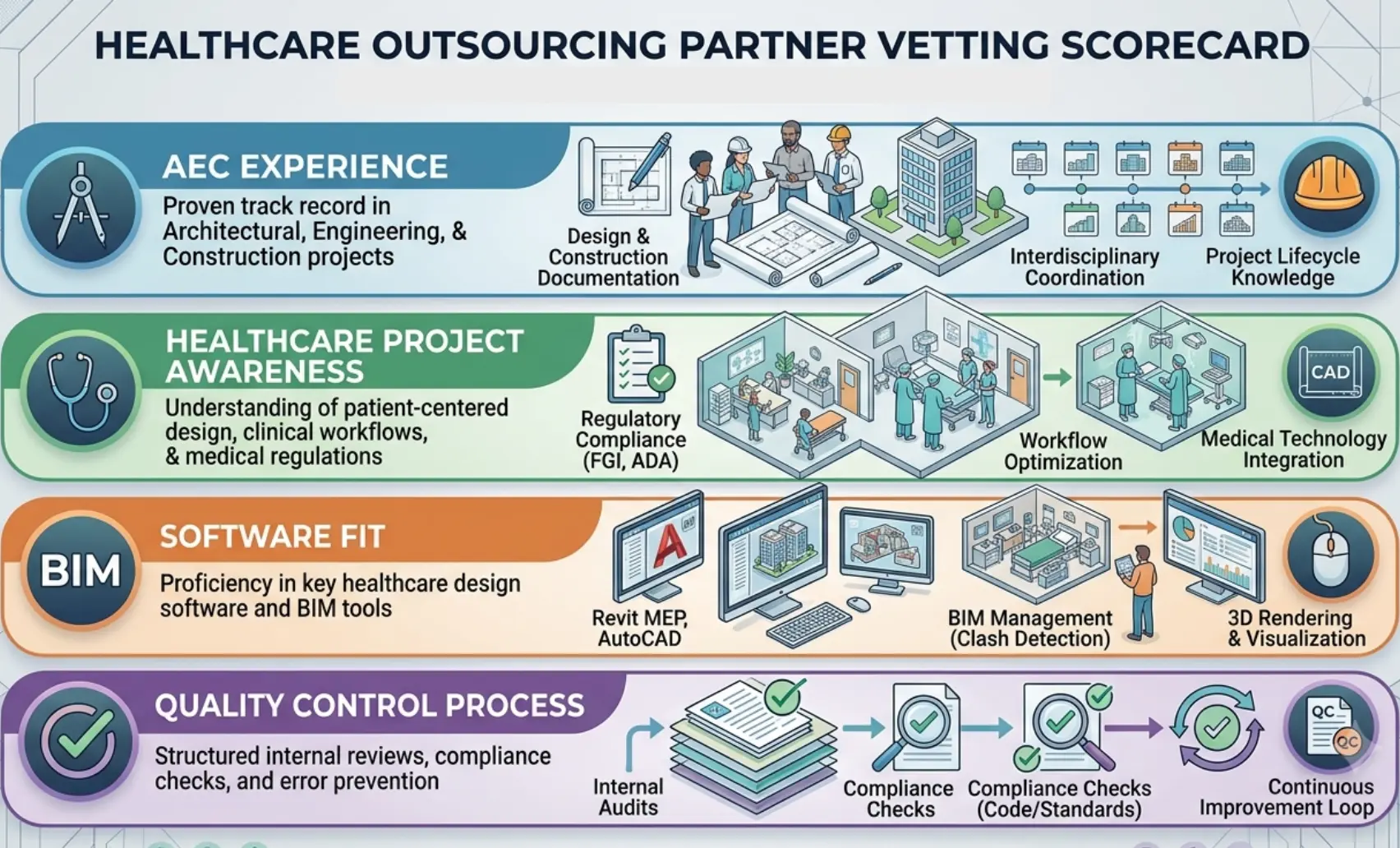
AEC-Specific Experience
A generic virtual assistant experience is not enough for healthcare architecture production. Verify:
- Architecture background with construction documentation experience across SD, DD, CD, and CA phases
- Revit and CAD proficiency, confirmed through a test task, not a self-reported skill list
- Willingness to follow firm templates, drawing standards, and QA conventions from day one
Healthcare Project Awareness
AEC experience is the baseline. Healthcare familiarity is what separates a productive assistant from one who creates rework.
Look for awareness of:
- Patient flow, staff circulation, and public versus clinical zone separation
- Medical equipment coordination and how equipment lists affect room layouts
- Infection Control Risk Assessment implications in construction drawings
- MEP coordination demands in operating rooms, imaging suites, and procedure spaces
Software Fit
Confirm proficiency before engagement:
- Revit, BIM modeling, and sheet production
- AutoCAD, CAD drafting, and markup conversion
- Bluebeam, PDF redline review and annotation
- Navisworks, clash detection support
- BIM 360 / Autodesk Construction Cloud, cloud model sharing
- Microsoft Teams / SharePoint, communication, and file management
Quality Control Process
Ask these before placing any assistant on a live healthcare project:
- How are candidates screened for technical and healthcare-specific skills?
- Can the firm interview candidates and make the final selection?
- Who supports onboarding, the provider or the firm alone?
- What is the replacement process if the fit is not right?
- Is the assistant dedicated full-time to our team only?
Why Remote AE Is a Strong Fit for Healthcare Architecture Support
Built for AEC, Not Generic Admin
Remote AE staff exclusively for architecture, engineering, and construction firms. Every remote architect assistant placed by Remote AE has genuine AEC production experience. An understanding of construction documentation phases, Revit BIM workflows, drawing coordination standards, and the professional context of healthcare facility planning.
Generic virtual assistant platforms cannot replicate this. A drafter who has never worked on a hospital floor plan will not recognize the difference between a clean and a soiled utility corridor, or why that distinction matters on every drawing they touch.
Vetted Architecture and Engineering Assistants
Remote AE’s placement process is built around professional qualification, not general availability.
- Minimum 5 years of industry experience per placement; every assistant carries a verified AEC production background
- Full-time dedicated support, one consistent assistant working exclusively for the client firm
- Candidate interviews, the firm interviews shortlisted candidates, and makes the final selection
- Structured remote onboarding, transition meeting, tool access confirmation, and check-ins during the first 30 days
- Guaranteed quality and reliability: Deliverables meet the firm’s defined standards, or issues are resolved immediately
- No upfront costs: Consult without financial obligation, no cost until the contractual phase begins
- Risk-free replacement: Up to two placements can be replaced in year one if the fit is not right
Services Aligned With Healthcare Project Needs
Remote AE’s service scope maps directly to the production tasks that healthcare architecture projects generate most consistently:
- Drafting and design support: CAD floor plans, Revit updates, redline incorporation, and detail drafting
- BIM and 3D modeling: Revit model maintenance, family placement, clash review support, and coordination exports
- Construction documentation: SD, DD, and CD drawing updates, sheet indexing, and issue set preparation
- Permitting support: Drawing package organisation, checklist compliance, and AHJ submission preparation
- Project coordination: RFI logs, submittal tracking, meeting notes, and document control
- Estimating and takeoffs: Quantity support for healthcare renovation scopes and tenant improvements
Every service category aligns with a real production need that healthcare architecture firms face across hospital design, medical facility planning, outpatient clinic rollouts, and active facility renovations.
Add Healthcare Architecture Production Support Without the Hiring Risk!
Your licensed architects should be leading clinical coordination, managing AHJ relationships, and driving design decisions, not updating Revit room tags and incorporating redlines at the end of a long project day.
Remote AE places dedicated remote architect assistants, remote engineering assistants with genuine AEC production experience. Ready to support your healthcare architecture projects across Revit BIM, CAD drafting, construction documentation, and project coordination from week one.
Book a Free Consultation With Remote AE, No Obligation, No Upfront Cost!
FAQs – Healthcare Architecture Outsourcing
Can hospital design work be outsourced safely?
Yes, with NDAs, secure CDE access, and QA procedures. Firms commonly outsource production while keeping clinical planning and responsibility in-house.
What hospital design tasks can a remote architectural assistant support?
They can assist with Revit modeling, redlines, sheet setup, room data sheets, and permit documentation. Clinical workflows and design decisions remain with the architect of record.
Can Revit modeling for healthcare facilities be outsourced?
Yes. Remote teams can model hospitals, clinics, and medical office buildings in Revit. They work within your templates, standards, and BIM execution plan.
Is outsourcing suitable for active hospital renovation projects?
Yes, especially for documentation, as-builts, and coordination support. Sensitive phasing and patient-care decisions should remain with the core team.
What should not be outsourced in healthcare architecture?
Do not outsource stamping, code interpretation, clinical planning, or major design decisions. These should stay under the responsible licensed architect.