


MEP engineering firms face one of the most uneven workload profiles in the AEC industry. Project phases create extreme drafting demand spikes, then taper off completely between milestones. Yet most small MEP engineering firms staff for average demand, not peak demand. According to the Bureau of Labor Statistics, employment in mechanical and electrical engineering services has grown steadily since 2024, but small firms consistently report that finding qualified drafters is one of their top operational constraints. A dedicated remote engineering assistant who handles Revit MEP production, CAD drafting, equipment schedules, and calculation documentation gives small MEP firms the drafting capacity to handle project surges, without adding fixed staffing costs they cannot sustain between peaks.
Why Small MEP Firms Run Out of Drafting Capacity So Quickly
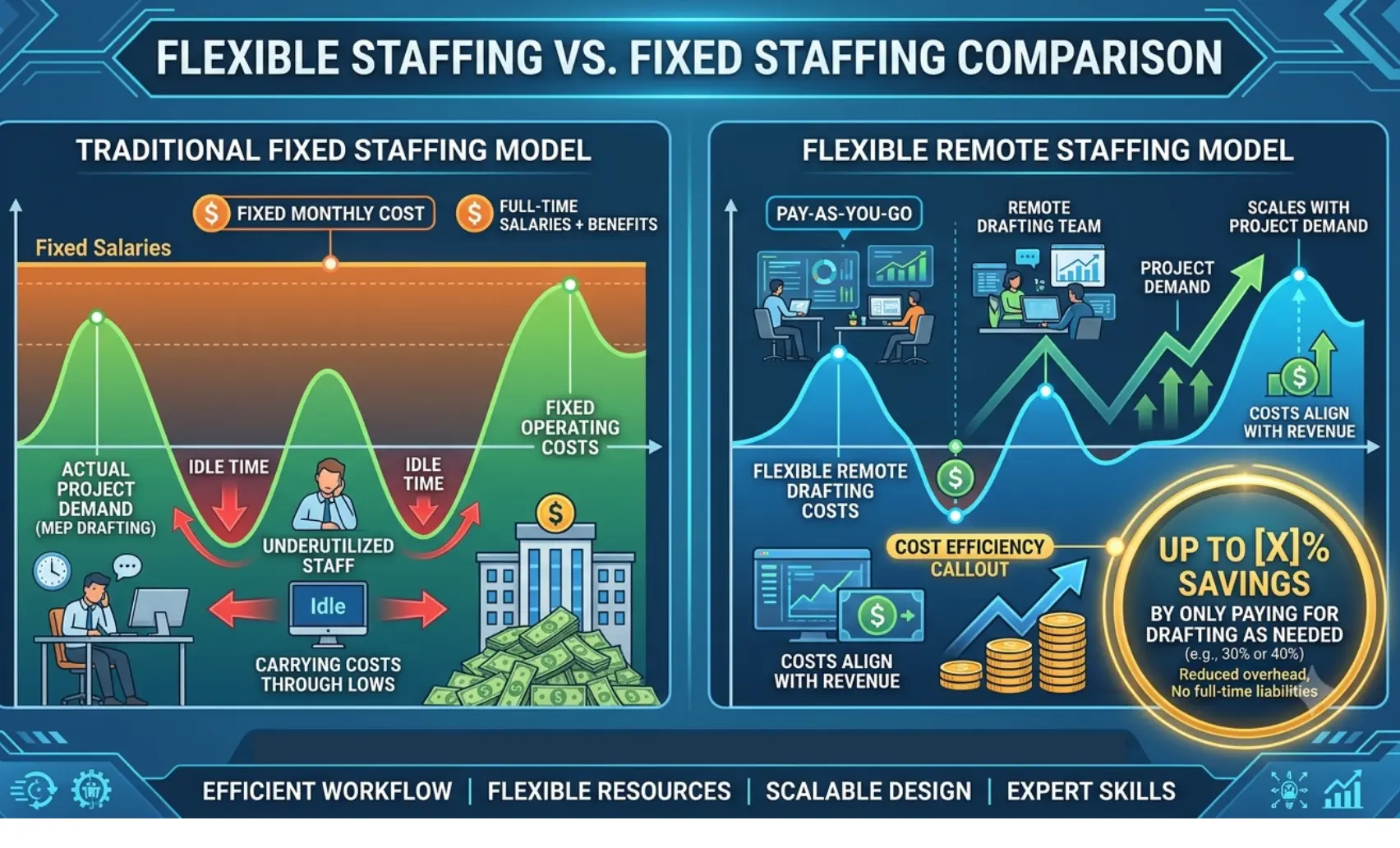
Project Flow Is Lumpy, But Payroll Is Fixed
MEP drafting work does not arrive in a steady stream. It arrives in concentrated bursts tied to design phases, and the volume swings between phases are significant.
- Schematic design generates preliminary system layouts and equipment locations
- Design development requires fully coordinated HVAC plans, duct layouts, pipe layouts, and electrical distribution drawings
- Construction documents demand complete, permit-ready sheet sets across mechanical, electrical, and plumbing systems simultaneously
- IFC drawings and permit sets require coordinated drawing packages that move quickly from issue to response cycles
- Construction administration generates redline markups, shop drawing reviews, and as-built updates on an irregular but ongoing basis
Full-time hiring works best when the drafting demand is stable. For small MEP engineering firms managing two to eight projects simultaneously, each at different phases, the demand profile is rarely stable enough to justify a permanent drafter at full capacity.
A Single Deadline Can Overload the Whole Team
On an active project, a single coordination round or milestone issue date can generate a week’s worth of drafting work across every discipline simultaneously.
Common deadline overload scenarios for small MEP firms:
- Mechanical plans need redline updates after a structural coordination meeting
- Electrical panel schedules need to be cleaned up before the permit set is issued
- Plumbing risers need detail edits after a plumbing fixture change
- Coordination backgrounds change late, the structural model updates, and every MEP drawing set needs revision
- Calculation reports need formatting before the PE review package is submitted
Each item is individually manageable. All of them arriving simultaneously is not.
The Real Bottleneck Is Often Production, Not Engineering Skill
The small MEP firm does not lack design knowledge. The principal engineer understands the HVAC system, knows how to size the duct, and has the electrical load calculations done. The bottleneck is the volume of production tasks required to translate that engineering into a permit-ready drawing set.
When production bottlenecks build, the options are limited: the licensed engineer absorbs the drafting work, the team works overtime, or deliverables slip. None of these is a sustainable strategy across a growing project portfolio.
The Real Capacity Problem: Engineers Spending Time on Drafting Tasks
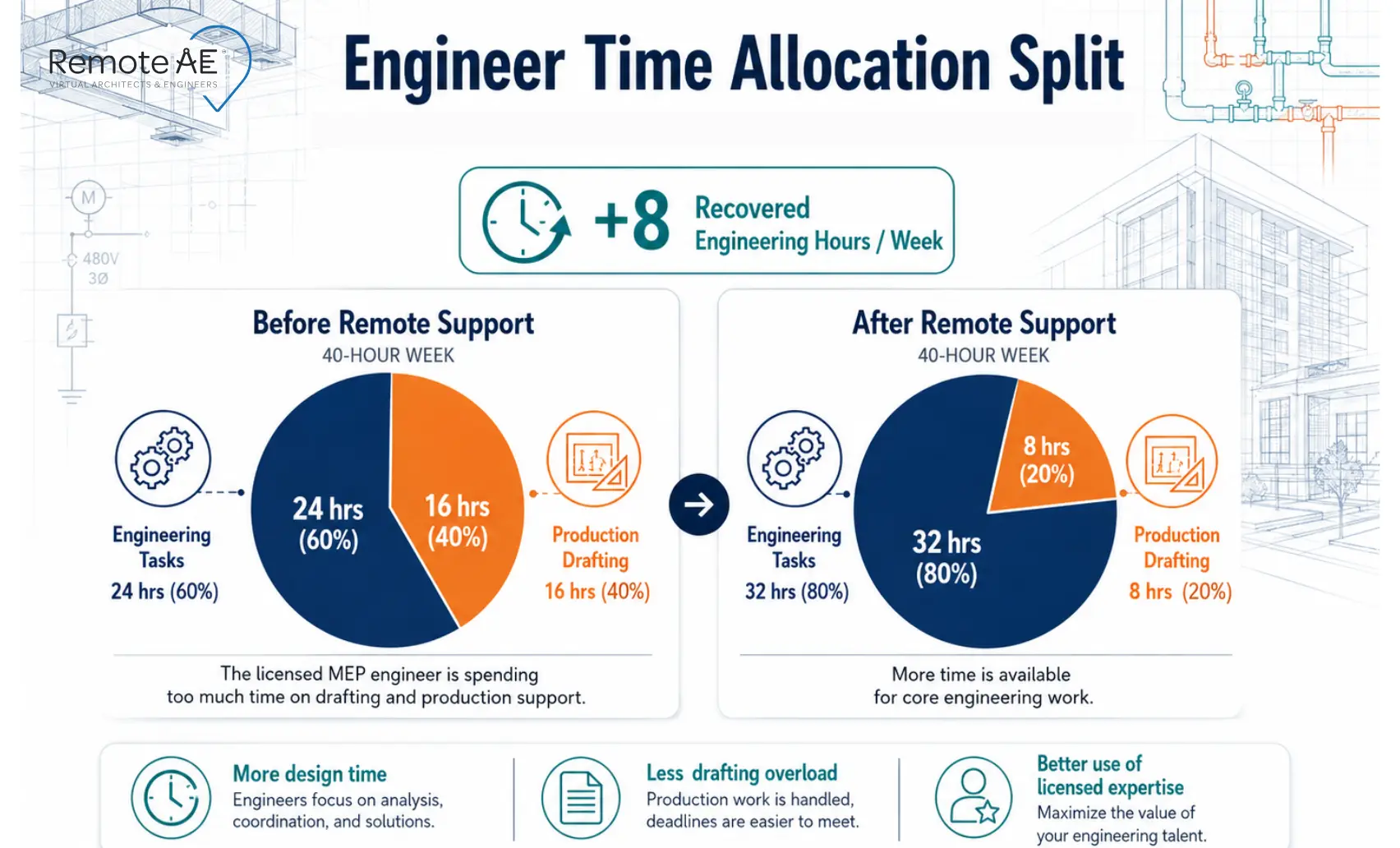
High-Value Engineers Are Often Pulled Into Production Work
In a small MEP engineering firm without dedicated drafting support, production work gravitates toward whoever has the technical knowledge to do it correctly, which is usually the licensed engineer.
Tasks that pull engineers into production work:
- Revising HVAC plans after coordination comments
- Updating redline markups in Revit MEP or AutoCAD
- Preparing sheet sets for permit submission
- Coordinating drawing packages with the architectural and structural teams
None of these tasks requires a PE to perform. All of them take a PE away from the work that only a PE can do.
Drafting Overload Slows Down Higher-Value Engineering Work
When the production queue builds, the downstream effects compound quickly.
- Design reviews are delayed because the engineering team is tied up updating drawings from the last coordination round
- Client responses slow down because there is no bandwidth to respond to RFIs or review submittals
- Context switching increases, and engineers moving between Revit MEP production and engineering calculations lose focus in both directions
- QA/QC time shrinks, drawing sets go out with less review because the deadline does not move
- Submission pressure increases as the team tries to recover lost time in the final days before the issue
$80–$100/hr engineering time should not be spent on every sheet update.
What Happens When Engineers Become Drafters
The consequences of sustained production overload in a small MEP firm are both operational and financial.
- Reduced engineering productivity, licensed engineers produce fewer engineered designs per week when drafting tasks fill their schedule
- Slower project delivery, milestones slip when the production queue exceeds available hours
- Less time for client communication and design decisions, the relationship-building and technical judgment that generate repeat work get deprioritised
- Increased burnout risk, engineers working full production days followed by drafting cleanup in the evenings, is not sustainable in any practice size
Community Pain Point: Engineers Are Already Talking About This
MEP engineers widely discuss the reality of handling their own production work. Many note that Revit MEP and BIM coordination have blurred the line between engineering and drafting; engineers now produce models they previously would have handed off to a dedicated drafter. Others express concern that outsourced MEP drafting creates excessive review work when drawing standards and QA/QC expectations are not clearly defined upfront.
The answer is not “send everything out.” The answer is to delegate the right production tasks, repetitive, well-defined, and reviewable, with a structured QA process that keeps the licensed engineer in control of quality and professional responsibility.
 What MEP Drafting Tasks Can Remote Support Handle?
Remote support can tackle these tasks easily:
Revit MEP Support
Revit MEP is the BIM software used to model, analyze, and iterate mechanical, electrical, and plumbing systems, enabling engineers to produce coordinated, data-rich construction documents directly from the engineering model.
A remote engineering assistant with Revit MEP proficiency handles:
- View setup, creating plan views, section views, and detail callouts organized by discipline and phase
- Sheet setup, populating title blocks, organizing view placement, and maintaining the sheet index
- Model updates, incorporating design changes, coordination revisions, and engineer-directed system modifications
- Equipment placement, locating mechanical equipment, electrical panels, and plumbing fixtures in the model per the engineer’s direction
- Family placement, inserting and configuring MEP families for diffusers, fixtures, devices, and equipment
- Annotation cleanup, dimensions, tags, notes, and callouts updated after model revisions
- Revit schedules, equipment schedules, panel schedules, fixture schedules, and device schedules were extracted and formatted
- Coordination backgrounds, linked architectural and structural model management within the MEP model
- Linked model updates, updating and managing model links after the coordination round revisions
CAD Drafting and Redline Updates
AutoCAD remains widely used for MEP details, standard sheets, and legacy project work, and redline incorporation is one of the highest-volume repeatable tasks in any MEP practice.
- AutoCAD markup incorporation, updating DWG files from the engineer or consultant redlines
- PDF redline updates, converting Bluebeam-marked PDF comments into updated CAD or Revit drawings
- Layer cleanup, correcting layer assignments, purging unused layers, and enforcing CAD standards
- Detail updates, modifying standard and project-specific details after design or code review
- As-built updates, incorporating field-marked drawings into the record set
- Standard detail sheets, maintaining and updating the firm’s standard MEP detail library
Calculation Documentation
Calculation documentation is not engineering; it is the organized, formatted presentation of engineering outputs. It is time-consuming, repetitive, and entirely delegatable.
- Formatting calculation packages, organizing load calculation outputs, backup sheets, and supporting data into a consistent, PE-review-ready format
- Preparing backup sheets, compiling assumptions, reference data, and code citations that support the engineer’s calculations
- Organizing load calculation outputs, mechanical load calculations, electrical load calculations, and plumbing fixture unit calculations, formatted consistently
- Creating consistent naming, calculation file naming aligned with the project’s document control convention
- Building calculation trackers, maintaining a log of completed, pending, and revised calculations across active projects
Equipment Schedules and Details
Equipment schedules are among the most time-consuming production tasks in MEP documentation, and among the most clearly delegatable once the engineer has confirmed the equipment selections.
- HVAC equipment schedules, AHU, RTU, VAV, fan coil unit, and exhaust fan schedules with capacities, efficiencies, and model numbers
- Diffuser and grille schedules, supply, return, and exhaust air device schedules with airflow quantities and locations
- Plumbing fixture schedules, fixture types, flow rates, and connection sizes organized by building zone
- Electrical panel schedules, panel designations, circuit lists, breaker sizes, and load summaries formatted for permit submission
- Lighting schedules, fixture types, lamp specifications, mounting heights, and control zone assignments
- Detail references and tags, confirming that every schedule item references the correct detail sheet and keynote
Coordination and Submittal Support
MEP coordination and construction administration generate a continuous stream of documentation tasks that do not require senior engineering judgment.
- Clash issue lists, organizing, and tracking clash detection findings from Navisworks or BIM coordination sessions
- Submittal logs, maintaining the submittal register from receipt through engineer review and contractor return
- RFI support, logging open RFIs, tracking response status, and organizing reference drawings and specifications for engineer response
- Drawing and specification cross-checks, confirming that drawing notes and details are consistent with the project specification sections
- Vendor data organisation, collecting, sorting, and filing equipment submittals and product data sheets for engineer review
What Should Stay With the Licensed Engineer?
Design Decisions
These responsibilities belong exclusively to the licensed engineer, and a well-structured remote drafting engagement never blurs this line.
- System selection, choosing between HVAC system types, electrical distribution configurations, and plumbing system layouts based on engineering judgment and project requirements
- Equipment sizing judgment, mechanical load analysis, electrical demand calculations, and plumbing fixture unit counts require PE-level engineering analysis
- Code interpretation, applying energy codes, mechanical codes, electrical codes, and plumbing codes to the specific project conditions
- Energy strategy, decisions about system efficiency, renewable integration, and code compliance pathways
- Owner requirement decisions, translating client operational needs and budget constraints into engineering system decisions
Final Review and Stamping
Remote support prepares and updates drawing sets; the licensed engineer reviews, approves, and stamps them where required by the applicable jurisdiction and professional licensing standards.
- The remote engineering assistant produces the drawing, updates the schedule, or formats the calculation package
- The licensed engineer reviews the output against design intent, code compliance, and coordination requirements
- The PE reviews, approves, and stamps documents requiring professional certification
- This division protects both the quality of the engineering product and the firm’s professional liability position
Client-Facing Engineering Judgment
Some functions require the engineer’s direct involvement, not because they are technically complex, but because they carry professional responsibility that cannot be delegated.
- Explaining design intent to owners, contractors, and reviewing agencies
- Defending calculations and design decisions during plan review or AHJ comment response
- Resolving major scope changes that require engineering re-evaluation
- Handling AHJ comments that involve code interpretation rather than drawing corrections
The defining principle: Remote MEP drafting support extends production capacity; it does not replace engineering responsibility. The licensed engineer remains accountable for every drawing that bears their seal, regardless of who produced the underlying production work.
How Flexible Drafting Support Helps Firms Handle Project Surges
Scaling Up During Busy Periods
Project surges are predictable in MEP engineering, construction document phases, permit submission deadlines, and IFC drawing issues, all of which create a concentrated demand for drafting that exceeds normal team capacity.
- A remote engineering assistant can be onboarded from Remote AE and contributing to active Revit MEP production within days, faster than any local recruitment cycle
- Additional drafting capacity during the CD and permit phases means the firm can meet submission deadlines without overtime or quality compromise
- Faster turnaround during critical project phases protects the firm’s reputation with architects, developers, and contractors who measure professionalism by delivery consistency
Scaling Back When Work Slows Down
The inverse of a drafting surge is equally real, and it is where fixed staffing cost becomes a financial liability.
- A full-time local drafter carries a salary, benefits, and overhead through every quiet week between project phases
- Remote drafting support scales with actual project demand; the firm is not paying for capacity it is not using
- Avoiding underutilised payroll expenses during slower periods improves project margins and gives the firm more financial flexibility for the next growth phase
Supporting Short-Term and Long-Term Projects
Remote MEP drafting support is not a one-size model; it adapts to what the firm actually needs.
- Temporary project assistance: A sprint of Revit MEP modeling, equipment schedule cleanup, or permit set formatting for a specific deadline
- Ongoing production support: A consistent weekly allocation of drafting capacity across all active projects, sheet updates, redline incorporation, and schedule maintenance running continuously
- Dedicated remote team members: A full-time remote engineering assistant integrated into the firm’s production workflow long-term, learning Revit templates, CAD standards, and project coordination preferences
How Remote AE Helps Small MEP Firms Expand Capacity Without Expanding Payroll
Remote AE staff exclusively for architecture, engineering, and construction firms. Virtual engineering assistants support CAD drafting, project management, data analysis, and technical documentation, within AEC-specific workflows that generic virtual assistant platforms cannot replicate.
Vetted Assistants With Industry Background
Every remote engineering assistant placed by Remote AE carries:
- Minimum five years of AEC industry experience
- Three-stage screening, technical skills, software proficiency, and communication quality
- Fluent English communication for daily coordination with the firm’s engineering team
- College or university education in a relevant engineering or technical field
- Candidate matching, Remote AE selects candidates based on the firm’s specific MEP workflow, software requirements, and project type
Onboarding That Fits Existing MEP Workflows
Remote AE’s process is designed to fit into the firm’s existing operation, not to replace it.
- Needs discovery, Remote AE defines the role around the firm’s specific drafting bottlenecks
- Candidate matching: Two shortlisted candidates are presented for the engineer’s interview and selection
- Onboarding support, 30-minute transition meeting, tool access confirmation, and daily check-ins during the first 30 days
- Ongoing support, regular check-ins, and a risk-free replacement policy that protects the firm if the initial match needs adjustment
Proof Point: Mechanical Design Support Case Study
Remote AE placed a remote engineering assistant with a Raleigh-based MEP consultancy specialising in HVAC and mechanical systems. The firm was facing internal capacity constraints that were limiting its ability to take on new work.
The remote assistant supported:
- CAD and BIM production for HVAC and mechanical systems
- Equipment schedules, calculation sheets, and engineering reports
- Specification support and submittal coordination
- Project planning and team coordination documentation
The engagement allowed the firm’s licensed engineers to focus on system design and client relationships while the remote assistant absorbed the production workload that had been creating delivery bottlenecks. (Remote AE, Mechanical Engineering Case Study)
Flexible Support for Changing Project Demands
- Short-term project support for specific delivery phases, permit sets, IFC drawings, or CA documentation
- Ongoing production assistance for firms with consistent weekly drafting needs across multiple active projects
- Dedicated remote staffing for firms that want a long-term production team member integrated into their MEP workflow
When a Small MEP Firm Should Add Remote Drafting Support
You Are Turning Down Work Because Production Is Full
- Project leads are arriving, but the firm has no drafting capacity to take them on without overloading the existing team
- The principal engineer is declining good-fit projects not because of the fee or scope, but because there are not enough hours in the production schedule
- Remote MEP drafting support gives the firm the capacity to say yes to more qualified work without adding permanent overhead
Engineers Are Drafting Late at Night
- Licensed engineers updating HVAC plans or formatting calculation packages after 6 pm is a staffing signal, not a project complexity problem
- High-value engineering staff absorbing production overflow means the firm is using its most expensive resource for its lowest-leverage tasks
Your Backlog Is Full of Redlines, Schedules, and Details
- A backlog of redline markups, uncompleted equipment schedules, and detail updates that have been sitting for more than two weeks is a clear delegation opportunity
- These tasks require MEP production skills, but they do not require senior engineering judgment or PE review to perform
- A remote engineering assistant who owns this backlog clears it faster and at lower cost than deferring it to the licensed engineering team
You Need Revit MEP Help Before Hiring Locally Makes Sense
- The firm needs Revit MEP production support for a specific project phase, not a permanent addition to the team
- Remote drafting support bridges the demand spike without the commitment of a full-time local hire
- A dedicated remote assistant who integrates into the firm’s Revit templates, CAD standards, and production rhythm can transition from project-based to ongoing support as workload justifies it
How to Start Without Disrupting Your Team
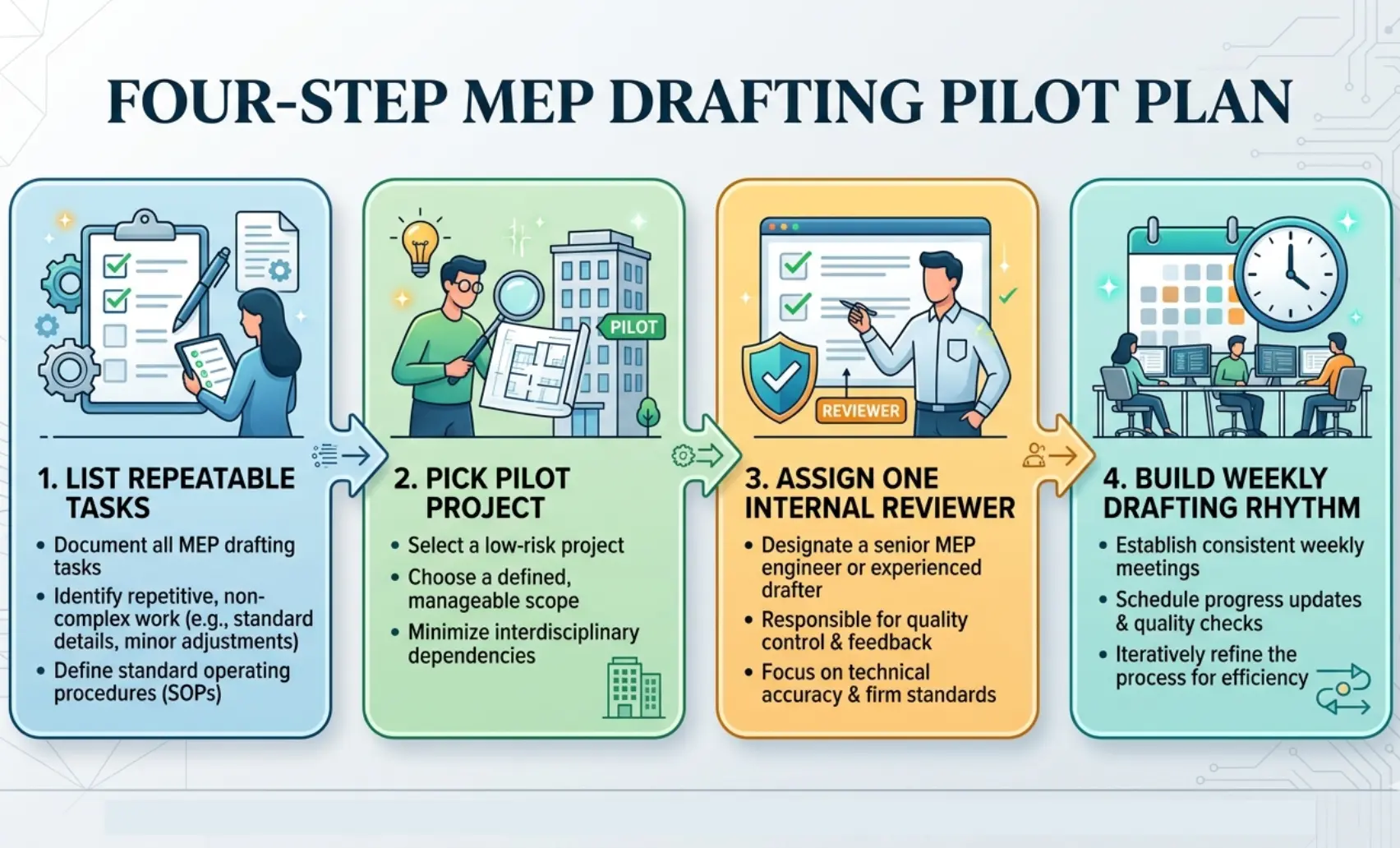
Follow these steps:
Step 1: List Repeatable Drafting Tasks
Start with an honest audit of what the engineering team produces every week that does not require PE-level judgment.
Common starting tasks for MEP firms:
- Redline incorporation, AutoCAD, and Revit MEP updates from the engineer or consultant markups
- Equipment schedule updates, HVAC, panel, lighting, and fixture schedules after design confirmation
- Sheet setup, new sheets, title block population, and sheet index maintenance
- Calculation formatting, organizing load calculation outputs into PE-review-ready packages
- As-built updates, field-marked drawing incorporation into the record set
- Detail cleanup, standard detail revisions after code or design review
These tasks are ideal first-delegation candidates, well-defined, reviewable, and currently consuming licensed engineer hours.
Step 2: Pick One Project as a Pilot
Do not hand over every active project in week one. Choose one project with clear, current markups and a defined deliverable scope.
- Choose a project where the engineer’s direction is documented, marked-up PDFs, Revit model notes, or a written task brief
- Avoid the most chaotic active project for the first pilot; a calmer project produces cleaner feedback on quality and process
- Define the deliverable clearly, which sheets, which schedules, which details, and what the completed output looks like
Step 3: Assign One Internal Reviewer
Conflicting feedback from multiple engineers is the most common source of confusion in a new remote drafting engagement.
- One lead engineer gives task instructions, and the remote engineering assistant knows exactly who to ask when something is unclear
- One lead engineer reviews completed work, provides consistent feedback, and trains the assistant to the firm’s standards faster
Step 4: Build a Weekly Drafting Rhythm
A simple weekly structure prevents the most common remote drafting failure: work that piles up without a defined delivery cadence.
- Monday: Task list issued, specific drawings, schedules, or documentation tasks with clear deliverable descriptions and deadlines
- Daily check-in: Brief async update, what was completed, what is in progress, what needs input
- Midweek QA: Engineer reviews in-progress work and provides redline feedback before the final delivery push
- Friday delivery review: Completed work reviewed against the task list, corrections noted, next week’s priorities identified
This rhythm builds quality progressively; the remote engineering assistant learns the firm’s standards through structured feedback rather than discovering them through trial and error on submission day.
Add Revit MEP and CAD Drafting Capacity This Week!
Your licensed engineers should be engineering, not updating panel schedules and incorporating redlines at 9 pm. Remote AE places dedicated remote engineering assistants with genuine MEP drafting experience, Revit MEP, AutoCAD, equipment schedules, HVAC plans, duct layouts, calculation documentation, and submittal support, ready to integrate into your existing workflow from week one.
Book a Free Consultation With Remote AE; No Obligation, No Upfront Cost!
FAQs – Small MEP Engineering Firms
Can small MEP firms outsource drafting without losing quality control?
Yes. Quality control depends on the firm’s review process, not where the drafter sits. Successful MEP firms use standard details, drafting standards, QA/QC checklists, redline workflows, and engineer reviews before issuing drawings. Remote drafters support production while engineers retain technical oversight.
Can remote support work in Revit MEP?
Yes. Many remote MEP drafters work daily in Revit MEP, including HVAC, plumbing, fire protection, and electrical models. They can follow your templates, families, view standards, worksets, and BIM execution requirements.
Should MEP engineers do their own drafting?
Engineers should focus on design, calculations, coordination, and technical decisions. While some engineers draft their own work, delegating production drafting often improves utilization and allows engineers to spend more time on higher-value engineering tasks.
How do you protect engineering liability when using remote drafting support?
Maintain a clear separation between drafting support and engineering responsibility. Engineers should review calculations, verify design intent, check drawings, and approve deliverables before issuance. Documented QA/QC procedures and controlled file access also help reduce risk.
Is remote drafting better than hiring a full-time drafter?
It depends on the workload. Remote drafting is often a good option when project volume fluctuates or firms need specialized support without committing to a full-time hire. A full-time drafter may make more sense when production needs are consistent year-round.