


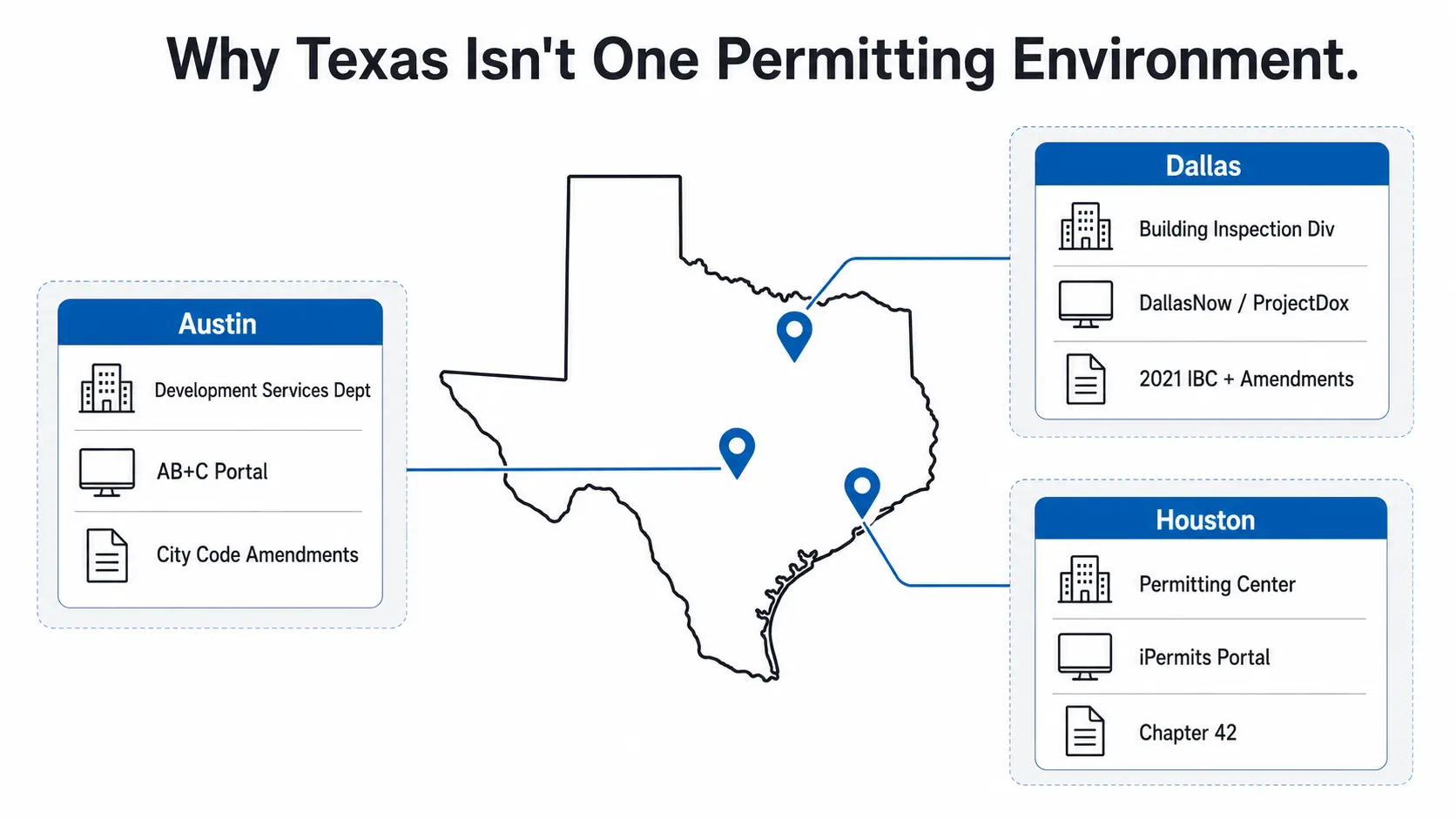
Texas issued more multifamily permits than any other state in 2025, yet there is no single “Texas building code” behind that volume. Austin, Dallas, and Houston each run their own permitting authority, their own portal, and their own set of code amendments- three review environments under one state line. If your firm is carrying projects in more than one of these metros, your multifamily drafting services in Texas need to speak three dialects of the same language. Below is how each metro’s permit workflow differs, where the documentation load is concentrated, and how a managed drafting team tracks all three so your licensed staff can stay on design and stamping. The three-metro problem is really a production capacity problem, the same one behind most multifamily design and construction outsourcing decisions a growing practice eventually has to make.
Carrying multifamily projects in more than one Texas metro? Book a consultation, and we’ll walk through how a dedicated drafting team tracks each jurisdiction’s requirements for you.
Key Takeaways
- Texas has no statewide commercial building code; Austin, Dallas, and Houston each adopt and amend their own codes separately.
- Austin requires a cleared site plan before a building permit application, submitted through the Austin Build and Connect (AB+C) portal.
- Dallas Ordinance 33099 lets projects up to 8 dwelling units, 3 stories, and 7,500 square feet use the simpler residential code path.
- Houston has no zoning; multifamily land use is governed by Chapter 42 and private deed restrictions covering roughly 45% of the city.
- TDLR reviews Texas Accessibility Standards, while the licensed architect of record retains responsibility for interpretation and stamping.
Why “Texas” Isn’t One Permitting Environment
Most states adopt a building code at the state level. Texas does not, not for commercial multifamily. Texas has no mandatory statewide commercial building code; cities adopt and amend their own.
The single statewide mandate is residential energy: the IECC applies to new residential construction under Texas Health & Safety Code Chapter 388. Everything else- which edition of the IBC is in force, which local amendments apply, how a multifamily set is reviewed- is decided city by city.
For a firm working one metro, that’s manageable. For a firm working two or three, it’s a coordination problem that lives inside your drawing set. The Austin edition and amendments are not the Dallas edition and amendments.
Houston’s review is structured around a land development ordinance that neither of the other two uses. A drafter who doesn’t know which city a sheet is bound for can’t produce a submission-ready sheet.
This is also where multifamily’s core advantage shows up. A unit type gets drawn once and repeats across every floor it stacks on. In a 200-unit building with six unit types, one corrected detail propagates to every instance of that unit; the leverage on getting the drawing right is multiplicative, not linear (illustrative).
The flip side is just as multiplicative: a metro-specific error in a unit plan repeats everywhere that unit repeats. Getting the jurisdiction right at the drafting stage is where the money is saved or lost.
Austin: Development Services Department and the AB+C Workflow
Austin processes permitting through the City of Austin Development Services Department (DSD), and all submissions go through a single portal. Austin Build + Connect (AB+C) is the electronic portal for application submission, fee payment, inspection scheduling, and document management.
One sequencing detail catches out-of-market teams first: a site plan, site plan correction, or site plan exemption is required before applying for a building permit. Get that order wrong, and the building permit application stalls before review even begins.
What Makes Austin Review Distinct
Austin’s review load is driven as much by environment and geometry as by the building itself. Compatibility standards codified in Austin City Code §25-2-1062 through §25-2-1069 restrict building height and setbacks on properties next to lower-density residential zones, and they disproportionately affect infill multifamily projects.
Layered on top are watershed and aquifer overlays: the Save Our Springs (SOS) Ordinance governs impervious cover and water quality in the Barton Springs Zone, and Edwards Aquifer recharge and contributing zones add review time for affected sites.
Each overlay is a documentation trigger: more sheets, more calculations, more coordination before a set is complete.
Austin has also invested in reducing initial review times, but experienced developers treat the published targets as optimistic baselines rather than promises. A pre-application conference adds one to three weeks to the front end but regularly prevents four to eight weeks of revision cycles by surfacing compliance questions before they become comment letters.
The lesson for a production team: the cost of an incomplete Austin submission is measured in review cycles, not in redraw hours.
What We Produce for Austin Submittals
A dedicated drafting team supports Austin work by preparing coordinated construction document sets to the city’s submittal requirements, supporting the site plan documentation that has to clear before the building permit, and turning around reviewer comments fast enough to keep a resubmittal from becoming a schedule event.
When the comment letter arrives, the bottleneck is usually production capacity, not design judgment; that is exactly the load that maps onto remote support. Austin’s site plan sequencing means the documentation work starts earlier than most out-of-market teams expect; multifamily architectural drafting services that cover unit plans, stacking diagrams, and enlarged plans are what move a set from design intent to AB+C-ready.
Dallas: Development Services and the DallasNow / ProjectDox Path
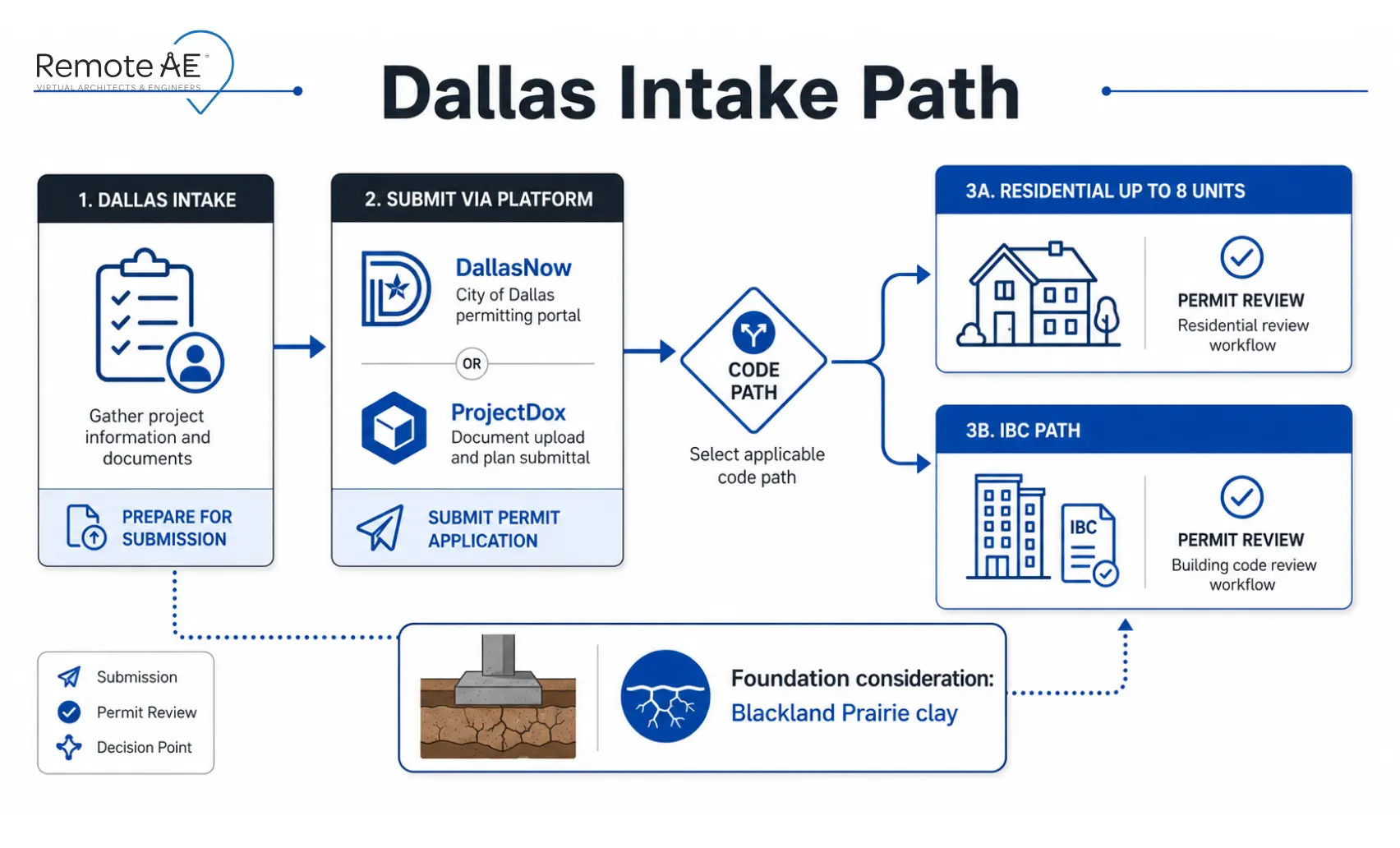
Dallas issues permits through the Building Inspection Division of the Development Services Department, and the city modernized the whole intake path in 2025. Applications now run through DallasNow, an Accela citizen portal that replaced the legacy POSSE system, with commercial plans uploaded for electronic review through ProjectDox.
If your last Dallas project predates the switch, your team is submitting into a different system than it remembers.
What Makes Dallas Review Distinct
Dallas enforces its own adopted editions with local amendments. The city adopted the 2021 IBC, IRC, IPC, IMC, and IECC, each with Dallas local amendments, effective May 12, 2023. Recent ordinance activity matters for smaller multifamily.
Ordinance 33099, effective May 23, 2025, expanded the residential code path to allow up to 8 dwelling units, 3 stories, and 7,500 square feet, so duplexes through 8-plexes now follow the simpler residential path instead of the more complex IBC. Knowing which code path a project falls under changes the entire sheet set, and it’s a Dallas-specific call.
Ground-up multifamily also runs through the zoning framework. Dallas categorizes multifamily uses in districts ranging from MF-1 through MF-4, and a project requiring a Planned Development (PD) rezoning adds six to twelve months to the pre-construction timeline.
Then there’s the ground itself. North Texas sits on Blackland Prairie expansive clay, among the most active in the country, which makes the foundation, not the framing, the highest-risk part of the build. Foundation documentation is where a Dallas set earns its scrutiny.
What We Produce for Dallas Submittals
For Dallas projects, a managed team produces coordinated CD sets built to the adopted 2021 editions and current Dallas amendments, keeps sheet sets aligned to the right code path when a project sits near the Ordinance 33099 threshold, and handles ProjectDox comment-response cycles.
The amendment awareness is the differentiator; a set drafted to generic IBC without the Dallas overlays comes back with comments.
Houston: The Permitting Center and Chapter 42 (No Zoning)
Houston is the outlier, and understanding why is the whole game. Houston is the largest city in the United States without traditional zoning.
Permits are issued through the Houston Permitting Center on Washington Avenue, with applications submitted through the iPermits portal and plans routed through ProjectDox.
What Makes Houston Review Distinct
No zoning does mean no rules; it means a different rulebook. Land use in Houston is shaped by the Houston Development Code (Chapter 42), which sets minimum lot sizes, setbacks, parking minimums, and density standards, together with private deed restrictions that govern roughly 45% of the city.
Multifamily site plans get reviewed against that framework: a multifamily site plan goes to Planning and the Fire Marshal for compliance with Chapter 42 and Fire Marshal review of Appendix D, submitted alongside either a sitework permit or a full building permit set. A team that drafts with a zoning mindset will miss what Houston actually reviews.
Location risk in Houston is water and wind. Site plans must carry floodplain boundaries with base flood elevation, and properties in a flood zone need a finished-floor elevation set two feet above the 500-year floodplain along with detention documentation.
On the coastal band, wind load and windstorm compliance add another documentation layer that inland sets never touch. These are not optional annotations; they are the difference between a set that clears Houston review and one that doesn’t.
What We Produce for Houston Submittals
Houston support centers on Chapter 42–compliant site plan production, floodplain and finished-floor documentation coordinated into the set, and full CD production routed correctly to Planning and Fire Marshal review.
The work is administratively heavy and jurisdiction-specific, precisely the profile that a dedicated remote team absorbs without pulling senior staff off design. The administrative weight of a Houston submittal, routing to Planning, Fire Marshal, and floodplain review simultaneously, is exactly the kind of multi-track work that remote permit coordination is built to absorb without pulling your licensed staff off design.
Texas Accessibility Standards and the TDLR Review Pathway
Here is the requirement that out-of-state firms miss most often, because no other state has it in quite this form. Multifamily projects in Texas answer to the Texas Accessibility Standards (TAS), administered through the Texas Department of Licensing and Regulation (TDLR), a review layer that sits alongside the federal accessibility rules your team already knows.
How TAS Differs From What You Already Know
TAS is a Texas-specific standard with its own review and inspection pathway, different from the ADA and from IBC accessibility provisions even where the requirements overlap. Texas Accessibility Standards are administered by TDLR statewide, and TDLR also licenses the electricians and other trades whose work appears in the set.
Qualifying projects are registered with TDLR and reviewed by a Registered Accessibility Specialist, which means accessibility isn’t a box checked once at the end; it’s a documentation thread that runs through every unit-type drawing, every common-area plan, and every accessible route on the site.
In a building where unit types repeat by the hundred, an accessibility detail drawn wrong repeats with them.
Where Responsibility Stays
A drafting partner produces the documentation that carries TAS requirements accurately into the set: the dimensioned clearances, the accessible route callouts, the unit-type annotations.
What a drafting partner does not do is interpret the code or stamp the drawings. The licensed architect of record retains full responsibility for TAS interpretation, code interpretation, and sealing the documents.
Remote AE provides documentation and production support, not code consulting or engineering judgment. That line matters; it’s what keeps outsourced production a genuine capacity multiplier rather than a liability transfer.
Managing TAS documentation across a multi-metro Texas portfolio? Book a consultation, and we’ll show you how dedicated drafters keep accessibility documentation consistent across every unit type and every metro.
Build-to-Rent Volume Across Texas Metros
If any product type makes the outsourcing math obvious, it’s build-to-rent, and Texas is the national center of it. Texas leads the U.S. in BTR development, with Dallas-Fort Worth ranking second among all metro areas for build-to-rent construction, trailing only Phoenix. Houston and Austin both sit among the leading BTR markets in the country as well.
Why BTR Compounds the Drafting Argument
BTR is repetition at the community scale. Instead of one unit type stacking vertically through a mid-rise, you have a small set of plan types platted across dozens of individual lots. Houston carries roughly 3,000 BTR units underway and Austin around 1,700, with Dallas leading the state’s pipeline.
Every plan type you get right spreads across every lot it’s placed on, which is exactly the leverage that makes per-unit-type economics beat per-hour economics. Draw the type once, correctly, to the right metro’s amendments, and the drafting cost per door drops as the community scales. That’s the multifamily thesis, and BTR is its purest expression.
How Remote AE Supports Multifamily Teams Across All Three Metros
The reason a Texas multifamily practice outsources production isn’t cost alone — it’s that the work is jurisdiction-specific, repetitive, and volume-heavy at exactly the moments your senior staff should be on design and client decisions. Remote AE has staffed the AEC industry for more than 15 years, so the drafters on your account already speak the language of a multifamily CD set.
A Managed Team, Not a Marketplace
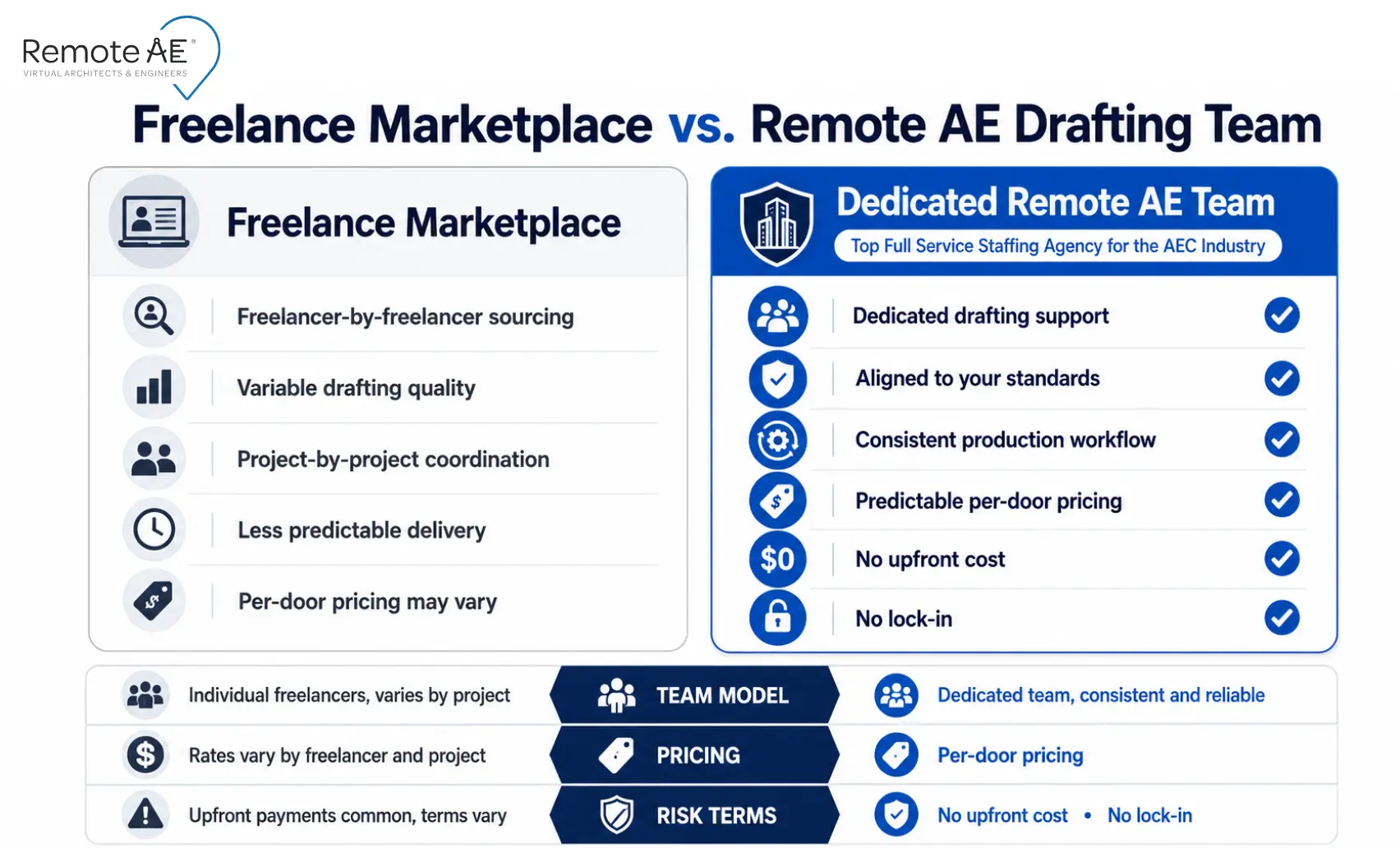
There’s a real difference between the two common outsourcing models. A freelance marketplace gives you a rotating cast who each learn your standards from scratch and don’t carry your project’s context between engagements.
A managed service like Remote AE gives you dedicated drafters who stay on your account, learn that Austin needs its site plan cleared first, that Dallas runs on 2021 editions with local amendments, and that Houston reviews to Chapter 42, and who apply that knowledge automatically on the next sheet. When you’re running three review cultures at once, continuity is the whole value.
Hourly rate is the wrong frame when what you actually need is continuity, which is the core of the freelance marketplace vs. managed outsourcing tradeoff in AEC, and why it matters most on jurisdiction-specific work that repeats across a pipeline.
Built to Lower Your Risk, Not Just Your Cost
The engagement is structured so trying it doesn’t expose you. There are no upfront costs and no long-term contract to sign; you scale the team to your pipeline and step back when a project wraps. Quality and reliability are guaranteed rather than hoped for, and if a drafter isn’t the right fit, the replacement is risk-free. The point is to make added production capacity a lever you can pull without betting the schedule on it.
What You Get, Framed Per Door
A dedicated team produces coordinated construction document sets, unit-plan and unit-matrix drafting, site plan support, and comment-response production, sized to your pipeline rather than billed by the hour.
The economics that matter to a developer are per-door, not per-hour: what does it cost to produce and revise the documentation for one unit type that will repeat across the building or the platted community?
That’s the number a managed team is built to lower. And the scope guardrail holds throughout: this is production support, not stamping, not code interpretation, not licensed work.
FAQs – Multifamily Drafting Services in Texas
Does Texas have a statewide building code for multifamily projects?
No. Texas has no mandatory statewide commercial building code; cities adopt and amend their own editions of the IBC and related codes. The one statewide mandate is residential energy efficiency under Health & Safety Code Chapter 388. For multifamily, the governing code depends entirely on which city is reviewing the project.
What’s the difference between permitting in Austin, Dallas, and Houston?
Each metro runs its own authority and portal: Austin’s Development Services Department uses AB+C and requires a site plan before the building permit; Dallas uses DallasNow and ProjectDox on 2021 editions with local amendments; Houston’s Permitting Center reviews against Chapter 42 rather than zoning. Three amendment sets, three review cultures.
What are Texas Accessibility Standards and who reviews them?
Texas Accessibility Standards (TAS) are the state’s accessibility requirements, administered by the Texas Department of Licensing and Regulation (TDLR). Qualifying projects are registered with TDLR and reviewed by a Registered Accessibility Specialist. TAS applies alongside federal ADA requirements, and the licensed architect of record retains responsibility for interpretation.
Can you support Houston multifamily projects given there’s no zoning?
Yes. Houston’s lack of zoning means land use is governed by Chapter 42 and private deed restrictions instead. Multifamily site plans are reviewed by Planning and the Fire Marshal for Chapter 42 and Appendix D compliance, with floodplain and finished-floor documentation where applicable. We draft to that framework directly.
How does outsourced drafting handle three different sets of city amendments?
A dedicated team assigned to your account learns which metro each project belongs to and applies the correct code path, amendments, and review requirements per submission. Continuity is the point; the same drafters carry Austin, Dallas, and Houston knowledge forward rather than relearning your standards each engagement.
One State, Three Review Environments, One Production Partner!
Texas gives multifamily developers demand, volume, and speed. What it doesn’t give you is a single rulebook. Austin, Dallas, and Houston each run their own authority, portal, and amendments; a set drafted for one metro’s review isn’t ready for another’s. The firms that scale across all three keep production moving without pulling licensed staff off design and stamping. That’s where Remote AE fits: dedicated drafters who produce coordinated CD sets to each metro’s requirements, turn comments around fast, and price per door instead of per hour. Documentation and production support: your architect of record keeps interpretation and seals. Your production capacity stops being the ceiling on how many Texas projects you can carry.
Book a consultation; we’ll map your Austin, Dallas, and Houston pipeline to a Remote AE drafting team that already knows AB+C from DallasNow from Chapter 42.