


Construction estimation feels simple until you miss one scope item and the job bleeds. Most teams don’t need “more speed.” They need repeatable support that keeps takeoffs clean, revisions tracked, and bid packages consistent. This guide explains construction estimation outsourcing in practical terms. It breaks down the full estimation workflow, shows where errors usually happen, and identifies which tasks are safe to outsource without risking bids, margins, or credibility. Moreover, why outsourcing is no longer limited to large firms and how to retain control through clear scope, tools, and quality checks, whether you use a remote construction estimator, a virtual estimation assistant, or a dedicated estimation resource.
What Construction Estimation Really Involves (Beyond Takeoffs)
Takeoffs are only one slice of estimation. The full workflow includes scope alignment, pricing discipline, revision control, and documentation that holds up under review.
AACE International defines estimate review as a quality assurance process that checks whether an estimate conforms to technical and procedural expectations (AACE Terminology, “Estimate Review”).
That framing matters because outsourcing only works when you separate production tasks from judgment calls.
Core Components of Construction Estimation
A complete estimate typically includes:
- Quantity takeoff / material takeoff: Measuring concrete, steel, drywall, and MEP quantities by CSI MasterFormat divisions.
- Cost pricing: Applying labor rates, production rates, material pricing, overhead, markup, profit, and contingency.
- Vendor and subcontractor coordination: Soliciting quotes, tracking responses, and comparing scope coverage.
- Scope reviews and exclusions: Defining assumptions, exclusions, and clarifications to avoid disputes later.
- Bid documentation: Assembling the final cost estimate, scope letters, and supporting narratives for submission.
Each step feeds the next. Errors early in the process compound quickly.
Where Most Errors Actually Happen
Most estimation errors don’t come from one big mistake. They come from small misses that compound:
- Rushed takeoffs → skipped sheets, wrong scale, inconsistent assemblies
- Missing scope items → “gray areas” between trades
- Inconsistent pricing sources → mixing supplier quotes, old unit rates, and market spikes
- Poor revision control → addenda changes applied to some tabs but not all.
The “Safe to Outsource” List (Low-Judgment Tasks)
Construction estimation outsourcing is most effective when firms begin with tasks that are structured, repeatable, and easy to audit. These activities consume time but do not require a pricing strategy or risk judgment.
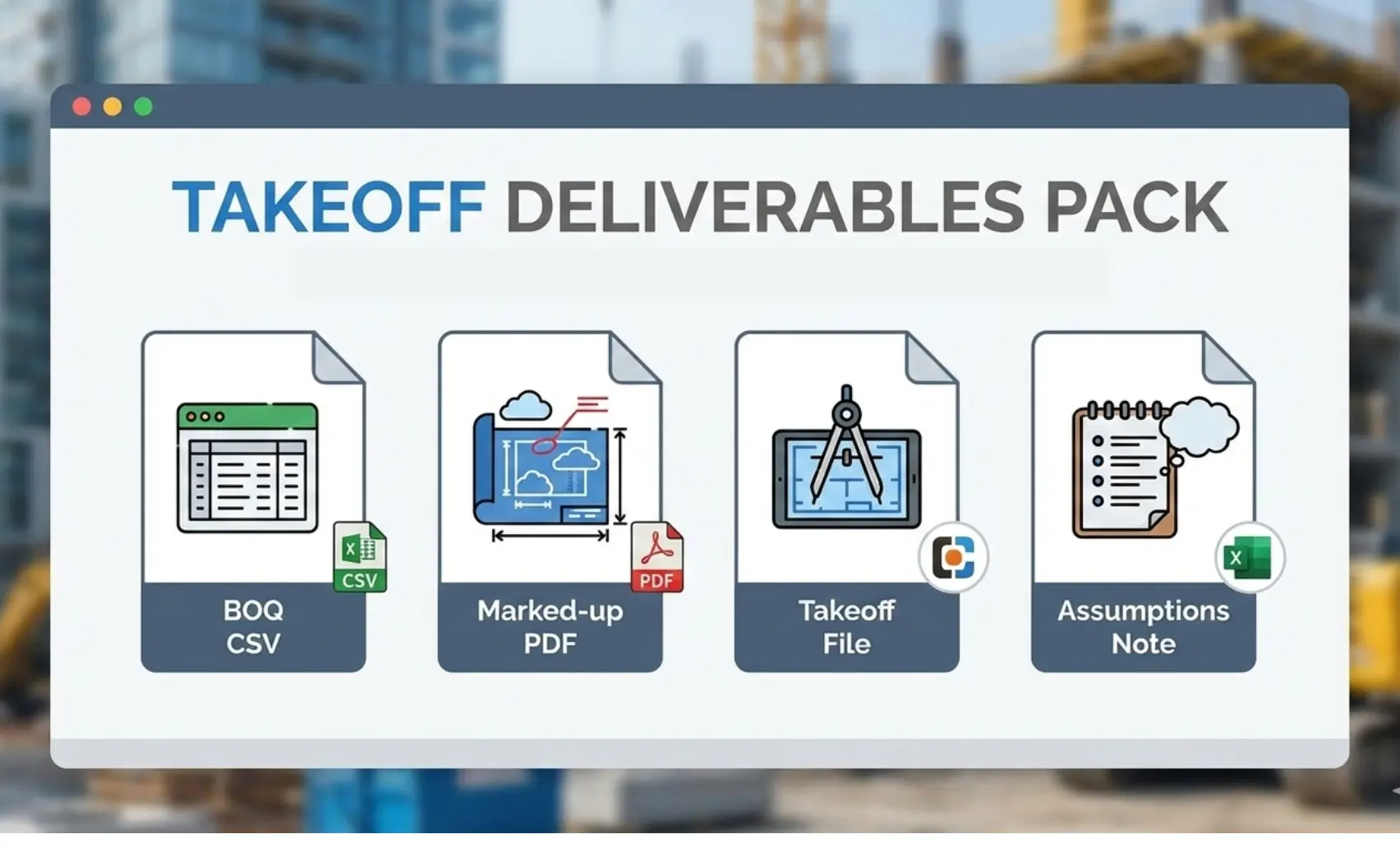
Quantity Takeoffs + BOQ / Quantity Reports (2D + 3D)
Quantity takeoff is the most commonly outsourced estimation task, and for good reason. Measuring quantities is rules-based and auditable when done correctly.
Material takeoffs by trade often include concrete, steel, drywall, and MEP systems, organized by CSI MasterFormat (Divisions). Remote teams follow defined measurement rules while internal estimators retain pricing control.
Why takeoffs are ideal for remote support?
They are time-intensive, repeatable, and easy to verify against drawings. Errors are visible before pricing is applied.
Tools commonly used:
Bluebeam, PlanSwift, OST, Autodesk Takeoff, and Excel for quantity summaries.
Estimation Data Preparation and Cleanup
Before pricing begins, estimation data must be clean. This includes organizing drawings, managing revisions, and preparing takeoff templates.
Remote estimation support often handles drawing version control, revision logs, standardized measurement units, and file structure setup. When this work is done well, internal estimators spend less time correcting inputs and more time reviewing assumptions.
Cost Database Management
Maintaining pricing data is essential but rarely prioritized. Outsourced estimation teams often support:
- Updating material pricing
- Tracking historical project costs
- Maintaining supplier cost sheets
- Organizing labor rate references
This work supports consistency across bids and improves estimate accuracy over time.
Subcontractor Bid Comparison Sheets
Comparing subcontractor bids requires structure, not judgment. Remote estimation assistants log incoming bids, align scope items, and highlight gaps or exclusions.
By consistently leveling the scope, internal teams can focus on selection and negotiation rather than data entry.
Preliminary and Budget Estimates
Early-stage feasibility studies, ROM (Rough Order of Magnitude) estimates, and concept-level cost modeling are often safe to outsource when assumptions are clearly defined.
Remote teams prepare quantity frameworks and baseline pricing, while senior staff validate logic and risk exposure.
Sheet Indexing, Scope Tagging, and Addenda Tracking
Revision control becomes critical as addenda accumulate. Outsourced teams track changes, tag scope impacts, and ensure updated sheets flow into takeoffs and BOQs.
This reduces missed scope items during fast-moving bid periods.
Bid Form Assembly (Scope Letters, Inclusions/Exclusions, Alternates)
Assembling bid packages is structured work. Remote support prepares scope letters, lists inclusions and exclusions, organizes alternates, and formats proposal documents, without touching final pricing decisions.
What You Should Keep In-House (High-Judgment Tasks)
Not every estimation task should be outsourced. Certain decisions must stay with leadership.
AACE notes estimate accuracy is driven by risk and systemic factors like quality of assumptions, experience, and market/pricing conditions, not just quantity math (AACE 18R-97, Aug 2020)
Labor Units, Crew Productivity, and Production Assumptions
Labor rates and production assumptions are company-specific. They reflect crew makeup, means and methods, and historical performance. These decisions belong in-house.
Markup, Overhead Allocation, Fee Strategy
Markup, profit targets, overhead recovery, and contingency strategies define competitiveness and risk tolerance. These are strategic choices, not production tasks.
Risk Allowances and Contingency Logic
Deciding how to cover scope gaps, escalation risk, or incomplete documents requires judgment and experience. Outsourcing supports data, but not risk decisions.
Bid / No-Bid Decisions and Win Strategy
Bid selection depends on market conditions, backlog, relationships, and capacity. This decision should never be outsourced.
Final Estimate Narrative + Sign-Off
The final estimate narrative ties scope, assumptions, exclusions, and pricing logic together. Ownership of this narrative protects credibility.
Client-Specific Knowledge
Past relationships, negotiation history, and market sensitivities influence pricing and positioning. This context must stay internal.
Control Systems That Protect Your Numbers
Construction estimation outsourcing only works when control systems are in place. The goal is not blind delegation. The goal is auditability. When scope, quantities, and revisions are visible at every stage, outsourcing reduces risk instead of adding it.
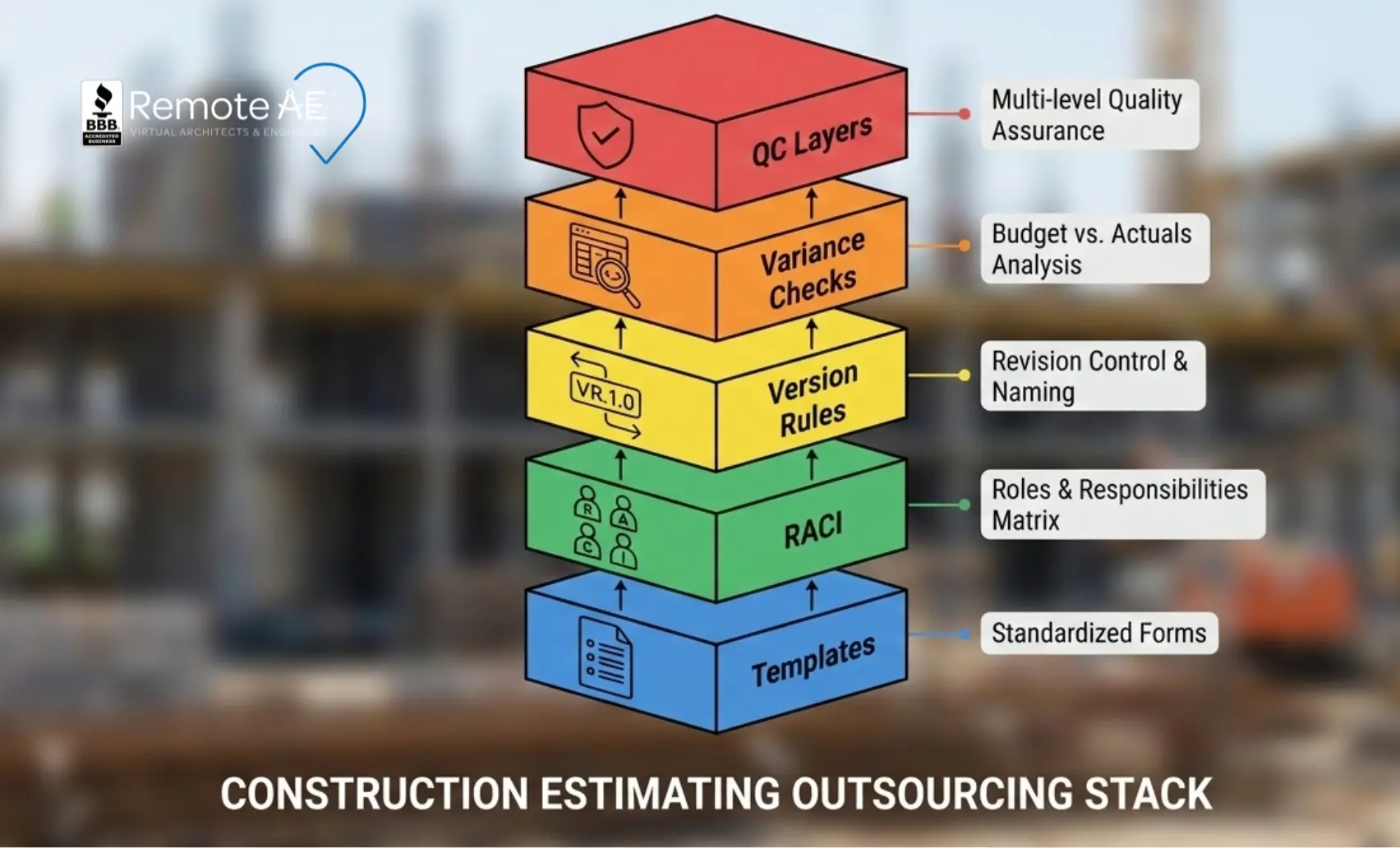
The 4-Layer QC Model (Self-Check → Peer-Check → Spot-Check → Sign-Off)
A layered quality control model protects estimate integrity.
First, the estimator or takeoff specialist performs a self-check against drawings and measurement rules. Next, a peer review verifies quantities and scope alignment. A spot-check by a senior estimator or project manager confirms logic and catches outliers. Final sign-off remains with in-house leadership.
This structure mirrors how strong in-house teams already work and translates cleanly to remote estimation support.
Variance Checks (Historical Jobs, Unit Rates, Outliers)
Variance checks act as an early warning system. Quantities and unit costs are compared against similar past projects to identify anomalies. Sudden jumps in material quantities, unrealistic labor hours, or pricing far outside expected ranges are flagged before bids are finalized.
This step protects against silent errors that pass visual review.
Version Control Rules (Addenda Logs, Naming, Locked Baselines)
Revision chaos is a major source of estimation error. Clear version control rules reduce this risk.
Every addendum should be logged. File naming must indicate revision status. Baseline quantities should be locked once pricing begins. When change orders or revisions arrive, updates are traceable rather than overwritten.
RACI for Estimation Handoffs
Defining who is Responsible, Accountable, Consulted, and Informed prevents confusion.
Remote estimators handle quantity takeoff and data preparation. Internal staff remain accountable for pricing decisions and risk. This clarity keeps ownership intact.
Templates That Enforce Consistency
Templates reduce variability. Takeoff checklists, assumptions sheets, exclusion logs, and scope summaries create structure. When templates are used consistently, outsourced work aligns with internal standards without constant supervision.
Outsourcing Models (Pick the One That Fits Your Bid Volume)
Not every outsourcing model fits every contractor. Choosing the wrong structure creates friction.
- Per-Project Takeoff Service: This model works for firms with occasional bid spikes. It offers speed and minimal integration but limited continuity. Best used for isolated takeoffs with a clear scope.
- Freelancers: Freelancers provide flexibility but require tight QC. Quality varies widely, and process knowledge is often shallow. This model suits simple scopes but struggles with repeatability.
- Dedicated Remote Estimator: A dedicated remote construction estimator or virtual estimation assistant from Remote AE delivers the best results for firms with steady bid volume. The estimator learns company standards, improves accuracy over time, and reduces revision cycles.
When Outsourcing Does Not Pencil Out
Outsourcing is inefficient when bid volume is low or when estimates are highly bespoke. In these cases, setup effort outweighs benefit.
How to Outsource Estimation in a Way You Can Audit
Auditability separates effective outsourcing from risk exposure. A defined process keeps estimates defensible.
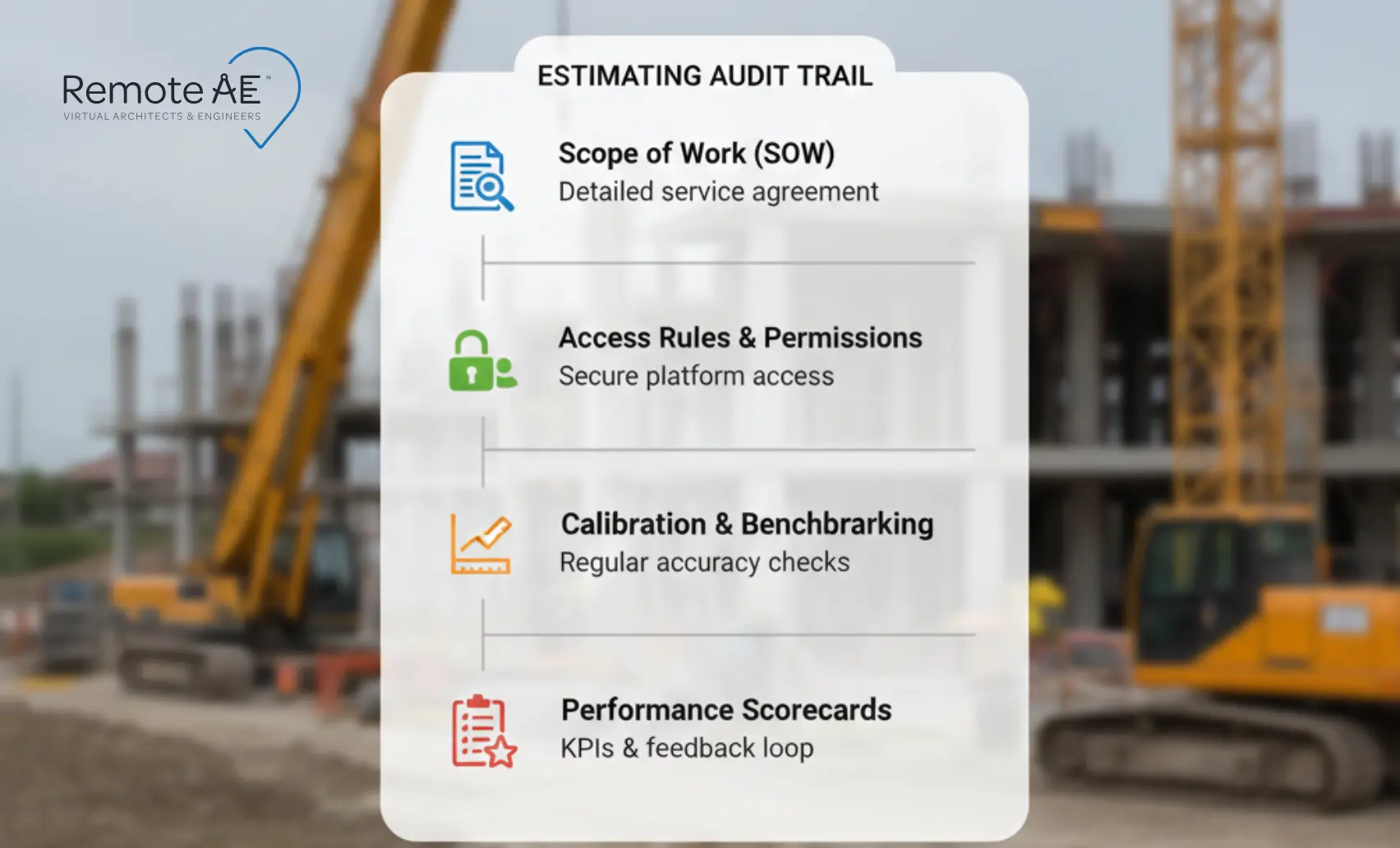
Step 1: Define Deliverables (Example SOW)
Deliverables should specify quantity formats, trade breakdowns, revision handling, and turnaround time. Clarity prevents scope creep.
Step 2: Tools and File Access Rules
Remote estimators should work inside approved tools, Bluebeam, PlanSwift, Excel, Autodesk Takeoff, or Procore, with controlled access. Permissions should match the task scope.
Step 3: Pilot Project and Calibration Loop
A pilot estimate aligns expectations. Feedback cycles refine measurement rules, assumptions, and presentation before scaling.
Step 4: Scale With Scorecards
Accuracy, revision count, and cycle time form the core metrics. These scorecards guide scaling decisions.
Hiring a Remote Estimator (Remote AE Tie-In)
Remote AE provides AEC-trained virtual assistants with construction backgrounds and estimation software experience. These professionals understand takeoffs, BOQs, bid documentation, and revision control.
Long-term dedicated support improves consistency and reduces onboarding time. Remote estimators work as extensions of internal teams, not detached vendors.
- No long-term commitment.
- No upfront costs.
- Plans starting from $499/week.
- Risk-free replacement available in the first year.
Role options range from takeoff specialists to full estimation assistants. Skills tests focus on plan reading, takeoff accuracy, CSI familiarity, and tool proficiency in Bluebeam, PlanSwift, and Excel.
Get Estimation Support Without Losing Control of Your Numbers!
Remote AE, with its more than 15 years of experience in the AEC industry, helps contractors outsource construction estimation the right way. Our AEC-trained virtual assistants support quantity takeoff, BOQs, bid preparation, and documentation, while your team retains full control over pricing, risk, and strategy.
Talk to Remote AE and build estimation capacity without adding overhead.
FAQs – What to Outsource in Construction Estimation
Is it safe to outsource construction estimation, or only takeoffs?
It can be safe to outsource either, but the risk is lower when you start with takeoffs. Full estimation involves your pricing logic, exclusions, and bid strategy, so it needs tighter controls and review. Many firms outsource quantities first, then outsource full estimates once the estimator proves accuracy and discretion.
What’s the difference between outsourcing takeoff vs outsourcing the full estimate?
A takeoff is measuring and counting quantities from drawings (LF, SF, EA). A full estimate adds pricing, labor productivity, equipment, subcontract quotes, scope gaps, and risk. Takeoffs support your internal estimator; full estimation often becomes a near-complete bid package that still needs final executive review.
How do I check an outsourced takeoff for accuracy quickly?
Do a fast “triangulation” review: spot-check 10–15 line items across major categories, then verify totals against a second method. Compare key drivers (e.g., concrete CY, drywall SF) to benchmarks from similar jobs. Also, confirm the estimator’s assumptions sheet matches plan notes and specs.
What tools should a remote estimator know (Bluebeam, PlanSwift, etc.)?
At minimum: Bluebeam Revu for markups and quantity checks, and a takeoff tool like PlanSwift (or equivalent). Many also use Excel, a cost database, and an estimation platform (e.g., Sage, ProEst, DESTINI).
How do I protect my pricing and historical cost data?
Treat pricing like sensitive IP. Use role-based access, least-privilege folders, and avoid sharing your full cost history unless necessary. Share template pricing or locked rate sheets, not raw databases. Enforce NDAs, MFA, and audit logs. Keep master cost data internal and sync only what’s needed per bid.
Freelancer vs dedicated remote estimator: which is better?
Freelancers fit one-off bids and overflow. Dedicated estimators are better for ongoing work because they learn your divisions, templates, and risk rules—reducing rework. If you bid weekly, dedicated wins. If you bid occasionally, a vetted freelancer plus tight SOPs can be enough.