


Construction estimating is under pressure. Bid volumes are rising, timelines are compressing, and skilled estimators are in short supply. AI-assisted quantity takeoffs promise to change the equation, automating repetitive measurement tasks and accelerating first-pass takeoffs across 2D drawings and 3D models. But speed without accuracy is a liability in preconstruction.
This article compares AI-assisted takeoffs against manual and digital methods across four accuracy factors, three speed scenarios, and three risk categories, and delivers a practical five-step hybrid workflow that general contractors and subcontractors can implement immediately. Where AI genuinely helps and where human review remains essential, both answers are here.
What Is a Quantity Takeoff in Construction?
A quantity takeoff is the process of measuring and counting every material, system, and component required to complete a construction scope, before a single line of pricing is applied. It is the foundation of every cost estimate, bid package, and procurement plan your preconstruction team produces.
Get it wrong and the consequences cascade, underbid contracts, procurement shortfalls, labor planning errors, and margin compression that no change order fully recovers.
What Gets Measured in a Takeoff?
Every quantity takeoff covers four measurement types, and each carries its own error risk.
- Counts: Doors, windows, fixtures, electrical devices, plumbing fittings, items measured by unit quantity
- Lengths: Walls, pipe runs, conduit, curb and gutter, structural members measured in linear feet or meters
- Areas: Flooring, roofing, wall finishes, waterproofing, insulation, measured in square feet or meters
- Volumes: Concrete, earthwork, fill material, and insulation measured in cubic yards or meters
Why Takeoff Accuracy Matters Before Pricing
A quantity takeoff is not just a measurement exercise. It is the scope of work translated into numbers, and those numbers drive every downstream decision.
- Missed quantities lead to underbidding, scope that wasn’t measured gets built at the contractor’s cost
- Overestimated quantities make bids uncompetitive, winning fewer contracts at inflated material assumptions
- Bad takeoffs affect procurement timing, labor scheduling, subcontractor scope alignment, and ultimately project margin
Quantity takeoff support is not just about measuring. It protects estimator time, bid quality, and the accuracy of every cost estimate that follows.
When a trained remote assistant handles routine takeoff production, senior estimators can focus on scope judgment, risk assessment, and pricing decisions that actually require experience.
Traditional Quantity Takeoff Methods Explained
Manual Takeoffs
Manual takeoffs rely on paper drawings, scale rulers, highlighters, and spreadsheets. The estimator measures directly from printed plan sets, counting, scaling, and recording quantities by hand.
Pros:
- Deeply familiar with drawing, the estimator touches every sheet
- Useful for small, unusual, or highly customized scopes where standard recognition tools fail
- Reliable when performed by a skilled, experienced estimator with strong scope judgment
Cons:
- Slow, a full manual takeoff on a mid-size commercial project can take days
- Hard to audit, handwritten notes and unmarked drawings leave no clear review trail
- Vulnerable to revision misses, addenda changes are easy to overlook on paper sets
- Difficult to scale across high bid volume without proportionally increasing estimator headcount
Digital Takeoffs
Digital takeoff tools, Bluebeam Revu, PlanSwift, Autodesk Takeoff, and STACK replace the scale ruler and paper set with on-screen measurement, markup, and export workflows. Estimators calibrate scale, draw measurements directly on the PDF or model, and link markups to live quantity calculations.
Bluebeam highlights scale calibration, trade-specific measurement tools, live-linked calculations, and audit-ready reports as core digital takeoff capabilities, giving estimators a faster, more traceable process than manual methods.
Critical distinction: Digital takeoff is not AI takeoff. Digital tools accelerate measurement, but every count, selection, and classification still depends on the estimator making the call. The tool measures what the estimator identifies. AI takeoff tools attempt to identify and measure autonomously.
What Makes AI-Assisted Quantity Takeoffs Different?
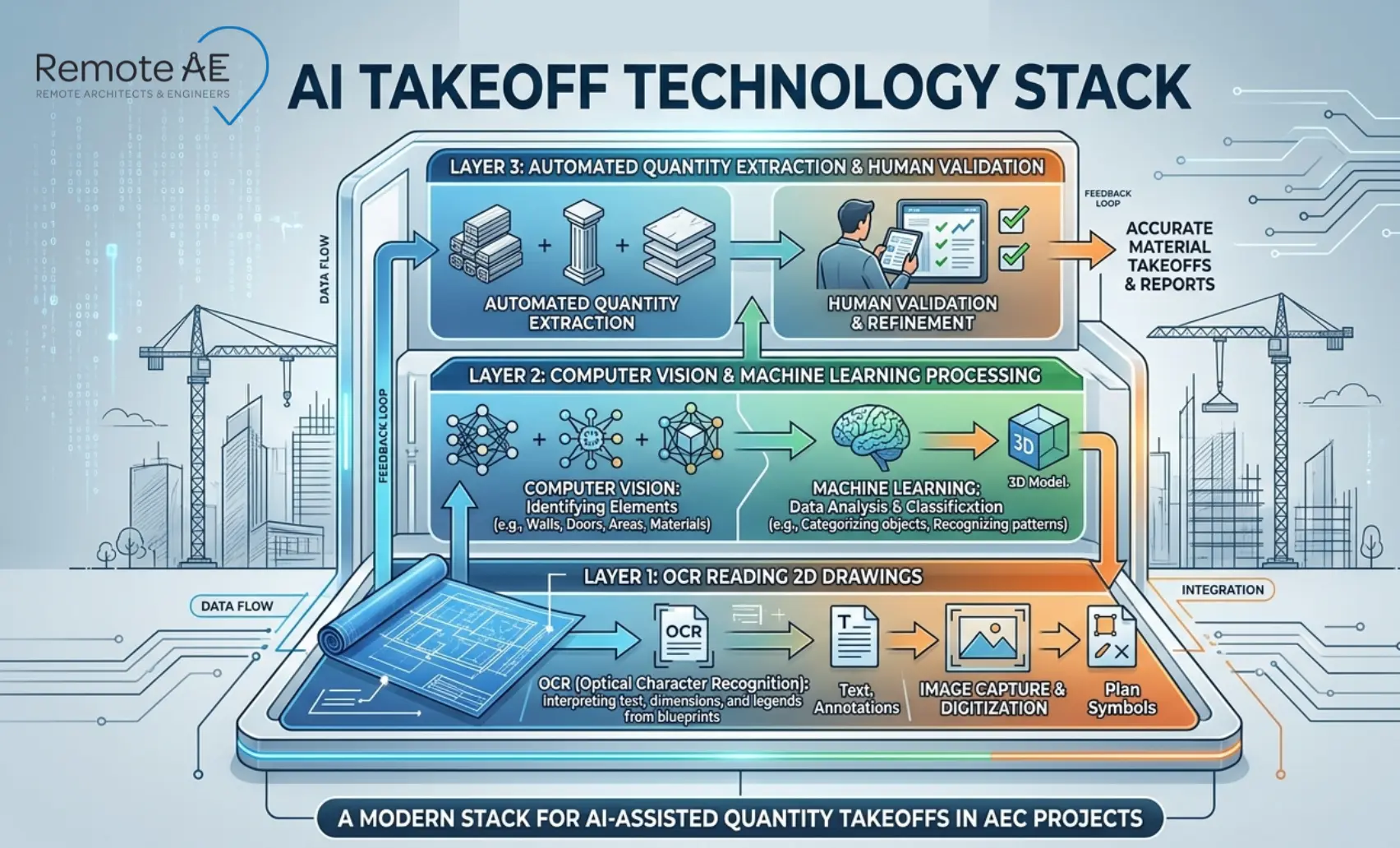
AI-assisted takeoff tools don’t just help estimators measure faster. They attempt to identify, classify, and count construction elements autonomously, using a combination of three underlying technologies working in sequence.
How AI-Assisted Takeoff Tools Work
What happens inside an AI takeoff tool explains both its strengths and its limitations.
- OCR (Optical Character Recognition): Reads text, dimensions, and labels from 2D drawings, extracting sheet numbers, room names, and dimension strings that the AI uses to orient itself within the drawing set
- Computer vision: Scans drawing geometry to identify and locate elements, doors, windows, fixtures, wall segments, by matching visual patterns against a trained symbol library
- Machine learning: Improves recognition accuracy over time by learning from confirmed takeoffs. The more similar projects the tool processes, the better it gets at recognizing project-type-specific symbols and layouts
- BIM data integration: When 3D models are available, AI tools extract material quantities directly from model geometry, bypassing the drawing recognition step entirely and producing more reliable quantity outputs than 2D PDF interpretation
- Human validation: Every AI-assisted takeoff tool is designed with a review step, quantities flagged as uncertain, symbols not recognized, or items identified as potentially missed are surfaced for estimator confirmation before the output is used in a cost estimate
STACK positions AI takeoff tools as a way to automate repetitive quantity extraction while keeping estimators in control of final decisions and validation, framing AI as a production accelerator, not a replacement for estimator judgment.
What AI Can Usually Help With
AI-assisted takeoffs deliver the most reliable output on structured, repetitive measurement tasks where pattern recognition is straightforward.
- Finding and counting repeated symbols, doors, windows, light fixtures, electrical devices, plumbing fixtures
- Detecting floor areas and room boundaries from architectural plans
- Measuring wall lengths from plan geometry
- Comparing drawing versions and flagging changes between addenda revisions
- Identifying potentially missed items by cross-referencing symbol counts across floors
- Speeding up first-pass takeoffs on clean, well-organized plan sets where symbol libraries match the project’s drawing standards
What AI Still Struggles With
No AI takeoff tool eliminates the need for an experienced estimator. The current generation of tools consistently underperforms in these scenarios:
- Poor scan quality: Blurry, low-resolution, or skewed scanned drawings produce OCR and computer vision errors that compound across the entire takeoff
- Inconsistent drawing symbols: Non-standard symbols, firm-specific legends, or hand-drawn details break pattern matching, and the AI either misses items or misclassifies them
- MEP complexity: Mechanical, electrical, and plumbing systems involve layered, interdependent geometry that 2D AI recognition handles unreliably, particularly for pipe routing, duct layouts, and electrical panel schedules
- Renovation scope: Existing-condition drawings, demolition plans, and phased construction scopes require contextual judgment about what stays, what goes, and what gets replaced, a scope interpretation task that AI cannot perform
- Specification interpretation: Quantities driven by specifications, insulation R-values, concrete mix designs, and finish schedules require the estimator to read and apply specification language that no AI tool currently processes reliably
- Alternates, exclusions, and clarifications: Bid alternates and scope exclusions are decision-based, not measurement-based; they require the estimator to make a business judgment that AI cannot replicate
Accuracy Comparison: AI-Assisted vs Traditional Quantity Takeoffs
Accuracy in construction estimating is not a single variable. It depends on four factors, and AI-assisted tools perform differently across each one.
Accuracy Factor 1: Drawing Quality
Drawing quality is the single biggest variable in AI takeoff accuracy.
- Clean, well-organized PDF drawings from a CAD or BIM export give AI tools the clearest possible input: sharp geometry, consistent symbols, and readable text. AI performs at its best here.
- Scanned drawings introduce resolution loss, skew, and OCR errors, particularly on older projects or field-issued plan sets. AI quantity recognition on scanned drawings carries a meaningful error risk that manual review must catch.
- Poor sheet naming and organization slow AI processing and increase the risk of missed sheets, which translates directly to missed scope in the quantity takeoff
- Missing scale calibration produces systematic quantity errors; every measurement on an uncalibrated sheet is proportionally wrong
Accuracy Factor 2: Trade Complexity
Trade complexity determines how reliably AI can interpret what it sees on a drawing.
| Trade / Scope Type | AI-Assisted Fit | Traditional Review Need |
| Flooring and finishes | High | Medium |
| Doors and windows | High | Medium |
| Drywall and framing | Medium | High |
| Concrete | Medium | High |
| Earthwork | Medium | High |
| Mechanical / plumbing | Lower | Very High |
| Electrical device counts | Medium | High |
| Renovation work | Lower | Very High |
Accuracy Factor 3: Scope Maturity
The stage of design documentation directly affects how reliable any takeoff method can be, AI or manual.
- Concept drawings: Quantities carry high uncertainty regardless of method. AI first-pass takeoffs are useful for order-of-magnitude screening but should never feed a bid-level cost estimate.
- Design Development (DD) drawings: Improve quantity reliability, AI tools perform better as geometry becomes more defined and symbols more standardized.
- Construction Documents (CDs): Support the highest takeoff confidence. AI-assisted takeoffs on complete CD sets with clean drawing organization deliver their most reliable quantity outputs.
- Addenda: Addenda revisions can change the takeoff baseline on any element of the scope. AI version comparison tools help identify what changed,but a human estimator must decide whether the change affects pricing, scope, or exclusions.
The AACE International framework confirms that estimate accuracy depends on project definition maturity and risk level, not solely on the estimating method applied.
Accuracy Factor 4: Estimator Skill
This is the accuracy factor that AI advocates most consistently understate.
- AI tools speed up measurement; they do not replace scope judgment
- A weak estimator using an AI takeoff tool can still produce a weak cost estimate, faster, but no more accurate in scope coverage or risk assessment
- A skilled estimator using AI as a production and review aid delivers better output than either approach alone, using AI to handle repetitive counting while applying their own judgment to complex scope, specifications, and alternates
- A trained remote assistant with strong AEC estimating knowledge and AI tool proficiency represents the same capability at a lower overhead cost, absorbing takeoff production work while the senior estimator focuses on pricing and bid strategy
Speed Comparison: Where AI Wins
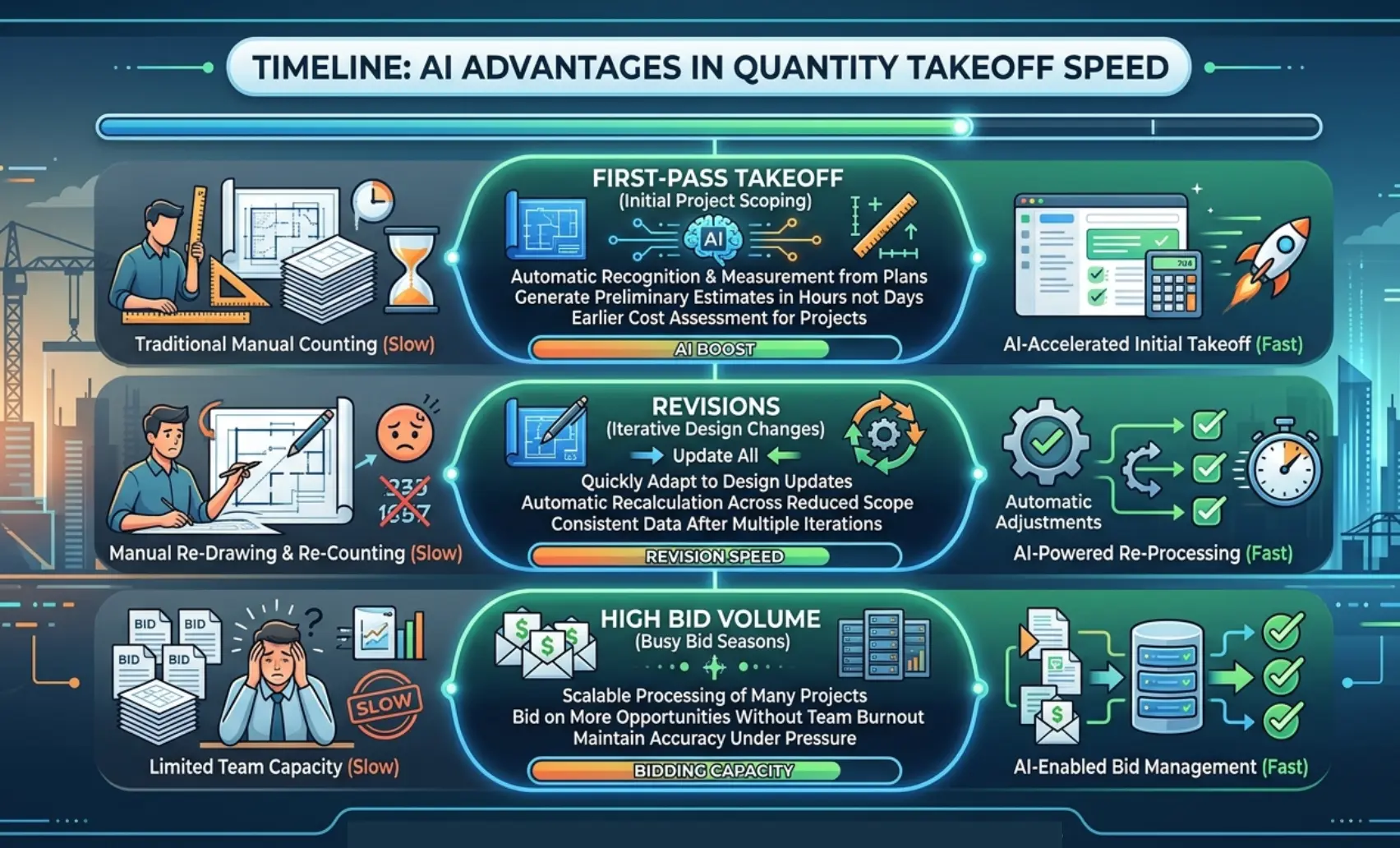
Speed is where AI-assisted quantity takeoffs deliver their clearest, most consistent advantage. Here is where that advantage is largest, and where it has limits.
First-Pass Takeoffs
The first pass is where AI delivers the most measurable time reduction. Counting doors, fixtures, and devices across 50 sheets manually takes hours. AI tools complete the same count in minutes.
Autodesk cites examples where 2D and 3D takeoff workflows reduced manual effort significantly, with one case study showing quantity takeoff time cut by more than 50% on comparable project types.
That time recovery changes how estimators work. Instead of spending 60% of their bid preparation time on measurement, they spend it reviewing risk, checking scope coverage, and refining pricing, the activities that actually win bids.
Revisions and Addenda
Addenda management is one of the most time-consuming and error-prone parts of any bid, and AI version comparison tools address it directly.
- AI tools can compare two versions of a drawing set and flag geometric changes, such as walls moved, rooms resized, and fixtures relocated
- Revision control matters as much as measurement speed in competitive bid management; a missed addenda change on a concrete or MEP scope can swing a bid by tens of thousands of dollars
- A human estimator still must decide whether the flagged change affects scope, pricing, exclusions, or the subcontractor scope packages; that judgment call is not delegable to any current AI tool
Bid Volume
The highest-leverage benefit of AI-assisted takeoffs is not faster individual bids; it is more bids pursued per cycle without proportionally increasing estimating headcount.
- AI first-pass takeoffs allow estimators to screen more opportunities quickly, identifying which bids warrant full investment and which should be passed based on early quantity signals
- Estimators focus on higher-risk, higher-value packages where their judgment delivers the most pricing advantage
- Remote takeoff support absorbs routine production work, quantity counting, drawing organization, revision comparison, freeing senior estimators entirely for scope review and bid strategy
Remote AE’s remote estimator support model connects quantity takeoff production directly with bid coordination, quote tracking, and proposal assembly, while keeping pricing decisions and risk assessment under the client’s control.
Risk Comparison: Where Traditional Methods Still Win
Speed and automation have real limits in construction estimating. Three categories of risk consistently favor experienced human judgment over AI output.
Scope Judgment
Scope interpretation is the estimator’s highest-value contribution, and the one most resistant to automation.
- Specification-driven quantities: Concrete mix designs, insulation specifications, finish schedule requirements, quantities driven by written specifications require reading comprehension and construction knowledge, not pattern recognition
- Scope notes and clarifications: Notes buried in detail sheets, general conditions, and division 01 specifications frequently modify what the drawings show. AI tools do not read or apply these modifications reliably
- Alternates and exclusions: Bid alternates require the estimator to understand what the owner is asking for and price it separately. Exclusions require judgment about what falls outside the contracted scope. Neither is a measurement task.
- Inclusions not shown: Experienced estimators know that some scope items, such as temporary facilities, site logistics, and phasing costs, are not drawn anywhere but must be included in the cost estimate. AI tools cannot identify what is absent from a drawing set.
Complex Trade Conditions
Certain trade scopes consistently exceed the reliable capability of current AI takeoff tools.
- Mechanical systems: Equipment schedules, duct routing in congested ceiling spaces, and equipment connections require reading both plans and specifications simultaneously
- Plumbing risers: Vertical pipe routing through multiple floors requires understanding the building section and plan simultaneously, a spatial reasoning task that flat 2D drawing AI handles poorly
- Electrical panels and device logic: Panel schedules, circuit assignments, and device counts involve reading schedules as much as plans
- Existing-condition drawings: Renovation and retrofit projects require the estimator to understand what exists, what changes, and what the net new scope is a judgment task requiring field knowledge and drawing interpretation that AI cannot perform
Accountability During Bid Review
Every quantity in a bid-ready cost estimate must be defensible, traceable to a specific sheet, a confirmed scale, and a documented assumption.
- Can each quantity be traced back to the drawing sheet that generated it?
- Is the scale confirmed for every sheet in the takeoff
- Are assumptions documented, waste factors, rounding conventions, scope inclusions, and exclusions?
- Can a reviewer, owner, subcontractor, or senior estimator audit the takeoff and defend every number without returning to the source drawings?
Best Workflow: AI-Assisted Takeoff + Human QA
The highest-performing estimating teams in preconstruction are not choosing between AI and traditional methods. They are combining both, using AI to accelerate production and human review to validate accuracy and scope coverage.
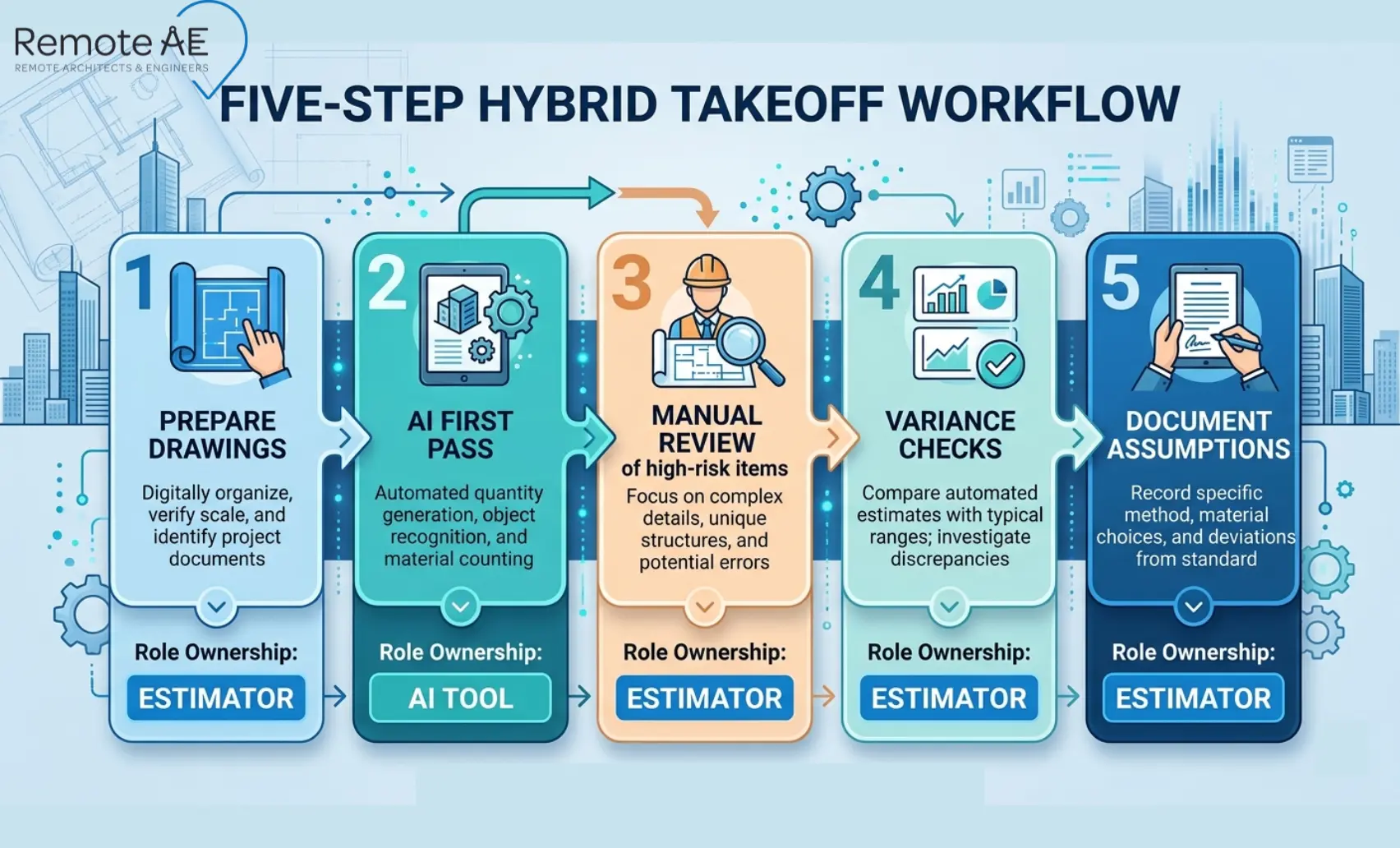
Here is the five-step hybrid workflow.
Step 1: Prepare the Drawing Set
Garbage in, garbage out; drawing preparation determines AI output quality before the tool runs.
- Confirm drawing date and revision level, identify the current addenda, and pull all superseded sheets
- Confirm scale calibration on every sheet, particularly on scanned drawings or older plan sets
- Organize sheets by discipline and level; consistent organization accelerates AI processing and reduces missed-sheet risk
- Separate addenda from the base drawing set, process them as a distinct comparison task, not as part of the primary takeoff run
- Flag sheets with poor scan quality, non-standard symbols, or complex overlay conditions for manual review before the AI pass begins
Step 2: Run AI-Assisted First Pass
With a clean, organized drawing set confirmed, run the AI takeoff across the full scope.
- Counts, doors, fixtures, devices, equipment units
- Areas, floor areas, wall areas, roofing, paving
- Lengths, walls, pipe, conduit, curb, structural members
- Repeated symbol recognition, standardized items across multiple floors or buildings
- Version comparison against the previous drawing set or addenda revision
Export the raw AI quantity output before any manual adjustment, and preserve the baseline for QA variance checking.
Step 3: Review High-Risk Items Manually
AI output on a complex scope requires an estimator review before it enters the cost estimate.
- MEP systems: Review all mechanical, electrical, and plumbing quantities against equipment schedules and specification sections; do not rely on AI counts for panel schedules, riser diagrams, or duct takeoffs
- Structural details: Verify connection hardware, rebar schedules, and embed quantities against structural notes and specifications
- Renovation scope: Manually review all demolition and existing-condition quantities. AI cannot reliably distinguish existing from new work
- Alternates: Manually scope every bid alternate; AI tools do not identify alternate scope boundaries
- Long-lead materials: Review AI quantities for major equipment, specialty systems, and long-lead items against the specifications before these quantities drive procurement decisions
Step 4: Use Variance Checks
Variance checks are the QA mechanism that catches AI errors before they reach the bid.
- Compare AI-generated quantities against similar past projects; significant deviations in cost per square foot or unit quantities warrant investigation before acceptance
- Check quantity ratios, concrete to formwork, linear feet of pipe to fixture count, square feet of flooring to room count; ratios outside expected ranges signal a potential AI recognition error
- Review outliers, quantities that are unusually high or low compared to the drawing set’s apparent scope
- Sample 10–20% of AI-generated measurements manually, spot-check counts and area measurements against the source drawings to confirm AI accuracy on the specific project type
Step 5: Document Assumptions
A quantity takeoff is only as defensible as its documentation.
- Record the sheet reference for every major quantity, which sheet, which detail, which revision
- Document scope notes, what is included, what is excluded, what was estimated or assumed, where drawings were unclear
- Record waste factors applied, concrete overpour, flooring waste, pipe fitting allowances
- Note all addenda references, which addenda were incorporated, and which quantities they affected
- Require reviewer initials on the final QA checklist before the quantities feed the cost estimate
This documentation is not administrative overhead. It is the audit trail that protects the estimator, the general contractor, and the subcontractor when a scope dispute arises during construction.
When Should Contractors Use AI-Assisted Takeoffs?
Use AI-Assisted Takeoffs When
AI delivers its strongest results under these conditions:
- The plan set is clean, well-organized PDFs from a CAD or BIM export, not scanned drawings
- Scope is repetitive, standard floor plates, repeated unit types, consistent symbol libraries
- You need a fast first pass, bid screening, early budget, or preliminary scope coverage check
- Bid volume is high, and more opportunities require faster initial quantity production
- A reviewer is available, a trained estimator or remote assistant will QA the output before it is priced
- Quantities can be traced back to specific drawing sheets, and the AI tool supports source attribution
Be Careful When
AI takeoff output carries meaningful risk in these scenarios:
- Drawings are incomplete, scanned, or poorly organized; OCR and computer vision accuracy degrade significantly
- The project is renovation-heavy; existing conditions, demolition scope, and phasing require human interpretation
- MEP scope drives high cost; mechanical, electrical, and plumbing quantities need manual review regardless of the AI tool used
- Specifications drive major quantities, insulation, concrete, and finishes specified by performance rather than shown by dimension
- The estimator has no time to review AI output; unreviewed AI quantities in a bid-level cost estimate are a liability, not an asset
Use Remote Estimating Support When
Remote estimating support fills the gap between the AI tool’s capabilities and bid-ready output.
- Senior estimators are at capacity, takeoff production is blocking pricing work, and bid deadlines are being missed
- Bid volume exceeds internal estimating bandwidth; more opportunities are available than the in-house team can pursue
- Takeoff work is consuming estimator time that should go to scope judgment and subcontractor management
- The firm needs trained AEC estimating help without the overhead of a full-time local hire
Why Remote AE Fits Into This Shift
The demand for skilled remote estimators is growing as AI takeoff tools become standard in preconstruction workflows. AI accelerates quantity production, but it creates a downstream need for trained reviewers to validate outputs, apply scope judgment, and assemble bid-ready packages.
Remote AE virtual assistants fill exactly that role, handling takeoff production, AI output review, drawing organization, and bid coordination while senior estimators focus on pricing, risk, and client relationships.
Why AEC firms choose Remote AE for estimating support:
- Industry-specific expertise: Every Remote AE assistant is trained in AEC estimating workflows. No generic staffing platform provides this depth.
- Guaranteed quality and reliability: Takeoff output meets your defined QA standards or the issue gets resolved immediately
- No long-term commitment: Engage for bid season, a specific project phase, or as an ongoing estimating resource; the model adapts to your pipeline
- No upfront costs: Consult with Remote AE without any initial financial burden. No cost or obligation until the contractual phase begins
- Risk-free replacement: In the first year, Remote AE provides risk-free replacements for up to two virtual assistants if a placement does not meet your standards
- Proven results: 52% of first-time Remote AE clients hire a second remote assistant within their first year, a direct reflection of the output quality and workflow integration Remote AE delivers
Remote AE has provided virtual assistants tailored specifically for the AEC industry for more than 15 years, covering quantity takeoff support, bid management coordination, document control, and preconstruction administration for general contractors and subcontractors at every scale.
Add Estimating Capacity Without Adding Overhead!
AI-assisted quantity takeoffs are changing how preconstruction teams work, but the firms winning more bids are combining AI speed with trained human review, not replacing one with the other.
Remote AE places pre-vetted virtual AEC assistants trained in quantity takeoff production, AI output review, drawing organization, and bid coordination, ready to integrate into your estimating workflow from week one.
Stop letting takeoff production bottlenecks limit your bid volume.
Book a Free Consultation with Remote AE Today, no obligation, no pressure. Just a direct conversation about what your estimating team needs to pursue more work and win more bids.
FAQs – AI-Assisted Quantity Takeoffs
Are AI-assisted quantity takeoffs more accurate than manual takeoffs?
Not automatically. AI can be faster and more consistent on clean drawings, but accuracy depends on drawing quality, symbols, scale, and training data. Manual review is still required. The best workflow uses AI for first-pass quantities and an estimator for validation, scope judgment, and pricing decisions.
Can AI replace construction estimators?
No. AI can speed up measuring, counting, and organizing quantities, but estimators still handle scope interpretation, exclusions, labor productivity, vendor quotes, risk, and bid strategy. AI is a support tool, not a replacement for professional estimating judgment.
What types of takeoffs are best suited for AI?
AI works best on repetitive, clearly drawn scopes such as walls, doors, rooms, finishes, fixtures, and simple linear measurements. It performs better when drawings are consistent and symbols are standardized. Complex assemblies, unclear details, and mixed-scope drawings still need experienced human review.
What is the difference between digital takeoff and AI-assisted takeoff?
Digital takeoff uses software tools where the estimator manually measures and counts from plans. AI-assisted takeoff uses machine learning to detect objects or areas automatically. Digital takeoff improves speed over paper; AI-assisted takeoff reduces manual clicking but needs stronger validation.
Where do AI takeoff tools make the most mistakes?
Common errors include missed symbols, duplicate counts, wrong scale, unclear boundaries, and misclassified objects. AI may also struggle with rotated sheets, low-quality scans, overlapping annotations, and inconsistent plan graphics. These mistakes can materially affect estimates if not checked.