
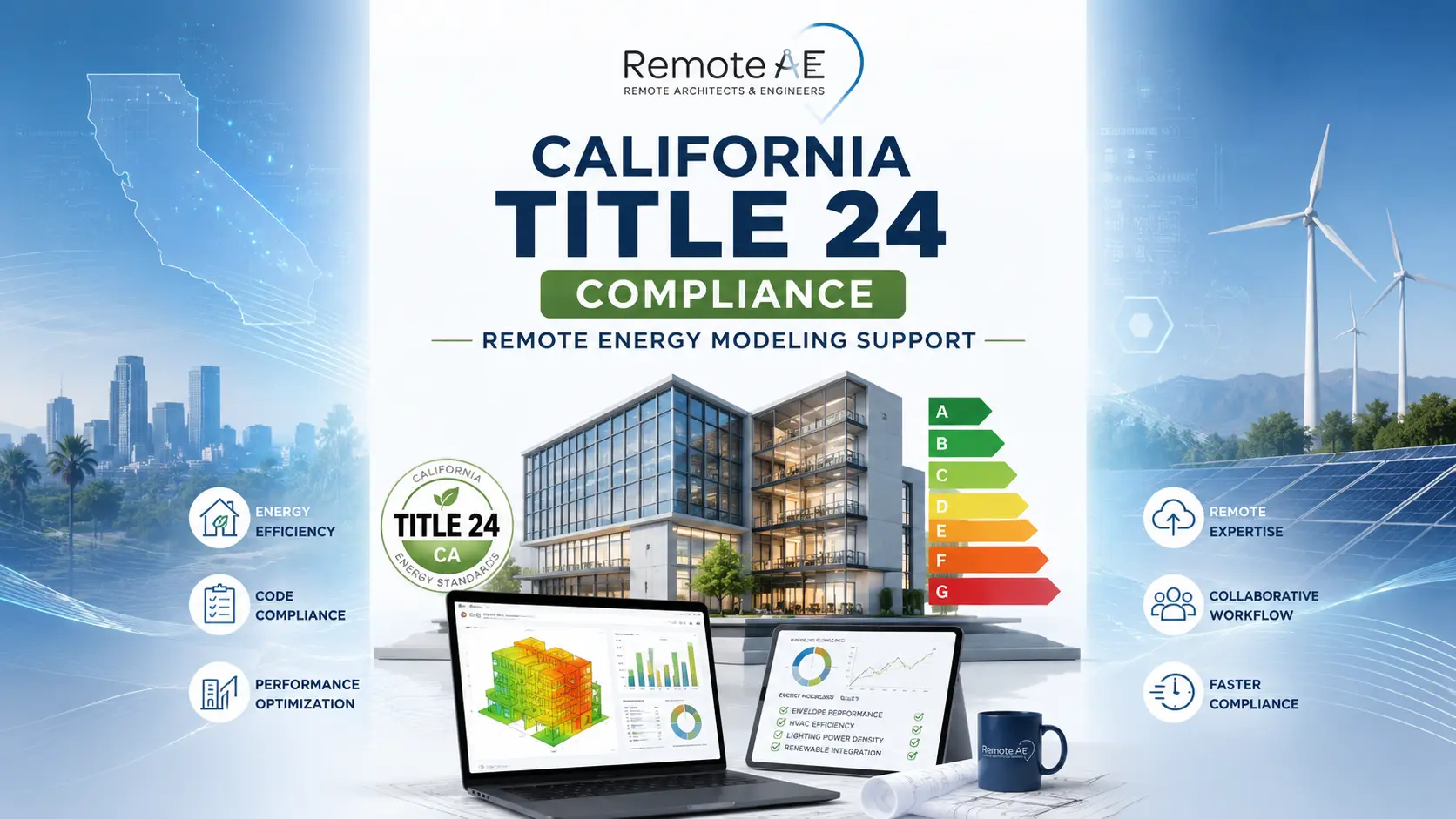
California’s Building Energy Efficiency Standards, Title 24 Part 6, are among the most demanding energy codes in the United States, and keeping up with them requires more than a compliance report. The California Energy Commission estimates that the 2025 Energy Code will reduce energy use in new buildings by approximately 30% compared to the 2019 standards, a target that directly affects how architects, engineers, and contractors design and document every California project. For AEC firms managing multiple active projects, remote energy modeling support, from CBECC and EnergyPro modeling through CF1R and NRCC documentation, provides the compliance capacity that in-house teams cannot always sustain.
What Title 24 Compliance Means for California AEC Teams
Title 24 Part 6 is California’s Building Energy Efficiency Standards, published by the California Energy Commission and updated on a roughly three-year code cycle. It applies to new construction, additions, alterations, and tenant improvements across residential, multifamily, and nonresidential building types throughout California.
Title 24 compliance is not a post-design checklist. It is a design coordination issue that affects building envelope decisions, HVAC system selection, lighting controls, water heating, and solar PV requirements from the earliest design phase.
A window specification change, a mechanical system substitution, or a glazing ratio revision can invalidate a compliance report that was prepared for an earlier design iteration, triggering plan check corrections and permit delays.
Why the 2025 Energy Code Matters Now
The 2025 Energy Code, formally adopted by the California Energy Commission, applies to permit applications submitted on or after January 1, 2026. Projects with applications submitted before that date may still reference the 2022 standards, depending on application timing and jurisdiction.
Key changes in the 2025 Energy Code that AEC teams need to track:
- Heat pump expansion: The 2025 standards expand heat pump requirements for space heating and water heating in new residential buildings, affecting HVAC and plumbing system specifications
- Electric readiness: New residential buildings must include electrical infrastructure to support future EV charging and all-electric appliances
- Ventilation standards: Strengthened indoor air quality and ventilation requirements affect mechanical design and energy modeling inputs
The California Energy Commission confirms these as central provisions of the 2025 update. AEC firms with active California projects must confirm which code cycle governs each permit application before modeling begins.
Projects That Require Title 24 Documentation
Title 24 compliance documentation is required for:
- New construction projects, all occupancy types
- Tenant improvements, when HVAC, lighting, or envelope work is included in the scope
- Additions and alterations, triggered by scope thresholds defined in the California Energy Code
- HVAC upgrades and replacement systems must meet current equipment efficiency requirements
- Lighting retrofits, fixture replacements that exceed defined scope thresholds, trigger lighting compliance documentation
Where Energy Modeling Fits Into Title 24 Compliance
Prescriptive Path vs Performance Path
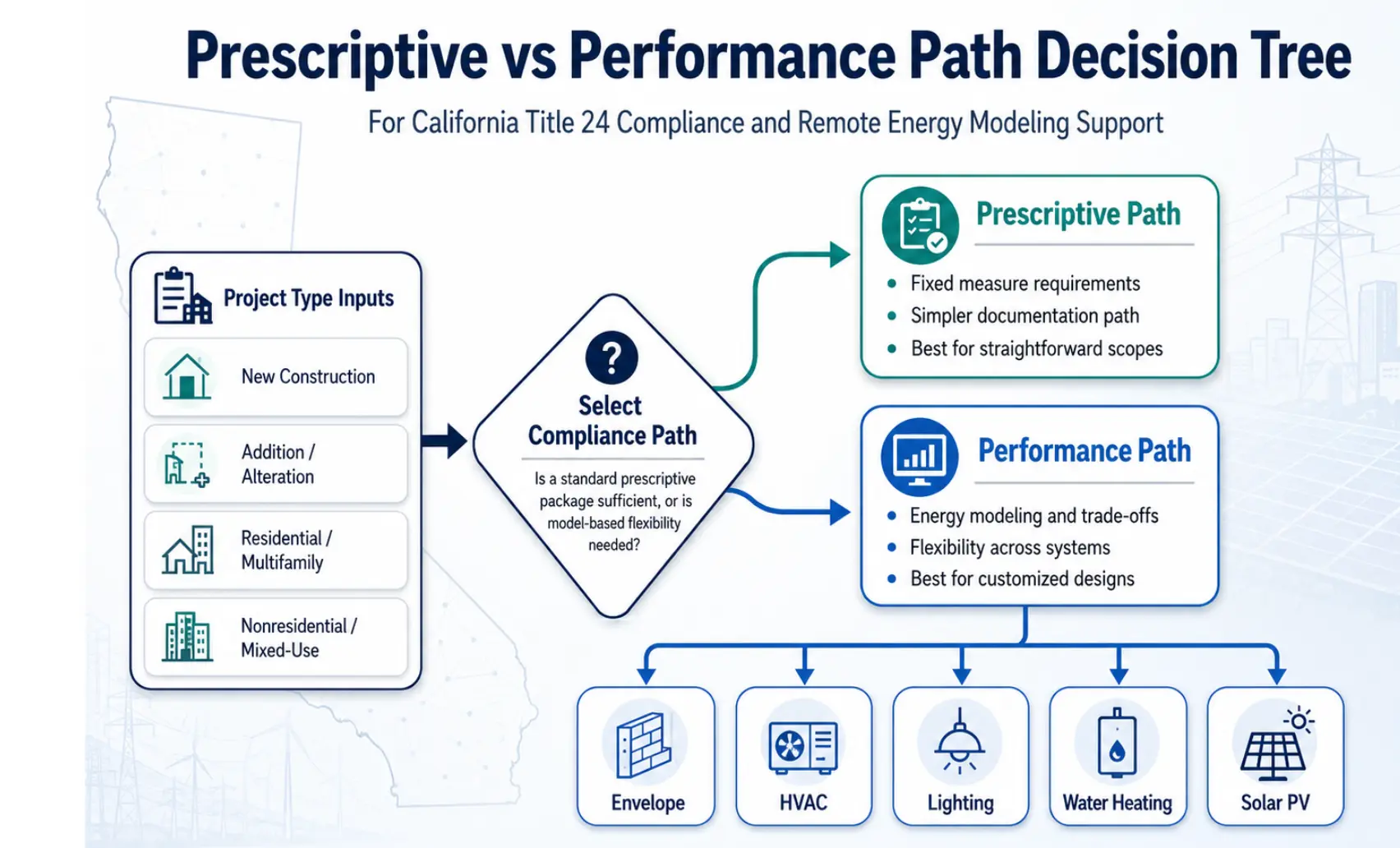
Title 24 Part 6 offers two compliance paths, and choosing the wrong one for a project type wastes modeling time or limits design flexibility.
- Prescriptive path: Fixed requirements for each building system, insulation R-values, HVAC efficiency ratings, and lighting power density limits. No whole-building modeling required. Works well for straightforward projects with standard systems.
- Performance path: Whole-building energy modeling against a code-defined baseline building. The proposed design must perform equal to or better than the baseline across all energy end uses. Required or preferred for custom homes, multifamily projects, complex remodels, and commercial buildings where prescriptive requirements would constrain design flexibility or where trade-offs between systems offer a compliance advantage.
What Energy Modeling Checks
A Title 24 performance model evaluates five primary compliance categories, and all five must be correctly characterized for the model to produce a valid compliance result.
- Building envelope: Insulation R-values, roof assembly U-factor, wall assembly U-factor, glazing U-factor and SHGC, fenestration area by orientation, and California climate zone assignment
- HVAC system: Equipment type, efficiency ratings (SEER2, HSPF2, AFUE), duct location and insulation, ventilation rates, and heat pump configuration under 2025 requirements
- Lighting controls: Fixture wattage, lighting power density, occupancy sensors, daylighting controls, and demand-responsive controls where required
- Water heating: System type, efficiency, storage volume, distribution system losses, and solar water heating credit, where applicable
- Solar PV and battery readiness: Required PV system size for new residential construction, battery storage readiness provisions under 2025 standards
Approved Software and Documentation
The California Energy Commission approves specific software tools for Title 24 compliance modeling, and the right tool depends on the project type.
- CBECC-Res: CEC-approved residential compliance software for single-family and low-rise multifamily projects
- CBECC: CEC-approved nonresidential compliance software for commercial and high-rise multifamily projects
- EnergyPro: The most widely used third-party CEC-approved compliance tool, covers both residential and nonresidential applications, and is accepted by most California AHJs
- IESVE: Used for complex commercial energy modeling where detailed HVAC simulation and system-level analysis are required beyond standard compliance modeling capability
No single tool fits every project type. The compliance output, CF1R for residential, NRCC for nonresidential, must match the actual project scope and the software’s approved application range for the AHJ’s plan check acceptance.
How Remote Energy Modeling Support Solves All Problems
Access to Dedicated Remote Specialists
Remote energy modeling specialists work as a direct extension of your in-house team, handling CBECC, EnergyPro, and IESVE modeling workflows without requiring the firm to hire and retain a full-time energy compliance specialist.
- Experienced Title 24 modelers familiar with CF1R and NRCC documentation requirements across California climate zones
- Flexible staffing based on project volume, scale up during permit pushes, scale back during quieter production periods
Faster Turnaround for Compliance Reports
Title 24 compliance reports requested late in the design process consistently cause permit delays, and those delays compound when design changes invalidate a report that was already prepared.
- Overnight production support, remote specialists in aligned time zones process model inputs and return updated compliance reports before the next business day begins
- Reduced bottlenecks during permit phases, energy documentation moves in parallel with construction document production, rather than waiting for the CD set to finalize
Lower Operational Costs
Maintaining a full-time in-house Title 24 energy consultant is expensive and inefficient for firms with variable California project volume.
- Avoid full-time hiring costs, salary, benefits, software licensing for CBECC or EnergyPro, and training overhead
- Scalable support without long recruitment cycles, remote AEC assistant capacity activates in days, not months
Better Coordination Across AEC Teams
Title 24 compliance touches every discipline: architecture, mechanical, electrical, and plumbing. Remote energy modeling support works within your existing project coordination tools.
- Remote collaboration with architects, engineers, and consultants through Autodesk Construction Cloud, Procore, Bluebeam, and shared drive environments
- Shared workflows that keep energy model assumptions aligned with current construction documents across every design revision
Support Across Multiple Project Types
- Custom residential and ADU projects
- Multifamily developments, low-rise and high-rise
- Commercial tenant improvements with HVAC or lighting scope
- Mixed-use projects requiring both residential and non-residential compliance paths
- Hospitality and healthcare facilities with complex HVAC and lighting control requirements
Services Included in Remote Title 24 Energy Modeling Support
Title 24 Documentation Preparation
- Preparing CF1R compliance forms for residential projects, correctly completed, correctly registered in CHEERS, and formatted for AHJ submission
- Preparing NRCC compliance forms for nonresidential projects, covering all applicable compliance categories and matching the current code cycle
- Assembling permit-ready submission packages, compliance reports, supporting forms, and plan check checklists organized to the AHJ’s requirements
Energy Calculations and Performance Analysis
- HVAC load calculations supporting equipment selection and compliance modeling inputs
- Lighting energy analysis, fixture schedule review, lighting power density calculations, and controls compliance verification
- Building envelope studies, U-factor and SHGC calculations for proposed assemblies, fenestration area tabulations by orientation, and climate zone compliance assessment
Plan Review Assistance
- Reviewing construction documents against energy model assumptions before permit submission, identifying window schedule mismatches, insulation conflicts, and HVAC specification discrepancies
- Preparing plan check response packages when AHJ corrections identify compliance gaps
- Reducing repeat plan check comments by catching model-to-drawing inconsistencies before the first submission
Revisions and Resubmittals
- Updating energy models after design changes, new glazing ratios, mechanical system substitutions, insulation assembly revisions, or lighting plan updates
- Fast response to AHJ plan check comments, revised compliance reports, and updated supporting documentation turned around within 24 to 48 hours of comment receipt
Drafting and BIM Coordination Support
- AutoCAD and Revit drawing support, updating mechanical schedules, window schedules, and energy notes to align with the current compliance model
- MEP coordination updates, confirming that mechanical, electrical, and plumbing drawings reflect the HVAC system, lighting controls, and water heating configuration modeled in the compliance report
Why Title 24 Reports Get Delayed or Rejected
The Biggest Issue: Plans and Energy Documents Do Not Match
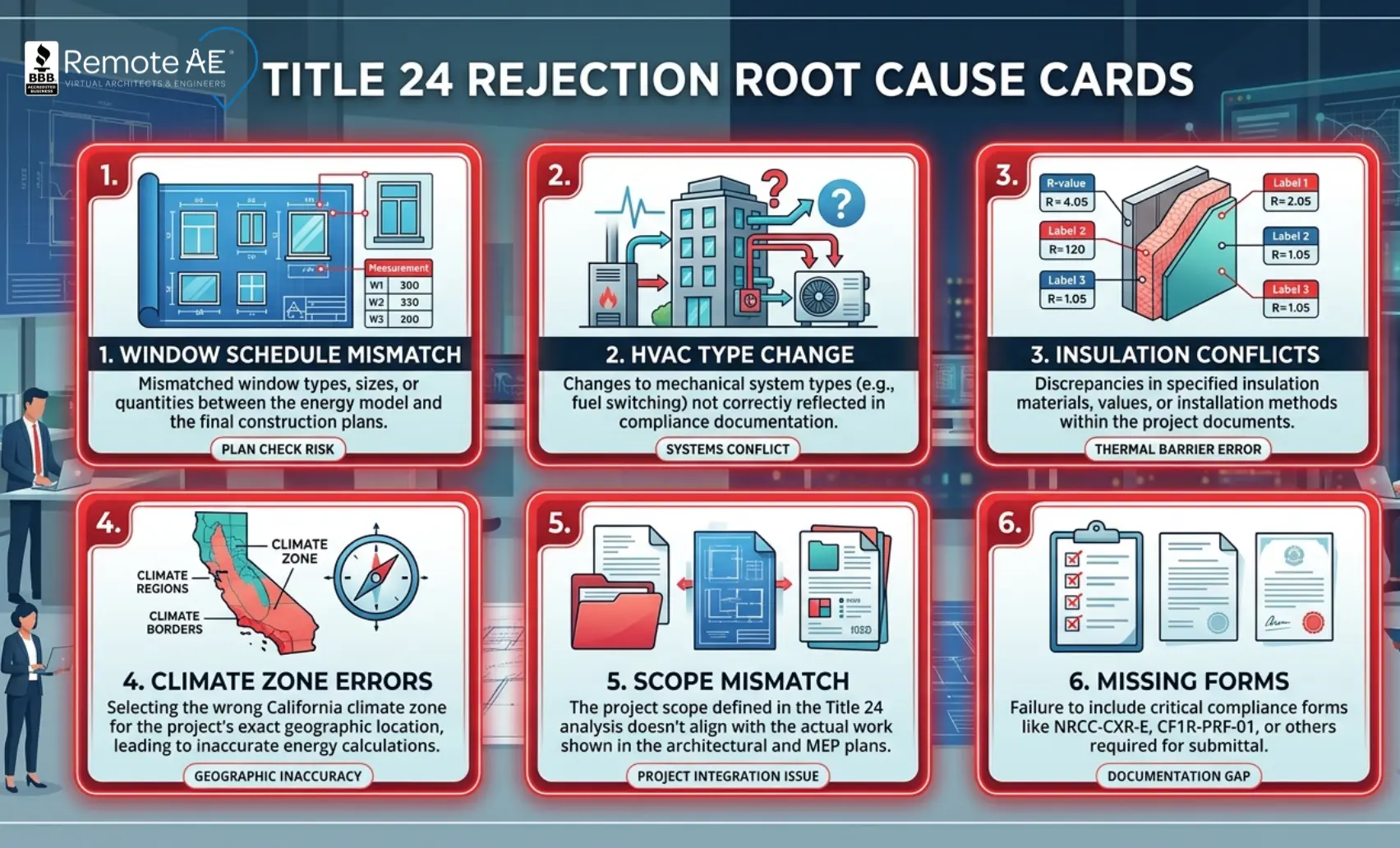
The most common cause of Title 24 plan check corrections is a discrepancy between what the energy compliance report shows and what the construction documents show. Plan examiners compare both, and any mismatch generates a correction.
Common mismatches that trigger corrections:
- Window schedules differ from the compliance report: Fenestration area, U-factor, or SHGC values on the architectural window schedule do not match the CF1R or NRCC compliance output
- HVAC system type changed after modeling: The mechanical contractor substituted a different equipment type or efficiency rating after the compliance model was completed, invalidating the HVAC compliance assumptions
- Insulation notes conflict with sections and details: Wall, roof, or floor assembly R-values shown in building sections or details differ from the assembly inputs used in the energy model
- Climate zone errors: The wrong California climate zone was assigned during modeling, a particularly common error for projects near climate zone boundaries or for out-of-state firms unfamiliar with CEC climate zone mapping
- Scope mismatch: The compliance report was prepared for new construction, but the project scope is an addition or alteration, triggering a different compliance path and different documentation requirements
- Missing forms, signatures, or CHEERS registry steps: Residential compliance reports that are not properly registered in CHEERS or that are missing required installer or designer signatures are rejected at plan check, regardless of the modeling accuracy
Why Remote Support Helps Before Submission
A second reviewer who specifically compares the energy compliance documents against the construction document set catches most of these errors before they reach the plan examiner.
- Remote AEC assistants compare window schedules, mechanical schedules, and insulation details against CF1R or NRCC inputs before submission, flagging discrepancies for the energy consultant or RDP to resolve
- Structured model-to-drawing QA checklists reduce repeated plan check comments by ensuring the same verification steps run on every project submission
- Faster updates after design revisions, when a window substitution or mechanical change occurs late in CD production, remote support turns around an updated compliance report before the permit application is delayed
How to Build a Remote Title 24 Support Workflow
Step 1: Collect the Right Project Inputs
Energy modeling cannot begin without complete, verified project inputs. Missing or incorrect inputs at this stage produce compliance reports that fail plan check, regardless of the modeling tool used.
Collect before modeling begins:
- Project address and California climate zone confirmation
- Occupancy type and scope of work: new construction, addition, alteration, or tenant improvement
- Floor plans, elevations, and building sections
- Window and door schedules, area, U-factor, SHGC, and frame type
- Wall, roof, and floor assembly details, insulation type, and R-value per layer
- Mechanical schedules, HVAC equipment type, efficiency ratings, duct location, and ventilation rates
- Lighting plans, fixture type, wattage, and controls
- Water heating system type, efficiency, and storage details
- Solar PV system size and battery readiness notes, where applicable
- Prior plan check comments from previous submissions on the same project
Step 2: Assign Clear Roles
Title 24 compliance involves multiple disciplines, and overlapping responsibilities without clear ownership is what causes model-to-drawing mismatches.
- Architect: Owns design intent, building envelope, glazing ratios, and assembly specifications
- MEP engineer: Owns system basis, HVAC equipment, lighting design, water heating, and MEP coordination
- Energy consultant: Owns compliance modeling and report output, CBECC, EnergyPro, or IESVE modeling, CF1R or NRCC preparation, HERS and CHEERS coordination
- Remote AEC assistant: Owns tracking, data preparation, cross-checking, and documentation support, comparing construction documents against model inputs and flagging discrepancies before submission
- Permit coordinator: Owns submission requirements, AHJ checklist, upload naming, and plan check response coordination
Step 3: Use a Model-to-Drawing QA Checklist
Run this checklist on every Title 24 project before permit submission:
- Project address on the compliance report matches the permit application and drawings
- Scope of work matches the compliance path selected, new construction vs. addition vs. alteration
- California climate zone confirmed against the CEC climate zone map for the project address
- Fenestration area and SHGC values on the window schedule match CF1R or NRCC inputs
- Insulation R-values in wall, roof, and floor details match assembly inputs in the compliance model
- HVAC equipment type and efficiency ratings on the mechanical schedule match the modeled system
- Lighting controls shown on electrical plans match lighting compliance inputs
- Compliance forms are current for the correct code cycle, 2022 or 2025, based on the application date
- HERS verification items are identified and flagged for field inspection coordination
- Required energy compliance notes are visible on the drawing set
Step 4: Keep Revision Control Tight
Design changes after modeling begins are the primary cause of invalidation of the compliance report. Structured revision control prevents the most common causes of plan-check rejections.
- Date every energy model input set, “issued for modeling” vs. “issued for permit” versions, tracked separately
- Log every design change that affects a compliance input, glazing substitution, mechanical system change, insulation revision, or lighting update
- Flag any change that triggers a compliance model update before the permit application advances
- Store model assumptions in a shared log accessible to the architect, energy consultant, and remote AEC assistant, so no change is applied to drawings without the compliance team knowing
When AEC Firms Should Hire Remote Energy Modeling Support
Best-Fit Project Types
Remote Title 24 energy modeling support delivers the most value on these project types:
- Custom residential projects: Performance path modeling with complex envelope and HVAC trade-offs requires dedicated modeling support that general practice architects cannot always provide internally
- ADUs with tight permit timelines: Accessory dwelling unit projects often have compressed permit schedules, and remote support accelerates CF1R preparation without adding permanent overhead
- Multifamily developments: Low-rise and high-rise multifamily projects require both CBECC-Res and CBECC modeling capability, depending on building height. Remote specialists familiar with both tools add flexibility
- Tenant improvements: HVAC and lighting scope changes in commercial TIs trigger NRCC documentation, and remote support handles compliance updates as the mechanical scope evolves
- Commercial projects with complex HVAC or lighting: Projects with multiple HVAC zones, daylighting controls, or demand-responsive lighting benefit from IESVE modeling capability that most in-house teams don’t maintain
- Firms outside California taking on California work: Out-of-state AEC firms entering the California market rarely have in-house Title 24 expertise; remote energy modeling support provides immediate compliance capability
Signs Your Team Needs Support
- Permit comments keep repeating the same Title 24 corrections across multiple projects, indicating a systematic model-to-drawing QA gap
- Energy compliance reports are being requested late in the CD phase, rather than running parallel with design development
- Senior architects or engineers are performing energy takeoffs and compliance documentation instead of focusing on design and client coordination
- MEP and architectural sheets are not aligned. Mechanical schedules, window schedules, and insulation details conflict with the compliance report at plan check
- The firm has a growing California workload, but not enough in-house code production capacity to handle compliance documentation across all active projects simultaneously
What to Ask Before Hiring
Before engaging any remote energy modeling support, confirm these capabilities:
- Do they understand AEC drawings? Can they read window schedules, mechanical schedules, and building sections to extract compliance inputs accurately?
- Can they work in Revit, AutoCAD, Bluebeam, Autodesk Construction Cloud, or your firm’s project management system?
- Can they support model input preparation and model-to-drawing QA, not just deliver a compliance report?
- Are they available full-time, part-time, or task-based, and does that match your project volume?
- Who reviews their work before it goes to the energy consultant or AHJ?
- Can they coordinate directly with your energy consultant on input revisions and resubmittals?
- How do they handle data security and client confidentiality on sensitive project data?
Why Remote AE Is Built for AEC Firms
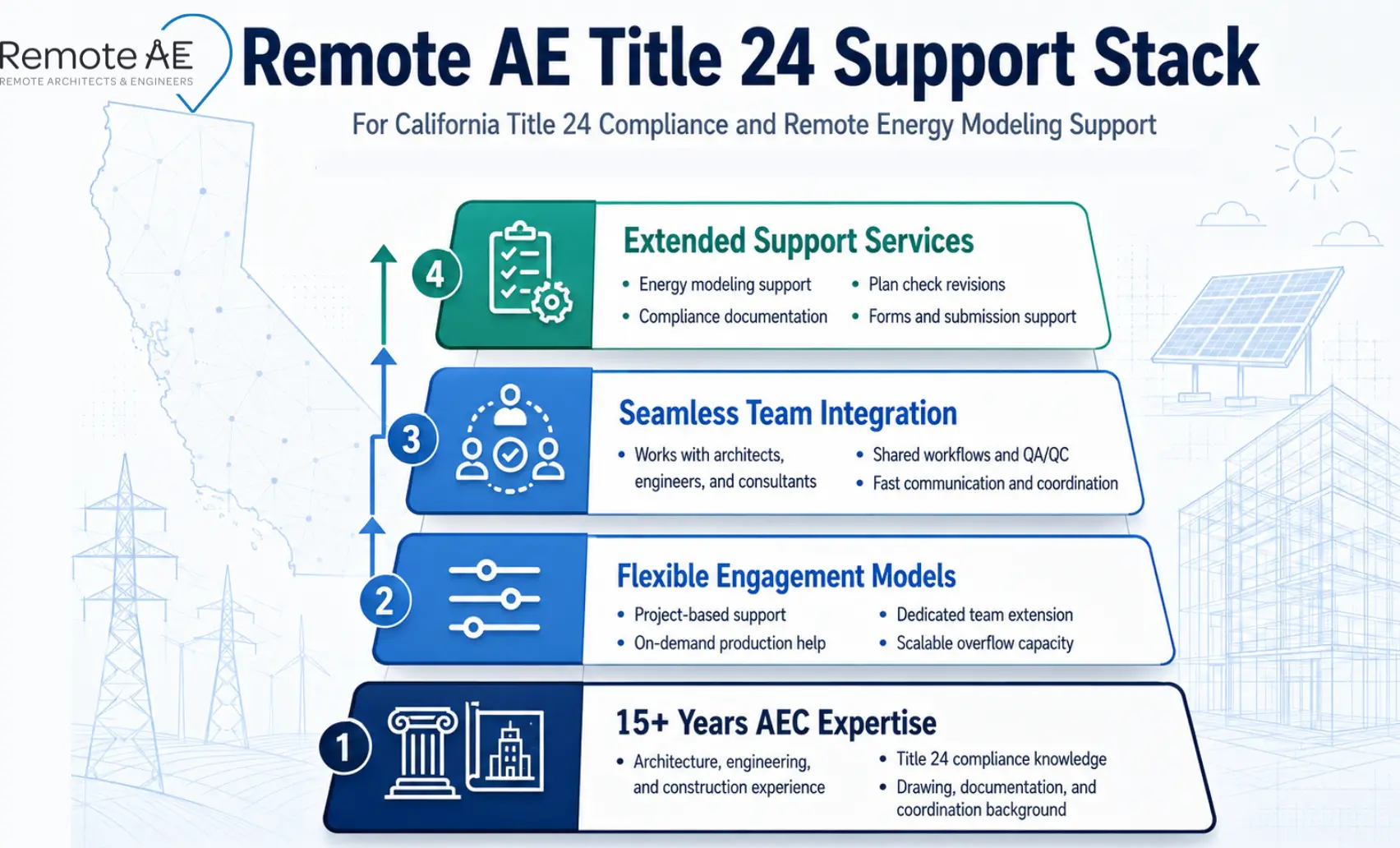
Remote AE has provided virtual assistants tailored specifically for architecture, engineering, and construction firms for more than 15 years. Every remote AEC assistant is selected and vetted against real AEC workflows, not general administrative criteria.
That AEC-specific depth matters in Title 24 support. An assistant who understands construction documents, reads mechanical schedules, and knows the difference between a CF1R and an NRCC does not need to be trained on AEC fundamentals before contributing to a compliance workflow.
Remote Teams Tailored to Project Needs
Remote AE places three core role types relevant to Title 24 compliance support:
- Virtual architect assistants: Drawing production, redline application, window schedule updates, energy compliance note coordination, and permit package preparation
- Virtual engineering assistants: MEP drawing coordination, mechanical schedule updates, lighting plan support, and consultant document tracking
- Construction support professionals: Permit documentation, plan check response coordination, and closeout support
Flexible Engagement Models
Remote AE structures engagements around your project pipeline — not a fixed staffing model.
- Full-time remote staff: Dedicated capacity for firms with consistent California Title 24 workload across multiple active projects
- Part-time support: Targeted assistance during permit phases, plan check response cycles, or compliance report preparation windows
- Project-based assistance: Discrete support for a single project’s Title 24 documentation from input collection through CF1R or NRCC submission
Seamless Integration With Existing Teams
Remote AE assistants integrate into your existing project tools and communication rhythms, not the other way around.
- Collaboration across time zones, extended production hours support, overnight model input preparation, and next-day compliance report delivery
- Compliance documentation meets your defined QA standards, or the issue is resolved immediately
- No long-term commitment: Engage for a single permit cycle, a specific project phase, or as an ongoing compliance resource
- No upfront costs: Consult with Remote AE without any initial financial burden. No cost or obligation until the contractual phase begins
- Risk-free replacement: In the first year, Remote AE offers risk-free replacements for up to two virtual assistants.
Support Beyond Energy Modeling
Remote AE assistants support the full AEC project delivery workflow, not just Title 24 compliance.
- CAD drafting: AutoCAD drawing production, sheet updates, and permit set preparation
- BIM support: Revit modeling, sheet coordination, and construction document updates
- Construction documentation: Drawing coordination, specification support, and submittal preparation
- Permit assistance: Application package assembly, plan check tracking, and correction response coordination
Add Title 24 Compliance Capacity Without Adding Overhead!
California’s 2025 Energy Code raises the compliance bar, and AEC firms that treat Title 24 as a last-minute report request will continue losing permit time to plan check corrections. Remote AE places pre-vetted remote AEC assistants trained in Title 24 documentation workflows, ready to support your CF1R and NRCC preparation, model-to-drawing QA, HERS and CHEERS coordination, and plan check response from week one.
Stop letting Title 24 documentation bottlenecks delay your California permit submissions.
Book a Free Consultation with Remote AE Today, no obligation, no pressure. Just a direct conversation about what your Title 24 compliance workflow needs right now.
FAQs – California Title 24 Compliance
What is Title 24 compliance in California?
Title 24 refers to California’s building energy efficiency standards. It regulates lighting, HVAC, insulation, glazing, water heating, and overall energy performance for residential and nonresidential buildings. Projects must show compliance before permits are approved.
Do all California building projects need a Title 24 report?
Most new construction and many remodels or additions require some level of Title 24 documentation. The exact requirement depends on project type, occupancy, scope of work, and whether energy-related systems are being modified.
Can remote staff help with Title 24 compliance?
Yes. Remote teams can prepare drawings, gather building data, coordinate mechanical and lighting information, organize compliance forms, and support modeling workflows. Final review and approval should still be handled by the responsible consultant or licensed professional.
Who can prepare a Title 24 energy compliance report?
Title 24 reports are typically prepared by energy consultants, mechanical engineers, HERS raters, or trained building performance specialists using approved California compliance software. Requirements vary depending on the project and jurisdiction.
Why do Title 24 reports get rejected during plan check?
Common reasons include inconsistent drawings, incorrect glazing or lighting data, HVAC mismatches, missing forms, outdated software versions, and coordination gaps between architectural and MEP plans. Small discrepancies between the model and drawings often trigger comments.