
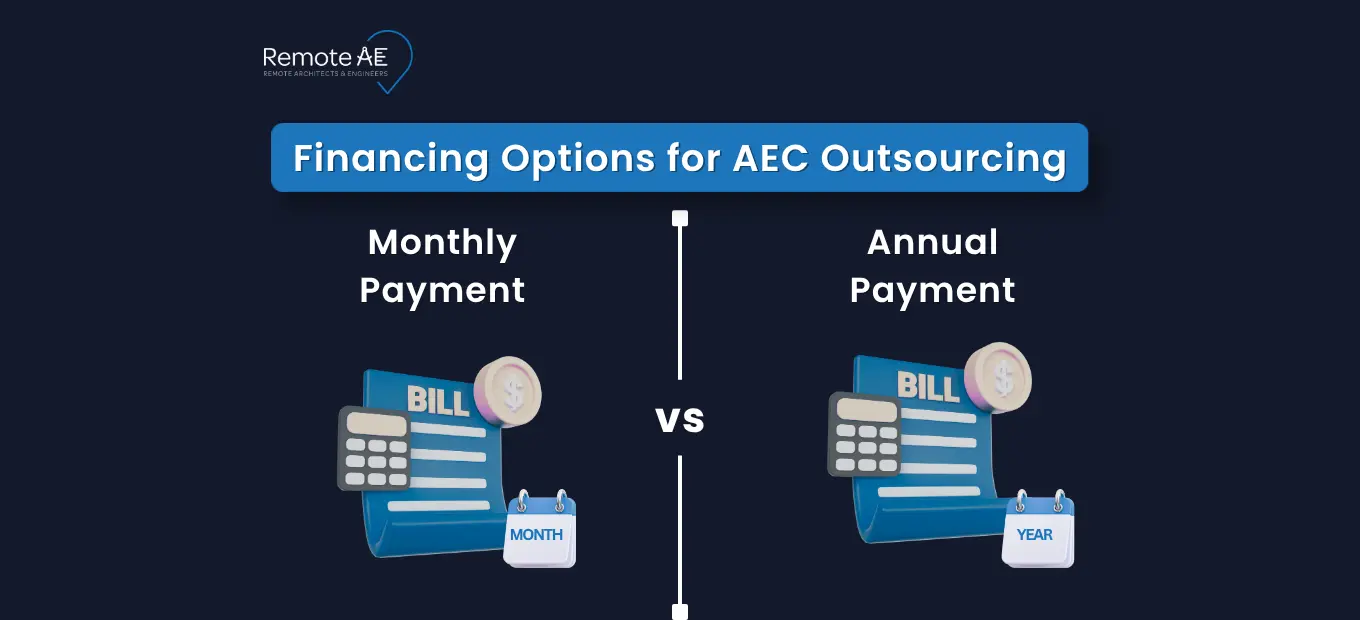
Choosing between monthly and annual payments for AEC outsourcing affects your cash flow, project pipeline, and long-term staffing strategy. Yet most Architecture, Engineering, and Construction (AEC) firms make this choice without a clear framework, only to pay for it later. This article breaks down both financing options for AEC outsourcing using real cost comparisons, decision criteria, and insights grounded in data from the U.S. Bureau of Labor Statistics, the American Institute of Architects (AIA), and the Associated General Contractors of America (AGC). Even if you’re piloting outsourcing for the first time or scaling an established remote team, you’ll leave with a clear path forward.
Why Payment Structure Matters in AEC Outsourcing
Most AEC firm principals focus on who they’re hiring when evaluating outsourcing. The smarter question is how the engagement is structured, because payment cadence shapes everything from budget approval to team continuity.
AEC outsourcing pricing models are not interchangeable. Monthly billing and annual billing create fundamentally different financial commitments, risk profiles, and operational dynamics. Getting this decision right from the start saves firms from costly mid-project restructuring.
Staffing Cost Is More Than Salary
The U.S. Bureau of Labor Statistics consistently shows that the true cost of an in-house AEC employee runs 1.25x to 1.4x their base salary when you add payroll taxes, benefits, software licenses, and administrative overhead.
AEC outsourcing removes most of that overhead by design. But the payment structure you choose still affects your total cost of ownership (TCO) in ways that aren’t obvious upfront.
- Monthly billing carries flexibility premiums; you pay more per unit for the ability to cancel or adjust
- Annual billing locks in a lower effective rate but requires a larger upfront commitment
- Both models carry indirect costs: onboarding time, platform access setup, and management bandwidth
An awareness of the full TCO of each option, not just the headline rate, is what separates firms that optimize outsourcing from those that just try it.
How Payment Cadence Affects Cash Flow, Bid Accuracy, and Hiring Speed
Payment structure ripples through three areas that most AEC leaders underestimate.
Cash flow is the most immediate impact. Monthly billing distributes cost evenly across the year, making it easier to absorb during slower billing periods. Annual billing front-loads the commitment but reduces per-month spend, which matters when you’re managing tight project margins.
Bid accuracy depends on predictable staffing costs. When you know your outsourcing spend twelve months out, you can build labor costs into project bids with greater confidence. Variable monthly arrangements introduce cost uncertainty that can erode margin on fixed-fee contracts.
Hiring speed shifts significantly based on the payment model. Monthly arrangements typically move through internal approval faster, and lower dollar thresholds mean fewer sign-offs. Annual retainers for AEC outsourcing require more procurement steps but deliver stronger team continuity once approved.
Monthly Payment for Outsourced AEC Staffing
Monthly billing is the entry point for most firms exploring remote AEC staffing for the first time. It lowers the barrier to starting and preserves flexibility while you validate the model.
Best for Firms With Variable Backlog or First-Time Outsourcing
If your project pipeline fluctuates, busy seasons followed by slower periods, monthly billing aligns your staffing cost with your actual workload. You’re not paying for capacity you don’t need.
First-time outsourcing firms also benefit from the lower commitment threshold. Monthly billing lets you run a real-world pilot with a BIM specialist, estimator, or project coordinator before committing to a longer engagement.
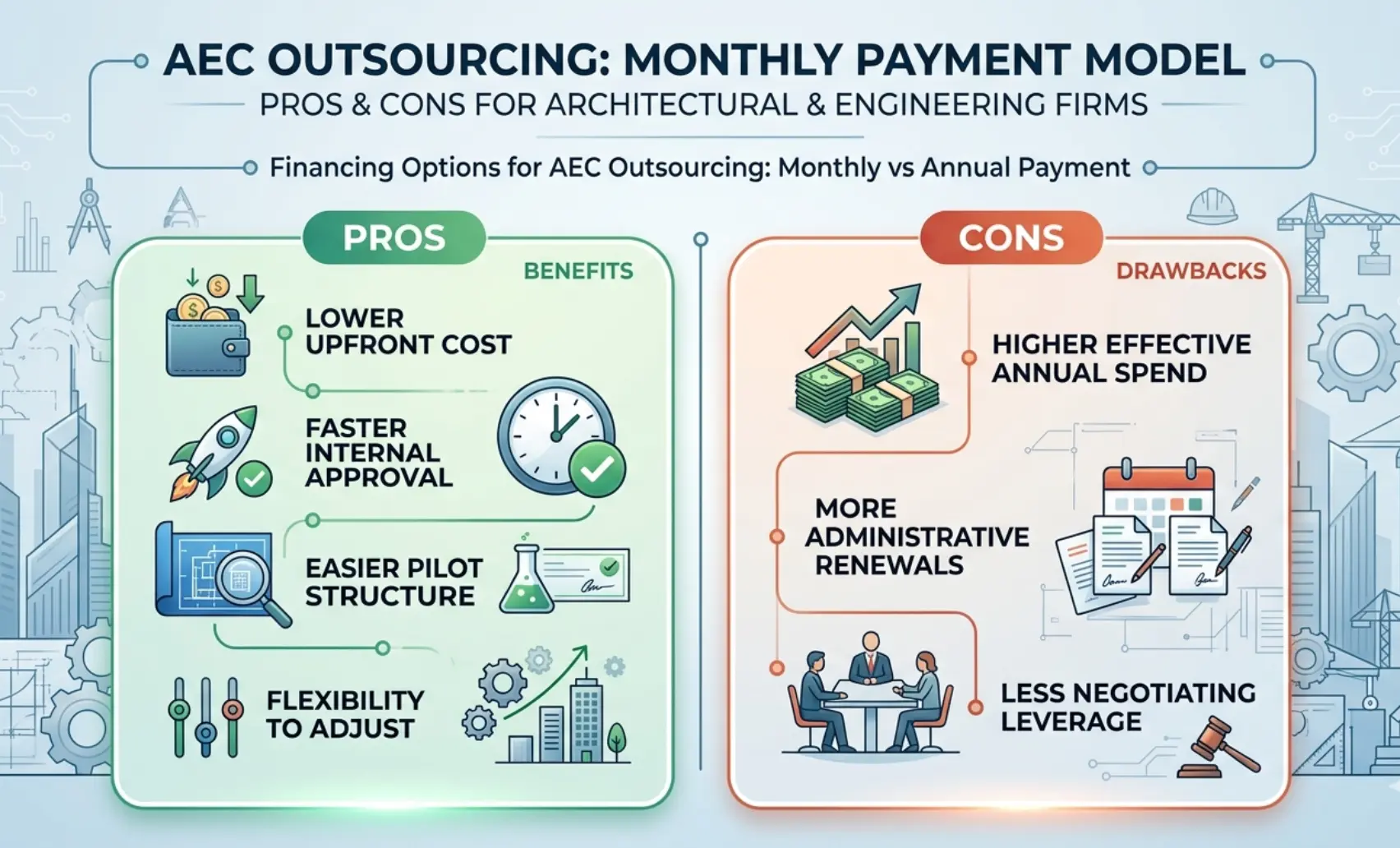
Pros: Lower Upfront Cost, Faster Approval, Easier Pilot
- Lower upfront cost: No large initial payment. You activate capacity at a manageable monthly rate and evaluate performance before renewing.
- Faster internal approval: Monthly billing typically falls below procurement thresholds that require executive sign-off, meaning you can move faster.
- Easier pilot structure: Test a remote AEC staffing arrangement on a single project or role before expanding. Monthly billing makes the pilot financially low-risk.
- Flexibility to adjust: Scale up or down as project needs shift without being locked into a fixed annual volume.
Cons: Higher Effective Annual Spend, More Renewals, Less Leverage
Monthly billing convenience comes at a cost.
- Higher effective annual spend: Across a full year, monthly billing typically costs 10–20% more than an equivalent annual plan; the flexibility premium is real.
- More administrative renewals: Each billing cycle is a potential friction point; approvals, invoice processing, and contract reviews add management overhead.
- Less negotiating leverage: Monthly clients carry lower commitment signals. Annual clients, who represent predictable revenue, typically command better pricing, priority placement, and stronger service-level agreement (SLA) terms.
Annual Payment for Outsourced AEC Staffing
An annual retainer for AEC outsourcing signals long-term intent, and vendors price it accordingly. For firms with a steady production workload, the annual model delivers measurable financial and operational advantages.
Best for Firms With Steady Production Workload
If your firm runs continuous project delivery, ongoing BIM coordination, sustained design production, or recurring construction administration, annual billing matches your cost structure to your actual operating model.
Architecture and engineering firms with predictable headcount needs get the most from annual arrangements. You’re not paying a flexibility premium for optionality you’ll never use.
Established firms scaling their remote teams also benefit here. Once you’ve validated a role or a workflow with a monthly pilot, committing annually is the logical next step, and it immediately reduces your per-unit staffing cost.
Pros: Lower Annual Cost, Budget Predictability, Stronger Commitment
- Lower annual cost: Annual plans typically deliver 10–20% savings over equivalent monthly billing, a meaningful difference when staffing multiple roles across a full year.
- Budget predictability: A fixed annual commitment makes it easier to build remote AEC staffing costs into project budgets and financial forecasts with precision.
- Stronger SLA terms: Annual clients carry more weight in provider relationships. Expect better service-level agreement (SLA) terms, priority support, and faster replacement resolution.
- Reduced procurement friction: One approval cycle per year instead of twelve monthly reviews, less administrative overhead for your finance and operations teams.
- Team continuity: Annual arrangements reduce turnover risk on the provider side. Your remote professionals stay assigned to your account longer, building familiarity with your workflows and standards.
Cons: Larger Upfront Commitment, Harder Exit if Scope Changes
Annual billing carries real trade-offs that firms must weigh honestly.
- Larger upfront commitment: Depending on the provider and plan structure, annual billing may require a significant payment at signing, a cash flow consideration for smaller firms.
- Reduced flexibility: If your project scope shifts mid-year or a key client pauses a program, you may be paying for capacity you can’t fully utilize.
- Harder exit: Breaking an annual arrangement mid-term typically involves notice periods, early termination clauses, or forfeited prepayments. Read the contract carefully before committing.
Monthly vs Annual Payment: Side-by-Side Decision Factors
Here’s where the two models separate clearly. Use these five factors to drive your decision.
Cash Flow
Monthly billing distributes cost evenly and protects working capital, critical for firms managing tight project margins or seasonal revenue cycles. Annual billing front-loads spend but reduces the total outflow across twelve months. AIA research consistently shows that cash flow management is among the top operational challenges for architecture firms. Your outsourcing payment model should work with your cash cycle, not against it.
Staffing Continuity
Annual arrangements produce stronger staffing continuity. Remote professionals on annual engagements build deeper familiarity with your Autodesk platforms, internal workflows, and project delivery standards. Monthly arrangements carry slightly higher rotation risk; providers naturally prioritize long-term clients when allocating their best talent.
Procurement Friction
Monthly billing means twelve approval cycles, twelve invoices, and twelve renewal decisions per year. For firms with layered procurement processes, that friction adds up. Annual billing compresses procurement to a single event, one approval, one contract, one budget line. AGC member surveys regularly flag administrative burden as a hidden cost driver in outsourcing relationships.
Contract Flexibility
Monthly billing wins on flexibility. no long-term lock-in, easy scope adjustments, and low exit cost. Annual billing trades flexibility for savings and stability. The right answer depends entirely on your pipeline certainty. If you’re managing a three-year infrastructure program, annual billing is a clear fit. If you’re navigating an unpredictable commercial real estate pipeline, monthly keeps your options open.
ROI Over 12 Months
AEC outsourcing ROI compounds differently under each model. Monthly billing delivers faster initial return on investment (ROI) because the commitment threshold is lower and capacity activates quickly. Annual billing delivers higher cumulative ROI over the full year, lower per-unit cost, stronger team performance from continuity, and reduced management overhead, all of which contribute. For most established AEC firms, the 12-month ROI favors annual billing once the pilot phase is complete.
Quick Comparison Table
| Decision Factor | Monthly Billing | Annual Billing |
| Cash Flow Impact | Lower per-period outlay | Higher upfront, lower total |
| Staffing Continuity | Moderate | High |
| Procurement Friction | High (12x/year) | Low (1x/year) |
| Contract Flexibility | High | Moderate |
| 12-Month ROI | Faster to start | Higher overall |
| Best For | Variable workload/pilots | Steady production/scaling |
Hidden Costs AEC Firms Should Compare Before Choosing
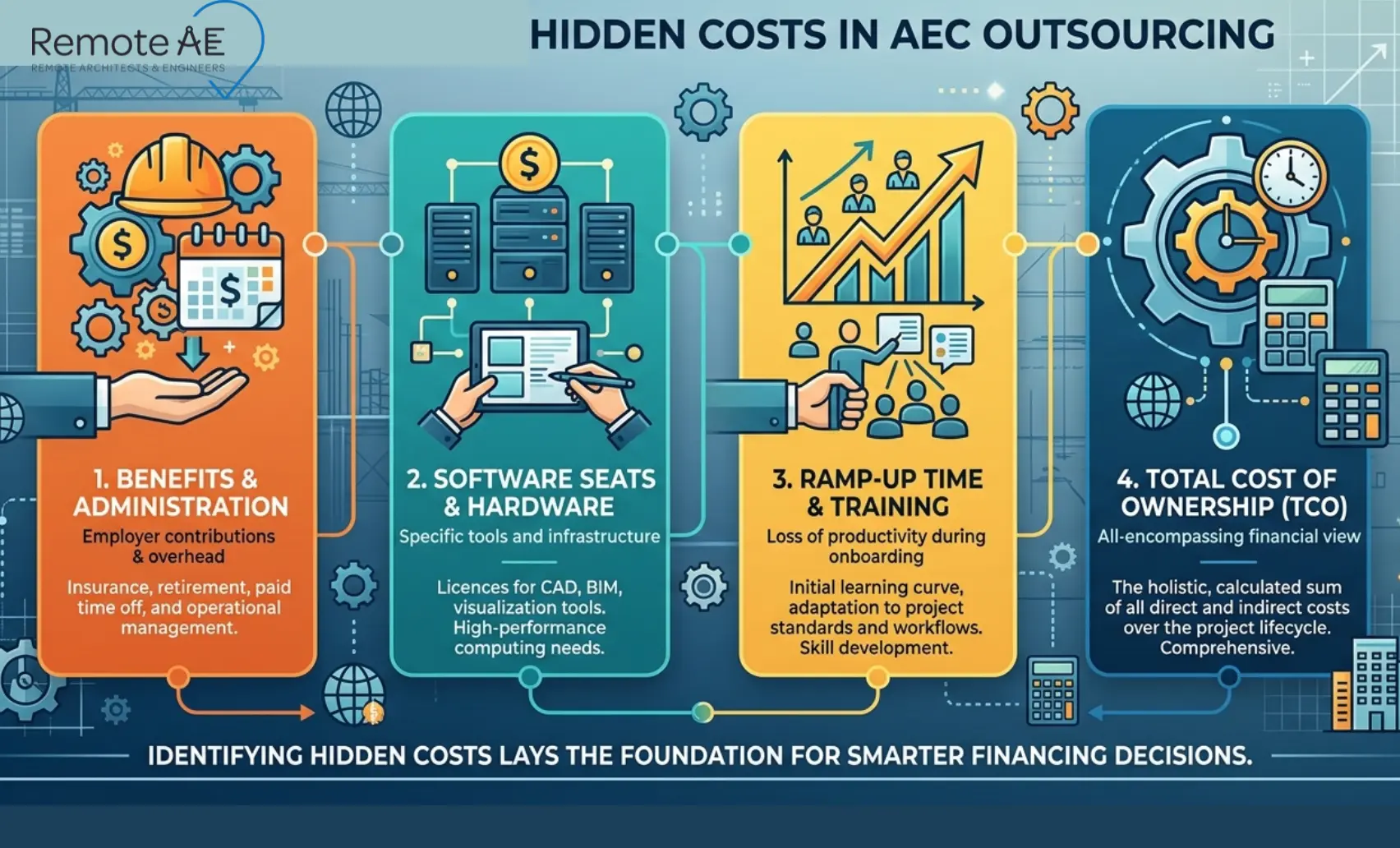
The headline rate of any AEC outsourcing plan is rarely the full picture. Three categories of hidden costs consistently catch firms off guard.
Benefits, Software Seats, and Management Overhead
In-house AEC employees come with benefits packages, workers’ compensation, payroll taxes, and software license costs that add 25–40% on top of base salary, according to U.S. Bureau of Labor Statistics employer cost data.
Outsourced staffing through a provider like Remote AE bundles most of these costs, no separate Autodesk license procurement, no benefits administration, and no payroll tax management. But firms should still confirm exactly what’s included in their plan fee before signing.
- Does the plan include platform access and software seats?
- Who manages compliance and data security?
- What management bandwidth is required from your internal team?
Rework, Ramp-Up Time, and Idle Capacity
Every new remote professional carries a ramp-up period, typically two to four weeks, before they reach full independent productivity. Monthly billing means this ramp-up cost recurs more frequently if personnel rotate.
Annual billing amortizes the onboarding investment across a longer engagement, making it more cost-efficient per productive hour delivered.
Idle capacity is another overlooked cost. If your workload drops mid-month and your remote team has nothing to process, you’re still paying for availability. Structuring roles around consistent workflow, BIM coordination, document control, or estimating pipelines, reduces idle time regardless of billing model.
In-House vs Outsourced TCO Example
Consider a mid-level project coordinator role in a U.S. architecture firm:
- In-house TCO (annual): $72,000 salary + $18,000 benefits/taxes + $6,000 software/overhead = ~$96,000/year
- Monthly outsourcing (annualized): $3,200/month × 12 = ~$38,400/year
- Annual outsourcing plan: ~$32,000–$35,000/year (10–15% discount vs monthly)
The total cost of ownership (TCO) comparison makes the case for outsourcing clear. Even the monthly model delivers 60%+ savings over in-house hiring. The annual model pushes that gap even further.
How to Choose the Right Financing Option for Your AEC Firm
No single payment model works for every firm. The right choice depends on four variables that only you can assess accurately.
Evaluate Your Project Pipeline
Start with the most honest question you can ask: how predictable is your workload over the next twelve months?
Consistent workload – ongoing design production, sustained BIM coordination, continuous construction administration, points clearly toward annual billing. You’re not buying optionality you’ll use. You’re buying stability at a lower cost.
Unpredictable workload – project-driven spikes, speculative bids, or a client base with variable procurement cycles, points toward monthly billing until your pipeline stabilizes. Paying a flexibility premium makes sense when you genuinely need the flexibility.
Assess Your Budget and Cash Flow
The annual plan delivers better ROI over twelve months, but only if the upfront commitment doesn’t strain your operating capital.
Ask your finance team one direct question: Can we absorb a lump-sum or semi-annual payment without affecting project execution or bid capacity? If the answer is yes, annual billing is almost always the better financial decision. If the answer is no, monthly billing protects your cash flow while you build toward the transition.
Remote AEC staffing cost comparison should always include your current liquidity position, not just the headline rate on the contract.
Consider Growth Stage
Your firm’s growth stage is one of the clearest signals for which model fits.
- Startup or early-stage AEC firm: Monthly billing lowers the barrier to entry, lets you test remote workflows with minimal financial risk, and preserves capital for other growth priorities.
- Scaling firm: A hybrid approach often works best, monthly billing for newer roles still in validation, annual billing for proven roles delivering consistent output.
- Established firm: Annual billing across most or all remote roles delivers the best total cost of ownership (TCO), the strongest team continuity, and the most favorable service-level agreement (SLA) terms from your outsourcing partner.
Why AEC Firms Choose Remote Staffing Solutions
The shift toward AEC outsourcing isn’t driven by a trend; it’s driven by math. Here are the four advantages firms report most consistently.
Access to Skilled Talent
Both the American Institute of Architects (AIA) and the Associated General Contractors of America (AGC) flag talent scarcity as a top operational challenge for AEC firms. Local hiring pools for BIM coordinators, quantity surveyors, and document specialists are thin and shrinking.
Remote staffing opens a global bench of specialized AEC assistants, trained in the workflows and platforms your projects actually require.
Cost Efficiency Compared to In-House Hiring
The U.S. Bureau of Labor Statistics confirms that fully loaded in-house AEC employee costs run 25–40% above base salary. Remote staffing eliminates the bulk of that overhead, no office space, no benefits administration, no idle capacity costs, and Autodesk platform access often bundled into the fee.
Faster Scaling
Traditional hiring takes six to ten weeks. Remote staffing compresses that to days. Pre-vetted Architecture, Engineering, and Construction (AEC) professionals integrate into your existing platforms and begin delivering within the first week, no waiting, no vacancy gaps.
How Remote AE Supports Flexible Financing for AEC Firms
Remote AE was built exclusively for Architecture, Engineering, and Construction (AEC) firms, not adapted from a generalist staffing model.
Tailored Payment Options
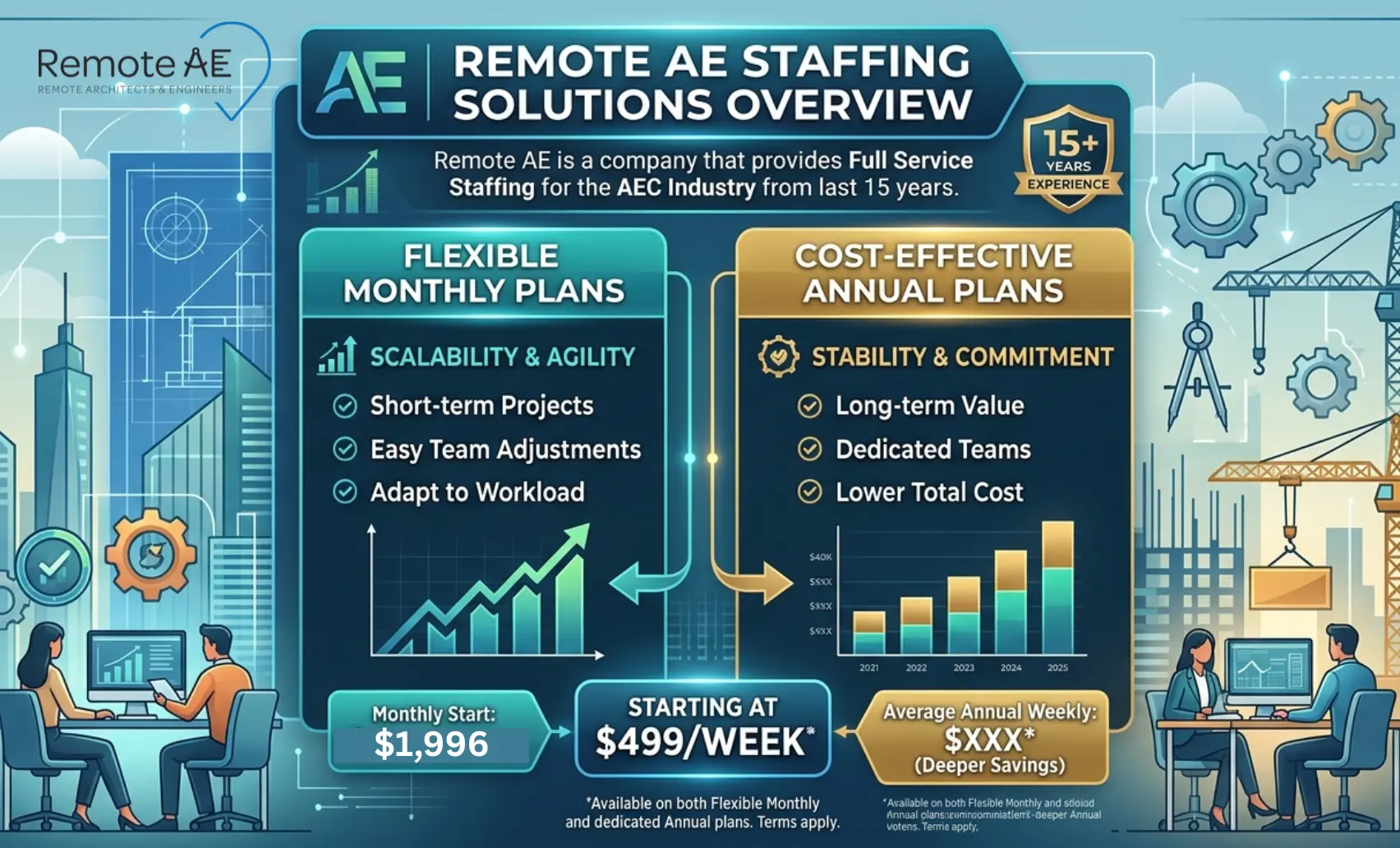
Remote AE offers both monthly billing and long-term plan options starting at $499/week, accessible for firms of all sizes. There is no upfront cost or obligation until the contractual phase begins.
Dedicated AEC Professionals
Every placement covers architects, engineers, remote civil engineers, BIM/CAD specialists, estimators, and project coordinators, each assessed against real AEC workflows across Autodesk, Procore, and Bluebeam before placement. You’re adding verified capacity, not running a training program.
5+ Years of Industry Experience
Remote AE brings over 15 years of AEC staffing experience to every engagement. That translates directly into:
- Industry-specific expertise – no time wasted explaining AEC basics
- Guaranteed quality and reliability – deliverables meet your standards or get resolved fast
- No long-term commitment – monthly or annual, the model fits your needs
- Staffing from $499/week – viable for firms at every growth stage
Scalable Staffing Solutions
Add roles when a contract ramps up. Adjust the scope when a phase closes. Remote AE’s model moves with your pipeline, no restarts, no new hiring cycles.
- No upfront costs – consult and evaluate fit before any financial commitment
- Risk-free replacement – up to two virtual assistant replacements in year one, at no disruption to your project or budget
Find the Right Payment Model, and the Right Team!
You now have the full picture. Monthly billing works for variable pipelines, pilots, and firms building confidence in remote workflows. Annual billing delivers stronger ROI, better pricing, and deeper team continuity for firms with steady production demand.
The smarter move is pairing the right payment model with the right staffing partner, one that understands AEC outsourcing from the inside and structures engagements around your project reality, not a generic template.
Remote AE connects Architecture, Engineering, and Construction firms with pre-vetted, industry-trained remote professionals, ready to integrate into your workflows and deliver from week one. Stop overpaying for in-house overhead and underdelivering on project capacity.
Book a Free Consultation with Remote AE Today, no obligation, no pressure, just a straight conversation about what payment model and staffing structure fits your firm.
FAQs – Financing Options for AEC Outsourcing
Is monthly or annual billing better for AEC outsourcing?
It depends on the workload. Monthly plans offer flexibility for changing project needs, while annual plans suit firms with steady pipelines and predictable staffing. Many firms start monthly to test fit, then shift to annual once the scope, quality, and communication are stable.
Why do annual outsourcing plans usually cost less?
Annual plans reduce vendor risk and admin overhead. Providers can allocate dedicated staff, plan capacity, and avoid frequent onboarding/offboarding, so they pass savings back through lower rates. Longer commitments also reduce idle time and improve team efficiency.
Can I sign an annual outsourcing agreement but pay monthly?
Yes, many firms do this. The contract sets a 12-month commitment, but payments are billed monthly. This balances cash flow with discounted pricing. Check terms for minimum hours, ramp-up periods, and exit clauses.
Is monthly billing better for first-time outsourcing?
Usually, yes. Monthly billing lets you pilot the relationship, test workflows, and validate quality without long-term commitment. It’s ideal for the first 4–8 weeks while you align standards, communication cadence, and QA processes.
What should be included in an AEC outsourcing contract?
Include scope, deliverables, SLAs, QA/QC process, turnaround times, pricing, IP ownership, NDA, data security, revision policy, and termination terms. Also define tools (CDE), naming standards, and review checkpoints to avoid ambiguity during production.