
The labor shortage in construction has reached a breaking point. Firms across the U.S. are losing bids, delaying projects, and burning out their best people, all because they can’t find qualified workers fast enough. The Associated General Contractors of America (AGC) and the U.S. Bureau of Labor Statistics (BLS) both confirm the gap is widening. Traditional hiring can’t keep pace. But a smarter model is emerging: remote construction staffing.
From virtual construction assistants handling RFIs and submittals to remote civil engineers supporting design teams, distributed talent is filling roles that used to sit vacant for months. This article shows you exactly how.
What’s Driving the Labor Shortage in Construction Today?
The construction workforce shortage didn’t happen overnight. It built up over two decades, and several forces are now colliding at once.
The retirement wave is accelerating. A large share of the current construction workforce is over 45. As experienced superintendents, estimators, and project managers retire, firms are losing institutional knowledge that takes years to replace.
Fewer young workers are entering the trades. For years, colleges were pushed over vocational training. The result? A generation with no exposure to construction careers. NCCER (National Center for Construction Education and Research) has flagged this pipeline problem repeatedly, yet enrollment in craft training programs remains far below industry demand.
The skills gap in modern construction tech is real. Today’s job sites run on BIM, Autodesk Construction Cloud, Procore, and Bluebeam. Workers who can operate these platforms are in short supply. Many experienced tradespeople lack digital skills, while tech-savvy graduates lack field experience.
Post-pandemic workforce shifts changed everything. COVID-19 accelerated retirements, pushed workers into other industries, and reshaped what job seekers expect from employers. Construction was hit harder than most sectors because remote work wasn’t seen as viable until now.
Key Statistics and Trends
The numbers behind the construction workforce shortage are stark.
- The U.S. Bureau of Labor Statistics (BLS) projects that construction will need to fill around 649,300 job openings per year through 2034, driven by both growth and replacement needs.
- The Associated General Contractors of America (AGC) reported that 91% of construction firms are struggling to fill hourly craft positions.
- According to AGC’s workforce survey, 88% of respondents expect difficulty finding qualified workers to continue or worsen in the coming years.
- The skilled labor shortage in construction is not limited to the U.S. The U.K., Australia, and Canada are facing similar demand vs. supply gaps, making global remote AEC hiring an increasingly logical response.
These aren’t projections to file away. They’re numbers that affect your next bid, your next deadline, and your next hire.
How It Affects Construction Companies
The downstream effects of the construction labor shortage show up fast, and they compound.
- Project delays are the most visible impact. When you can’t staff a project properly, schedules slip. Delays trigger penalties, damage client relationships, and eat into margins.
- Labor costs are climbing. Firms are offering signing bonuses, higher wages, and expanded benefits just to stay competitive. That pressure squeezes profit on every contract.
- Reduced bid capacity limits growth. If your team is already stretched thin, you can’t pursue new work. Companies are turning down contracts they’d otherwise win, purely because they lack the staff to execute.
- Burnout among existing staff is accelerating. When a team of ten is doing the work of fifteen, morale drops. Errors increase. Turnover rises. And the cycle repeats.
This is the reality facing construction firms right now. The question is no longer whether the shortage is serious; it’s what you’re going to do about it.
Why Traditional Hiring Is No Longer Enough
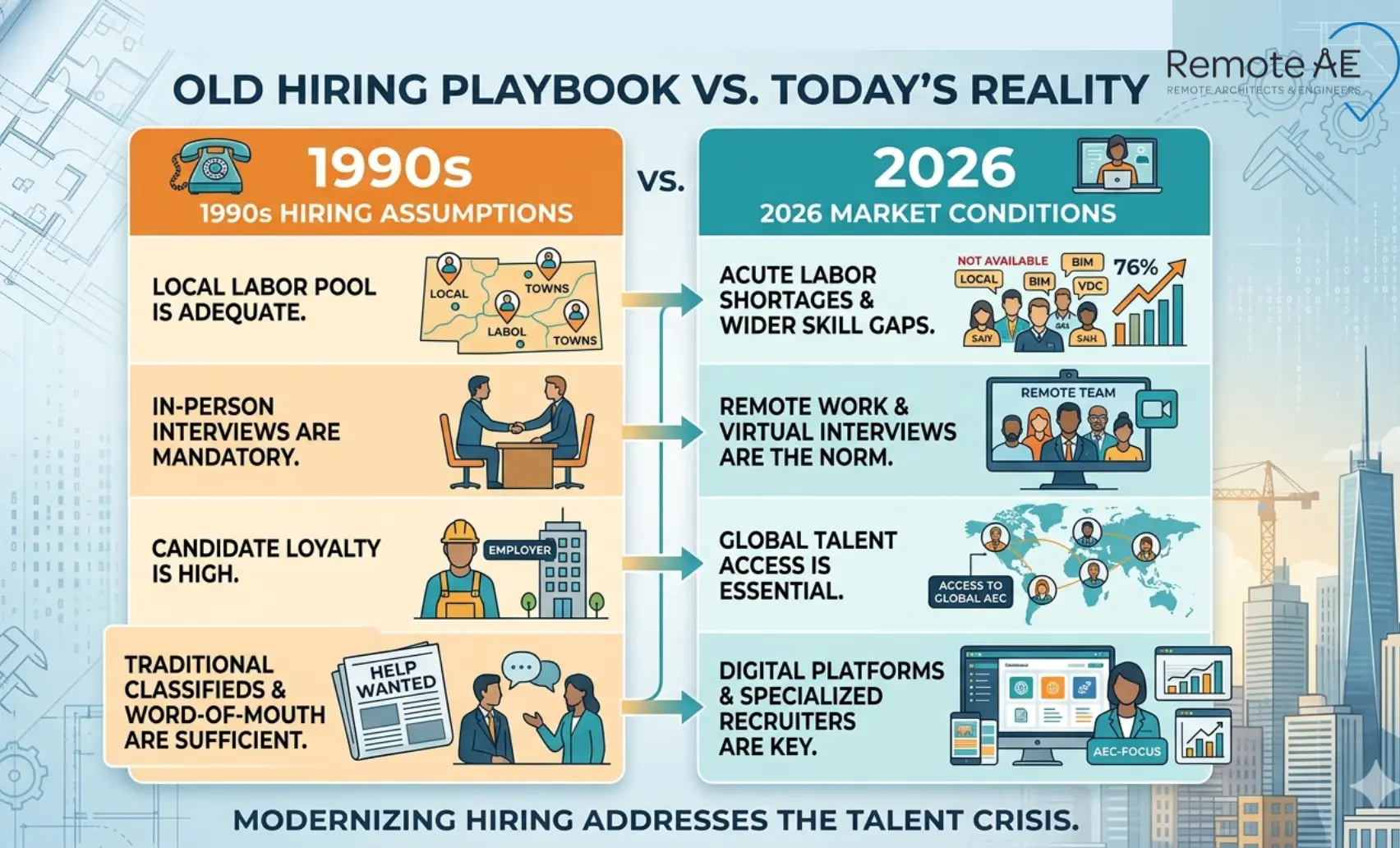
Most construction firms are still running a 1990s hiring playbook in a 2026 labor market. Post job, screen resumes, interview, hire, repeat. That approach is broken, and the data proves it.
The construction workforce shortage has made local talent pools thinner than ever. Firms that once competed on salary alone now compete on culture, flexibility, technology, and brand. And they’re still losing candidates to larger GCs with deeper pockets.
Limitations of Local Talent Pools
Geography has always constrained construction hiring. Unlike software or finance, most firms historically hired within driving distance of the job site.
That radius is now almost empty for specialized roles. Finding a qualified estimator, BIM technician, or document control specialist within commuting range of your office is increasingly a matter of luck, not process.
Competition among firms drives up costs and slows timelines. When five firms in the same metro area are chasing the same three qualified project managers, everyone loses, except the candidate. Bidding wars delay hiring by weeks and inflate salary expectations well beyond budget.
Rising Costs of On-Site Employees
Even when you find the right person locally, the full cost of employment is rarely what the salary line suggests.
Salaries, benefits, and insurance stack up fast. A mid-level estimator earning $75,000 annually can cost a firm $95,000–$110,000 when you factor in health insurance, workers’ comp, payroll taxes, and retirement contributions.
Office overhead adds another layer. Desk space, equipment, software licenses, and administrative support are real costs, often invisible in hiring decisions but very visible in year-end financials.
For smaller firms and subcontractors, these costs can determine whether a project is profitable at all.
Time-Consuming Recruitment Process
Hiring is not just expensive, it’s slow. And in construction, slow hiring has a direct cost.
The average construction hiring cycle runs 6–10 weeks from job posting to offer acceptance. For senior roles like superintendents or project managers, it can stretch to four months. That’s four months of a vacant seat while deadlines move forward.
High turnover rates compound the problem. Construction sees above-average turnover compared to other industries. Every time a position turns over, the firm absorbs the full recruitment cost again, plus the productivity loss during the transition period.
Traditional hiring works when talent is plentiful and time is flexible. In today’s market, neither condition applies.
Construction Roles That Work Best Remotely
Here’s what often surprises project executives the first time they explore remote construction staffing: the list of roles that can be done remotely is much longer than expected.
Not every function needs boots on the ground. Many of the most time-consuming, backlog-heavy tasks in a construction office are entirely location-independent, and that’s exactly where remote support delivers the fastest ROI.
Estimating and Quantity Takeoffs
Estimating is one of the highest-value, most transferable remote roles in AEC.
A skilled remote estimator can perform quantity takeoffs, build bid packages, analyze subcontractor quotes, and maintain cost databases, all from a remote workstation with access to your project files.
Tools like Bluebeam, Autodesk Construction Cloud, and cloud-based takeoff platforms make real-time collaboration seamless.
Project Coordination, RFIs, Submittals, and Document Control
This is where the remote construction assistant model proves its value most clearly.
RFIs (Requests for Information) and submittals are essential but administratively heavy. Logging, tracking, routing, and following up on RFIs and submittals can consume hours of a project manager’s day, hours better spent on field decisions and client communication.
Document control – maintaining version histories, distributing drawings, and managing change logs- is equally critical and equally remote-friendly. A structured Common Data Environment (CDE) aligned with ISO 19650 standards makes this seamless, with clear permissions, audit trails, and naming conventions that keep remote and on-site teams fully synchronized.
Remote construction assistants handling this workload frees your senior staff for work only they can do.
BIM/VDC, Drafting, Redlines, and Model Support
BIM (Building Information Modeling) specialists and VDC coordinators are among the most in-demand and hardest-to-hire roles in the skilled labor shortage in construction.
Remote BIM teams can handle 2D/3D drafting, model updates, clash detection, and coordination drawings, all within shared cloud environments like Autodesk Construction Cloud. Redlines from the field get incorporated overnight. Model reviews happen on schedule. RFI responses get built into the model without delay.
Reporting, Scheduling Support, Procurement Follow-Up, and Admin Work
These tasks are foundational to project delivery, yet they rarely require physical presence.
Schedule updates, procurement follow-ups, subcontractor communication logs, and progress reports can all be managed remotely with the right tools and handoff protocols in place.
Virtual construction assistants handling admin and coordination work give your on-site team room to breathe. That breathing room directly reduces burnout, improves accuracy, and protects your project schedules.
How Remote Work Helps Solve the Labor Shortage
Remote work isn’t a workaround for the construction workforce shortage. It’s a structural solution, one that addresses the root causes rather than patching symptoms.
Here’s how it works in practice.
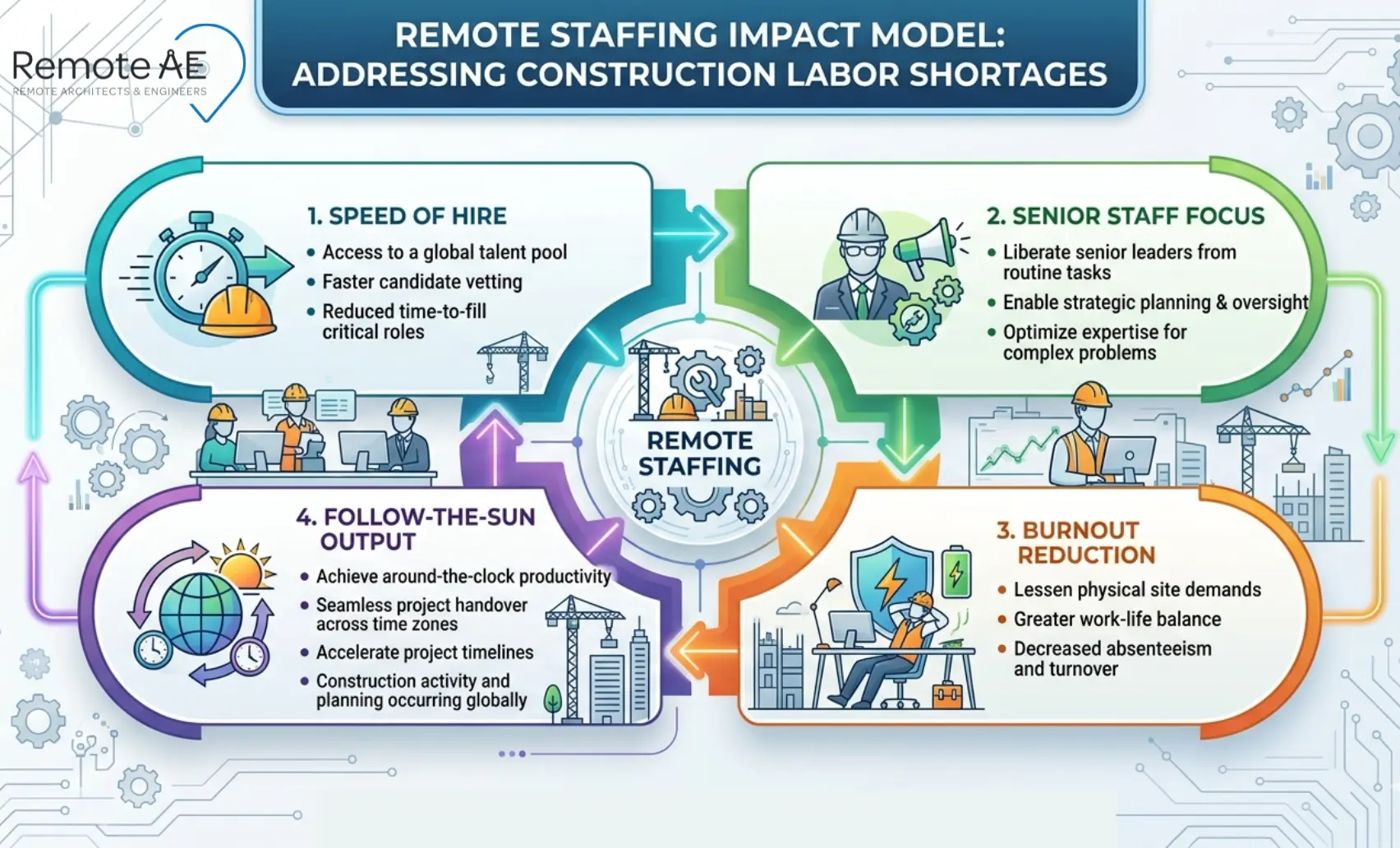
Adds Capacity Faster Than Local Hiring
When a project ramps up, and your team is already at capacity, you don’t have six weeks to run a hiring cycle.
Remote construction staffing compresses that timeline dramatically. Pre-vetted professionals,, familiar with Procore, Autodesk Construction Cloud, Bluebeam, and standard AEC workflows, can be onboarded and contributing within days, not months.
That speed matters. A remote estimator picked up on a Monday can be turning over bid packages by Wednesday. A remote document control specialist can be managing your RFI log before the week is out.
Frees Senior Staff for Higher-Value Work
Your superintendents, project managers, and senior estimators are your most expensive and most valuable resources. They should be solving field problems, managing client relationships, and making strategic decisions, not chasing submittals or reformatting reports.
Remote construction assistants absorb the administrative and coordination load that currently buries senior staff. The result is a sharper, more focused on-site team that performs at a higher level, without adding headcount to your permanent payroll.
Reduces Burnout in Office-Heavy Roles
Burnout is one of the most underreported drivers of turnover in the construction industry. Project coordinators, estimators, and document control staff routinely work beyond capacity. This is not because of poor time management, but because there aren’t enough people to share the load.
Remote staffing changes that equation. When administrative tasks are distributed across a broader team, including remote civil engineers, virtual construction assistants, and remote BIM specialists, the pressure on in-house staff drops. Retention improves. Morale stabilizes. And your best people stop looking for the exit.
Supports Follow-the-Sun Production and Faster Turnaround
One of the least-discussed advantages of remote AEC hiring is time zone leverage.
When your remote BIM team or document control specialist operates in a different time zone, work doesn’t stop when your office closes. RFI responses drafted at the end of the day get processed overnight. Model updates requested at 5 PM are ready by 8 AM. Procurement follow-ups sent late afternoon come back resolved by morning.
This follow-the-sun model compresses project timelines in ways that purely local teams simply cannot replicate.
What Makes Remote Construction Support Actually Work
Remote staffing succeeds or fails based on infrastructure and process, not just talent. Here’s what firms that get it right have in place.
Cloud Tools and Common Data Environments
The foundation of effective remote construction support is a well-configured Common Data Environment (CDE). A CDE, aligned with ISO 19650 standards, gives every team member, regardless of location, access to the same documents, models, and data at the right permission level.
Platforms like Autodesk Construction Cloud and Procore serve as the operational backbone. Bluebeam handles markup, review, and redline workflows. When these tools are properly configured, remote team members operate with the same visibility as anyone sitting in your office.
Without a structured CDE, remote work creates version confusion and communication gaps. With one, it runs as smoothly as any in-house operation.
Communication Cadence and Handoff Rules
Technology alone doesn’t make remote teams work. Clear communication protocols do.
Effective remote AEC teams operate on defined rhythms, daily async updates, weekly check-ins, and structured handoff documentation at shift transitions. Every task has an owner, a deadline, and a delivery format. Nothing floats in ambiguity.
Handoff rules are especially critical for document control and project coordination roles. When one team closes out for the day and another picks up, the transition must be seamless.
That means standardized naming conventions, logged activity trails, and clear escalation paths for unresolved items.
QA/QC, Permissions, Security, and Accountability
Construction firms handling sensitive project data, contracts, drawings, and bid information, rightfully ask hard questions about remote security.
The answer lies in access architecture. Role-based permissions within your CDE ensure remote team members access only what they need. Activity logs track every document interaction. Non-disclosure agreements and data handling protocols are established at onboarding, before any project files are shared.
QA/QC processes for remote deliverables mirror what you’d apply in-house: structured review cycles, checklists, and sign-off requirements. Accountability doesn’t require physical presence; it requires clear standards and consistent enforcement.
Onboarding Steps for Remote AEC Assistants
A strong onboarding process is the single biggest predictor of remote team success.
- Week 1: Platform access setup, tool walkthroughs, introduction to project structure and naming conventions
- Week 2: Supervised task execution, shadow workflows, review deliverables before submission
- Week 3: Independent task ownership with daily check-ins
- Week 4: Full integration into project rhythms with weekly reporting
Firms that invest two to four weeks in structured onboarding see dramatically better performance and retention from remote construction assistants than those who drop new hires into live projects without context.
Benefits of Remote Staffing for AEC Companies
Remote staffing isn’t just a stopgap for the construction labor shortage. For firms that implement it well, it becomes a long-term competitive advantage.
- Reduced hiring costs. Remote AEC hiring eliminates recruiter fees, reduces time-to-fill, and cuts the overhead associated with full-time on-site employees. Firms consistently report 30–50% cost savings compared to equivalent local hires when accounting for salary, benefits, and overhead combined.
- Access to specialized talent. Geography no longer limits your talent pool. Remote hiring opens a global bench of pre-qualified candidates your local market simply can’t match.
- Flexibility and scalability. Remote staffing scales with your project pipeline. Ramp up capacity during bid season. Pull back during slower periods. No lengthy notice periods, no idle headcount, no fixed overhead, just the right people at the right volume when you need them.
- Faster project turnaround. With remote construction assistants managing RFIs, submittals, scheduling support, and document control, your core team operates at full capacity on delivery-critical tasks. Projects move faster, and clients notice.
- Lower employee burnout. Distributing workload across remote and on-site staff reduces the overload that drives turnover. When your project managers and coordinators aren’t buried in administrative work, they perform better, stay longer, and bring more value to every project.
Why Choose Remote AE for Construction Staffing
There are generalist staffing platforms, and then there’s Remote AE, built exclusively for the AEC industry from the ground up.
Industry-Specific Expertise
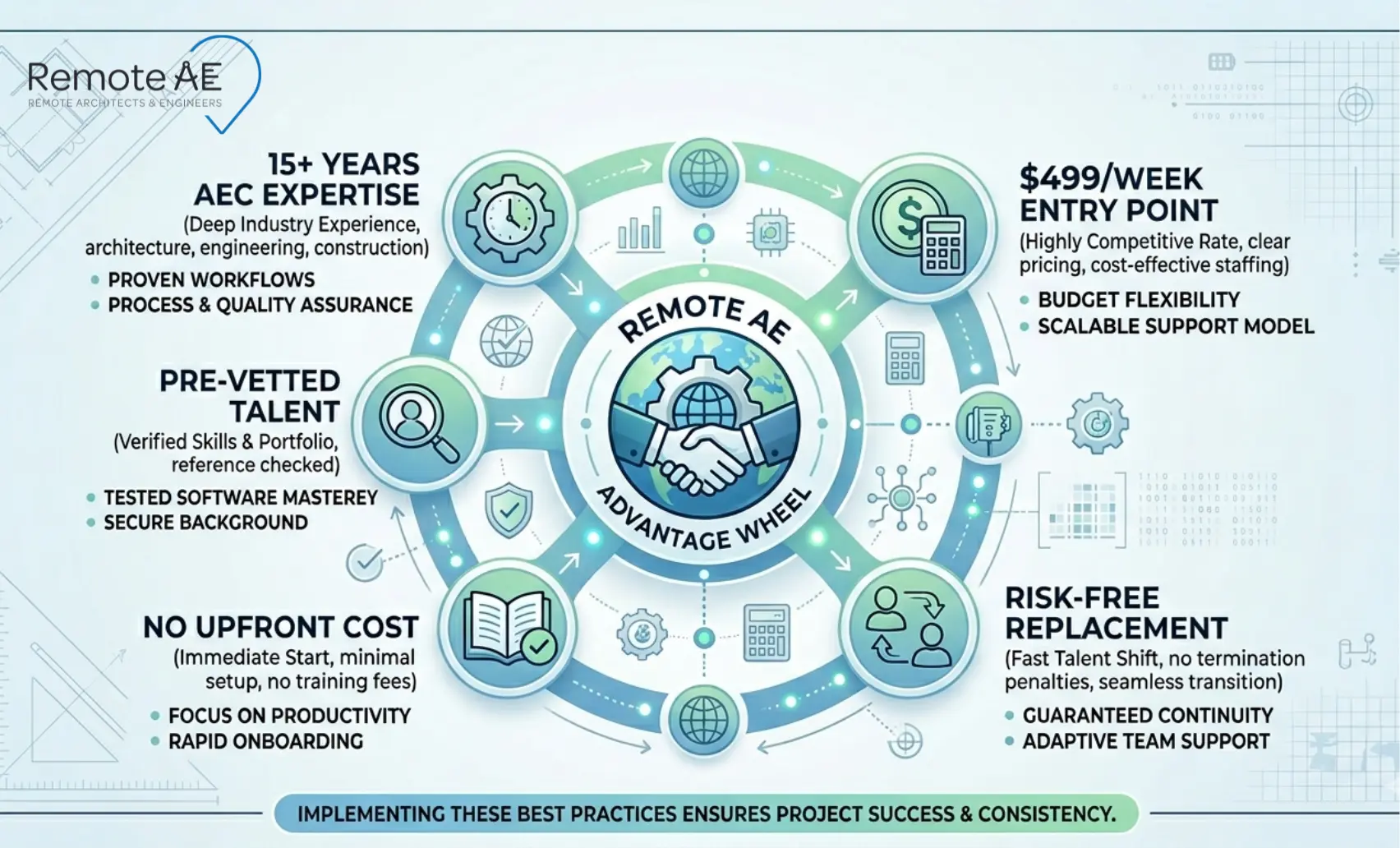
Remote AE brings over 15 years of AEC staffing experience to every engagement. The team understands construction workflows, project delivery structures, and the software ecosystems your firm runs on, Procore, Autodesk Construction Cloud, Bluebeam, and beyond.
That industry depth means shorter ramp-up times, fewer misalignments, and professionals who speak your language from day one. You’re not explaining what an RFI log is or why submittal tracking matters; our professionals already know.
- Guaranteed quality and reliability underpin every placement. Remote AE doesn’t send candidates to learn on your projects. Every professional is assessed against real AEC workflows before they ever touch a client engagement.
- No long-term commitment required. Engage remote talent on a project basis or as an ongoing extension of your team; the model adapts to your needs, not the other way around. Staffing starts from $499/week.
Pre-Vetted Skilled Professionals
Every Remote AE candidate goes through a structured vetting process that evaluates technical skills, software proficiency, communication quality, and AEC-specific knowledge.
When you receive a shortlist, it’s genuinely ready-to-hire talent, not a stack of resumes requiring another round of internal screening. Your hiring timeline compresses from weeks to days.
Reliable Support and Integration
Remote AE manages the onboarding process end-to-end, ensuring remote professionals integrate seamlessly into your existing platforms and communication rhythms.
No upfront costs. You can consult with the Remote AE team without any initial financial burden. There’s no upfront cost or obligation until the contractual phase begins, so you evaluate fit before you commit.
Risk-free replacement. In the first year, Remote AE offers risk-free replacements for up to two virtual assistants. If a placement doesn’t meet your standards, it gets resolved without disrupting your project or your budget.
Close the Gap with Remote AE!
Your projects can’t wait for the labor market to fix itself. Remote AE connects AEC firms with pre-vetted, industry-trained remote professionals, from virtual construction assistants and remote civil engineers to BIM specialists and estimators, ready to integrate into your workflows and deliver from week one.
Stop losing bids and burning out your best people.
Book a Free Consultation with Remote AE Today, no obligation, no pressure, just a straight conversation about what your team needs.
FAQs – Labor Shortage in Construction
Can construction jobs really be done remotely?
Yes, many preconstruction, documentation, and coordination tasks can be remote. Estimating, BIM/VDC, scheduling, procurement support, and document control work well off-site. Field supervision, inspections, and safety oversight still require onsite presence. Most firms use a hybrid model to balance speed and control.
What construction roles are best suited to remote work?
Best-fit roles include estimators, BIM/VDC specialists, coordinators, document controllers, schedulers, and project engineers (precon-focused). These roles rely on drawings, specs, and data rather than constant site access. Field-heavy roles (superintendents, inspectors) are usually not fully remote.
Can construction jobs really be done remotely?
Yes, many preconstruction, documentation, and coordination tasks can be remote. Estimating, BIM/VDC, scheduling, procurement support, and document control work well off-site. Field supervision, inspections, and safety oversight still require onsite presence. Most firms use a hybrid model to balance speed and control.
What construction roles are best suited to remote work?
Best-fit roles include estimators, BIM/VDC specialists, coordinators, document controllers, schedulers, and project engineers (precon-focused). These roles rely on drawings, specs, and data rather than constant site access. Field-heavy roles (superintendents, inspectors) are usually not fully remote.