

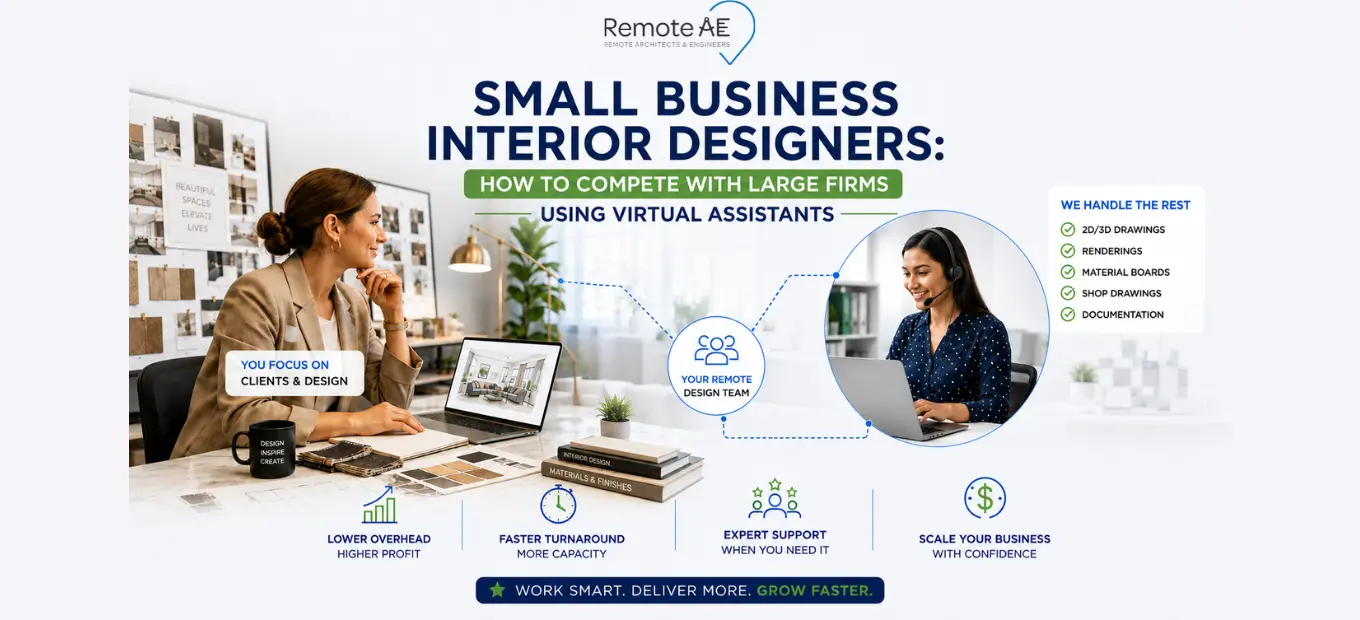
Small business interior designers produce exceptional work, but they consistently lose ground to larger firms, not on design quality, but on operational capacity. According to the Bureau of Labor Statistics, there were over 87,100 interior designers employed in the United States in 2024, with independent practitioners and small studios making up a significant share of that market.
The gap between a solo designer and a ten-person firm is not creative talent. It is production support, drafting, rendering, FF&E procurement, client communication, and project coordination that large firms distribute across dedicated staff. A virtual assistant or remote design assistant changes that equation for small business interior designers, without the overhead of a permanent hire.
Why Small Interior Design Firms Struggle Against Larger Firms
The competition between small business interior designers and large design firms is rarely about design vision. It is about delivery infrastructure, and the gap shows up in every client-facing interaction.
Large Firms Have More Production Capacity
Large design firms carry dedicated support roles that small studios rarely have, and that capacity advantage shows in every project deliverable.
- Dedicated drafters handle AutoCAD, Revit, and SketchUp production while the lead designer focuses on concept and client relationships
- In-house renderers produce 3D visualisations that elevate proposals and win competitive pitches
- Procurement coordinators manage FF&E sourcing, vendor follow-ups, and delivery tracking without consuming the designer’s time
- Administrative staff handle scheduling, invoicing, and client communication so project managers can stay on delivery
The result is faster turnarounds, more polished presentation packages, and a client experience that feels seamless, even on complex multi-room or multi-site projects.
Small Firms Often Lose Time to Non-Design Work
A solo designer or small studio principal is often doing all of this simultaneously, and the time cost is high.
Tasks that routinely consume non-billable hours for small business interior designers:
- Inbox management and client email responses
- Vendor follow-ups and stock availability checks
- Scheduling consultations, site visits, and contractor meetings
- Product sourcing and FF&E procurement tracking
- Proposal formatting and presentation deck assembly
- Purchase order management and delivery coordination
Each of these tasks is necessary. None of them requires a licensed interior designer to perform them. But when there is no one else to do them, they eat directly into the billable design hours that generate revenue.
The Real Issue Is Not Talent, It Is Bandwidth
Small business interior designers are not losing projects because their design work is weaker. They are losing time and opportunities because they lack the support roles that large design firms treat as standard overhead.
A principal at a ten-person firm reviews concept boards in the morning and attends a client presentation in the afternoon. A solo designer formats the concept board in the morning and then chases a vendor quote in the afternoon. Same talent. Dramatically different capacity for client-facing, billable work.
Rising Client Expectations in Design and Communication
Client expectations have risen across every design category, driven partly by the visual standards set by large firms and design media platforms. Clients now expect rapid response times, polished branded presentations, mood boards assembled to a high visual standard, and real-time project updates. Meeting those expectations takes both design skill and production support, and small studios without that support are perpetually playing catch-up.
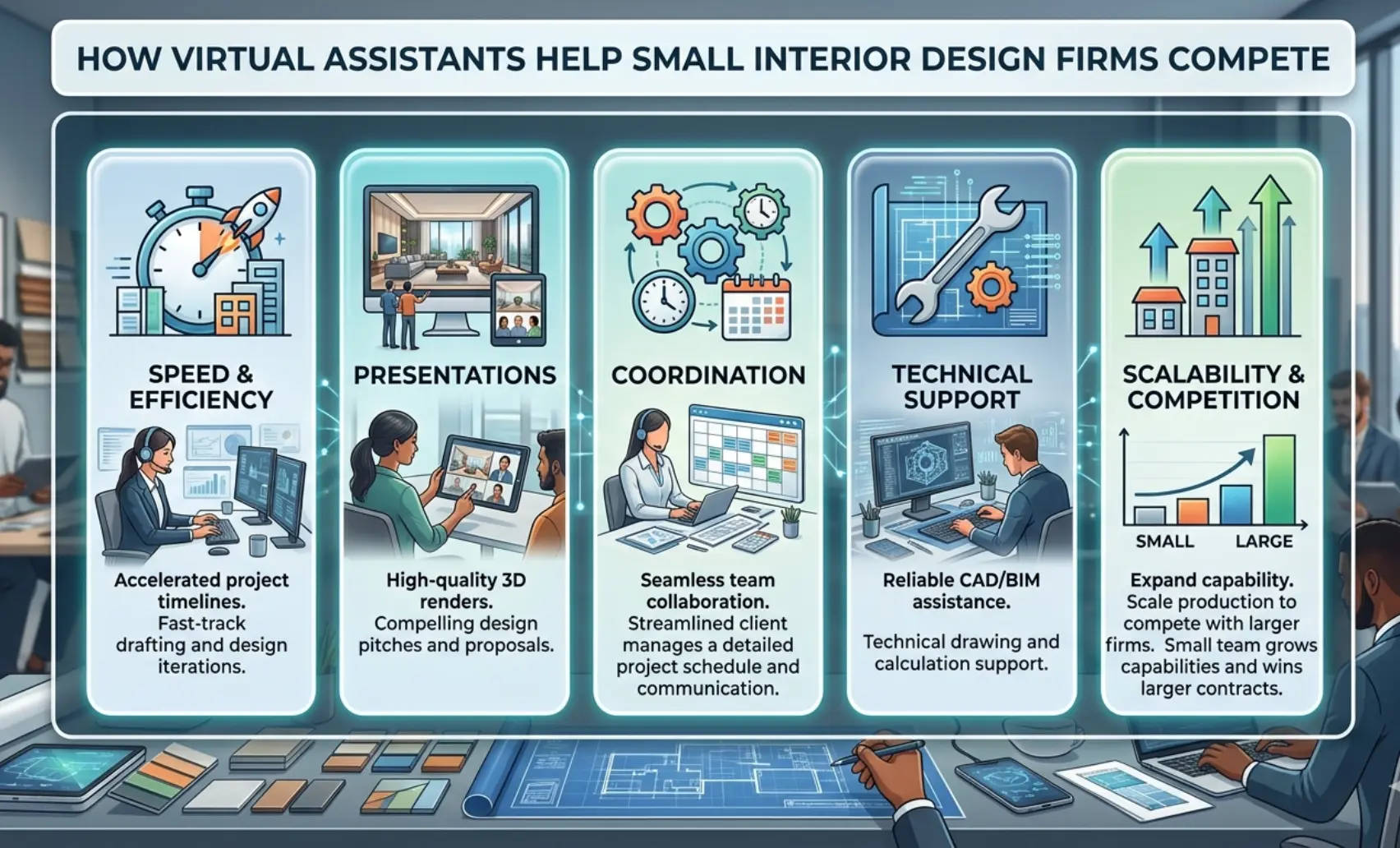
How Virtual Assistants Help Small Firms Compete With Large Firms
A well-integrated virtual assistant or remote design assistant gives small business interior designers access to the same support infrastructure that large firms build into their headcount, at a fraction of the overhead cost.
Faster Client Response Times
Client communication speed is a competitive differentiator that small studios consistently underperform on, not because they care less, but because they have no one managing the communication workflow.
A virtual assistant handles:
- Email triage, flagging priority client messages, filing routine enquiries, and preparing draft responses for designer review
- Meeting scheduling, managing the designer’s calendar, confirming appointments, and sending reminders
- Follow-up reminders, ensuring no client query or vendor request goes unanswered beyond a defined response window
- Client update templates, standardised project status communications that keep clients informed without requiring the designer to write every update from scratch
- Faster proposal delivery, formatting, and sending proposals on the same day they are approved, rather than waiting for the designer to find time
Better-Looking Presentations
Large design firms win pitches partly on presentation quality, and that quality comes from having dedicated staff to assemble and polish client-facing materials.
A virtual assistant with an interior design or AEC background produces:
- Mood boards and concept boards assembled to the designer’s visual standards
- Finish boards and material specification layouts formatted consistently
- Client decks with branded templates, correct image sizing, and professional layout
- Before/after visual comparisons using provided photography and rendering assets
- Proposal documents formatted to match the firm’s established brand identity
More Consistent Project Coordination
Project coordination failures, missed vendor follow-ups, untracked design decisions, and delayed delivery updates damage client relationships and create rework. A virtual assistant owns the coordination workflow, so the designer can focus on design.
- Tracking design decisions and client approvals in a shared project board
- Updating procurement trackers with order status, lead times, and delivery dates
- Managing vendor communication, chasing quotes, confirming orders, and logging responses
- Sending delivery status updates to clients without the designer needing to check every order individually
- Maintaining procurement notes that give the designer an accurate project status at any point
Stronger Technical Support
This is where a remote design assistant with AEC skills delivers value that generic virtual assistants cannot.
Interior design outsourcing capabilities cover space planning, CAD drafting, Revit drafting, 3D rendering, FF&E schedules, material specs, and full documentation packages, the technical production tasks that consume the most time in a small design studio.
Technical support tasks a remote design assistant handles:
- AutoCAD and Revit drafting, floor plans, reflected ceiling plans, elevations, and details
- SketchUp modeling, concept massing, furniture layout, and space planning studies
- 3D rendering, interior visualisations using Enscape or equivalent rendering tools
- Drawing clean-up and redline updates, incorporating design revisions into current drawing sets
- FF&E schedule preparation, itemised furniture, fixture, and equipment lists with specifications
Better Margins Without a Large Payroll
Every hour a designer spends on procurement tracking, inbox management, or proposal formatting is an hour that is not charged to a client. Recovering those hours, even partially, directly improves the studio’s billable rate efficiency.
- Less time on low-value workflow tasks means more time for design work that clients pay for
- More billable design hours per week without working longer hours
- Reduced payroll risk compared to a permanent employee, no benefits, no minimum hours, no redundancy exposure
- Ability to scale support up during busy project phases and back down during quieter periods
Interior Design Tasks Small Firms Should Delegate First
Not every task is equal when it comes to delegation. Start with the work that is repeatable, well-defined, and does not require your design judgment, then expand from there.
Administrative Support
The highest-volume, lowest-barrier tasks to delegate immediately:
- Calendar management, scheduling consultations, site visits, contractor meetings, and follow-up calls
- Inbox management, triaging emails, flagging urgent items, and drafting routine responses
- Client onboarding, sending welcome packs, collecting questionnaires, and setting up project folders
- Meeting notes, documenting decisions, action items, and next steps from every client and contractor call
- File organisation, maintaining a consistent folder structure across all active projects
- Invoice follow-ups, chasing outstanding payments against issued invoices
Client-Facing Support
Client communication quality directly affects perception of the studio’s professionalism:
- Proposal formatting, assembling scope, fee, and timeline documents to a consistent branded standard
- Presentation deck updates, refreshing mood boards, finishing schedules, and concept decks after design reviews
- Client questionnaires, preparing and sending intake forms, design preference surveys, and approval requests
- Follow-up emails, sending project updates, decision confirmations, and next-step reminders
- Design decision logs, maintaining a written record of every client-approved choice for future reference
Design Production Support
This is where AEC-trained remote support separates itself from generic virtual assistants:
- AutoCAD and Revit drafting, floor plans, elevations, sections, and construction documents
- SketchUp modeling, furniture layouts, space planning studies, and concept massing
- 3D rendering, interior visualisations for client presentations and proposal packages
- Mood board and finish board assembly, curated visual layouts built to the designer’s format standards
- FF&E schedules, itemised furniture, fixture, and equipment lists with product specifications and supplier details
Procurement and Vendor Support
FF&E procurement is one of the most time-consuming workflows in interior design, and one of the most delegatable:
- Product sourcing, finding specified or alternative products against a defined brief
- Stock checks, confirming availability and lead times before orders are placed
- Lead-time tracking, monitoring order status, and flagging delays before they affect the project programme
- Quote requests, preparing and sending RFQ documents to multiple suppliers
- Purchase order tracking, logging issued POs, confirming acknowledgements, and chasing outstanding confirmations
- Delivery coordination, liaising with suppliers and site contacts to align delivery schedules
Marketing Support
Marketing tasks that keep the studio visible without consuming the designer’s time:
- Portfolio updates, adding completed project photography and descriptions to the firm’s website or Houzz Pro profile
- Case study drafts, structuring completed project narratives for website or award submissions
- Social media scheduling, preparing and scheduling posts from approved content
- Blog formatting, laying out written content for website publication
- Email newsletter prep, assembling, and formatting client and prospect communications
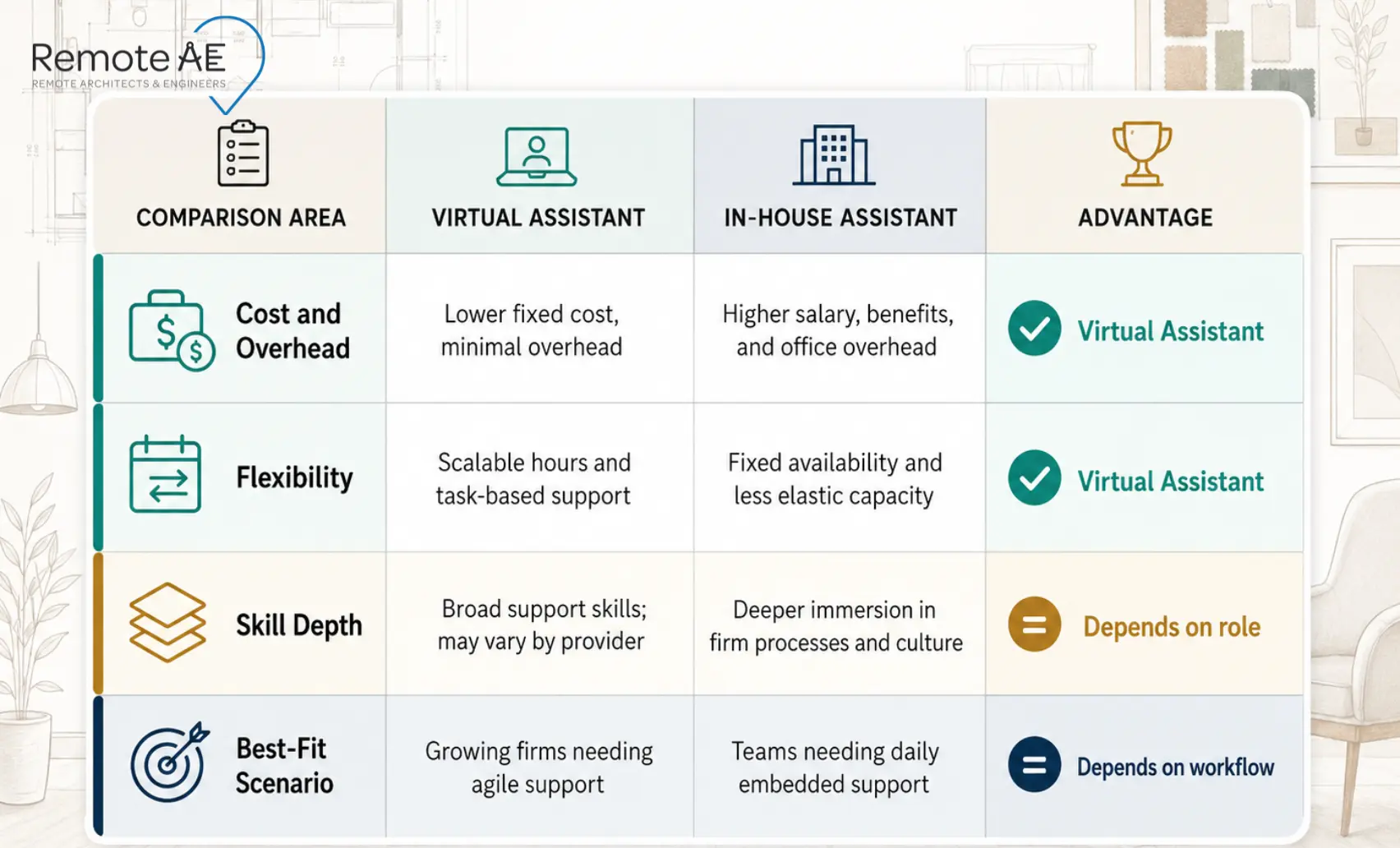
Virtual Assistant vs In-House Assistant: Which Works Better for Small Design Firms?
Cost and Overhead
Hiring an in-house assistant carries costs that extend well beyond the salary line:
- Payroll taxes, employer National Insurance (UK) or FICA (US) contributions on every pound or dollar paid
- Employee benefits, health insurance, pension contributions, paid leave, and sick pay
- Software and equipment, licensed design software, computer, monitor, and office setup
- Office overhead, desk space, IT support, and facilities costs
A virtual assistant or remote design assistant eliminates most of this overhead. The engagement fee covers the service, with no additional employer contributions, no equipment costs, and no office space required. According to Global Workplace Analytics, businesses save an average of $11,000 per year per remote worker compared to an equivalent in-house position. For a small interior design studio, that saving directly improves project margins.
Flexibility During Busy and Slow Periods
Interior design project workloads are seasonal and project-driven, high during active design phases, quieter during planning approvals or procurement lead-time windows. Fixed in-house headcount carries a fixed cost regardless of fluctuation.
Remote staffing gives small business interior designers direct control over support capacity:
- Scale up during busy project phases, additional hours, or an additional remote design assistant during peak periods
- Scale back during quieter months, without redundancy costs, notice periods, or difficult conversations
- Remote AE’s dedicated full-time support model provides consistent, long-term capacity without the fixed overhead of permanent employment
Skill Depth
One in-house admin assistant may handle scheduling and emails well, but they are unlikely to produce AutoCAD drawings, prepare FF&E schedules, build SketchUp models, and coordinate vendor procurement simultaneously.
AEC-focused remote support matches specific skills to specific tasks:
- A remote design assistant with Revit and AutoCAD proficiency handles technical drawing production
- A procurement-focused remote assistant manages FF&E sourcing, vendor coordination, and delivery tracking
- A client communication specialist handles proposals, presentation decks, and follow-up workflows
When In-House Still Makes Sense
Not every function works remotely.
In-house support makes more practical sense when:
- The role requires heavy site presence, attending installations, supervising deliveries, or managing physical showroom visits
- Constant client showroom visits require a local representative
- The practice relies on active local vendor relationships that benefit from in-person contact
- Physical sample library management, receiving, cataloguing, and returning material samples, is a core daily function
For everything else, production, procurement tracking, client communication, and design support, remote staffing is a viable and often more cost-effective alternative.
A Practical Workflow: How a Small Studio Can Use a Virtual Assistant
The difference between a successful remote assistant integration and a frustrating one is structure. Studios that delegate without a defined workflow create confusion and then blame the remote model rather than the missing process.
Step 1: List Repeatable Tasks
Start by identifying tasks you perform every week or every project without variation. These are your delegation starting points.
Examples:
- Weekly client project status updates
- Procurement tracker updates after new orders are placed
- Drawing revisions following the client or contractor redlines
- Proposal formatting after the scope and fee are agreed
- Vendor follow-ups on outstanding quotes or delivery confirmations
If a task follows the same steps every time, it can be documented and delegated.
Step 2: Create Simple SOPs
An SOP does not need to be a formal document. It needs to answer three questions: what the task involves, what a good output looks like, and where the completed work goes.
Basic SOP components for an interior design studio:
- File naming rules, project code, document type, date, and version number
- Drawing issue process, who reviews, who approves, and how revisions are logged
- Client email templates, standard responses for common enquiries, update requests, and decision confirmations
- Approval steps, which outputs go to the designer for review before they reach the client
- Review the checklist, which the remote assistant checks before marking a task complete
One afternoon, building these documents saves hours of correction and rework every week.
Step 3: Start With One Project Lane
Do not hand everything over at once. Pick one workflow lane and build confidence in the remote assistant’s output before expanding scope.
Starting lane options:
- Admin lane: Calendar, inbox, meeting notes, and file organisation
- Design documentation lane: CAD drafting, drawing revisions, and FF&E schedule updates
- Procurement lane: Vendor quotes, order tracking, and delivery coordination
- Marketing lane: Portfolio updates, social scheduling, and newsletter prep
Start with the lane that consumes the most non-billable time; that is where the ROI shows up fastest.
Step 4: Set a Quality Control Rhythm
Quality control is not about distrust; it is about consistency. Small-business interior designers need client-facing deliverables that reflect the studio’s standards every time.
A simple QC rhythm for the first 90 days:
- Daily check-in at first, a brief async update covering what was completed, what is in progress, and what needs input
- Weekly project review, 30-minute call covering all active deliverables, open procurement items, and upcoming deadlines
- Redline review: the designer marks up any output corrections directly rather than describing changes verbally
- Approval gates, client-facing documents (proposals, presentations, FF&E schedules) always pass through designer review before sending
- Change log, a running record of every revision, who requested it, and when it was completed
After 90 days, most studios reduce check-in frequency as the remote assistant builds familiarity with the firm’s standards.
Step 5: Measure the Impact
Delegation without measurement is guesswork. Track these indicators from the first month:
- Hours saved per week on non-design tasks
- Faster proposal turnaround, days from brief to client delivery
- More projects are handled simultaneously without extending working hours
- Fewer missed vendor follow-ups or overdue client responses
- More client-facing time per week, meetings, site visits, and design consultations
Most small business interior designers who track these metrics report a measurable shift within the first four to six weeks of a well-structured remote assistant engagement.
What to Look for in an Interior Design Virtual Assistant
Interior Design or AEC Background
A virtual assistant without an interior design or AEC context will slow down rather than speed up your workflow. Look for candidates who demonstrate:
- CAD and Revit knowledge, ability to read, interpret, and update floor plans, elevations, and construction documents
- FF&E understanding, familiarity with furniture specifications, product sourcing, and procurement workflows
- Drawing package experience, understanding of what a complete interior design drawing set contains, and how it is organised
- Construction document awareness, knowledge of how design drawings coordinate with contractor and specialist drawings
- Vendor coordination experience, previous work managing supplier quotes, purchase orders, or delivery schedules
Software Skills
Confirm proficiency in the tools your studio uses before engagement begins:
- Design production: AutoCAD, Revit, SketchUp, Enscape for 3D rendering
- Presentation: Canva, Adobe InDesign, Adobe Photoshop for mood boards and client decks
- Practice management: Studio Designer, Houzz Pro, covering proposals, sourcing, project management, schedules, invoices, mood boards, and purchase orders
- Project coordination: Asana, Trello, ClickUp, or Monday.com for task tracking and workflow management
- Communication: Slack, Microsoft Teams, or your firm’s preferred async communication platform
Communication Discipline
The best remote design assistants are proactive communicators; they surface problems before they become delays.
Look for candidates who demonstrate:
- Clear, structured written updates, not vague status messages
- Specific questions, asking precisely what they need rather than requesting a general briefing call
- Meeting summaries, documenting decisions, and action items without prompting
- Deadline tracking, flagging when a deliverable is at risk before the deadline passes
- Risk flagging, identifying when a vendor delay, a missing approval, or a drawing discrepancy will affect the project programme
Portfolio or Task Samples
Ask every candidate for tangible evidence of their work before making a placement decision:
- A sample spec sheet or FF&E schedule from a previous project
- A CAD drafting sample, floor plan, or elevation, showing drawing standard and annotation quality
- A presentation deck or mood board showing layout, visual quality, and branded formatting
- A procurement tracker showing how they organise vendor data, lead times, and order status
- A project coordination template, task list, decision log, or meeting summary, showing their documentation approach
These samples are faster and more reliable than references alone; they show you directly how the assistant works.
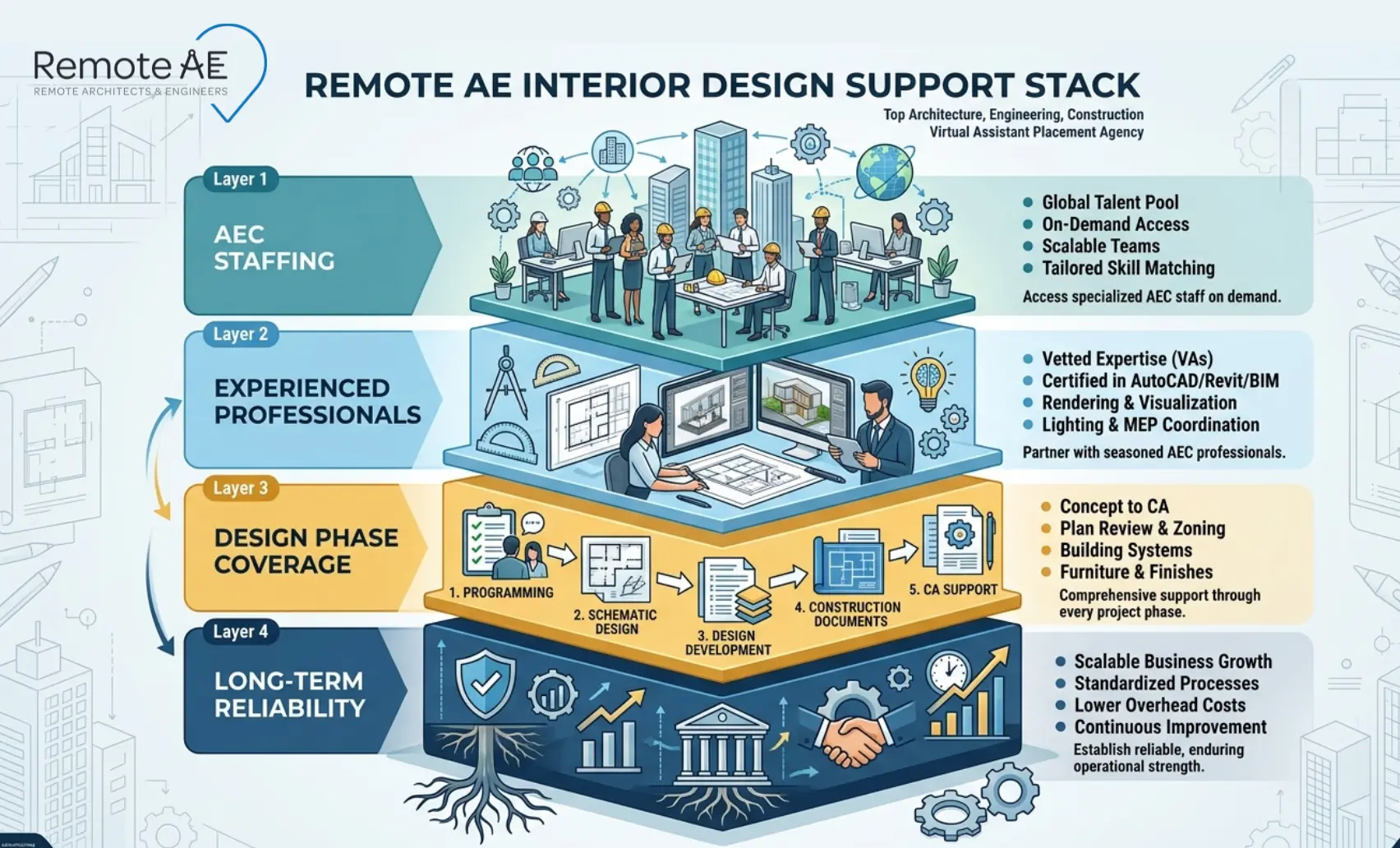
Why Remote AE Is Built for AEC and Interior Design Firms
Remote AE staff exclusively for architecture, engineering, construction, and interior design workflows, not general business administration. Every remote professional placed by Remote AE carries a production context that generic virtual assistant platforms cannot provide.
That means a remote design assistant who understands space planning drawings, knows how FF&E schedules are structured, can read a construction document set, and has worked within project coordination workflows specific to the AEC and interior design industry, before they join your studio.
Experienced Remote Professionals
Remote AE proof points that matter for small business interior designers:
- Over 15 years of placing virtual assistants specifically for AEC and design firms
- Every assistant carries a minimum of five years of industry experience, not entry-level generalists learning on your projects
- Full-time dedicated support, one consistent person integrated into your studio’s workflow, not a rotating pool of task workers
- Seamless workflow integration, assistants work within your existing tools, file structures, and communication systems from week one
- No long-term commitment, engage per project, per phase, or as an ongoing studio resource
- No upfront costs, consult without any financial obligation, no cost until the contractual phase begins
- Risk-free replacement, in the first year, Remote AE replaces up to two virtual assistants if a placement does not meet your studio’s standards
Support Across Design and Delivery
Remote AE assistants cover the full interior design production workflow, not just administrative tasks:
- Space planning and layout studies
- AutoCAD, Revit, and SketchUp drafting and drawing updates
- 3D rendering and visualisation support
- FF&E schedule preparation and specification formatting
- Procurement support, sourcing, vendor coordination, and purchase order tracking
- Construction documentation, drawing packages, redline incorporation, and issue management
- Project coordination, task tracking, client communication support, and decision logging
Stop Competing With One Hand Tied Behind Your Back!
Large interior design firms win projects on capacity as much as creativity. Your design work is strong enough; what your studio needs is the production and coordination support to deliver at the same standard. Remote AE places dedicated remote design assistants with AEC and interior design experience, ready to handle your FF&E schedules, CAD drafting, procurement coordination, client presentations, and project management from week one.
No Upfront Cost. No Commitment. Just a Stronger Studio, Book Your Free Consultation today!
FAQs – Small Business Interior Designers
What does a virtual assistant do for an interior designer?
A virtual assistant can support scheduling, client coordination, sourcing, presentations, specifications, document organization, procurement tracking, and drawing updates. Some also help with rendering, mood boards, and project administration, freeing designers to focus on creative and client-facing work.
Can a virtual assistant help with CAD or Revit drawings?
Yes, if they have AEC or design software experience. Many remote assistants support AutoCAD drafting, Revit updates, furniture layouts, redline revisions, sheet setup, and documentation tasks under the direction of the lead designer or architect.
Is a virtual assistant cheaper than hiring an in-house design assistant?
Often yes. Remote assistants usually reduce costs tied to office space, benefits, recruiting, and downtime between projects. Firms can scale support based on workload instead of committing immediately to a full-time in-house hire.
Can small interior design firms compete with large firms using remote staff?
Yes. Remote support allows smaller firms to scale production, improve turnaround time, and handle larger workloads without building a large in-house team. Many boutique firms use remote drafting and admin support to stay competitive on deadlines and deliverables.
Should I hire a general VA or an AEC-trained virtual assistant?
For design workflows, an AEC-trained assistant is usually better. They already understand drawings, terminology, file structures, and coordination workflows, reducing onboarding time and rework compared with a general administrative VA.